Category Archives: Science

The Disturbance Theory

dl10c

Reference: Disturbance Theory

.

On June 9th, 1952, Einstein stated in the preface of the 15th edition of his “Relativity–The Special and General Theory”,

“In this edition I have added, as a fifth appendix, a presentation of my views on the problem of space in general and on the gradual modifications of our ideas on space resulting from the influence of the relativistic viewpoint. I wished to show that space-time is not necessarily something to which one can ascribe a separate existence, independently of the actual objects of physical reality. Physical objects are not in space, but these objects are spatially extended. In this way the concept of “empty space” loses is meaning.”

The Disturbance Theory is based on the postulate that space, when disturbed, breaks into electric and magnetic fields. In other words, when space and time come together they transform into energy of disturbance. This transition is seamless, meaning that space, time and energy are intimately related. They show up as wavelength, period and frequency of the disturbance.

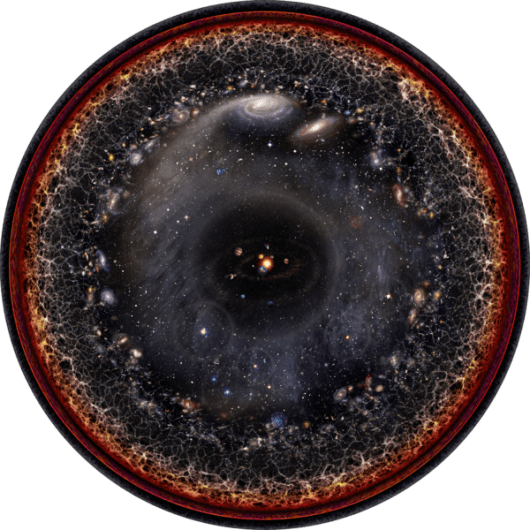
The electromagnetic spectrum represents increasing state of disturbance, which ranges from low frequency radio waves to high frequency gamma rays. The disturbance starts to condense in the range of gamma rays until it transforms into matter. In this sense, space, time, energy and matter are fundamentally related.

All stages of the electromagnetic spectrum may be found in the structure of an atom, if we consider the atomic boundary to extend all the way to space. The most condensed disturbance forms the nucleus of the atom.

Atoms may be looked upon as tiny whirlpools in the sea of electromagnetic field of disturbed space.

The above shows that not only space, time and energy are intimately related, the energy appears as mass at very high disturbance levels.

.

The Disturbance Levels

The undisturbed space has no bounds or form. It acquires a form only when it is disturbed. The disturbance appears as a dynamic electromagnetic field that has gradients of disturbance levels. A gradient of disturbance levels has the form of acceleration, force or gravity. Within a uniform disturbance level there is stillness or constant velocity.

The disturbance levels are defined by their wavelength, period and frequency. The wavelength and period maintain a constant ratio ‘c’. The frequency is the inverse of period. This may be shown symbolically as

λ / T  = c

f = 1/T

Where,   λ is the wavelength associated with space;

               T is the period associated with time;

               c is a universal constant referred to as speed of light;

 and,       f is the frequency associated with energy

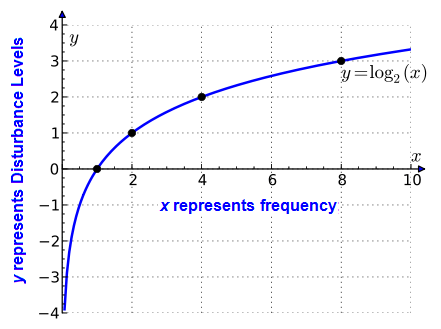
The electromagnetic spectrum covers a large range of frequencies as radio and micro waves, infra-red, visible and ultra-violet light, X and Gamma ionizing radiation, and subatomic particles. These frequencies may be expressed more conveniently on a logarithmic scale of base 2. The logarithmic form of frequency is referred to as Disturbance Level (D).

D = log2 (f)

DL-Freq

DL Chart1

So we have a fundamental relationship among space, time, energy and matter.

By equating space-time with energy-mass, the Disturbance Theory hopes to bring about an interpretation that makes the theory of relativity consistent with quantum mechanics and Newton’s theory of motion.

.

Space, Time & Reality

We live on a material plane, and so we view space, time and energy from the viewpoint of matter. Our reality is the fact of matter.

Matter appears at the upper end of the electromagnetic spectrum. It is highly condensed disturbance. If we look at the wavelength of disturbance as the unit of space, it is infinitesimal at the level of matter. Similarly, the unit of time as period of disturbance is also infinitesimal at the level of matter. This makes the calculus of space and time possible. But this is so at the level of matter only and not at other parts of the electromagnetic spectrum. There is continuity at disturbance levels lower than matter but it is of a different sort. At these parts of the electromagnetic spectrum the wavelength and period is finite and the  reality can be very different, but we do not get to experience it ordinarily.

We live on earth. We are connected to matter all the time. Therefore, we perceive space and time in infinitesimal increments. This brings smoothness of continuity to our physical senses. It forms the basis of our knowledge. Euclidean geometry and Newtonian mechanics has its basis in it.

But how is it out in the interstellar space? How does one experience space and time away from matter—even away from the matter of the spaceship that carried us there, or away from the matter that constitutes our bodies? What is space and time like when its units in terms of wavelength and period are no longer infinitesimal?

How do we visualize an electromagnetic field spread over vast interstellar space in which finite wavelength, period and frequency are changing dynamically. Here the gradients in frequencies bring about the sense of acceleration, force or gravity. It is like living within Faraday’s lines of force that come together, and then spread out in an eternal cosmic dance.

Like a blurred vision, the location in space and time gets blurred far from material surface of a planet. A location can be defined with pin-point precision on a material surface only. The GPS signals that travel to a satellite and back require relativistic correction. This is because the location of satellite is a bit blurred relative to the locations on earth.

The theory of relativity gets it right about the blurring of the very nature of space and time.

Dark energy and matter in the interstellar space has no reasonable explanation at the moment. The concept of disturbed space might be able to provide an explanation.

.

Mathematics

Relativistic mathematics of Einstein is based on MRF (material reference frame). The Disturbance Theory proposes mathematics based on SRF (space reference frame).  SRF math is yet to be developed. It should lead to similar space-time correction in case of the GPS signals.

MRF math uses the concept of velocity, which is applicable only for a specialized view of space and time near the surfaces of planets.

SRF math shall use the concept of disturbance levels, instead of velocity.

The concept of disturbance level is applicable to all locations near or far from planets.

.

The Inertial Frame and Space

Observable_universe_logarithmic_illustration

Reference: Disturbance Theory

.

The Inertial Frame

In 1632, Galileo Galilei first described that in a ship travelling at constant velocity, without rocking, on a smooth sea; any observer doing experiments below the deck would not be able to tell whether the ship was moving or stationary. This is a nice description of an inertial frame.

An inertial frame is one in which Newton’s first law remains true. In other words, in this frame, an object stays either at rest or at a constant velocity unless a force acts on it. A non-inertial frame shall be experienced inside an accelerating rocket. In this frame Newton’s first law will not hold true.

In short, all inertial frames are in a state of constant, straight line motion with zero acceleration. Measurements in one inertial frame can be converted to the measurements in another by a simple transformation.

For example, suppose two cars are moving side by side at the speed of 60 mph in the same direction. The driver of each car will see the other car to be practically still. The speed of a car relative to the other would be the “algebraic difference” of their speeds: 60 – 60 = 0. If the two cars were approaching each other at 60 mph, a driver will see the other car approaching at 120 mph [60 – (–60) = 120].

NOTE: The individual speeds would have to be measured in a common reference frame, such as, earth for the above transformation to be valid.

This simple transformation shall also apply to the relative speed of disturbances moving through a medium. Here the medium stays still while the disturbance moves through it. The speed of the disturbance relative to the medium is determined by the properties of the medium.

For example, suppose a ripple on the surface of water moves at speed, R based on the properties of water. We see two ripples approaching each other, each moving on the surface of water at speed R toward the other. Their relative speed shall be: R – (–R) = 2R. The transformation is the same as in the case of cars in the previous example, because individual speeds are measured in a common reference frame of water.

Sound travels in dry air at 20°C at a speed of 343 meters per second. If two waves of sound are approaching each other, their relative speed shall be 343 x 2 = 686 meters per second. This is because the medium in which these waves are traveling (air) provides a common reference frame. By no means is this relative speed “supersonic”, because this speed is not relative to the medium.

If two beams of light were approaching each other in a medium that provided a common reference frame, similar consideration shall apply. In other words, their relative speed shall be “2c” where c is the speed of light relative to the medium. This shall not violate the limit placed by the medium on the speed of light.

In the 19th century a medium called “luminiferous ether” was postulated for light, but it could not be found in terms of its postulated mechanical properties. The absence of a mechanical medium resulted in the assumption that the relative speed of two light beams approaching each other would also be ‘c’ instead of ‘2c’. This was because no common reference frame existed in the form of a medium. This resulted in a mathematics that led to the ideas of ‘length contraction’ and ‘time dilation’.

Why couldn’t we find any medium for light? Were we looking for the wrong thing?

.

The Ether

In 1873, Maxwell’s effort to determine the relationship between electromagnetic theories and the Newton’s theory of motion resulted in the amazing discovery that light was an electromagnetic phenomenon.

Maxwell wrote in the preface to the first edition of his book A TREATISE ON ELECTRICITY AND MAGNETISM:

“The most important aspect of any phenomenon from a mathematical point of view is that of a measurable quantity… I have therefore thought that a treatise would be useful which should have for its principal object to take up the whole subject in a methodical manner, and which should also indicate how each part of the subject is brought within the reach of methods of verification by actual measurement… before I began the study of electricity I resolved to read no mathematics on the subject till I had first read through Faraday’s Experimental Researches in Electricity.

“As I proceeded with the study of Faraday, I perceived that his method of conceiving the phenomena was also a mathematical one, though not exhibited in the conventional form of mathematical symbols. I also found that these methods were capable of being expressed in the ordinary mathematical forms, and thus compared with those of the professed mathematicians.

“For instance, Faraday, in his mind’s eye, saw lines of force traversing all space where the mathematicians saw centres of force attracting at a distance: Faraday saw a medium where they saw nothing but distance: Faraday sought the seat of the phenomena in real actions going on in the medium, they were satisfied that they had found it in a power of action at a distance impressed on the electric fluids.

“When I had translated what I considered to be Faraday’s ideas into a mathematical form, I found that in general the results of the two methods coincided, so that the same phenomena were accounted for, and the same laws of action deduced by both methods, but that Faraday’s methods resembled those in which we begin with the whole and arrive at the parts by analysis, while the ordinary mathematical methods were founded on the principle of beginning with the parts and building up the whole by synthesis.”

It is interesting to note that Maxwell finds Faraday’s “lines of force traversing all space” to be mathematically equivalent to other mathematician’s “centers of force attracting at a distance”. Maxwell notes, “Faraday saw a medium where they [other mathematicians] saw nothing but distance”.

Space is not “nothing” because it has the electromagnetic properties of permittivity and permeability. These properties of space determine the speed of light per Maxwell’s equations. This fact alone should be enough to convince that space is the medium through which light travels.

Why is space not considered to be the medium of light? Why can’t space be that mysterious ether?

.

The Space

According to Maxwell, light travels in space as an electromagnetic wave. This wave has the following properties.

  1. A changing electric field produces a magnetic field of force

  2. A changing magnetic field produces an electric field of force

The frequency of the electromagnetic wave is determined by the rate at which the electric and magnetic fields are interchanging back and forth in space as the wave propagates.

Let’s make the following postulate, which is quite reasonable.

“Space, when disturbed, breaks into electric and magnetic fields.”

This is similar to the observation that water, when disturbed breaks into peaks and valleys; or air, when disturbed, breaks into high and low pressure areas.

In case of the ripple in water we see the movement of peaks and valleys, but not that of water. In case of sound we see the movement of high and low pressure areas, but not that of air. We may say that in case of light we see the movement of electric and magnetic fields but not that of space.

The above postulate provides a seamless continuity from space to electromagnetic fields. How does this compare with the 19th century consideration of “luminiferous ether”?

The “luminiferous ether” was required to be elastic enough to allow light to travel. This requirement is met when we consider light to be a disturbance in space, we can see this disturbance to propagate when changing electric and magnetic fields generate each other. The problem of ether being “rigid” to electromagnetic fields is thus resolved.

But it was perceived that “luminiferous ether” was  permeable to matter, because matter could move freely through it. This “fact” was actually seen as contradictory to ether being elastic. This created confusion. Is this confusion resolved when we see space as the medium of light?

The truth seems to be that matter cannot move freely through space.  Matter encounters resistance when pushed through space. This resistance is INERTIA.

Newton defined inertia as his first law in his Philosophiæ Naturalis Principia Mathematica, which states:

“The vis insita, or innate force of matter, is a power of resisting by which every body, as much as in it lies, endeavours to preserve its present state, whether it be of rest or of moving uniformly forward in a straight line.”

Maxwell states in “A Treatise On Electricity & Magnetism, Vol1, Art. 5

“If, as in the astronomical system, the unit of mass is defined with respect to its attractive power, the dimensions of [M] are [L3T -2].”

These dimensions of mass may be looked upon as “(area) x (acceleration)”, which agrees with Newton’s description of inertia as “innate force of matter.”

The context of light as an electromagnetic wave may be expanded from low frequency radio waves to very high frequency gamma rays of the electromagnetic spectrum. Gamma rays are produced in the disintegration of the nucleus of an atom. The de Broglie frequency of the  nucleus places it well inside the gamma range. The electrons surrounding the nucleus have frequencies at the beginning gamma range. Beyond these electrons we may visualize the lower parts of the electromagnetic spectrum. Beyond that spectrum is space.

From space to the nucleus of an atom we seem to have the whole frequency range of the electromagnetic spectrum.

Space seems to represent the lower end of the electromagnetic spectrum as frequency reduces towards zero. Mass seems to represent the upper end of the electromagnetic spectrum as frequency increases towards infinity. The increasing frequency throughout the spectrum seems to represent an increasingly disturbed state of space. The nucleus of an atom then represents a highly disturbed state of space, which appears as mass.

When we visualize mass as “a region of high frequency”, It is like intense disturbance moving through undisturbed space, there shall be a high frequency gradient at the boundaries of this “region”. As mass moves through space, the undisturbed space in the path of mass must cross this high gradient of frequency. It must go from undisturbed to a highly disturbed and back to undisturbed space after the mass has passed. Obviously, there would be resistance. The greater is the mass, the higher would be this resistance. This is inertia.

There is an illusion of space being permeable to matter because we see matter gliding through space. But in those moments, matter is moving at a constant velocity.  That motion is relative to other matter and not relative to space. Motion relative to space is accompanied by acceleration.

It is very possible that light propagates as a disturbance through space. Space imparts elasticity to electromagnetic fields, which then appears as inertia.

.

Space as a Reference Frame

When we look at space as the medium of light we find it consistent with the following excerpt from Wikipedia,

In classical physics, light is described as a type of electromagnetic wave. The classical behaviour of the electromagnetic field is described by Maxwell’s equations, which predict that the speed c with which electromagnetic waves (such as light) propagate through the vacuum is related to the electric constant ε0 and the magnetic constant μ0 by the equation

speed

Thus, from classical physics point of view, when two beams of light approach each other, their relative velocity can be ‘2c’, and this would not violate the limit on ‘c’ as postulated by Einstein. We may also define ‘c’ as the “wavelength to period” throughout the electromagnetic spectrum that includes mass at its upper end.

For matter both wavelength and period are infinitesimal. Therefore, space and time are experienced as absolute and independent in the reference frame of matter in which we live. Thus,

In a more fundamental way, ‘c’ is the ratio of Space to Time.

The inertial frame of Galileo and Newton uses matter as its basis. It may be referred to as the Material Reference Frame (MRF). The more general inertial frame identifies space as the basis. We may refer to it as the Space Reference Frame (SRF).

The inertial frames of Galileo and Newton are based on the reference frame of matter. Matter represents a special case of a more general reference frame of space.

The SRF (space reference frame) provides consistency throughout the classical physics in a fundamental way. It offers a very simple and elegant explanation for INERTIA.

.

The Ultimate Basis

This bottom line in my view is — If light is made up of moving particles (like bullets from a gun), then no “medium” is required. We just have discrete particles. But if light is moving as a disturbance among particles then there is a medium, which is seen as a continuum.

So, the question becomes,

“Is light consist of moving particles, or is it a continuum of disturbance?”

In other words,

“Is light connected throughout, or does that connection gets broken intermittently?”

And ultimately…

“Is reality fundamentally continuous or discrete?”

We can see discreteness emerging from continuity, but not the other way around.

.

Theory of Relativity & SRF

600_332158572

Per Maxwell’s equations, the speed of light ‘c’ is determined by the properties of space. Light appears to travel in space from one location to another as a transverse wave. From the model of a wave traveling in a medium it appears that the medium of light is space. The new idea here is that a non-material space acts as a medium. Up till now the medium was thought to be “ether” of material-like properties. That didn’t work out. So, what are the non-material properties of space as a medium?

Space, when disturbed seems to break into electric and magnetic fields. Space “doesn’t move”, but the disturbance in space (electromagnetic field) moves. This disturbance moves in such a way that the ratio of its wavelength to period is the constant ‘c’. This is what an electromagnetic wave is.

But light also moves at speed ‘c’ relative to uniformly moving material, regardless of how fast or how slow that material might be moving. Therefore, uniformly moving material has a velocity zero relative to space. It is “carrying space” with it, so to say. That is why no “ether wind” was discovered in Michelson-Morley’s experiments.

We have two different reference frames. The first is Galilean Reference or relativistic frame attached to matter called MRF (material frame of reference). The other is non-material reference frame attached to space called SRF (space frame of reference). The latter has never been considered in science. NOTE: The Lorentz transformations, like Galilean transformations are part of MRF.

We are conditioned to MRF. In it we see the distance changing uniformly between two uniformly moving material bodies moving towards each other or away from each other. But in SRF a uniformly moving material has a velocity zero relative to space. So, the distance is invariable, or it does not exist, between two uniformly moving material bodies.

In MRF we see time changing as a material body moves with uniform speed. In SRF the time is invariable, or it does not exist. The truth is that space and time exist in SRF as “wavelength” and “period” and the ratio between them is the constant ‘c’. All matter has infinitesimal wavelength and period. This gives us a uniform character of space and time in MRF. But in SRF this situation exists only at the upper end of the electromagnetic spectrum. MRF is, therefore, a specialized subset of SRF.

SRF gives us a much wider view of reality than MRF. This explains the relativistic “length contraction” and “time dilation” in terms of increasing or decreasing frequency. In MRF the frequency is collapsed beyond gamma range and appears to be “uniform”; and this gives us a uniform measure of length and time.

The relativistic world is understood much better when viewed through Space Reference Frame (SRF) derived directly from Maxwell’s Equations.

It appears that the speed ‘c’ can be attained only by an inertialess particle in MRF. As particle gains inertia its maximum attainable speed will reduce to a fraction of ‘c’. This is evident by the speed of electrons in MRF.

The Unified Field Theory

discreteness

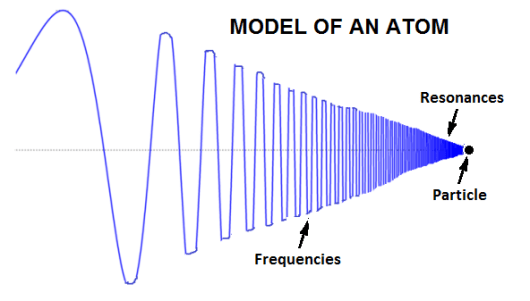
Evolution starts by increasing discreteness. This aspect of evolution covers the whole realm of physics. Discreteness evolves from

  1. Frequency of disturbance to
  2. Resonance as reinforced frequency to
  3. Particle as collapsed resonance.

.

The subject of physics started from observation of the motion of planets and other heavenly bodies in the sky. The fundamental property associated with these bodies was mass. So, physics evolved within a frame of reference based on mass. This aspect of physics was rounded up by Newton in the second half of 17th century.

Another aspect of Physics emerged in the beginning of 20th century when Einstein formulated the Theory of Relativity. This theory established the speed of light as a universal constant. The concepts of space and time could no longer be conceived as independent of each other as it was in the frame of reference based on mass. The frame of reference of Physics had now shifted from mass to energy.

NOTE 12/05/19: Both mass and energy are forms of substance.

Following the above development, another aspect of physics evolved very rapidly during the first quarter of 20th century to explain the observations made at atomic dimensions. This aspect was called Quantum Mechanics because it did not have a well-grounded theory, and was based primarily on mathematical models. It seemed to have a frame of reference based on resonance.

Physics has long been trying to come up with a unified theory that can bring these three aspects of physics together. We may make some progress in that direction by relating the frames of reference of Theory of Relativity, Quantum Mechanics, and Newtonian Physics on a scale of increasing discreteness. On this scale space shall have zero discreteness.

Energy (frequency) obviously is disturbed space; resonance is reinforced frequency; and mass (particle) appears to be collapsed (folded up) resonance. We may be able to use space as a reference point for all these frames of references.

Thus, if we can reformulate the Theory of Relativity, Quantum Mechanics, and Newtonian Physics using a frame of reference based on space, we may be able to come up with a unified theory. This is the idea underlying the Disturbance theory, which is currently under development.

Granted the above ideas are very sketchy and are nothing more than conjectures at this stage, but they provide an overall coherence within which a unified theory may be developed.

.

Research in Physics


SL5

Reference: KHTK Physics

R = REVIEWED

Logic & Reality

The Criterion of Objectivity (R)

An Outlook on Science (R)

The Background of Modern Physics (R)

Physics & Objectivity (R)

Inconsistencies and Knowledge (R)

The Postulates (R)

Physics & Reality (R)

The Subjectivity in Physics (R)

Space

Substance, Space, Time and the Void (R)

The “Particles in Void” Framework (R)

Particle & Void (R)

Emptiness, Void and Space (R)

Void and Space (R)

Substance

What is Substance? (R)

Force, Substance & Spacetime (R)

Matter, Light and Substance (R)

Matter and Substance (R)

More on Substance (R)

The Problem of Aether (R)

The Problem of Space (R)

Matter – Wikipedia

Particle and Continuum (R)

Quantum

A Critique of Einstein’s Light Quanta (R)

Einstein’s 1905 Paper on Light Quanta (R)

Einstein 1938: The Quanta of Light

The Quantum Particle

Frame of Reference

Reference Frames: MRF vs SRF (R)

High Energy Gamma Rays Go Slower than the Speed of Light?

Frame of Reference & Einstein (R)

Frame of reference (Wikipedia) (R)

Inertial frame of reference (Wikipedia)

Absolute Motion (R)

Mass Density and Motion (R)

The Local Frames of Reference

Relativity

Validity of Lorentz Transformation

Lorentz Transformations

Einstein 1920: Lorentz Transformation

Einstein 1920: Simple Derivation of the Lorentz Transformation

Lorentz transformation

Relativity & Problem of Space (1952)

The Problem of Relativity

Mass & Energy

Mass, Energy and Time (R)

The Dimension of “Mass” (R)

Spectrum

The Electromagnetic Spectrum (Old) (R)

The Spectrum of Substance (R)

The Logic of Field 

The Logic of Motion

Particle & Continuum (Field)

Nucleus, Electrons and Light

Einstein 1938: Field and Matter

Einstein 1938: Elementary Quanta of Matter and Electricity

Einstein 1938: The Waves of Matter

Quantum & Quantization

Particle, Quantum and Density

Wave-Particle Duality

Wave Theory

The Logic of Reality

The Logic of Substance 

.

Unified Theory

The Unified Field Theory

The Dimensions of Physical Location

Mass – Wikipedia

Faraday: Electrical Conduction & Nature of Matter

Faraday: Thoughts on Ray Vibrations

What is Substance?

The “Particles in Void” Framework

Motion & Force

Inertia – Wikipedia

Newton: Inertia & the Laws of Motion

The Problem of Inertia

The Spectrum of Inertia

Absolute Rest, Inertia & Motion

Newton: Basic Concepts

Matter in Disturbance Theory

.

Faraday: On the Conservation of Force

Electromagnetism

Maxwell’s Preface to his Book

A Study of Maxwell

Faraday & Maxwell

Maxwell and Gravity

Electromagnetic Spectrum (Wikipedia)

The Electromagnetic Spectrum

“Lines of Force” & Maxwell

The Field-Substance

Light Particle

Wave-Particle Duality

Newton, Einstein & Inertia

Quantum Particle

Elementary Particle – Wikipedia

Particles in Space

Quantum Theory

Black-body radiation (Notes)

Einstein’s 1905 Paper on Light Quanta

Einstein’s Theory of Quantum

The Quantum Phenomena

Newton, Einstein & Quantum Mechanics

Classical to Quantum Mechanics

Energy, Substance & Quantization

The Disturbance Levels

Energy and Cycle

Quantization

Electromagnetic Spectrum (Wikipedia)

The Spectrum of Substance

The Atomic Structure

A New Model of Atom

The Electromagnetic Spectrum

Electrons in Atom

Theory of Relativity

On the Theory of Relativity

Einstein’s 1905 Paper on Relativity (Part 1)

Einstein’s 1905 Paper on Relativity (Part 2)

Einstein’s 1905 Paper on Relativity

Einstein’s Paper on Relativity (1905)

.

TO BE REVIEWED

Relativity: The Special and General Theory (1920)

Michelson-Morley’s Null Result

Quantization & the Atom

Interpretation of Quantum Phenomena

Inertia, Geometry & Quantization

The Faraday Atom

The Nature of Space

Space & Einstein

A Look at Spacetime

The Nature of Spacetime

The Inertial Frame and Space

Obsolete: Space and Wavelength

Inertial frame of reference (Wikipedia)

The Problem of Field

Frame of Reference & Einstein

Reference Frames: MRF vs SRF

.

WIKIPEDIA ARTICLES (with comments)

Comments on Electric Charge

Energy

Time

Charge carrier

Rest Mass

Wave Function

Einstein Solid

Thermodynamic temperature

.

THE HISTORY

Aberration of light in SRF

The Philosophy of Cosmology

.

PAPERS UNDER REVIEW

The Problem of Distance

Inertia of EM Field

The Field

Inertia and Field

Time and Period

The Limitation of Einstein’s Theory

The Disturbance Theory

Universe & Inertia

Gravitational attraction

Gravitational attraction

A Conceptual Model of Inertia, Mass & Location

.