Zen Buddhism goes into incredible detail about how to sit in meditation 1. It provides the size and shape of cushions to sit on, and the kinds of clothes that should be worn. It specifies how to place legs and knees on the mat, and hands and fingers in the lap. It dictates how ears should be lined up with the shoulders, and nose with the navel. It even directs the position of tip of the tongue, and the angle of the gaze.
If you give importance to such niceties you can waste much time worrying about the correct posture during meditation. The essential points of correct posture are explained below.
.
Buddha’s Instructions
In the Satipatthana Sutta 2 Buddha instructs:
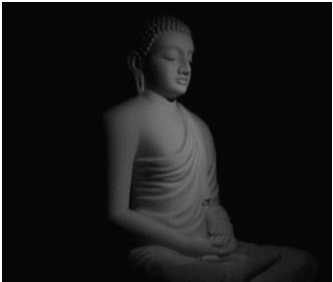
Herein, monks, a monk, having gone to the forest, to the foot of a tree or to an empty place, sits down with his legs crossed, keeps his body erect and his mindfulness alert.
The ancient statues of Buddha show him sitting in this posture.
In the Yoga Sutra 3, Patanjali describes this asana as a “steady and comfortable posture.” So, a meditative posture, besides being stable must also be natural and comfortable.
.
The Essential Points
Crossing of legs and locking them in full-lotus position stabilizes the body. The body thus maintains its posture even during deep meditation. In the ancient culture people were used to sitting with their legs crossed. This posture was natural and comfortable to them.
The meditative posture must stably maintain itself besides being natural and comfortable.
.
Sitting in a Chair
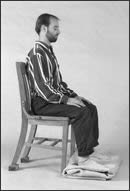
These days many people are used to sitting on a chair, and they cannot sit comfortably in a lotus position for a long time. From a scientific viewpoint it is okay to meditate sitting in a chair if that is more natural and comfortable, as long as the body can stably be maintained in an erect posture. This may be achieved by sitting in a straight-backed chair with knees parallel to the shoulders and feet flat on the ground. Cushions may be used to ensure the immobility of the body under deep meditation.
Let the body attain a naturally relaxed posture. The arms may rest in the lap. The hands, fingers and tongue may assume their natural positions. The eyes may open, half open or close according to their natural tendency. The attention may focus or not focus on anything in particular. The gaze may become narrow or wide (like in peripheral vision). These variations may occur naturally during meditation.
When the meditative posture is natural and comfortable, the body is well-balanced. There is no strain on body parts. An erect posture imparts alertness. The primary requirement is mindfulness.
It is important that the body be stably erect, and the mind alert in the mindfulness mode.
When you start to meditate the body relaxes, many physical reactions occur, and long suppressed thoughts start to emerge. Let it all happen without interference.
Meditation is being there, and seeing things as they are.
TR0 is simply a version of the ancient exercise of meditation. It is the very first exercise in Scientology. It is the first exercise in Subject Clearing too but with mindfulness.
“TR” stands for training routine. “0” stands for a reference point on a scale. Thus, TR0 serves as the fundamental reference point for all other training, exercises and processes in Scientology, and also in Subject Clearing.
People get wonderful results on TR0, when they naturallyBe There and Confront. The purpose of mindfulness is, “To be there with total attention so you can see things as they are.”
In the context of assisting another person, one should be able to see exactly what is going on with the other person. This requires that the person learn to totally be comfortable in the presence of another person. But before he can do that, he should learn to be comfortable with himself.
.
Confronting Oneself
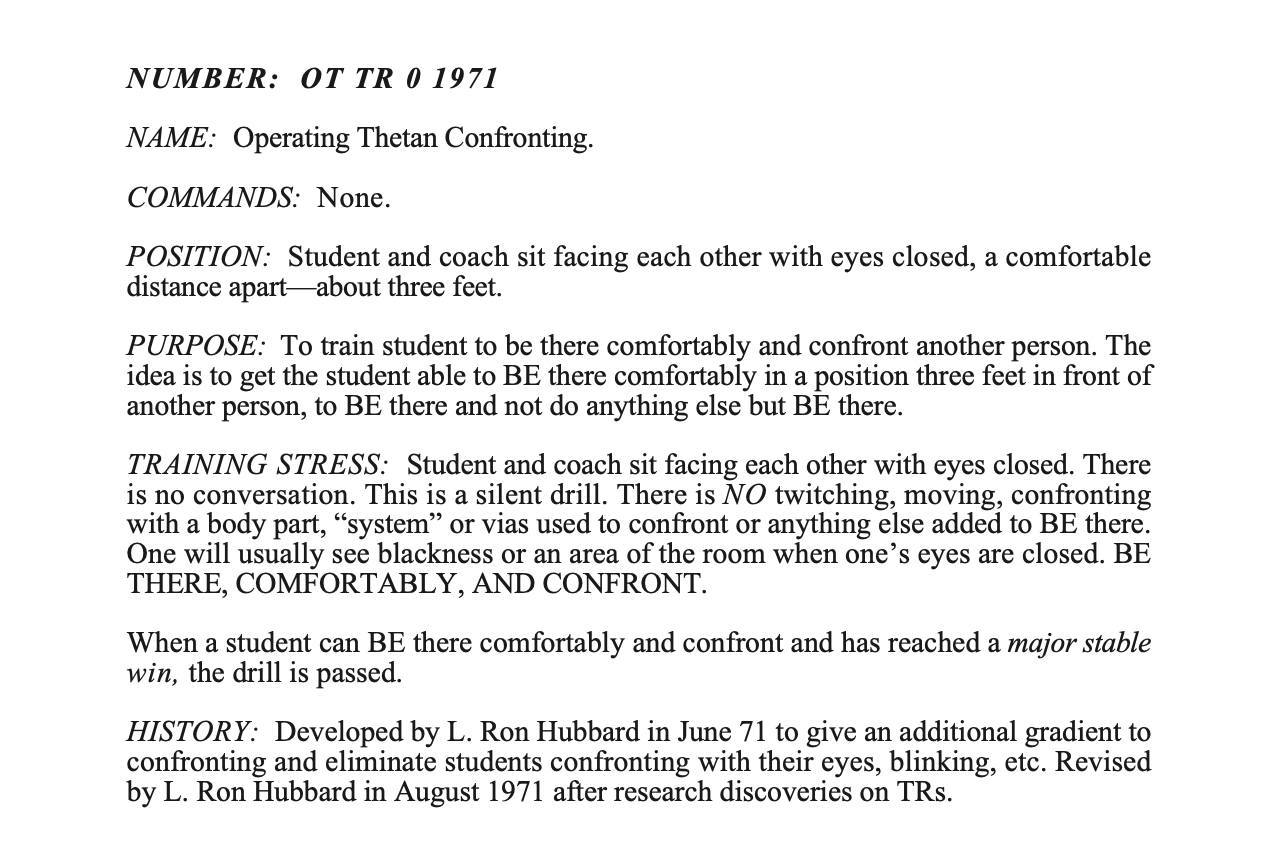
The first part of TR0 is “OT TR0, Operating Thetan Confronting.” The missing gradient in Scientology TR0 has been that the student needs to learn to confront his ideas of relationships with others before he can learn to confront others. Before you start this exercise, make sure you have read and understood the document Be There and Confront.
Here the student is not really confronting the other person because his eyes are closed. But he could be confronting his thoughts about relationships with others. This exercise may be done quite gainfully with thoughts that you are sensitive to, or with ideas that make you feel uncomfortable. You simply look at those thoughts and ideas more closely until you gain greater clarity.
So, you do the following exercise with the following purpose:
“To be there comfortably with your thoughts about relationships with others.”
You don’t try to avoid your thoughts or suppress them. You just be there with your thoughts without flinching away.
.
Confronting Another Person
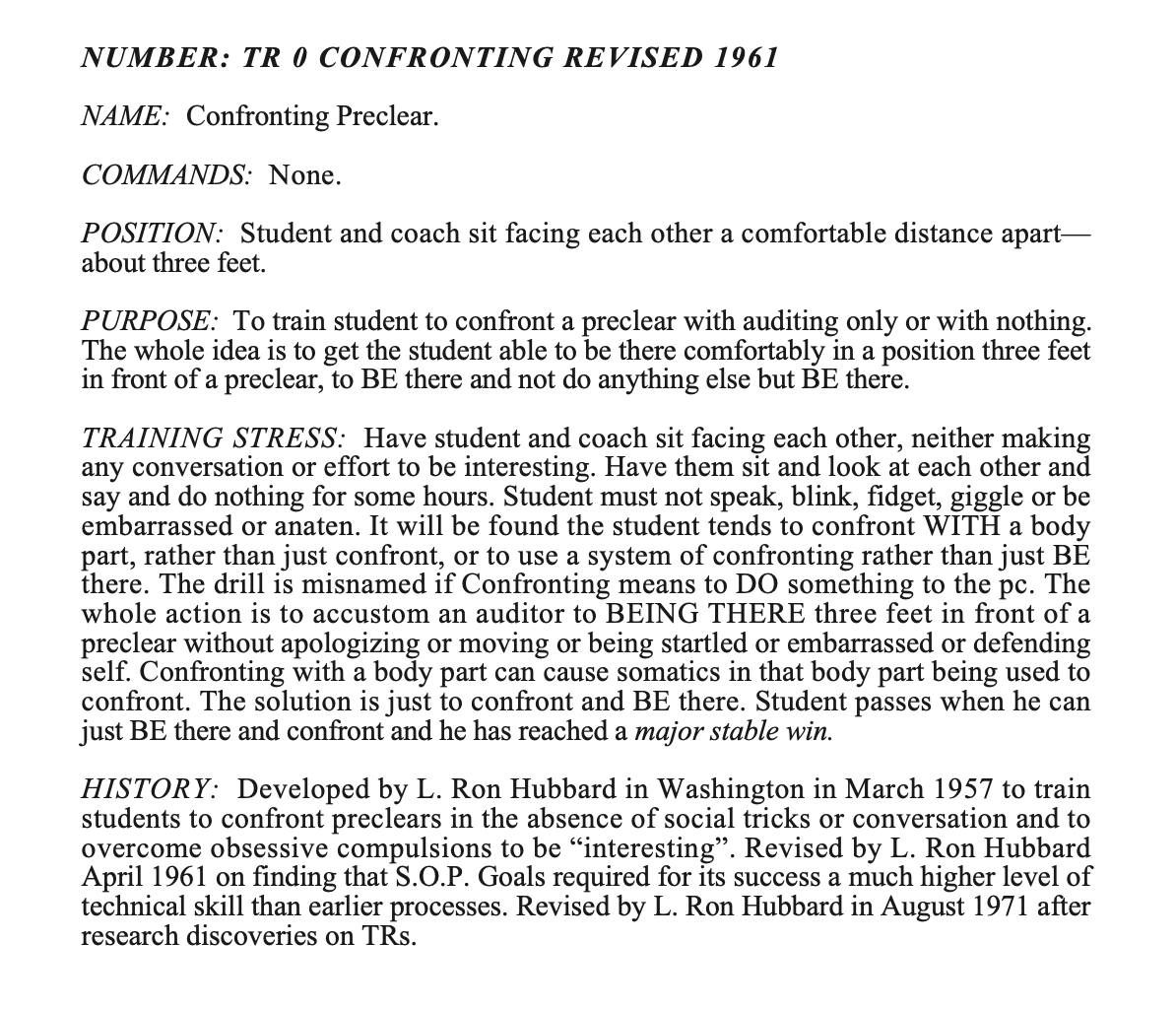
You actually confront another person on the second part of TR0 called “TR 0 Confronting.” This is a powerful exercise that promotes mindfulness if practiced with the following purpose:
“To be there comfortably observing another person as that person observes you.”
Do not try to suppress any thoughts, feelings of embarrassment, or pressure to do something. You just be there without avoiding such reactions, or flinching away.
This is not a simple exercise. It makes the student confront his social machinery, which is not easy to do. The social machinery is activated in close presence of another person, especially when there is not enough prior familiarity with that person. This exercise may be done with different people in an organized TR0 course. Alternatively, one may sit leisurely in a cafe and confront different people unobtrusively from a larger distance.
Everybody has skeletons in their closet. These are the things the person does not want others to find out about him, even when they are trivial. The student needs to confront all such things about himself that make him flinch and withdraw. He must be comfortable with himself before he can be comfortable with another person.
If ‘TR0 Confronting’ becomes a bit overwhelming, one may go back to ‘OT TR0’, until one can do both parts of TR0 comfortably.
.
Please Note
In the Subject Clearing version, the TR0 exercises require two students who are practicing TR0. There is no coaching other than supporting each other by simply being present. The two students may not be the same each time. The pairing can keep on changing.
The longer is the TR0 session (uninterrupted), the more beneficial it is. You can start with a 20 minute session and build it up to a session that lasts for 2 hours or more. Do it daily until you can do both parts comfortably. After that you may extend this exercise by one week at a time, depending on its merit.