TR0 with Mindfulness

Mindfulness TR0

Reference: Grassroots Scientology

TR0 is simply a version of the ancient exercise of meditation. It is the very first exercise in Scientology. It is the first exercise in Subject Clearing too but with mindfulness.

“TR” stands for training routine. “0” stands for a reference point on a scale. Thus, TR0 serves as the fundamental reference point for all other training, exercises and processes in Scientology, and also in Subject Clearing.

People get wonderful results on TR0, when they naturally Be There and Confront. The purpose of mindfulness is, “To be there with total attention so you can see things as they are.”

In the context of assisting another person, one should be able to see exactly what is going on with the other person. This requires that the person learn to totally be comfortable in the presence of another person. But before he can do that, he should learn to be comfortable with himself.

.

Confronting Oneself

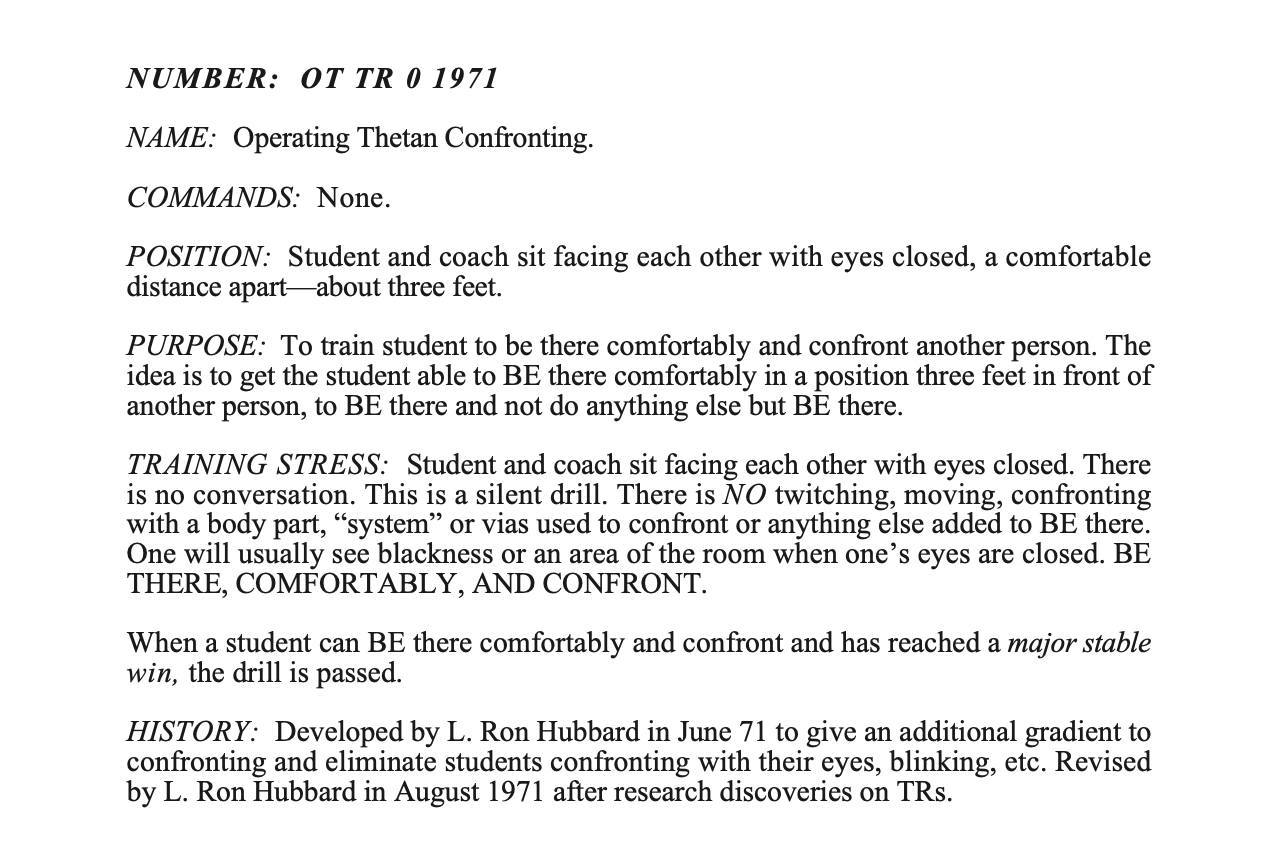
The first part of TR0 is “OT TR0, Operating Thetan Confronting.” The missing gradient in Scientology TR0 has been that the student needs to learn to confront his ideas of relationships with others before he can learn to confront others. Before you start this exercise, make sure you have read and understood the document Be There and Confront.

Here the student is not really confronting the other person because his eyes are closed. But he could be confronting his thoughts about relationships with others. This exercise may be done quite gainfully with thoughts that you are sensitive to, or with ideas that make you feel uncomfortable. You simply look at those thoughts and ideas more closely until you gain greater clarity.

So, you do the following exercise with the following purpose:

“To be there comfortably with your thoughts about relationships with others.”

You don’t try to avoid your thoughts or suppress them. You just be there with your thoughts without flinching away.
.

Confronting Another Person

You actually confront another person on the second part of TR0 called “TR 0 Confronting.” This is a powerful exercise that promotes mindfulness if practiced with the following purpose:

“To be there comfortably observing another person as that person observes you.”

Do not try to suppress any thoughts, feelings of embarrassment, or pressure to do something. You just be there without avoiding such reactions, or flinching away.
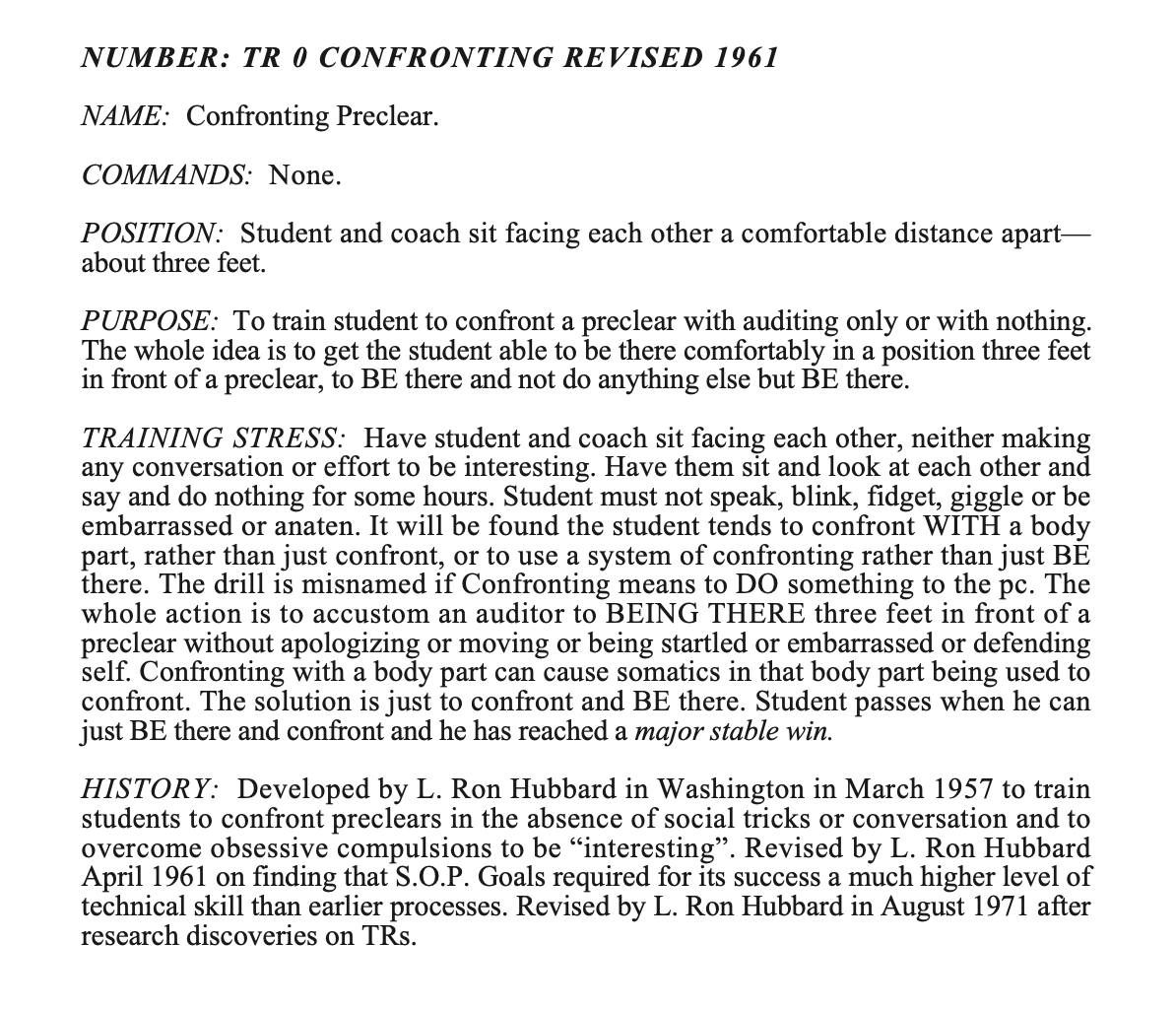
This is not a simple exercise. It makes the student confront his social machinery, which is not easy to do. The social machinery is activated in close presence of another person, especially when there is not enough prior familiarity with that person. This exercise may be done with different people in an organized TR0 course. Alternatively, one may sit leisurely in a cafe and confront different people unobtrusively from a larger distance.

Everybody has skeletons in their closet. These are the things the person does not want others to find out about him, even when they are trivial. The student needs to confront all such things about himself that make him flinch and withdraw. He must be comfortable with himself before he can be comfortable with another person.

If ‘TR0 Confronting’ becomes a bit overwhelming, one may go back to ‘OT TR0’, until one can do both parts of TR0 comfortably.

.

Please Note

In the Subject Clearing version, the TR0 exercises require two students who are practicing TR0. There is no coaching other than supporting each other by simply being present. The two students may not be the same each time. The pairing can keep on changing.

The longer is the TR0 session (uninterrupted), the more beneficial it is. You can start with a 20 minute session and build it up to a session that lasts for 2 hours or more. Do it daily until you can do both parts comfortably.  After that you may extend this exercise by one week at a time, depending on its merit.

.
Exercises from Buddha

These exercises are derived directly from Satipatthana Sutta.

.

Exercise 1: Buddha on Body (Set 1)

Exercise 2: Buddha on Body (Set 2)

Exercise 3: Buddha on Mind (Set 1)

Exercise 4: Buddha on Mind (Set 2)

Exercise 5: Buddha on Mind (Set 3)

Exercise 6: Buddha on Mind (Set 4)

Exercise 7: Buddha on Mind (Set 5)

Exercise 8: Buddha on Mind (Final Set)

.

Lectures on Zen

Zen-0

Reference: Buddhism Research

These are Yasutani-Roshi’s introductory lectures on Zen training from THE THREE PILLARS OF ZEN by Philip Kapleau.

.

Definitions:    Zen and Zazen

Lecture 1:      Theory and Practice of Zazen

Lecture 2:      Precautions to Observe in Zazen

Lecture 3:      Illusory Visions and Sensations

Lecture 4:      The Five Varieties of Zen

Lecture 5:      The Three Aims of Zazen

Lecture 6:      Individual Instruction

Lecture 7:      Shikan-taza

Lecture 8:      The Parable of Enyadatta

Lecture 9:      Cause and Effect Are One

Lecture 10:    The Three Essentials of Zen Practice

Lecture 11:    Aspiration

.

ZEN 11: Aspiration

zazen-10

Reference: Lectures on Zen

These are Yasutani-Roshi’s introductory lectures on Zen training from THE THREE PILLARS OF ZEN by Philip Kapleau.

There is little to comment here. Any comment is to empasize a point. The comments are in color.

.

Lecture 11—Aspiration

Even while we all do zazen, our individual aspirations are not identical. These aspirations resolve themselves into four main groups or levels.

The first and shallowest level involves neither faith in Zen Buddhism nor even a cursory understanding of it. One just happens to hear about it and decides he would like to sit with a zazen group or in a sesshin. Nevertheless, that out of millions of deluded people (entirely ignorant of Buddhism) one particular individual should be led to this 2,500-year-old, unbroken line of teaching is, in the Buddhist view, not a fortuitous but a karmic circumstance and hence of vast spiritual significance.

The second level of aspiration is a level which goes no deeper than the desire to do zazen in order to improve physical or mental health or both. This, you will recall, falls into the first of the five classifications of Zen, namely, bompu (ordinary) Zen.

At the third level we find people who, no longer satisfied merely to increase their physical and mental well-being, want to tread the path of the Buddha. They recognize how exalted is the Buddhist cosmology, which views existence as not confined to one life-span but endlessly evolving lifetime after lifetime, with the circle of human destiny completed only upon the attainment of Buddhahood. More, they have established faith in the reality of the enlightenment experience, and though the resolve to attain it has not yet been awakened, the desire to pursue the Buddha’s Way is clear and real.

The fourth level comprises those determined to realize their True-self. They know this experience to be a living reality, for they have encountered people who have had it, and they are convinced they can likewise attain it. When they come before their teacher they come with an open mind and a humble heart, ready to follow whatever course he prescribes, secure in the knowledge that by so doing they can realize their goal in the shortest time.

I will now quickly recapitulate these four classes of aspirants: those who, having no particular faith in Zen, come to it through fortunate karmic circumstances; those who practice zazen through a desire only to add to their physical or mental health or both; those who practice Zen out of belief in the exalted nature of the Buddha’s teaching; and those who have a strong determination to become enlightened.

Hereafter you will come before me one by one and I will ask you what you feel to be the nature of your aspiration, that is, into which of the four classes you fall. Tell me your feelings honestly. Do not add anything through pride, and do not subtract anything out of false modesty. Depending upon what you tell me, I will assign you the zazen most appropriate for you.

There is no definitive practice which applies to everyone. Generally speaking, one who puts himself in the first class is assigned the practice of counting his breaths; one in the second category, the following of his breaths; in the third class, shikan-taza; and in the fourth, a koan, usually Mu.

When students come before me individually for the first time, they make all manner of curious replies. Some say: “I think I belong between the first and second classes.” Others tell me: “I have a chronically bad stomach, so would you assign me a type of zazen that will help this condition?” Or sometimes a person will say: “I am somewhat neurotic; what kind of zazen would be good for that?”

Depending on the type of person and the strength of his determination, I prescribe what I believe to be a suitable practice. With a stolid individual it is usually desirable to spur him on with the kyosaku, whereas a somewhat nervous or sensitive person can do better zazen without it. Only if your appraisal of your feelings is frank can I select for you the most effective practice.

.

ZEN 10: The Three Essentials of Zen Practice

zazen-9

Reference: Lectures on Zen

These are Yasutani-Roshi’s introductory lectures on Zen training from THE THREE PILLARS OF ZEN by Philip Kapleau.

There is little to comment here. Any comment is to empasize a point. The comments are in color.

.

Lecture 10—The Three Essentials of Zen Practice

What I am about to say is especially applicable to daijo Zen, which is specifically directed toward satori, but it also embraces saijojo, though in a lesser degree.

The first of the three essentials of Zen practice is strong faith (dai-shinkon). This is more than mere belief. The ideogram for kon means “root,” and that for shin, “faith.” Hence the phrase implies a faith that is firmly and deeply rooted, immovable, like an immense tree or a huge boulder. It is a faith, moreover, untainted by belief in the supernatural or the superstitious. Buddhism has often been described as both a rational religion and a religion of wisdom. But a religion it is, and what makes it one is this element of faith, without which it is merely philosophy. Buddhism starts with the Buddha’s enlightenment, which he attained after strenuous effort. Our supreme faith, therefore, is in the Buddha’s enlightenment experience, the substance of which he proclaimed to be that human nature, all existence, is intrinsically whole, flawless, omnipotent—in a word, perfect. Without unwavering faith in this, the heart of the Buddha’s teaching, it is impossible to progress far in one’s practice.

The second indispensable quality is a feeling of strong doubt (dai-gidan) 1. Not a simple doubt, mind you, but a “doubt-mass”—and this inevitably stems from strong faith. It is a doubt as to why we and the world should appear so imperfect, so full of anxiety, strife, and suffering, when in fact our deep faith tells us exactly the opposite is true. It is a doubt which leaves us no rest. It is as though we knew perfectly well we were millionaires and yet inexplicably found ourselves in dire need without a penny in our pockets. Strong doubt, therefore, exists in proportion to strong faith.

1 In Zen, “doubt” implies not skepticism but a state of perplexity, of probing inquiry, of intense self-questioning.

I can illustrate this state of mind with a simple example. Take a man who has been sitting smoking and suddenly finds that the pipe which was in his hand a moment before has disappeared. He begins to search for it in the complete certainty of finding it. It was there a moment ago, no one has been near, it cannot have disappeared. The longer he fails to find it, the greater the energy and determination with which he hunts for it.

From this feeling of doubt the third essential, strong determination (dai-funshi), naturally arises. It is an overwhelming determination to dispel this doubt with the whole force of our energy and will. Believing with every pore of our being in the truth of the Buddha’s teaching that we are all endowed with the immaculate Bodhi-mind, we resolve to discover and experience the reality of this Mind for ourselves.

The other day someone who had quite misunderstood the state of mind required by these three essentials asked me: “Is there more to believing we are Buddhas than accepting the fact that the world as it is, is perfect, that the willow is green and the carnation red?” The fallacy of this is self-evident. If we do not question why greed and conflict exist, why the ordinary man acts like anything but a Buddha, no determination arises in us to resolve the obvious contradiction between what we believe as a matter of faith and what appears to us to be just the reverse, and our zazen is thus deprived of its prime source of power.

I shall now relate these three essentials to daijo and saijojo Zen. While all three are present in daijo, this doubt is the main prod to satori because it allows us no rest. Thus we experience satori, and the resolution of this doubt, more quickly with daijo Zen.

In saijojo, on the other hand, the element of faith is strongest. No fundamental doubt of the kind I mentioned assails us and so we are not driven to rid ourselves of it, for we sit in the unswerving faith that we are inherently Buddhas. Unlike daijo Zen, saijojo, which you will recall is the purest type of zazen, does not involve the anxious striving for enlightenment. It is zazen wherein ripening takes place naturally, culminating in enlightenment. At the same time saijojo is the most difficult zazen of all, demanding resolute and dedicated sitting.

However, in both types of zazen all three elements are indispensable, and teachers of old have said that so long as they are simultaneously present it is easier to miss the ground with a stamp of the foot than to miss attaining perfect enlightenment.

.