Category Archives: Mathematics

Applied Algebra

Contents

.

UNIT  01 Real Numbers

                Answers to Unit 01

.

UNIT  02 Variable Expressions

                Answers to Unit 02

.

UNIT  03 Solving Equations

                Answers to Unit 03

.

UNIT  04 Solving Equations: Applications

                Answers to Unit 04

.

UNIT  05 Polynomials

                Answers to Unit 05

.

UNIT  06 Factoring

                Answers to Unit 06

.

UNIT  07 Algebraic Functions

                Answers to Unit 7

.

UNIT  08 Graphs & Linear Equations

                Answers to Unit 08

.

UNIT  09 Systems of Linear Equations

                Answers to Unit 09

.

UNIT  10 Inequalities

                Answers to Unit 10

.

UNIT  11 Radical Expressions

                Answers to Unit 11

.

UNIT  12 Quadratic Equations

                Answers to Unit 12

.

PSAT Diagnostics

These are PSAT Tests and Diagnostics:

01 PSAT Diagnostics 1

02 PSAT Diagnostics 2

03 PSAT Algebra

04 PSAT Equation

05 PSAT Inequalities

06 PSAT Geometry

07 PSAT Fractions

08 PSAT Percentage

09 PSAT Averages

10 PSAT Rates

11 PSAT Ratio

12 PSAT Work

13 PSAT Data Interpretation

14 PSAT Quantitative Comparison

15 PSAT Typical Test A

16 PSAT Typical Test B

17  PSAT Typical Test C

18 PSAT Typical Test D

19 PSAT Typical Test E

20 PSAT Typical Test F

21 PSAT Typical Test G

22 PSAT Typical Test H

23 PSAT Typical Test I

24 PSAT Typical Test J

A Musical Interpretation of Pi

March 14 is pi day, and to celebrate, here is a musical representation of pi, to 31 decimal places, at 157 beats per minute (which, incidentally, is 314 divided by two). The video was produced by Austin-based musician Michael John Blake. You can  continue your pi day celebrations here.

.

Arithmetic Overview

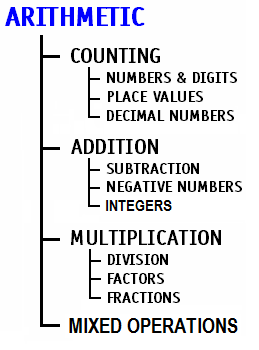
The basic parts of ARITHMETIC are as follows.
The word ARITHMETIC comes from [Greek, ARITHMOS number + TECHNE skill]

Arithmetic helps find the answers to problems that involve numbers. Knowing the fundamentals of Arithmetic, problems with large numbers can easily be solved mentally.

For example: Find the sum of 297 and 562.

  1. Imagine two stacks of 297 and 562 pennies.
  2. Transfer 3 pennies from the 562-penny stack to 297-penny stack.
  3. You now have two stacks of 300 and 559 pennies.
  4. This can be added quickly as 859 pennies.

ARITHMETIC, literally, means “skill with numbers.”

.

The first thing one learns in arithmetic is COUNTING. Counting helps one determine the number of things.

  1. A UNIT is what we count one at a time.
  2. A NUMBER is how many we have counted
  3. Counting starts with ONE.
  4. Then we count one more each time as TWO, THREE, FOUR, etc.
  5. ZERO is absence of count.
  6. The abacus introduces grouping by PLACE VALUES.
  7. The abacus teaches counting numbers to BILLIONS and more.
  8. Numbers are made up of DIGITS, just like words are made up of letters.
  9. The digits in a number have place values of ONES, TENS, HUNDREDS, etc.
  10. The place values may be expanded to provide DECIMAL NUMBERS.

.

ADDITION is “counting together.”

  1. Raise 3 fingers on hand and 2 fingers on the other. You count them together as 5 fingers. This is ADDITION.
  2. To add mentally one needs the knowledge of numbers and place values.
  3. The opposite of addition is SUBTRACTION. If you get money, you add it to what you already have; when you give money away, then you subtract it from what you have. The two actions are opposite to each other.
  4. A Number Line helps display numbers relative to each other. It helps with mental addition and subtraction.
  5. Skill in mental addition makes it easy to acquire skill in mental subtraction.
  6. With subtraction we get NEGATIVE NUMBERS.
  7. With negative numbers we get a wider concept of numbers as INTEGERS.
  8. The integers appear on a number line on both sides of zero.

.

Multiplication is “repeated addition.”

  1. If you sell 5 books for $6 each, you receive $30. This is MULTIPLICATION.
  2. Skill with mental multiplication depends on the earlier skill with mental addition.
  3. The opposite of multiplication is DIVISION. If you collect $6 each from 5 people, you get $30. If you distribute $30 equally among 5 people, then each person gets $6. The two actions are exactly opposite of each other.
  4. Skill in mental multiplication makes it easy to acquire skill in mental division.
  5. Multiplication and Division are greatly assisted by the concept of FACTORS.
  6. With division we get FRACTIONS.

.

Multiplication has the priority when mixed with Addition.

Multiplication and division are higher order operations compared to addition and subtraction.

.
Math Overview

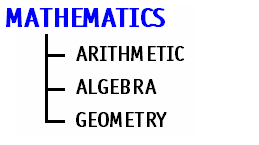
The basic parts of MATHEMATICS are as follows.

The word MATHEMATICS comes from a Greek word, mathema, which means, “Things learned.”

Do this simple exercise:

  1. Count the chairs in the room.
  2. Get how many chairs are there
  3. Note that you learned this fact by counting.

This means that counting provides you a systematic way of finding how many things there are. It is a tool for learning.

In general, Mathematics consists of tools for learning. It helps one learn in a systematic manner.

.

The word ARITHMETIC comes from [Greek, ARITHMOS number + TECHNE skill]

Arithmetic helps find the answers to problems that involve numbers. Knowing the fundamentals of Arithmetic, problems with large numbers can easily be solved mentally.

For example: Find the sum of 297 and 562.

  1. Imagine two stacks of 297 and 562 pennies.
  2. Transfer 3 pennies from the 562-penny stack to 297-penny stack.
  3. You now have two stacks of 300 and 559 pennies.
  4. This can be added quickly as 859 pennies.

ARITHMETIC, literally, means “skill with numbers.”

.

The word ALGEBRA comes from [Arabic, AL- the + JABARA to bind together]

ALGEBRA uses the relationships among quantities to determine what they are. Algebra is a natural extension of Arithmetic. Many word problems requiring arithmetic can be solved more easily with techniques learned in algebra.

For example: Find three consecutive numbers that add up to 30.

  1. Let’s say the middle number is N,
  2. Then the next number is “one more” or (N+1),
  3. And the previous number is “one less” or (N-1),
  4. So, we have (N-1), N, and (N+1) as three consecutive numbers.
  5. The sum of these three consecutive numbers is 30.
  6. Therefore, (N-1) + N + (N+1) = 30
  7. Or, 3N = 30
  8. Or, N = 10; Therefore, N – 1 = 9; and N+ 1 = 11
  9. Therefore, the three consecutive numbers are 9, 10 and 11, and we learn that the middle number of three consecutive numbers is always one-third of their sum.

Thus, ALGEBRA, determines the value of quantities from the relationshp that binds them.

.

The word GEOMETRY comes from [Greek, GEO earth + METREIN to measure]

GEOMETRY provides an understanding of the relationships among locations so one can determine distances, areas and volumes to construct and manipualate things in space. It is fascinating to learn the properties of space. Questions, such as, “How to accurately measure the vertical height of a mountain,” are easily solved through geometry. Here is how you can find the width of a river without crossing it.

  1. Locate a landmark, such as a tree, on the opposite bank.
  2. Place a pole right opposite the tree on this side of the bank.
  3. The separation between the pole and tree would denote the width of the river.
  4. Tie a rope to the pole and start walking parallel to the river on your side of the bank.
  5. Use a sextant to measure the angle between the pole and the tree from your location.
  6. Find the location where this angle is 45 degrees.
  7. Measure the length of the rope between this location and the pole.
  8. This length would be equal to the separation between the pole and the tree.
  9. Therefore, this length will give you the measure of the width of the river.

Thus, GEOMETRY determines useful values from the relationships among locations in space.

.