Monthly Archives: November 2022

Physics I: Chapter 4

Reference: Beginning Physics I

CHAPTER 4: FORCES IN EQUILIBRIUM

.

KEY WORD LIST

Force, Resultant Force, Line of Action, Rigid Body, Translational Motion, Center of Mass, Uniform Translational Motion, Rotational Motion, Translational Equilibrium, Rotational Equilibrium, Frame of Reference, Inertial Frame of Reference, Newton’s First Law, Law of Equilibrium, Collinear Forces, Concurrent Forces, Body Diagram, Newton’s Third Law, Friction, Normal Force, Static Friction, Kinetic Friction

.

GLOSSARY

For details on the following concepts, please consult CHAPTER 4.

FORCE
A force is a mechanical effect of the environment on an object. It is either a push or a pull that manifests either as motion or as distortion of the object. Force may be applied through direct contact or from a distance, such as, the magnetic force. Mathematically, a force can be represented by a vector as it has both a magnitude and a direction. Coplanar forces are “forces” that are acting in the same plane.

RESULTANT FORCE
The vector sum of the forces acting on a particle is called the resultant force on that particle. The forces acting on a particle may be replaced by their resultant, and it will have the same effect.

LINE OF ACTION
The line of action of a force is an imaginary line parallel to the force and drawn through the point at which the force is acting. A force acting on a rigid body can be applied anywhere along its line of action and still have exactly the same effect.

RIGID BODY
A rigid body refers to an object that doesn’t change its shape when forces act on it. No real object is truly rigid, but the concept is a good approximation for stiff objects

TRANSLATIONAL MOTION
Translational motion is the motion of an object as a whole, through space, without regard to how it spins on itself. The translational motion of a very small object, idealized as a particle, is just the motion of the particle along its path.

CENTER OF MASS
The center of mass is a special point of an object, whose translational motion represents the translational motion of the object as a whole, through space, without regard to how it spins on itself. For simple uniform symmetric objects, such as a disk, a sphere, a rod, or a rectangular solid, the center of mass is at the geometric center of the object.

UNIFORM TRANSLATIONAL MOTION
Uniform translational motion means that the center of mass of the object is either at rest or moving at constant speed in a straight line.

ROTATIONAL MOTION
Rotational motion is the spinning motion of an object about a fixed axis, such as the spinning of a wheel on a shaft, but it can also refer to the spinning of an object on itself as the object moves through space. Rotational motion is the change in the angular orientation of the object.

TRANSLATIONAL EQUILIBRIUM
Translational equilibrium means that the object as a whole, aside from rotation, has uniform translational motion. This is the case when the forces acting on an object add up to zero.

ROTATIONAL EQUILIBRIUM
Rotational equilibrium means that the object—whether it is undergoing translational motion or not—is either not spinning or it is spinning in a uniform fashion. For simple symmetric objects it means spinning at a constant rate about a fixed direction.

FRAME OF REFERENCE
A Frame of Reference refers to the “framework” that defines the coordinate system in which one’s measurements and observations are made. If a coordinate system is fixed to the earth and another one is fixed to a rotating merry-go-round, one is going to observe things differently in each. Each of these coordinate systems is fixed in a different frame of reference.

INERTIAL FRAME OF REFERENCE
An inertial frame of reference is a frame of reference in which a completely isolated object (no forces) will appear to be in both translational and rotational equilibrium. For most purposes the earth can be considered an inertial frame. The importance of inertial frame is that Newton’s laws hold only in such frames, and most of the other laws of physics take on simpler form when described in such frames.

NEWTON’S FIRST LAW
Newton’s first law is the condition that the center of mass of the object is either at rest or moving at constant speed in a straight line. Here the vector sum of all forces acting on the object is zero.

LAW OF EQUILIBRIUM
See Newton’s first law.

COLLINEAR FORCES
Two forces are collinear when they act along a common line of action.

CONCURRENT FORCES
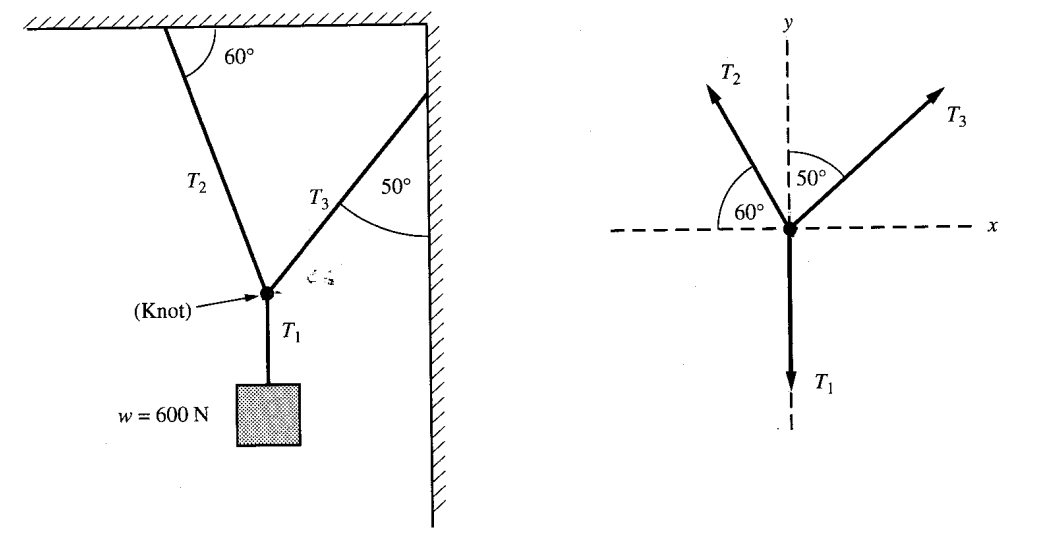
Three forces are concurrent when their lines of action pass through a common point.

BODY DIAGRAM
Body diagram, as drawn, consists of the isolated object with only the forces acting on it.

NEWTON’S THIRD LAW
This law, otherwise known as the law of action and reaction, states that if some object exerts a force on another object, then the other object exerts a force back that is equal in magnitude and opposite in direction. The law holds   both for contact forces and for action-at-a-distance forces.

FRICTION
Friction is the rubbing force between two objects whose surfaces are in contact. The force of friction always acts parallel to the touching surfaces. The magnitude of the frictional force exerted by each surface on the other depends on how tightly the two surfaces are pressed together.

NORMAL FORCE
The force responsible for two surfaces pressing together is called the normal force because it acts perpendicular to the two surfaces. By Newton’s third law each surface exerts a normal force that is equal in magnitude and opposite in direction to that exerted by the other.

STATIC FRICTION
When two surfaces are at rest with respect to one another, the frictional force each exerts on the other always opposes any tendency to relative motion. The frictional force on an object adjusts itself in magnitude and direction to oppose and counterbalance any other forces on the object that would tend to make the object start to slide, as needed, from zero magnitude up to some maximum value to stop such slippage. The maximum static friction force that one surface can exert on another is proportional to the normal force, and the proportionality constant is called the coefficient of static friction. This coefficient depends on the nature of the two surfaces.

KINETIC FRICTION
Once two surfaces are in motion relative to one another, the frictional force, now called kinetic friction, acting on a surface is always in a direction opposed to the velocity of that surface. Its magnitude is independent of the magnitude of the velocity. The coefficient of kinetic friction is equal to or smaller than the coefficient of static friction for any given pair of surfaces.

.

Physics I: Chapter 3

Reference: Beginning Physics I

CHAPTER 3: MOTION IN A PLANE

.

KEY WORD LIST

Vector, Scalar, Component of A Vector, Displacement In A Plane, Velocity In A Plane, Acceleration In A Plane, Component Method For Motion, Trajectory Equation, Uniform Circular Motion, Centripetal Acceleration, Periodic Motion, Period, Relative Motion

.

GLOSSARY

For details on the following concepts, please consult CHAPTER 3.

VECTOR
Any physical quantity that is described by a magnitude and a direction is called a vector quantity. A vector is defined geometrically by means of an arrow. The length of the arrow is the magnitude of the vector, and the direction of the arrow is the direction of the vector. The value of the vector does not depend on where it is located on the graph, only on its magnitude and direction. You may study this chapter for Rules of vector algebra.

SCALAR
These are ordinary algebraic quantities having only magnitude. They are representable by position on a scale or line.

COMPONENT OF A VECTOR
The component of vector in a given direction equals plus or minus the magnitude of the vector times the cosine of the acute angle with that direction. The correct sign is then chosen by inspection. A knowledge of the two components of a two-dimensional vector uniquely determines the magnitude and direction of the vector.

DISPLACEMENT IN A PLANE
The displacement in a plane r has a horizontal component rx and a vertical component ry.

VELOCITY IN A PLANE
The instantaneous velocity in a plane v has a horizontal component vx and a vertical component vy.

ACCELERATION IN A PLANE
The instantaneous acceleration in a plane a has a horizontal component ax and a vertical component ay.

COMPONENT METHOD FOR MOTION
We see that the motion of a particle can be analyzed by studying the motion of particle’s shadows on the different axes of the coordinate system, each of which is a one-dimensional motion. If we know everything about the shadow motions along the axes, we can reconstruct the full two- or three-dimensional motion.

TRAJECTORY EQUATION
The trajectory equation is the equation for the path of the projectile in the xy plane, that is, to obtain an equation for y in terms of x.

UNIFORM CIRCULAR MOTION
This is the case of an object moving with constant speed v around a circular path of radius r. It has the peculiar property that while the magnitude of the velocity is just the constant speed v, the direction of the velocity is continually changing.

CENTRIPETAL ACCELERATION
The centripetal acceleration is the acceleration of a particle in uniform circular motion. It is strictly due to the change in direction of the velocity v. It points toward the center of the circular path. Its magnitude is,

Thus, just as for the velocity, the acceleration has constant magnitude but changing direction.

PERIODIC MOTION
Periodic motion is the motion that repeats itself over and over. The uniform circular motion is an example of it.

PERIOD
A period (T) is the time for one repetition of the periodic motion. For uniform circular motion, v equals the distance traveled in one revolution divided by the time to complete the revolution, or v = 2πr/T.

RELATIVE MOTION
A velocity has meaning only when it is measured relative to something that is assumed to be at rest.

.

Physics I: Chapter 2

Reference: Beginning Physics I

CHAPTER 2: MOTION IN A STRAIGHT LINE

.

KEY WORD LIST

Kinematics, Coordinate System, One-Dimensional, Particle, Displacement, Time, Velocity, Distance, Speed, Acceleration, Case of Constant Acceleration, Freely Falling Bodies

.

GLOSSARY

For details on the following concepts, please consult CHAPTER 2.

KINEMATICS
Kinematics is the study of physical quantities that describe the motion of an object.

COORDINATE SYSTEM
Origin: “order together.” A coordinate system is a fixed system of directions and angles from an ‘origin point’ that uses numbers to define the position of a point, line, or the like.

ONE-DIMENSIONAL
One-dimensional means, in a straight line; in the same direction; along the x-axis.

PARTICLE
In mechanics, a particle is an infinitesimally small object located at a definite point in a coordinate system. The particle is the representation of the mathematical ‘center of mass’ of an object. If there is no center of mass, as in the case of a “light particle” then the laws of mechanics do not apply.

DISPLACEMENT
Displacement is the measure of the position of the object in a coordinate system. Absolute displacement specifies a particle’s location as measured from the origin. It has both a magnitude and a sign. Its magnitude is the straight-line distance from the origin to the location of a particle. Its sign is positive if the particle is on the positive side of the axis, and negative if it is on the negative side. Relative displacement is the location of the particle as measured from an arbitrary point. Like absolute displacement, relative displacement can be either positive or negative. If right is chosen as the positive direction, then the relative displacement is negative when the position of the particle is to the left of the position from which it is measured.

TIME
Time is a measure of when the object is at a certain position in a coordinate system. Time elapsed is always positive.

VELOCITY
Velocity is the time rate of change of displacement.

The average velocity is defined as,

Text

Description automatically generated with medium confidence

Since the time difference in the denominator is always positive, the sign of average velocity is the sign of the relative displacement, and thus it indicates whether the particle has moved to the right (plus) or to the left (minus).

Instantaneous velocity is the velocity of the particle at a given instant of time. It is determined by the slope of the tangent line to the x-t curve at any time. The instantaneous velocity at time t1 is given by

Text

Description automatically generated with low confidence

DISTANCE
Distance is the absolute value of the relative displacement. Therefore, the distance traveled is always positive.

SPEED
Average speed is defined as the total distance traveled in a given time divided by that time interval. Since distance traveled is always positive, the average speed is always positive. Its units are the same as those of velocity. Average speed is either equal to or greater than the average velocity. Instantaneous speed is always the same as instantaneous velocity.

ACCELERATION
Acceleration is the time rate of change of velocity.

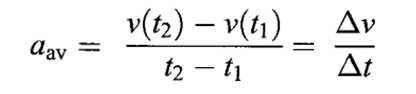
The average acceleration is defined as,

Text

Description automatically generated with low confidence

Like velocity, acceleration can be positive, negative or zero.

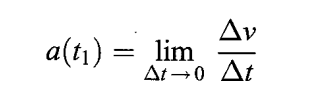
Instantaneous acceleration is the acceleration of the particle at a given instant of time. It is determined by the slope of the tangent line to the v-t curve at any time. The instantaneous acceleration at time t1 is given by

Text

Description automatically generated

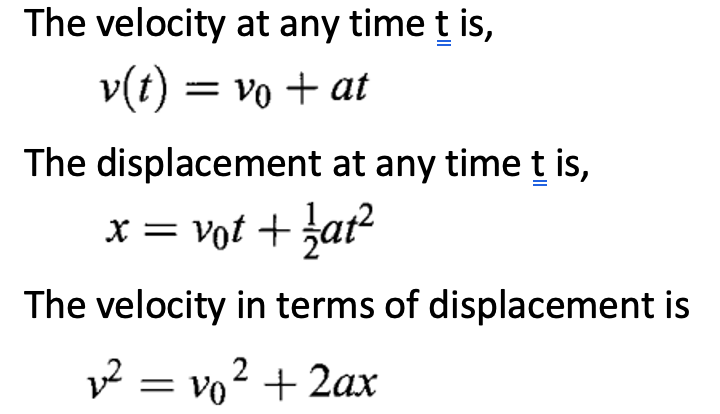
CASE OF CONSTANT ACCELERATION
For a particle starting at origin, x = 0, t = 0, and v = v0. Also, x = displacement from origin, and t = time elapsed.

Text

Description automatically generated with medium confidence

FREELY FALLING BODIES
A body falling freely under gravitation has

  1. Constant downward acceleration (g) of 9.81 m/s2, or 32.2 ft/ s2
  2. Negligible air resistance.

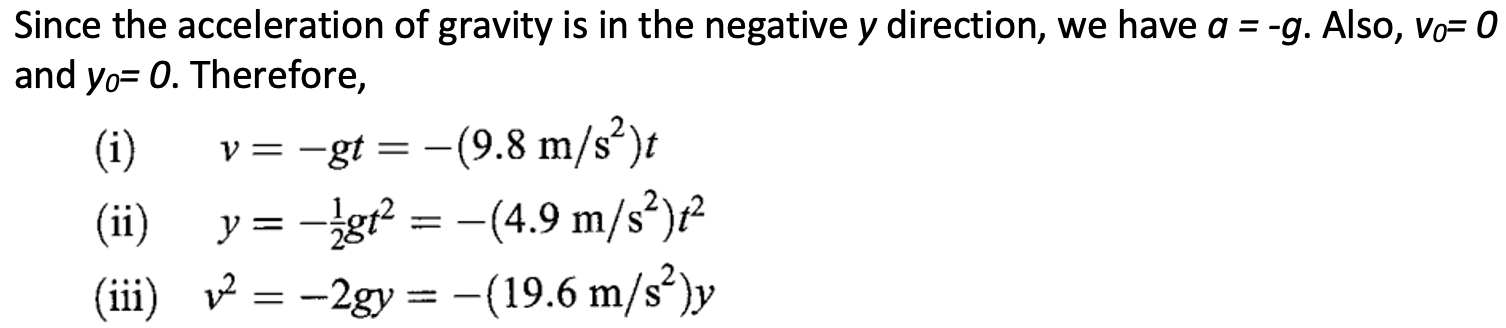
Since the acceleration of gravity is in the negative y direction, we have a = -g. Also, v0= 0 and y0= 0. Therefore,

Diagram, text

Description automatically generated

.

Beginning Physics I

Reference: Schaum Beginning Physics I
Reference: Beginning Physics II

Here are the KEY WORD LIST and GLOSSARY for each chapter of this wonderful reference. The purpose here is to make it easy to understand the subject of Physics. You should buy a copy of this book for easy reference, though each chapter is reproduced below.

.

  1. CHAPTER 1: INTRODUCTION & MATHEMATICAL BACKGROUND
  2. CHAPTER 2: MOTION IN A STRAIGHT LINE
  3. CHAPTER 3: MOTION IN A PLANE
  4. CHAPTER 4: FORCES IN EQUILIBRIUM
  5. CHAPTER 5: NEWTON’S SECOND LAW
  6. CHAPTER 6: WORK AND MECHANICAL ENERGY
  7. CHAPTER 7: ENERGY, POWER AND SIMPLE MACHINES
  8. CHAPTER 8: IMPULSE AND LINEAR MOMENTUM
  9. CHAPTER 9: RIGID BODIES I: EQUILIBRIUM & CENTER OF GRAVITY
  10. CHAPTER 10: RIGID BODIES II: ROTATIONAL MOTION 
  11. CHAPTER 11: DEFORMATION OF MATERIALS & ELASTICITY
  12. CHAPTER 12: SIMPLE HARMONIC MOTION (SHM)
  13. CHAPTER 13: FLUIDS AT REST (HYDROSTATICS)
  14. CHAPTER 14: FLUIDS IN MOTION (HYDRODYNAMICS)
  15. CHAPTER 15: THERMODYNAMICS I: TEMPERATURE & HEAT
  16. CHAPTER 16: THERMODYNAMICS II: GAS LAWS, THE ATOMIC …
  17. CHAPTER 17: TRANSFER OF HEAT
  18. CHAPTER 18: THE FIRST & SECOND LAWS OF THERMODYNAMICS

.

Physics I: Chapter 1

Reference: Beginning Physics I

CHAPTER 1: INTRODUCTION & MATHEMATICAL BACKGROUND

.

KEY WORD LIST

Physics, Science, Mathematics, Absolute value, Variables, Function, Graph, Inverse function, Trigonometric Function, Simultaneous equations, Linear equation, Units, Standard, International System of Units (SI), Significant figures, Scientific notation

.

GLOSSARY

For details on the following concepts, please consult CHAPTER 1.

PHYSICS
Origin: “pertaining to nature.” Physics is the science that deals with matter, energy, motion, and force.

SCIENCE
Origin: “to know.” Science is systematic knowledge of the physical or material world gained through observation and experimentation.

MATHEMATICS
Origin: “something learned.” Mathematics is the systematic treatment of magnitude, relationships between figures and forms, and relations between quantities expressed symbolically.

ABSOLUTE VALUE
The value without regards to its sign.  It is the magnitude of a number.

VARIABLES
Variables are quantities that can take on a range of values.

FUNCTION
Origin: “performed, executed.” A function is a mathematical relationship between two variables. If one of the variables takes on a particular value, the relationship tells us the corresponding value of the other variable.

GRAPH
Whenever one has a mathematical relationship between two variables, one can represent the function by a two dimensional graph. Note: Look up the definitions of the following on page 3: axes, origin, independent variable, dependent variable, slope, intercept.

INVERSE FUNCTION
A function gives us a y value for every x value. Inverse function turns it around and gives us an x value for every y-value. To get the graph of inverse function, rotate the graph of the function 90 deg clockwise so that y appears along the horizontal.

TRIGONOMETRIC FUNCTION
Trigonometric Functions are most usually defined in terms of ratios of sides of a right triangle, in which the angle plays the role of the independent variable.

SIMULTANEOUS EQUATIONS
When we have two different relationships involving the same two variables, then both relationships can be valid only for specific values of the variables.

LINEAR EQUATION
Such equation are represented by straight lines on a graph.

UNITS
Origin: “unity.” Unit is an identity element. We need units of measurement to measure physical quantities, such as, length, area, volume, velocity, acceleration, mass, time and temperature. Not all measurable quantities require their own units. Often, the unit is automatically defined in terms of other units. Such units are called derived units. In the subject of mechanics, only three physical quantities must have their units defined independently. These three quantities are usually taken to be length, mass and time, and their units are called  fundamental units. It turns out that units can be treated algebraically in any physics equation.

STANDARD
The physical specimen, which defines the unit, is called the standard.

INTERNATIONAL SYSTEM OF UNITS (SI)
The set of units most commonly used throughout the world, and which is almost exclusively used in scientific work. In mechanics, the units are the meter, the kilogram, and the second, and are what is commonly called the mks system.

SIGNIFICANT FIGURES
Whenever a measured value is given for a physical quantity, it can only be an approximation, because it is not possible to measure  anything with “infinite” accuracy. A scientist or engineer who specifies the numerical value of a physical quantity keeps only as many figures in the number as are justified by the accuracy to which the physical quantity is known. For any measured quantity there is always some uncertainty in the last digit given. The number of significant figures provide a rough measure of percent uncertainty.

SCIENTIFIC NOTATION
Scientific notation is a method for expressing a given quantity as a number having significant digits necessary for a specified degree of accuracy, multiplied by 10 to the appropriate power, as 1385.62 written as 1.386 × 10³.

.