From Scientology 8-8008, section THETA-MEST THEORY:
“One of the most valuable contributions of Scientology to knowledge is the definition of a true static… Formerly a static was defined only as a motionless object which definition is not adequate, since an object—or a state of rest for an object—is attained only by an equilibrium of forces and all objects have in themselves, if only on a molecular level, motion, and exist in space which is itself an integral portion of motion. Hence we see we are dealing with a higher level static.”
This is a very good observation. A deeper level of static shall be zero energy. According to Einstein, matter is condensed energy. Therefore, even when still, none of the objects are truly static as they contain motion at atomic level.
We observe matter converting back to electromagnetic energy in atomic or nuclear explosions. The electromagnetic energy is disturbance in space. This disturbance has a frequency spectrum. On this spectrum, the theoretical frequency of zero may be the true static. This shall denote undisturbed space.
POSTULATE 5: The theoretical static is undisturbed space where space represents the overall scope of physical dimensions.
Space provides the extent in which we find the dimensions of energy and matter.
.
From Scientology 8-8008, section THETA-MEST THEORY:
“In Scientology, the static is represented by the mathematical symbol theta… Theta can be the property or beingness of any individual and is, for our purposes, considered to be individualistic for each individual… The capabilities of the static are not limited.”
Static is no motion but it is associated with unlimited potential in Scientology. This is inconsistent because true static shall be complete absense of energy whether it is kinetic or potential. It is not only a static in physical dimensions but also in spiritual dimensions.
Scientology Filter #3: It is an arbitrary assumption in Scientology that static condition in the spirtual dimenion is unlimited capabilities.
The overall scope of spiritual dimensions is represented by awareness. Therefore, the true static shall denote undisturbed awareness.
POSTULATE 6: The theoretical static is undisturbed awareness where awareness represents the overall scope of spiritual dimensions.
Awareness provides the scope in which we find the dimensions of consciousness and identity.
COROLLARY 7: The physical concept of space extends into metaphysics as the concept of awareness.
I humbly submit my review and revision of “The Factors” of Scientology by L. Ron Hubbard, which appear in the book Scientology 8-8008.
.
THE FACTORS
FACTOR # 1: Before the beginning was a Cause and the entire purpose of the Cause was the creation of effect.
This Factor anchors the whole existence on an absolute Cause. This is similar to the idea of God in the Abrahamic religions. However, this is inconsistent with the Vedas and Buddhism, which are the earliest ancestors of Scientology according to Hubbard.
The Vedas inquire about the basis of universe by the keynote of Neti-neti (neither this, nor that). Buddhism declares.
“The Absolute Truth is that there is nothing absolute in the world, that everything is relative, conditioned and impermanent, and that there is no unchanging, everlasting, absolute substance like Self, Soul, or Ātman within or without.”
In other words, there are no absolute certainties as regards the basis of this universe. So we start with the unbiased basis of emptiness. Please see Emptiness.
Thus, this Factor is inconsistent with Vedas and Buddhism when it posits the basis of this universe in absolute certain terms.
Mindfulness says,
FACTOR # 1 (revised): The universe is simply there. Its beginning, or basis, cannot be ascertained with certainty. So we start with the unbiased basis of emptiness.
.
FACTOR # 2: In the beginning and forever is the decision and the decision is TO BE.
The universe is there. It is being (existing). We may only speculate about its beginning. But about the beginning of things within this universe we may say the following:
(1) The universe is a continuum of substance. Whatever appears within the universe is relative, conditioned and impermanent.
(2) The things in the universe may evolve in different forms; but there is consistency to them.
(3) The things in the universe may become more complex or less; but there is harmony to them.
(4) The things in the universe may become more intense or less; but there is continuity to them.
Mindfulness says,
FACTOR # 2 (revised): The universe is always changing but it is consistent, harmonious and continuous in its beingness.
.
FACTOR # 3: The first action of beingness is to assume a viewpoint.
The continuity, harmony and consistency of the universe manifest in the form of a universal viewpoint. The universal viewpoint is not bound or limited in any way and it can see things as they are. A viewpoint becomes subjective to the degree it is less than universal.
FACTOR # 3 (revised): The universal viewpoint is characterized by seeing things as they are. This is the definition of objectivity.
.
FACTOR # 4: The second action of beingness is to extend from the viewpoint, points to view, which are dimension points.
The beingness is all that there is to view. It spreads out into infinity of dimensions, where each dimension comprises of infinity of points to view.
FACTOR # 4 (revised): The universal beingness offers infinity of dimensions to view.
.
FACTOR # 5: Thus there is space created, for the definition of space is: viewpoint of dimension. And the purpose of a dimension point is space and a point of view.
The universe is infinite in its dimensions, and thus provides the space and all that is within it. The universal beingness is thus aware of itself.
FACTOR # 5 (revised): The dimensions provide the space in which to view the dimension points.
.
FACTOR # 6: The action of a dimension point is reaching and withdrawing.
The dimension points go through a cycle of consideration when attention is placed on them. In other words, the dimension points come in and go out of view.
FACTOR # 6 (revised): The dimension points come in and go out of view. Thus there is consideration.
.
FACTOR # 7: And from the viewpoint to the dimension points there are connection and interchange. Thus new dimension points are made. Thus there is communication.
The viewpoint can recognize the anomalies of inconsistency, disharmony or discontinuity among the dimension points, and straightens them out. Thus realizations come about. So, there is communication because the purpose of communication is to establish understanding through consistency, harmony and continuity.
FACTOR # 7 (revised): The consideration resolves inconsistency, disharmony and discontinuity among dimension points. Thus missing connections are discovered. Thus there is communication.
.
FACTOR # 8: And thus there is light.
Communication is the means for pereiving what is there and aligning it with knowledge existing in the mind to gain understanding.
FACTOR # 8 (revised): And thus there is perception, understanding, and enlightenment.
.
FACTOR # 9: And thus there is energy.
Perception and understanding is followed by purposeful activity to bring about greater consistency, harmony and continuity.
FACTOR # 9 (revised): And thus there is purposeful activity.
.
FACTOR # 10: And thus there is life.
With purposeful activity there comes about the evolution of life in the universe.
FACTOR # 10 (revised): And thus life evolves.
.
FACTOR # 11: But there are other viewpoints and these viewpoints out-thrust points to view. And there comes about an interchange amongst viewpoints; but the interchange is never otherwise than in terms of exchanging dimension points.
There is only one universally objective viewpoint. Therefore, as the viewpoint narrows from universality it breaks into multiple viewpoints. The multiple viewpoints are subjective and hold different views of dimension points. Thus come about discontinuity, disharmony and inconsistency.
FACTOR # 11 (revised): There is only one universal and objective viewpoint. A departure from universality generates multiplicity of viewpoints that are subjective in different ways. Thus comes about interchange of opinions.
.
FACTOR # 12: The dimension point can be moved by the viewpoint, for the viewpoint, in addition to creative ability and consideration, possesses volition and potential independence of action; and the viewpoint, viewing dimension points, can change in relation to its own or other dimension points or viewpoints. Thus comes about all the fundamentals there are to motion.
The integrity of the viewpoint is lost when it becomes narrow and subjective and cannot view the facts and accuracy of the dimension points. The viewpoint becomes blind to the discontinuities, disharmonies and inconsistencies that it is mired into.
To restore its integrity a viewpoint must broaden its context and confront the discontinuities, disharmonies and inconsistencies that now come to view. Exteriorization of the viewpoint depends on the resolution of these anomalies. Scientology talks about agreement. But agreements on narrow views keep the viewpoints interiorized.
FACTOR # 12 (revised): Creative ability, consideration, volition and potential independence of action underlie the changes in viewpoint and dimension points. The criteria they must adhere to is continuity, harmony and consistency. Thus comes about all the fundamentals there are to motion.
.
FACTOR # 13: The dimension points are each and every one, whether large or small, solid. And they are solid solely because the viewpoints say they are solid.
Reality improves as discontinuities, disharmonies and inconsistencies are found and resolved. Life becomes less confusing and more stable. Things in life start to become more useful and they are applied again and again. They start to become more real and solid. Even at physical level solidity comes from quantization as frequency increases. Thus, dimension points become solid to the degree there is continuity, harmony and consistency among them.
FACTOR# 13 (revised): The dimension points are each and every one, whether large or small, real. And they are real to the degree they are continuous, harmonious and consistent.
.
FACTOR #14: Many dimension points combine into larger gases, fluids or solids. Thus there is matter. But the most valued point is admiration, and admiration is so strong its absence alone permits persistence.
The dimension points are both physical and metaphysical. The physical dimension points appear as the substance formed of electromagnetic field and matter. The metaphysical dimension points appear as the qualities and attributes. These dimension points vary from simple to complex, abstract to concrete. Their beauty lies in their continuity, harmony and consistency that lead to complete understanding.
Admiration of dimension point means complete recognition of their beauty as described above. Absence of such admiration means that the dimension points are not recognized for what they are. Such misconception leads to the persistence of unresolved opinions, assumptions, fixed ideas, and speculations. The universe is neither persisting nor not-persisting. Only those things persist that are not fully resolved.
FACTOR #14 (revised): The dimension points combine to generate more complex forms. But these forms are pure to the degree they are viewed as they are. This is admiration. Lack of admiration results in persistence of impurity.
.
FACTOR #15: The dimension point can be different from other dimension points and thus can possess an individual quality. And many dimension points can possess a similar quality, and others can possess a similar quality unto themselves. Thus comes about the quality of classes of matter.
The dimension points are infinitely varied with unique individual qualities. There are similarities and differences among them. Thus there are classes of matter in terms of qualities, such as, density, hardness, flammability, etc., and classes of abstractions, such as, principles, rules, laws, etc.
FACTOR #15 (revised): The dimension points are different because of their unique qualities, while they have many similarities. Thus comes about the quality of classes of matter.
.
FACTOR # 16: The viewpoint can combine dimension points into forms and the forms can be simple or complex and can be at different distances from the viewpoints and so there can be combinations of form. And the forms are capable of motion and the viewpoints are capable of motion and so there can be motion of forms.
Simple dimension points combine by free association to form more complex dimension points under the criteria of continuity, harmony and consistency. These dimension points differ in their dimensions of distances, durations, motions, etc. Thus evolution comes about in terms of various forms and capability of self-animation. Here we have the beginning of life.
FACTOR# 16 (revised): The dimension points combine into forms that are capable of motion, and so there is motion among parts of complex forms. Thus comes about self-animation.
.
FACTOR # 17: And the opinion of the viewpoint regulates the consideration of the forms, their stillness or their motion, and these considerations consist of assignment of beauty or ugliness to the forms and these considerations alone are art.
Thus, evolution takes place from inanimate minerals to active plant life to animated animal life. The physical form and metaphysical essence develops accordingly and it reaches its pinnacle in the human identity. Art lies in the stillness or motion of these forms in infinite ways. It is the continuity and harmony of the motion involved that determines the beauty of forms.
FACTOR# 17 (revised): The forms evolve from inanimate minerals to growing plants to animated animals. Beauty lies in the continuity, harmony and consistency of the stillness and motion of these forms. These criteria alone are art.
.
FACTOR # 18: It is the opinion of the viewpoints that some of these forms should endure. Thus there is survival.
The theory of Dianetics and Scientology is based on the idea of survival. But the universe is designed to continually evolve toward better states. It takes attention and effort to make certain forms, such as, self, to endure. This effort is better spent in removing hindrances to evolution toward better states. Evolution surpasses mere survival.
FACTOR # 18 (revised): The forms continually endeavor toward attaining greater continuity, harmony and consistency. Thus there is evolution.
.
FACTOR # 19: And the viewpoint can never perish; but the form can perish.
The universal viewpoint and the universal form maintain continuity, harmony and consistency. They have no beginning or end. But there are narrow viewpoints and subjective anomalies of discontinuity, disharmony and inconsistency that come and go.
FACTOR # 19 (revised): The universal beingness and viewpoint can never perish; but narrow viewpoints and their opinions of forms can perish.
.
FACTOR # 20: And the many viewpoints, interacting, become dependent upon one another’s forms and do not choose to distinguish completely the ownership of dimension points and so comes about a dependency upon the dimension points and upon the other viewpoints.
The narrow viewpoints interact with each other and many of them obtain agreement on their subjective opinions, assumption, fixed ideas and speculations. Thus come about beliefs, such as, “Earth is the center of the universe,” or “our soul gets punished or rewarded after death.” Such beliefs then become paramount and the viewpoints become subject to them. Interactions among viewpoints come to be guided by such beliefs.
FACTOR # 20 (revised): And many viewpoints, interacting, come to agree on subjective opinions, assumption, fixed ideas and speculations. And so they become dependent on beliefs thus generated.
.
FACTOR # 21: From this comes a consistency of viewpoint of the interaction of dimension points and this, regulated, is TIME.
The universal viewpoint and the objective form are eternal without beginning or end. Time accounts for its continual evolution toward greater continuity, harmony and consistency. But as the universal viewpoint narrows into multiple viewpoints, and agreements come about among their subjective views, there comes about a system of agreement, which becomes the common reality. Changes then occur in line with this common reality. Such changes then provide the idea of TIME.
FACTOR # 21 (revised): From this comes about a system of beliefs that regulates the viewpoints in their perception of reality. Thus TIME acquires a fixed characteristic.
.
FACTOR # 22: And there are universes.
There is only one objective universe, which is displayed through subjects, such as, science, logic, mathematics, philosophy, etc. All these subjects are based on an innate sense of continuity, harmony and consistency. It has the universal viewpoint of seeing things as they are. But each narrow viewpoint has its own subjective universe, which is expressed through individual narrow system of beliefs.
FACTOR # 22 (revised): There are as many “universes” as there are subjective viewpoints; but there is only one objective universe.
.
FACTOR # 23: The universes, then, are three in number: the universe created by one viewpoint, the universe created by every other viewpoint, the universe created by the mutual action of viewpoints which is agreed to be upheld—the physical universe.
There is only a single objective universe and its viewpoint. But there are as many subjective universes as there are subjective viewpoints. There are no separate and independent physical and metaphysical (or spiritual) universes. Physical and metaphysical are two aspects of the same universe.
As the context broadens, all viewpoints converge to the same objective viewpoint because they see reality for what it is. No agreement is required.
FACTOR # 23 (revised): All created universes are subjetive. A common universe created out of agreement is still subjective. Objectively, there is only one universe.
.
FACTOR # 24: And the viewpoints are never seen. And the viewpoints consider more and more that the dimension points are valuable. And the viewpoints try to become the anchor points and forget that they can create more points and space and forms. Thus comes about scarcity. And the dimension points can perish and so the viewpoints assume that they, too, can perish.
A viewpoint is defined by its frame of reference. A person generally uses his body as his frame of reference. When studying astronomy he may change that frame of reference to the earth. When that frame of reference is the whole universe then it is a universal viewpoint. Thus a person can assume different viewpoints. In other words, the viewpoint can be flexible.
An anchor point refers to a fixed frame of reference. Here the viewpoint has lost its flexibility. When the body becomes a person’s anchor point then he looks at everything with his body as his fixed frame of reference. When the body dies the frame of reference is gone, and so the person’s individuality dies too. A flexible viewpoint survives such a death when it has attained the universal viewpoint.
FACTOR # 24 (revised): When a person’s viewpoint is fixed to the body, it has become subjective. When the body perishes the viewpoint gets absorbed in the universal viewpoint.
.
FACTOR # 25: Thus comes about death.
Death is the disintegration of the form and the viewpoint (individuality) anchored to that form. The disintegrated elements of the form and the anchored viewpoint disperse into the universe. The viewpoint that survives this disintegration is the objectivity of the universal viewpoint. This universal viewpoint can be attained only in the human form.
FACTOR # 25 (revised): Thus comes about death of the form and its individual identity.
.
FACTOR # 26: The manifestations of pleasure and pain, of thought, emotion and effort, of thinking, of sensation, of affinity, reality, communication, of behaviour and being are thus derived and the riddles of our universe are apparently contained and answered herein.
The manifestations of pleasure and pain, of thought, emotion and effort, of thinking, of sensation, of affinity, reality, communication, of behaviour and being are all subjective. They derive from the viewpoints anchored on perishable forms. The resolution of such manifestations depends on attaining the objectivity of the universal viewpoint.
FACTOR # 26 (revised): Manifestations of pleasure and pain, of thought, emotion and effort, of thinking, of sensation, of affinity, reality, communication, of behaviour and being are derived from viewpoints attached to perishable forms. The resolution of such manifestations comes from attaining the objectivity of the universal viewpoint.
.
FACTOR # 27: There is beingness, but Man believes there is only becomingness.
The ultimate beingness is the objectivity of the universal viewpoint. But Man hankers after the personal viewpoint provided by the identity centered on the body.
FACTOR # 27 (revised): The ultimate beingness is attained by moving beyond the subjective viewpoint attached to the human body, and arriving at the objectivity of the universal viewpoint.
.
FACTOR # 28: The resolution of any problem posed hereby is the establishment of viewpoints and dimension points, the betterment of condition and concourse amongst dimension points, and, thereby, viewpoints, and the remedy of abundance or scarcity in all things, pleasant or ugly, by the rehabilitation of the ability of the viewpoint to assume points of view, and create and uncreate, neglect, start, change and stop dimension points of any kind at the determinism of the viewpoint. Certainty in all three universes must be regained, for certainty, not data, is knowledge.
The resolution of human condition comes from letting the viewpoint unwind through all its fixations and widen its context. This is accomplished by practicing the discipline of mindfulness to resolve all discontinuities, disharmonies and inconsistencies as described at The Mindfulness Approach.
FACTOR # 28 (revised): The resolution of any condition comes when the viewpoint toward that condition attains the objectivity of the universal viewpoint, and establishes continuity, harmony and consistency among the dimension points. This is accomplished by practicing the discipline and exercises of mindfulness.
.
FACTOR # 29: In the opinion of the viewpoint, any beingness, any thing, is better than no thing, any effect is better than no effect, any universe better than no universe, any particle better than no particle, but the particle of admiration is best of all.
Universal beingness is always there without beginning or end. It can be understood objectively on the basis of emptiness, or absence of phenomena. Any viewpoint, which is less than universal, is subjective because it tries to overcome its lack of universality by assuming things. Admiration means seeing things as they are without assumptions. That is the route to attaining the ultimate universal viewpoint.
FACTOR # 29 (revised): There is always a beingness with a viewpoint. Both beingness and viewpoint improve as they become more objective. True admiration arises from objectivity.
.
FACTOR # 30: And above these things there might be speculation only. And below these things there is the playing of the game. But these things which are written here Man can experience and know. And some may care to teach these things and some may care to use them to assist those in distress and some may desire to employ them to make individuals and organizations more able and so give to Earth a culture of which we can be proud.
I have analyzed the Factors proposed by Hubbard with as much objectivity as I could muster. This revision basically replaces the idea of an arbitrary Cause by the criteria of continuity, harmony and consistency.
Hubbard’s pioneering work brought great improvement to prior understanding. This revision is an attempt to bring consistency to Hubbard’s materials with Vedas and Buddha’s work. The goal, of course, is to bring about greater understanding and better workability to the resolution of human condition.
FACTOR # 30 (revised): This revision of Hubbard’s pioneering work is an attempt to make it consistent with Vedas and Buddha’s work. It is hoped that this effort shall bring about better understanding and more workable techniques for the resolution of human condition.
The Theta-MEST theory forms the core of the philosophy of Scientology. It parallels the concept of Shakti-Shiva in Hinduism. Whereas Shakti and Shiva are looked upon as two sides of the same coin, Scientology looks at Theta and MEST as two different systems that are independent of each other.
Here is an understanding of the Theta-MEST Theory aftersubject clearing.
Hubbard is correct in recognizing that there is a spectrum of motion, one end of which is STATIC (Theta) and the other end is KINETIC (MEST). He is also correct in saying that STATIC and KINETIC are theoretical in the sense that they are not absolute. This is a great advance on the philosophy of Semitic religions.
At physical level the spectrum of motion starts with undisturbed space. When space is disturbed it produces a ripple of interchanging electromagnetic fields. Thus, we have an electromagnetic spectrum of increasing frequency. At upper end of this spectrum, frequency collapses into mass.
The essense of UNDISTURBED SPACE is the STATIC. Of course, matter is not part of the STATIC because matter is produced by a collapse of extreme disturbance in space.
The STATIC is pure awareness. Therefore, the Scientology Static has no motion; no width, length, breadth, depth; not held in suspension by equilibrium of forces; does not have mass; and does not contain wavelengths.
This Scientology static has no situation in time or space simply because it is the undisturbed space with the essence of awareness. Thus, static is not something discrete. It would be an error to consider it so.
Hubbard’s first error is to assign individuality to the Static. Static is a phenomenon that has “properties”. It is not an individual that has “capabilities”. The static when disturbed becomes kinetic. It is not a “static” interacting with a “kinetic”.
Outer form and inner essence go hand in hand. There cannot be an outer form without inner essence. There must be an outer form to any inner essence. The outer form is represented by “physical”; the inner essence is represented by “spiritual”. One can’t think of spirit without some form even if that form is abstract. And however abstract a form may be there is always a spirit to it.
The disturbance in space proceeds within space in the form of electromagnetic ripples. Similarly, we may postulate that the disturbance in awareness proceeds within pure awareness in the form of ripples of consciousness. We may regard the electromagnetic field as the outer form of consciousness field. We may postulate a “consciousness spectrum” similar to the electromagnetic spectrum. This characterizes consciousness as something dynamic with an inner frequency
It is only at the upper end of the electromagnetic spectrum that a continuous wave collapses into discrete mass as we see in the structure of an atom. It seems that continuous consciousness at high frequency collapses into a discrete identity. This identity is called “thetan” in Scientology.
We may summarize the above as follows:
Undisturbed space is the outer form of Static.
The space is disturbed with the introduction of time. Static awareness is disturbed with the introduction of desire (per the Vedas). We may say that time is the outer form of desire.
Disturbance in space spreads out as electromagnetic ripples within space. Disturbance in awareness spreads out as consciousness ripples within awareness. This is the manifestation of energy. Electromagnetism is the physical energy. Consciousness is the spiritual energy. We may say that electromagnetism is the outer form of consciousness.
Mass and matter come about with the condensation of electromagnetic energy. Individuality and identity come about with the condensation of consciousness energy. We may say that mass and matter are the outer forms of individuality and identity respectively.
Matter – Energy – Space – Time (MEST) are simply the outer form of Identity – Consciousness – Awareness – Desire (ICAD).
Thus, THETA-MEST Theory may be referenced more accurately as ICAD-MEST Theory.
When studying a subject one should be able to detect the hidden assumptions and subjectivity present in it. This is especially necessary when one is studying the fundamentals of a subject. Such subjectivity can be very pervasive. It may even enter the definitions of words provided in dictionaries.
Study of a subject must improve one’s objective perceptions in that area. It must be accompanied by full awareness of assumptions and subjectivity in the fundamentals of that subject.
The following procedure may help one detect and clear assumptions and subjectivity present in a subject being studied.
.
MINDFULNESS APP: To Engage in Subject Clearing
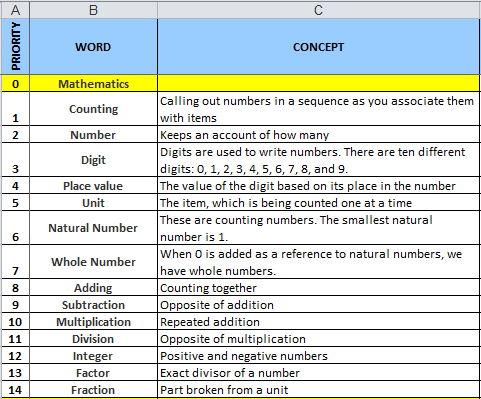
1. Make a list of key words that describe the concepts in that subject.
Skim through the chapter that you are going to study, and make a list of key words that introduce new concepts in that chapter. Put that list on an Excel worksheet, so you can rearrange their order as necessary. You may add key words from previous chapters, or from other books, that you have studied. This list may grow as your studies get deeper into the subject.
2. Write down the broad concept associated with the word.
In a dictionary you may find the broad concept listed under the ‘history’, ‘origin’, or ‘derivation’ of the word. This may appear either before, or after the definitions. For example, when you look up ARITHMETIC, you may find the underlying concept expressed as “skill with numbers.”
Look for broad concept only. Sometimes you may have to piece together the concept from the derivations given. Ignore most other details. Once you have grasped the broad concept note it down next to the word on your Excel worksheet.
3. Locate the definition of the word that fits the context.
Scan through the definitions provided for that word, and locate the one that seems to be most appropriate in the current context. Note down this definition in your Excel worksheet.
It may help to visualize the definition through applications, such as, “Google Image” on the Internet. You may visualize more abstract concepts through personal experiences and through examples provided in dictionaries and books.
Of course, if there are words in the definition that you do not understand then you need to look them up in the same way. You may modify your notes on Excel worksheet as you gain more familiarity with the concept over time through application of mindfulness.
4. Gradually build upon each concept for that subject.
Study the materials of the subject one paragraph at a time. Reduce a paragraph to its main thought before proceeding to the next paragraph.
It is useful to have the study material in an editable document on a computer. Then you can note down your thoughts and comments under each paragraph. If the paragraph is difficult to reduce to its main thought then look for words in that paragraph that may not be clear in that context. If the difficulty with a paragraph still persists then note down the confusion at the bottom of the paragraph. It may get clarified by something you read later.
This may provide you with additional conceptual understanding. If so, then note it down next to the appropriate word on your Excel worksheet.
5. Keep the purpose of study in mind.
Since additional information on a subject may easily be accessed through Internet these days, the purpose of study is not to memorize but to improve one’s critical thinking.
The true purpose of study is to resolve inconsistencies (things that do not make sense) as you come across them in a subject. This develops clarity of mind and the ability to think fast on your feet.
6. Arrange the key words with their concepts in proper sequence.
The concepts in any subject are always connected to each other. There is a sequence in which they evolved. The key words on your Excel worksheet should be separated in a group that expresses fundamental concepts from the group of secondary concepts.
Arrange the fundamental concepts in the sequence they evolved. Then place the secondary concepts in the order that they were derived. Move the words expressing more fundamental concepts toward the top. Move the words expressing derived concepts toward the bottom.
This sequencing may not be totally linear. Connections may be more like that in a multidimensional matrix. The whole idea is to arrange these words so you can easily see the connection among various concepts.
You may create a “Priority column” in the worksheet with numbers assigned to each row in such a way that you can look at the key concepts in various arrangements.
7. Note any inconsistencies among the concepts and clarify them.
As the study of the subject progresses and better understanding comes about, rearrange the list of key words to examine consistency among the various concepts. You are looking for things that appear inconsistent and do not make sense. There may be holes among these concepts that need to be filled.
Deeper research may be required to discover such holes and fill them. First review your materials to clarify any inconsistency. If it does not clarify easily then note it down on the worksheet and research through other materials in the library or on Internet.
8. Clarify the fundamentals of the subject as a priority.
The fundamentals concepts of a subject must be consistent. Any inconsistency at the fundamental level must be handled as a priority. The consistency of the fundamentals determines the consistency of the whole subject.
If an observed inconsistency does not resolve upon proper research of the materials on that subject then test the fundamentals for possible assumptions. Arbitrary assumptions may reveal gaps in the subject itself.
There are likely to be many contributors to a subject. For example, many different cultures have contributed to the broad subject of religious knowledge. You may find similar concepts referred to by different words from different sources. Note down such words and study the differences among their concepts.
Develop your own understanding by seeking consistency among these concepts.
9. Make the subject as complete as possible.
There are many examples in the subject of religion where gaps in knowledge are hidden under assumptions and dubious explanations. This may be the case with any subject where inconsistencies abound.
Underlying such assumptions and dubious explanations is subjectivity coming from a narrow viewpoint. As this viewpoint is recognized and expanded upon greater objectivity and consistency is achieved. The gaps in knowledge become obvious. Real progress becomes possible now.
Fill gaps in the subject with wider research. Make the subject as complete as possible through experimentation and direct experience.
Once you have become comfortable with mindfulness meditation, you may advance to self-guided meditation.
The purpose of self-guided meditation is to resolve doubts and perplexities that commonly occur in one’s life. Meditate on the doubt or perplexity uppermost in your mind by bringing up all data related to it, and letting it associate freely as described in this exercise.
.
Mindfulness Meditation 2: Let the confusion resolve through free association.
Bring up in meditation the doubt or perplexity uppermost in your mind. For example, it could be a doubt regarding marital relationship.
Let yourself be grounded in your body through awareness of breathing; and in your mind through awareness of the order in the universe.
Let the data regarding the doubt and perplexity associate freely as it comes up. Do not avoid, resist, or suppress any thoughts, emotions, feelings, sensations, etc. Let anything suppressed be released.
Do not anxiously dig into the mind for answers, or act out impulsively. Let the mind unwind itself. This process goes deeper than any logic.
Broaden the context as wide as possible. For example, when doubt relates to marital relationship then broaden the context to all marital relationships that you are aware of, such as, those of parents, friends, acquaintances, etc.
Look at basic purpose of the key area of doubt and perplexity. For example, in the case of marital relationship you would look at the purpose of marriage not only in yours, but also in other cultures.
Work out the ideal scene for that area. For example, in the case of marital relationship, look at the actions and condition, which make a marital relationship happy and successful in the broad context.
Place the specific data of your situation in the broad context, and let free association sort it all out.
Repeat the above steps using the 12 aspects of mindfulness until the doubt and perplexity resolve.
Other doubts and perplexities may arise during this process. Apply the same steps as above to resolve them.