Reference: Christianity
[NOTE: In color are Vinaire’s comments.]
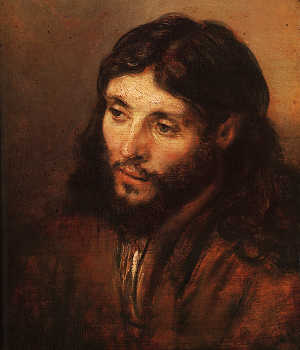
In the end it seemed to those who knew him best that here was a man in whom the human ego had disappeared, leaving his life so completely under the will of God that it was transparent to that will.
How does one move from the Jesus of history, whose life and work have thus far occupied us, to the Christ whom his followers came to believe had been God in human form? His disciples did not reach that conclusion before Jesus’ death, but even in his lifetime we can witness momentum building in its direction. Having tried in the preceding section to describe the facts of Jesus’ life, we turn now to the way he appeared to his disciples. Here we are on firmer ground, for if the Gospels disclose little in the way of historical facts, they are transparent as to his impact on his associates. Our presentation will fall into three parts: what they saw Jesus do, what they heard him say, and what they sensed him to be.
How did the followers of Jesus came to believe that he had been God in human form? What was the impact of Jesus on his associates?
“He Went About Doing Good.” We begin with what Jesus did. The Gospel accounts, written by members of the early Church, vibrate with wonder at his performances. Their pages, especially those of Mark, teem with miracles. We have seen that these impressed multitudes, but it would be a mistake to place our emphasis there. For one thing, Jesus did not emphasize his miracles. He never used them as devices to strong-arm people into believing in him. He was tempted to do so, but in the wilderness soul-searchings that prefaced his ministry he rejected this temptation. Almost all of his extraordinary deeds were performed quietly, apart from the crowds, and as a demonstration of the power of faith. Moreover, other writings of the times abound in miracles, but this didn’t lead witnesses to deify their agents. They merely credited the miracle-workers with unusual powers.
Jesus was a miracle worker but there were others too. But Jesus was different in that he did not emphasize his miracles. Almost all of his extraordinary deeds were performed quietly, apart from the crowds, and as a demonstration of the power of faith.
We get a better perspective on Jesus’ actions if we place the emphasis where one of his disciples did. Once, in addressing a group, Peter found it necessary to compress into short compass what Jesus did during his lifetime. His summary? “He went about doing good” (Acts 10:38). A simple epitaph, but a moving one. Circulating easily and without affectation among ordinary people and social misfits, healing them, counseling them, helping them out of chasms of despair, Jesus went about doing good. He did so with such single-mindedness and effectiveness that those who were with him constantly found their estimate of him modulating to a new key. They found themselves thinking that if divine goodness were to manifest itself in human form, this is how it would behave.
Jesus went about doing good, circulating easily and without affectation among ordinary people and social misfits, healing them, counseling them, helping them out of chasms of despair. He did so with such single-mindedness and effectiveness.
“Never Spoke Man Thus.” It was not only what Jesus did, however, that made his contemporaries think of him in new dimensions. It was also what he said. There has been a great deal of controversy over the originality of Jesus’ teachings. Possibly the most balanced view is that of the great Jewish scholar Joseph Klausner. If you take the teachings of Jesus separately, he wrote, you can find every one of them paralleled in either the Old Testament or its commentary, the Talmud. But if you take them as a whole, they have an urgency, an ardent, vivid quality, an abandon, and above all a complete absence of second-rate material that makes them refreshingly new.
What Jesus said can be found in earlier writings in form or other. But if you take them as a whole, they have an urgency, an ardent, vivid quality, an abandon, and above all a complete absence of second-rate material that makes them refreshingly new.
The language of Jesus has proved to be a fascinating study in itself, quite apart from its content. If simplicity, concentration, and the sense of what is vital are marks of great religious literature, these qualities alone would make Jesus’ words immortal. But this is just the beginning. They carry an extravagance of which wise men, tuned to the importance of balanced judgment, are incapable. Their passionate quality has led one poet to coin a special word for Jesus’ language, calling it “gigantesque.” If your hand offends you, cut if off. If your eye stands between you and the best, gouge it out. Jesus talks of camels that hump through needles’ eyes, of people who fastidiously strain gnats from their drinks while oblivious of the camels that caravan down their gullets. His characters go around with timbers protruding from their eyes, looking for tiny specks in the eyes of others. He talks of people whose outer lives are stately mausoleums while their inner lives stink of decaying corpses. This is not language tooled for rhetorical effect. The language is part of the message itself, prompted by its driving urgency.
The language of Jesus has a passionate quality which is extraordinary in its driving urgency.
A second arresting feature of Jesus’ language was its invitational style. Instead of telling people what to do or what to believe, he invited them to see things differently, confident that if they did so their behavior would change accordingly. This called for working with peoples’ imaginations more than with their reason or their will. If listeners were to accept his invitation, the place to which they were being invited would have to seem real to them. So, because the reality his hearers were most familiar with consisted of concrete particulars, Jesus began with those particulars. He spoke of mustard seeds and rocky soil, of servants and masters, of weddings and of wine. These specifics gave his teachings an opening ring of reality; he was speaking of things that were very much a part of his hearers’ worlds. But having gotten them that far, having roused in them a momentum of assent, Jesus would then ride that momentum while giving its trajectory a startling, subversive twist. That phrase, “momentum of assent,” is important, for its deepest meaning is that Jesus located the authority for his teachings not in himself or in God-as-removed but in his hearers’ hearts. My teachings are true, he said in effect, not because they come from me, or even from God through me, but because (against all conventionality) your own hearts attest to their truth.
Instead of telling people what to do or what to believe, Jesus invited them to see things differently. He worked with peoples’ imaginations more than with their reason or their will. He spoke of things that were very much a part of his hearers’ worlds and their own truth.
So what did Jesus use his invitational, gigantesque language to say? Quantitatively, not a great deal, as far as the records report; everything that the New Testament records can be spoken in two hours. Yet his teachings may be the most repeated in history. “Love your neighbor as yourself.” “Whatsoever you would that men should do unto you, do you also unto them.” “Come unto me, all you that labor and are heavy laden, and I will give you rest.” “You shall know the truth, and the truth shall make you free.” Most of the time, however, he told stories that we call parables: of buried treasure, of sowers who went out to sow, of pearl merchants, of a good Samaritan, of a young man who blew his inheritance on a binge and found himself cadging scraps from the pigs, of a man who had two sons. The world knows them well. People who heard these stories were moved to exclaim, “This man speaks with authority…. Never spoke man thus!”
Jesus didn’t say much, yet his teachings may be the most repeated in history. Most of the time he told stories that we call parables. People who heard these stories were moved at their authenticity.
They were astonished, and with reason. If we are not it is because we have heard Jesus’ teachings so often that their edges have been worn smooth, dulling their subversiveness. If we could recover their original impact, we too would be startled. Their beauty would not cover the fact that they are “hard sayings” for presenting a scheme of values so counter to the usual as to rock us like an earthquake.
His sayings had an edge of subversiveness. They presented a scheme of values so counter to the usual as to rock the hearers like an earthquake.
We are told that we are not to resist evil but to turn the other cheek. The world assumes that evil must be resisted by every means available. We are told to love our enemies and bless those who curse us. The world assumes that friends are to be loved and enemies hated. We are told that the sun rises on the just and the unjust alike. The world considers this undiscriminating; it would like to see clouds over evil people and is offended when they go unpunished. We are told that outcasts and harlots enter the kingdom of God before many who are perfunctorily righteous. Again unfair, the world thinks; respectable people should head the procession. We are told that the gate to salvation is narrow. The world would prefer it to be broad. We are told to be as carefree as birds and flowers. The world counsels prudence. We are told that it is more difficult for the rich to enter the Kingdom than for a camel to pass through a needle’s eye. The world admires wealth. We are told that the happy people are those who are meek, who weep, who are merciful and pure in heart. The world assumes that it is the rich, the powerful, and the wellborn who are happy. The great Russian philosopher Nikolai Berdyaev said that a wind of freedom blows through these teachings that frightens the world and makes us want to deflect them by postponement—not yet, not yet! H. G. Wells was evidently right: Either there was something mad about this man, or our hearts are still too small for his message.
A wind of freedom blows through these teachings that frightens the world and makes us want to deflect them by postponement. Either there was something mad about this man, or our hearts are still too small for his message.
Again we must come back to what those teachings were about. Everything that came from his lips formed the surface of a burning glass to focus human awareness on the two most important facts about life: God’s overwhelming love of humanity, and the need for people to accept that love and let it flow through them to others. In experiencing God as infinite love bent on peoples’ salvation, Jesus was an authentic child of Judaism; he differed, we have seen, only in not allowing the post-Exilic holiness code to impede God’s compassion. Time after time, as in his story of the shepherd who risked ninety-nine sheep to go after the one that had strayed, Jesus tried to convey God’s absolute love for every single human being. To perceive this love and to let it penetrate one’s very marrow was to respond in the only way that was possible—in profound and total gratitude for the wonders of God’s grace.
Jesus emphasized God’s overwhelming love of humanity, and the need for people to accept that love and let it flow through them to others. He did not allow the post-Exilic holiness code to impede God’s compassion.
The only way to make sense of Jesus’ extraordinary admonitions as to how people should live is to see them as cut from this understanding of the God who loves human beings absolutely, without pausing to calculate their worth or due. We are to give others our cloak as well as our coat if they need it. Why? Because God has given us what we need. We are to go with others the second mile. Why again? Because we know, deeply, overwhelmingly, that God has borne with us for far longer stretches. Why should we love not only our friends but our enemies, and pray for those who persecute us? “So that you may be children of your Father in heaven; for he makes his sun rise on the evil and on the good, and sends rain on the righteous and the unrighteous…. Be perfect, therefore, as your heavenly Father is perfect” (Matthew 5:45, 48). We say his ethic is perfectionistic—a polite word for unrealistic—because it asks that we love unreservedly. But the reason we consider that unrealistic, Jesus would have answered, is because we do not experience the constant, unstinted love that flows from God to us. If we did experience it, problems would still arise. To which of the innumerable needy should limited supplies of coats and cloaks be given? If the target of evil is someone other than myself, should I still not resist it? Jesus offered no rule book to obviate hard choices. What he argued was the stance from which they should be approached. All we can say in advance, as we face the demands of a tangled world, is that we should respond to our neighbors—all of them insofar as we can foresee the consequences of our acts—not in proportion to what we judge to be their due, but in proportion to their need. The cost to us personally should count for nothing.
We are to give others our cloak as well as our coat if they need it. Why? Because God has given us what we need. Jesus offered no rule book to obviate hard choices. What he argued was the stance from which they should be approached. The cost to us personally should count for nothing.
We have spoken of what Jesus did and what he said. But these alone would not have been enough to edge his disciples toward the conclusion that he was divine had it not been for a third factor: what he was.
“We Have Seen His Glory.” “There is in the world,” writes Dostoevsky, “only one figure of absolute beauty: Christ. That infinitely lovely figure is…an infinite marvel.”
Certainly, the most impressive thing about the teachings of Jesus is not that he taught them but that he appears to have lived them. From the accounts that we have, his entire life was one of humility, self-giving, and love that sought not its own. The supreme evidence of his humility is that it is impossible to discover precisely what Jesus thought of himself. His concern was what people thought of God—God’s nature and God’s will for their lives. True, by indirection this tells us something about Jesus’ own self-image, but it is the obvious, that he esteemed himself to be less than God. “Why do you call me good? Don’t you know that only God is good?” It is impossible to read what Jesus said about selflessness without sensing how free of pride he was himself. Similarly with sincerity. What he said on the subject could only have been said by someone whose life was uncluttered by deceit. Truth was like the air to him.
Jesus appears to have lived what he taught. His entire life was one of humility, self-giving, and love that sought not its own. His life was uncluttered by deceit. Truth was like the air to him.
Through the pages of the Gospels Jesus emerges as a man of strength and integrity who bore about him, as someone has said, no strangeness at all save the strangeness of perfection. He liked people and they liked him in turn. They loved him; they loved him intensely and they loved him in numbers. Drawn to him not only for his charismatic powers but for the compassion they sensed in him as well, they surrounded him, flocked about him, followed him. He stands by the Sea of Galilee and they press so hard that he has to speak to them from a boat. He sets out for the day and a crowd of several thousand accumulates, missing their lunch, staying on until suddenly they discover that they are famished. People responded to Jesus, but equally he responded to them. He felt their appeal, whether they were rich or poor, young or old, saints or sinners. We have seen that he ignored the barriers that mores erected between people. He loved children. He hated injustice because of what it did to those he called, tenderly, “the least of these” (Matthew 25:40). Above all he hated hypocrisy, because it hid people from themselves and precluded the authenticity he sought to build into relationships. In the end it seemed to those who knew him best that here was a man in whom the human ego had disappeared, leaving his life so completely under the will of God that it was transparent to that will. It came to the point where they felt that as they looked at Jesus they were looking at something resembling God in human form.
In the end it seemed to those who knew him best that here was a man in whom the human ego had disappeared, leaving his life so completely under the will of God that it was transparent to that will.
This is what lies behind the lyric cry of the early Church: “We have seen his glory,…full of grace and truth” (John 1:14). Centuries later, Shakespeare put it this way:
Some say that ever ’gainst that season comes
Wherein our Savior’s birth is celebrated,
The bird of dawning singeth all night long;
And then, they say, no spirit can walk abroad;
The nights are wholesome; then no planets strike,
No fairy tales, nor witch hath power to charm,
So hallow’d and so gracious is the time.
It came to the point where people felt that as they looked at Jesus they were looking at something resembling God in human form.
.