Faraday’s Intuition on Substance

Scientists today have the same difficulty with reality that Maxwell had. But Faraday, the greatest experimental scientist of the century, had his feet firmly planted in reality

Scientists today seem to discount the broad concept of substance as in the following post.

Energy Is Not A Substance And How To Easily Understand This

Here are my responses to this article:

Sascha, if you are saying that energy is not a material substance then you are right; but if you say energy is not a substance than you have the concept of substance very narrowly defined. Light is “something.” It is not made of material substance, but it is made of energy substance because it has momentum that can be sensed and measured.

Kinetic energy cannot exist by itself. Something must be in motion for kinetic energy to exist. When there is nothing, then there is no motion and no kinetic energy. So, there is substance underlying kinetic energy, which is not always material substance. The concept of substance from its derivation is “that which stands under.”

In your cart example, what flowed from the body to the carts was force. Force was recognized by Faraday as the most basic substance. Einstein loved Faraday. Faraday was the greatest experimental scientist of his time. He was very much in touch with reality unlike the mathematical scientists of today. You may want to study the following from Faraday.

Faraday: Electrical Conduction & Nature of Matter
Faraday: On the Conservation of Force
Faraday: Thoughts on Ray Vibrations

It was the concept of force as SUBSTANCE that Maxwell disagreed with Faraday on. Faraday was not a mathematician like Maxwell. Maxwell did discover wonderful relationships by applying mathematics to Faraday’s concept of field; but Faraday’s intuition of field being a substance was right. Maxwell missed that. See

Faraday & Maxwell

To understand whether energy is a substance or not, one needs to define the word SUBSTANCE first.

SUBSTANCE
Origin: “That which stands under.” A thing is made of substance. The substance is a spectrum that extends from tangible matter to intangible light to ephemeral thought. This whole spectrum of substance is substantial enough to be sensed one way or another. The substance may be divided broadly as material substance, energy substance and thought substance.

I think that most people limit the definition of substance to material substance only. This is just a narrow viewpoint.

MATERIAL SUBSTANCE
The material substance comes in the forms of solids, liquids and gases. All of these forms of material substance can be reduced to discrete particles. These discrete material particles have a solid form and a center of mass. The ultimate material particles are protons and neutrons.

The general characteristics of substance is that it can be sensed and measured.

ENERGY SUBSTANCE
The energy substance is that which fills the atom beyond its nucleus. It is real. It is much more than just mathematical symbolism. Einstein demonstrated the existence of atoms in his 1905 paper.

Thanks for letting me express my broader viewpoint.

.
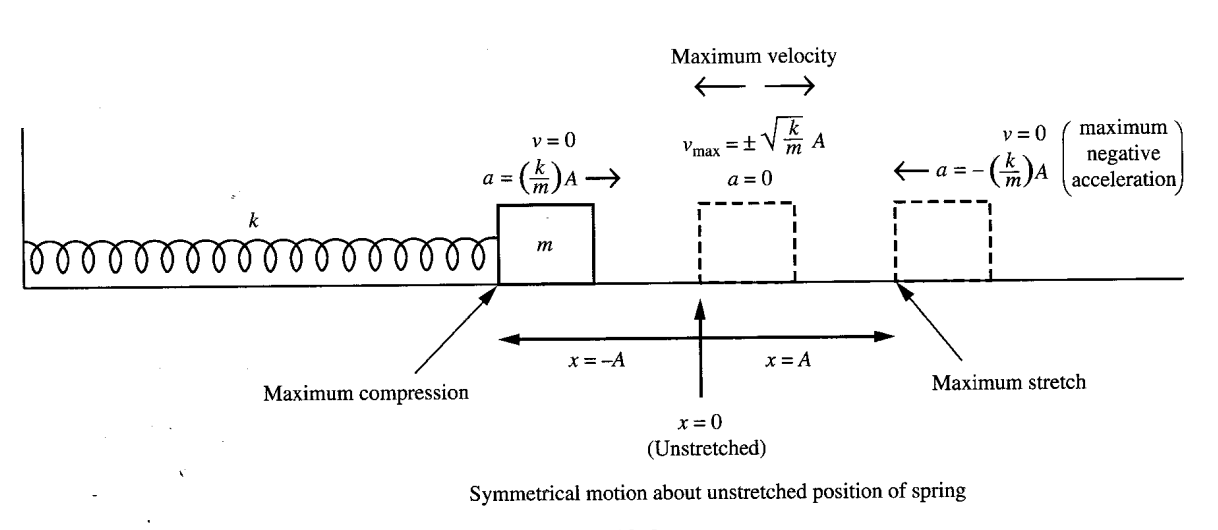
Physics I: Chapter 12

Reference: Beginning Physics I

CHAPTER 12: SIMPLE HARMONIC MOTION (SHM)

.

KEY WORD LIST

Simple Harmonic Motion, Periodic Motion, Period, Frequency, Reference Circle, Time Interval, SHM Time Equations, Spring Motion, Torsional Motion, Simple Pendulum

.

GLOSSARY

For details on the following concepts, please consult CHAPTER 12.

SIMPLE HARMONIC MOTION (SHM)
It is the back-and-forth type vibratory motion of an object that is subjected to Hooke’s Law type force, which is a restoring force that is proportional to the displacement from the equilibrium position (F = -kx). Since the force is varying, the acceleration of the object, and its velocity is also varying.

The uniformity of circular motion and rotation does not occur in SHM.

PERIODIC MOTION
Periodic motion is motion repeated in equal intervals of time.

PERIOD (T)
The period (T) is defined as the time to make one complete repetition of the motion. Thus, T is the time interval from when the object traverses any position x moving in a given direction to the next time the object traverses position x moving in the same direction.

FREQUENCY (f)
The frequency f of the periodic motion is the number of repetitions per second. It is the reciprocal of the period: f = 1/T.

REFERENCE CIRCLE
Consider a particle undergoing uniform circular motion on a circle about the origin of a coordinate system.

As the particle moves around the circle, its shadow moves back and forth along the x-axis. Finding the time equations for the shadow’s motion is equivalent to finding the time equations for SHM. For this reason, this circle is called the reference circle for SHM.

TIME INTERVAL

SHM TIME EQUATIONS

In general,

SPRING MOTION

TORSIONAL MOTION

SIMPLE PENDULUM

.

The Matrix Approach (old)

Reference: Course on Subject Clearing

A matrix is a system of infinite number of elements, with each element capable of being a matrix in its own right.

This system is simple, yet it allows enough complexity to describe the Universe. Such complexity is necessary to address the anomalies existing in our view of the universe.

An anomaly is a variance between the way something appears and the ONENESS that should be there.

The anomaly is hidden under unreal beliefs and strange rituals. A doubt, uncertainty, confusion, contradiction, dissonance, conflict, etc., all point to some anomaly. Resolution of anomalies leads back to a natural equilibrium.

.

Resolving Anomalies

To resolve the anomalies in an area, one must identify them precisely. To do so one first examines the postulates existing in that area. 

A postulate is a self-created truth based on which further reasoning is done. The postulates reconstruct the universe in our awareness. We experience a rock being solid. So we postulate the concept of solidity based on that experience. We then apply that concept to other things.

The objects of the universe are perceived based on our fundamental experience and postulates. Any anomaly exists only among the postulates that we have formed based on our experience. The postulates are found in the concepts supporting a subject. These concepts are expressed through Key words.

So, the first step of the matrix approach to resolve anomalies is to make a list of the key words in the area of interest. This list may consist of just three words or as many as fifteen to twenty words. 

One then defines these words until all definitions are consistent with each other. The definitions are placed in a glossary for that area.

The words are then arranged in a sequence in which their definitions make the most sense. This is called the Key words list.

The definitions are continually refined throughout this process to make them increasingly consistent with each other.

As one continues with the above process the anomalies start to appear.

One then resolves the anomalies one by one, by closely examining the relationships among the key words and their definitions. This may require research, contemplation and even meditation.

It is likely that one may discover gaps among the definitions. So, one finds appropriate key words and their definitions to fill such gaps.

As the anomalies get resolved the complex situation starts to clear up.

The process follows a natural gradient such that there is no overwhelm at any point.

.

The Ultimate Background

The ultimate background is uniformly consistent on a universal scale.

(1) It is connected at all points. There are no discontinuities in it.

(2) It is consistent throughout. There are no contradictions.

(3) It is harmonious. There are smooth gradients at all points.

All theories that are consistent are part of this background. Such theories are also consistent with each other.

Anything that stands out against this background is then immediately recognized as an anomaly. An anomaly is any violation of the integrity of reality, such as, discontinuity (missing data), inconsistency (contradictory data), or disharmony (arbitrary data).

Once recognized, the anomaly may be resolved by making it consistent with the background,

The lesser are the anomalies in one’s thinking, the sharper is the power of observation of that person; and the more he can be counted upon to solve problems.

.

The Unknowable and “I”

Reference: Course on Subject Clearing

The starting postulate of the Matrix Model to grasp the Unknowable is:

THE UNIVERSE IS ONE.

Actually, the universe, by its very definition, is ONE. The dictionary defines the origin of the universe as follows:

1325–75; Middle English < Old French univers < Latin ūniversum, noun use of neuter of ūniversus entire, all, literally, turned into one, equivalent to ūni- one + versus (past participle of vertere to turn)

From this starting postulate arise other postulates. For example, this universe is knowable because it is manifested. That which is not manifested is unknowable. All that is knowable is connected with each other. Wherever we notice discontinuity, inconsistency or disharmony, there is an anomaly. When there is an anomaly, something is missing from our knowledge and understanding; and so on.

Thus, from the starting postulate, there comes about a system of postulates. These postulates may be arranged in a matrix. Each postulate may be seen as an element of this matrix.

This procedure repeats itself with each postulate in this matrix. In other words, each postulate in this matrix may generate its own system of postulates, which may, in turn, be arranged in a sub-matrix. This recursive process may continue this way to an infinite number of levels of sub-matrices, until this system of postulates is able to describe the whole universe in a consistent fashion.

Does thus recursion go in the other direction as well, meaning, is the starting postulate itself is an element of a larger matrix? This is quite possible. It shall lead us into a path of tremendous discoveries.

For now, we may look at the universe as consisting of an infinity of elements, and all these elements relate with each other to make a consistent whole.

This is the matrix model in a nutshell.

.

The Being or “I”

The Being or “I” is a system of postulates that may be conceived as a matrix. This system of postulates may contain some degree of inconsistency. The aim of “I” is to make itself “complete.” In other words, the aim of “I” is to remove all inconsistencies from its system.

That is what my aim as a being or “I” is. I am a system of postulates that may be conceived as a matrix. My aim is to spot and resolve all inconsistencies in myself. At that point I shall be able to merge smoothly into the universal system of postulates, or matrix.

.

Vertical and Horizontal Asymptotes

HOLES

  1. Factor both the numerator N(x) and the denominator D(x).
  2. Cancel any common factors and simplify the function.
  3. Equate the canceled factor to zero. This will give you the x-value of the hole.
  4. Plug this x-value in the simplified function to find the y-value of the hole.
  5. Plot that hole (or holes) on the graph.

VERTICAL ASYMPTOTES

  1. Plot the remaining zeros of D(x) on the x-axis. Draw vertical dotted lines through them. These are the locations for the vertical asymptotes.
  2. Find the sign of f(x), just before and after the dotted line. This you can do by finding the signs of the factors in the simplified function and resolving them. This will tell you if the graph is going asymptotic upwards or downwards near the dotted vertical line.
  3. Find remaining zeros of N(x) on the x-axis. These are points where the graph crosses the x-axis.

HORIZONTAL ASYMPTOTES

  1. Horizontal asymptotes occurs at either end of the graph as x goes to plus or minus infinity.
  2. For n < m, the horizontal asymptote is y = 0 (the x-axis).
  3. For n = m, the horizontal asymptote is y = an / bm
  4. For n = m+1, the asymptote is a slanted line, y = kx, found by dividing N(x) by D(x).
  5. For n > m+1, there are no asymptotes;
    when n – m is even, both ends of the graph rise up
    when n – m is odd, the left end goes down while the right end rises up.

From the above data you can sketch a rough approximation of the shape of the graph.

.