The Matrix Approach (old)

Reference: Course on Subject Clearing

A matrix is a system of infinite number of elements, with each element capable of being a matrix in its own right.

This system is simple, yet it allows enough complexity to describe the Universe. Such complexity is necessary to address the anomalies existing in our view of the universe.

An anomaly is a variance between the way something appears and the ONENESS that should be there.

The anomaly is hidden under unreal beliefs and strange rituals. A doubt, uncertainty, confusion, contradiction, dissonance, conflict, etc., all point to some anomaly. Resolution of anomalies leads back to a natural equilibrium.

.

Resolving Anomalies

To resolve the anomalies in an area, one must identify them precisely. To do so one first examines the postulates existing in that area. 

A postulate is a self-created truth based on which further reasoning is done. The postulates reconstruct the universe in our awareness. We experience a rock being solid. So we postulate the concept of solidity based on that experience. We then apply that concept to other things.

The objects of the universe are perceived based on our fundamental experience and postulates. Any anomaly exists only among the postulates that we have formed based on our experience. The postulates are found in the concepts supporting a subject. These concepts are expressed through Key words.

So, the first step of the matrix approach to resolve anomalies is to make a list of the key words in the area of interest. This list may consist of just three words or as many as fifteen to twenty words. 

One then defines these words until all definitions are consistent with each other. The definitions are placed in a glossary for that area.

The words are then arranged in a sequence in which their definitions make the most sense. This is called the Key words list.

The definitions are continually refined throughout this process to make them increasingly consistent with each other.

As one continues with the above process the anomalies start to appear.

One then resolves the anomalies one by one, by closely examining the relationships among the key words and their definitions. This may require research, contemplation and even meditation.

It is likely that one may discover gaps among the definitions. So, one finds appropriate key words and their definitions to fill such gaps.

As the anomalies get resolved the complex situation starts to clear up.

The process follows a natural gradient such that there is no overwhelm at any point.

.

The Ultimate Background

The ultimate background is uniformly consistent on a universal scale.

(1) It is connected at all points. There are no discontinuities in it.

(2) It is consistent throughout. There are no contradictions.

(3) It is harmonious. There are smooth gradients at all points.

All theories that are consistent are part of this background. Such theories are also consistent with each other.

Anything that stands out against this background is then immediately recognized as an anomaly. An anomaly is any violation of the integrity of reality, such as, discontinuity (missing data), inconsistency (contradictory data), or disharmony (arbitrary data).

Once recognized, the anomaly may be resolved by making it consistent with the background,

The lesser are the anomalies in one’s thinking, the sharper is the power of observation of that person; and the more he can be counted upon to solve problems.

.

The Unknowable and “I”

Reference: Course on Subject Clearing

The starting postulate of the Matrix Model to grasp the Unknowable is:

THE UNIVERSE IS ONE.

Actually, the universe, by its very definition, is ONE. The dictionary defines the origin of the universe as follows:

1325–75; Middle English < Old French univers < Latin ūniversum, noun use of neuter of ūniversus entire, all, literally, turned into one, equivalent to ūni- one + versus (past participle of vertere to turn)

From this starting postulate arise other postulates. For example, this universe is knowable because it is manifested. That which is not manifested is unknowable. All that is knowable is connected with each other. Wherever we notice discontinuity, inconsistency or disharmony, there is an anomaly. When there is an anomaly, something is missing from our knowledge and understanding; and so on.

Thus, from the starting postulate, there comes about a system of postulates. These postulates may be arranged in a matrix. Each postulate may be seen as an element of this matrix.

This procedure repeats itself with each postulate in this matrix. In other words, each postulate in this matrix may generate its own system of postulates, which may, in turn, be arranged in a sub-matrix. This recursive process may continue this way to an infinite number of levels of sub-matrices, until this system of postulates is able to describe the whole universe in a consistent fashion.

Does thus recursion go in the other direction as well, meaning, is the starting postulate itself is an element of a larger matrix? This is quite possible. It shall lead us into a path of tremendous discoveries.

For now, we may look at the universe as consisting of an infinity of elements, and all these elements relate with each other to make a consistent whole.

This is the matrix model in a nutshell.

.

The Being or “I”

The Being or “I” is a system of postulates that may be conceived as a matrix. This system of postulates may contain some degree of inconsistency. The aim of “I” is to make itself “complete.” In other words, the aim of “I” is to remove all inconsistencies from its system.

That is what my aim as a being or “I” is. I am a system of postulates that may be conceived as a matrix. My aim is to spot and resolve all inconsistencies in myself. At that point I shall be able to merge smoothly into the universal system of postulates, or matrix.

.

Vertical and Horizontal Asymptotes

HOLES

  1. Factor both the numerator N(x) and the denominator D(x).
  2. Cancel any common factors and simplify the function.
  3. Equate the canceled factor to zero. This will give you the x-value of the hole.
  4. Plug this x-value in the simplified function to find the y-value of the hole.
  5. Plot that hole (or holes) on the graph.

VERTICAL ASYMPTOTES

  1. Plot the remaining zeros of D(x) on the x-axis. Draw vertical dotted lines through them. These are the locations for the vertical asymptotes.
  2. Find the sign of f(x), just before and after the dotted line. This you can do by finding the signs of the factors in the simplified function and resolving them. This will tell you if the graph is going asymptotic upwards or downwards near the dotted vertical line.
  3. Find remaining zeros of N(x) on the x-axis. These are points where the graph crosses the x-axis.

HORIZONTAL ASYMPTOTES

  1. Horizontal asymptotes occurs at either end of the graph as x goes to plus or minus infinity.
  2. For n < m, the horizontal asymptote is y = 0 (the x-axis).
  3. For n = m, the horizontal asymptote is y = an / bm
  4. For n = m+1, the asymptote is a slanted line, y = kx, found by dividing N(x) by D(x).
  5. For n > m+1, there are no asymptotes;
    when n – m is even, both ends of the graph rise up
    when n – m is odd, the left end goes down while the right end rises up.

From the above data you can sketch a rough approximation of the shape of the graph.

.

Matching Polynomials with Graphs

  1. The constant term of the polynomial shows the y-intercept of the graph.
  2. Look at the highest degree of the polynomial. The corresponding graph will have one less bend. For example, if the degree of the polynomial is 3, the corresponding graph shall have two bends.
  3. If all the zeros of the polynomial are real, then the corresponding graph will cross the x-axis as many times as the degree of the polynomial. For example, if the degree of the polynomial is 3, the corresponding graph shall cross the x-axis 3 times.
  4. If the zeros of the polynomial are visible because the polynomial is factored; then, match the zeros to the values where the graph crosses the x-axis.
  5. When two of the zeros are the same; then, the corresponding bend will simply touch the x-axis at that value.
  6. When two of the zeros are imaginary; then, the corresponding bend will not cross or even touch the x-axis.
  7. When all the zeros are real, the constant term of the polynomial shall be the product of the zeros.
  8. When there are two graphs matching the polynomial, take the root that is not common in both the graphs, and plug it in the polynomial. You will know if that zero belongs to the polynomial or not.

.

Physics I: Chapter 11

Reference: Beginning Physics I

CHAPTER 11: DEFORMATION OF MATERIALS & ELASTICITY

.

KEY WORD LIST

Stress, Strain, Elastic, Elastic Limit, Hooke’s Law, Young’s Modulus, Ultimate Strength, Force Constant, Shear Deformation, Twisting Deformation, Pressure, Bulk Modulus, Compressibility

.

GLOSSARY

For details on the following concepts, please consult CHAPTER 11.

STRESS
Force needed for certain stretch is proportional to the cross-sectional area of the rod. If we define stress as the ratio of the force to the cross-sectional area, we have a quantity that measures the effectiveness of the force in accomplishing a given stretch, independent of the cross-sectional area of the rod. The dimensions of the stress are force per area (pascal = 1 N/m2). A given stress will give rise to a definite strain in a rod of a certain material irrespective of either the thickness or the length of the rod.

STRAIN
A given force will cause a stretch that is proportional to the length of the unstretched rod. We define strain as the ratio of the change in the length of the rod to the unstretched length of the rod. The strain due to a given force will be the same for any length of rod of the same material and cross-section. The strain is thus a measure of the stretch of the rod that is independent of the length of the rod. The strain is dimensionless.

ELASTIC
Any material that returns to its original shape after the distorting forces are removed is said to be elastic.

ELASTIC LIMIT
For a rod of any given material there is a stress beyond which the material will no longer return to its original length. This boundary stress is called the elastic limit.

HOOKE’S LAW
For stresses below the elastic limit it is found that, to a good approximation, the strain is proportional to the stress; for example, if we double the stress, the strain would double. This is called the Hooke’s Law.

YOUNG’S MODULUS
In the elastic region stress/strain = constant.  The constant is called the Young’s modulus (Y). Its value depends on the material. Young’s modulus has dimensions of stress, and can be measured in pascals.

If a force tends to compress a rod rather than stretch it, the relationship of stress to strain still holds with the same Young’s modulus. In that case, the change in length represents a compression rather than stretch.

ULTIMATE STRENGTH
If one applies stress to a rod beyond the elastic limit, the rod will retain some permanent strain when the stress is removed. If the stress gets too great, the rod will break. The stress necessary to just reach the breaking point is called the ultimate strength of the material.

FORCE CONSTANT
For a rod of definite cross section (A) and length (L), the applied force (F) is proportional to the elongation ( L), and can therefore be expressed as F = kx, where k is the force constant of the system.

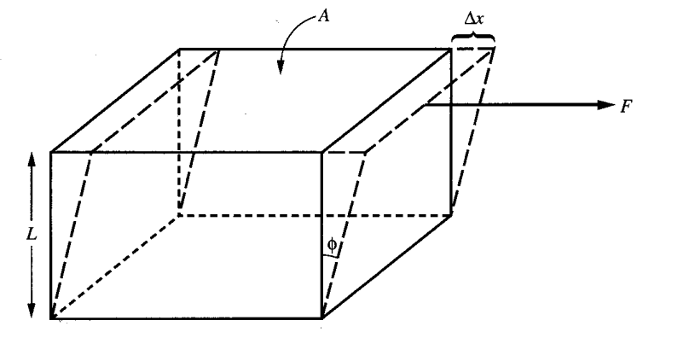
SHEAR DEFORMATION

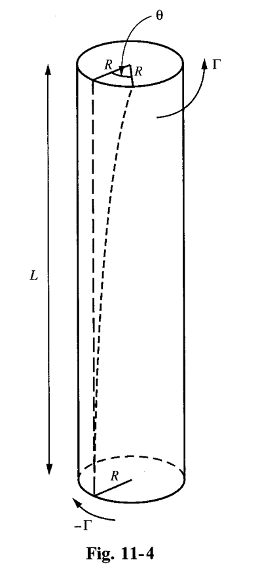
TWISTING DEFORMATION

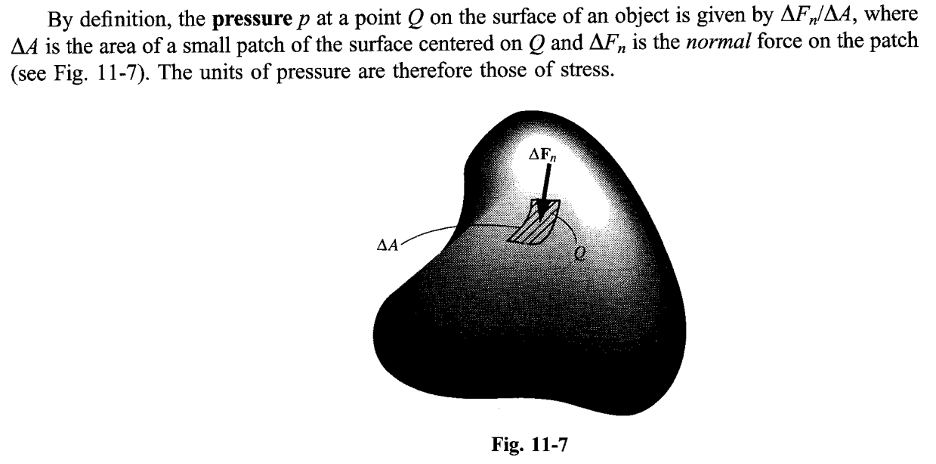
PRESSURE

BULK MODULUS

COMPRESSIBILITY

.