HINDUISM: The Stations of Life

Reference: Hinduism

Note: The original Text is provided below.
Previous / Next

People are different. The point of caste is the natural differences in dispositions that put people into classes as seers, administrators, producers, and followers. Insofar as caste has come to mean rigidity, exclusiveness, and undeserved privilege, Hindus today are working to clear the corruption from their polity.

.

Summary

.

Comments

.

Original Text

People are different—we are back a third time to this cardinal Hindu tenet. We have traced its import for the different paths people should follow toward God, and the different patterns of life appropriate at various stages in the human career. We come now to its implications for the station the individual should occupy in the social order.

This brings us to the Hindu concept of caste. On no other score is Hinduism better known or more roundly denounced by the outside world. Caste contains both point and perversion. Everything in the discussion of this subject depends on our ability to distinguish between the two.

How caste arose is one of the confused topics of history. Central, certainly, was the fact that during the second millennium B.C. a host of Aryans possessing a different language, culture, and physiognomy (tall, fair-skinned, blue-eyed, straight-haired) migrated into India. The clash of differences that followed burgeoned the caste system, if it did not actually create it. The extent to which ethnic differences, color, trade guilds harboring professional secrets, sanitation restrictions between groups with different immunity systems, and magico-religious taboos concerning pollution and purification contributed to the pattern that emerged may never be fully unraveled. In any event the outcome was a society that was divided into four groups: seers, administrators, producers, and followers.

Let us record at once the perversions that entered in time, however they originated. To begin with, a fifth group—of outcastes or untouchables—appeared. Even in speaking of this category there are mitigating points to be remembered. In dealing with her lowest social group, India did not sink to slavery as have most civilizations; outcastes who in their fourth stage of life renounced the world for God were regarded as outside social classifications and were revered, even by the highest caste, the brahmins; from Buddha through Dayananda to Gandhi, many religious reformers sought to remove untouchability from the caste system; and contemporary India’s constitution outlaws the institution. Still, the outcaste’s lot through India’s history has been a wretched one and must be regarded as the basic perversion the caste system succumbed to. A second deterioration lay in the proliferation of castes into subcastes, of which there are today over three thousand. Third, proscriptions against intermarriage and inter-dining came to complicate social intercourse enormously. Fourth, privileges entered the system, with higher castes benefiting at the expense of the lower. Finally, caste became hereditary. One remained in the caste into which one was born.

With these heavy counts against it, it may come as a surprise to find that there are contemporary Indians, thoroughly familiar with Western alternatives, who defend caste—not, to be sure, in its entirety, especially what it has become, but in its basic format. What lasting values could such a system possibly contain?

What is called for here is recognition that with respect to the ways they can best contribute to society and develop their own potentialities, people fall into four groups. (1) The first group India called brahmins or seers. Reflective, with a passion to understand and a keen intuitive grasp of the values that matter most in human life, these are civilization’s intellectual and spiritual leaders. Into their province fall the functions our more specialized society has distributed among philosophers, artists, religious leaders, and teachers; things of the mind and spirit are their raw materials. (2) The second group, the kshatriyas, are born administrators, with a genius for orchestrating people and projects in ways that makes the most of available human talents. (3) Others find their vocation as producers; they are artisans and farmers, skillful in creating the material things on which life depends. These are the vaishyas. (4) Finally, shudras, can be characterized as followers or servants. Unskilled laborers would be another name for them. These are people who, if they had to carve out a career for themselves, commit themselves to long periods of training, or go into business for themselves, would founder. Their attention spans are relatively short, which makes them unwilling to sacrifice a great deal in the way of present gains for the sake of future rewards. Under supervision, however, they are capable of hard work and devoted service. Such people are better off, and actually happier, working for others than being on their own. We, with our democratic and egalitarian sentiments, do not like to admit that there are such people, to which the orthodox Hindu replies: What you would like is not the point. The question is what people actually are.

Few contemporary Hindus defend the lengths to which India eventually went in keeping the castes distinct. Her proscriptions regulating intermarriage, inter-dining, and other forms of social contact made her, in her first prime minister’s wry assessment, “the least tolerant nation in social forms while the most tolerant in the realm of ideas.” Yet even here a certain point lies behind the accursed proliferations. That proscriptions against different castes drinking from the same source were especially firm suggests that differences in immunity to diseases may have played a part. The presiding reasons, however, were broader than this. Unless unequals are separated in some fashion, the weak must compete against the strong across the board and will stand no chance of winning anywhere. Between castes there was no equality, but within each caste the individual’s rights were safer than if he or she had been forced to fend alone in the world at large. Each caste was self-governing, and in trouble one could be sure of being tried by one’s peers. Within each caste there was equality, opportunity, and social insurance.

Inequalities between the castes themselves aimed for due compensation for services rendered. The well-being of society requires that some people assume, at the cost of considerable self-sacrifice, responsibilities far beyond average. While most young people will plunge early into marriage and employment, some must postpone those satisfactions for as much as a decade to prepare themselves for demanding vocations. The wage earner who checks out at five o’clock is through for the day; the employer must take home the ever-present insecurities of the entrepreneur, and often homework as well. The question is partly whether employers would be willing to shoulder their responsibilities without added compensation, but also whether it would be just to ask them to do so. India never confused democracy with egalitarianism. Justice was defined as a state in which privileges were proportionate to responsibilities. In salary and social power, therefore, the second caste, the administrators, rightly stood supreme; in honor and psychological power, the brahmins. But only (according to the ideal) because their responsibilities were proportionately greater. In precise reverse of the European doctrine that the king could do no wrong, the orthodox Hindu view came very near to holding that the shudras, the lowest caste, could do no wrong, its members being regarded as children from whom not much should be expected. Classical legal doctrine stipulated that for the same offense “the punishment of the Vaishya [producer] should be twice as heavy as that of the shudra, that of the kshatriya [administrator] twice as heavy again, and that of the brahmin twice or even four times as heavy again.” In India the lowest caste was exempt from many of the forms of probity and self-denial that the upper castes were held to. Its widows might remarry, and proscription against meat and alcohol were less exacting.

Stated in modern idiom, the ideal of caste emerges something like this: At the bottom of the social scale is a class of routineers—domestics, factory workers, and hired hands—who can put up with an unvaried round of duties but who, their self-discipline being marginal, must punch time clocks if they are to get in a day’s work, and who are little inclined to forego present gratification for the sake of long-term gains. Above them is a class of technicians. Artisans in preindustrial societies, in an industrial age they are the people who understand machines, repair them, and keep them running. Next comes the managerial class. In its political wing it includes party officials and elected representatives; in its military branch, officers and chiefs-of-staff; in its industrial arm, entrepreneurs, managers, board members, and chief executive officers.

If, however, society is to be not only complex but good, if it is to be wise and inspired as well as efficient, there must be above the administrators—in esteem but not in pay, for one of the defining marks of this class must lie in its indifference to wealth and power—a fourth class, which in our specialized society would include religious leaders, teachers, writers, and artists. Such people are rightly called seers in the literal sense of this word, for they are the eyes of the community. As the head (administrators) rests on the body (laborers and technicians), so the eyes are placed at the top of the head. Members of this class must possess enough willpower to counter the egoism and seductions that distort perception. They command respect because others recognize both their own incapacity for such restraint and the truth of what the seer tells them. It is as if the seer sees clearly what other types only suspect. But such vision is fragile; it yields sound discernments only when carefully protected. Needing leisure for unhurried reflection, the seer must be protected from over-involvement in the day-to-day exigencies that clutter and cloud the mind, as a navigator must be free from serving in the galley or stoking in the hold in order to track the stars to keep the ship on course. Above all, this final caste must be protected from temporal power. India considered Plato’s dream of the philosopher king unrealistic, and it is true that when brahmins assumed social power, they became corrupt. For temporal power subjects its wielder to pressures and temptations that to some extent refract judgment and distort it. The role of the seer is not to crack down but to counsel, not to drive but to guide. Like a compass needle, guarded that it may point, the brahmin is to ascertain, then indicate, the true north of life’s meaning and purpose, charting the way to civilization’s advance.

Caste, when it has decayed, is as offensive as any other corrupting corpse. Whatever its character at the start, it came in time to neglect Plato’s insight that “a golden parent may have a silver son, or a silver parent a golden son, and then there must be a change of rank; the son of the rich must descend, and the child of the artisan rise, in the social scale; for an oracle says ’that the state will come to an end if governed by a man of brass or iron.’” As one of the most thoughtful recent advocates of the basic idea of caste has written, “we may expect that the coming development will differ chiefly in permitting intermarriage and choice or change of occupation under certain conditions, though still recognizing the general desirability of marriage within the group and of following one’s parents’ calling.” Insofar as caste has come to mean rigidity, exclusiveness, and undeserved privilege, Hindus today are working to clear the corruption from their polity. But there remain many who believe that to the problem no country has yet solved, the problem of how society ought to be ordered to insure the maximum of fair play and creativity, the basic theses of caste continue to warrant attention.

Up to this point we have approached Hinduism in terms of its practical import. Beginning with its analysis of what people want, we have traced its suggestions concerning the ways these wants might be met and the responses appropriate to various stages and stations of human life. The remaining sections of this chapter shift the focus from practice to theory, indicating the principal philosophical concepts that rib the Hindu religion.

.

Physics I: Chapter 14

Reference: Beginning Physics I

CHAPTER 14: FLUIDS IN MOTION (HYDRODYNAMICS)

.

KEY WORD LIST

Viscosity, Viscous Forces, Non-Viscous Fluids, Turbulent Flow, Steady-State Flow, Laminar Flow, Flow Line, Streamline, Flow Tube (Stream Tube), Incompressible Fluid, Ideal Fluid, Equation of Continuity, Bernoulli’s Equation, Torricelli’s Theorem, Venturi Tubes, Stagnation Point, Aerodynamics, Coefficient Of Viscosity, Poiseuille’s Law, Stoke’s Law, Reynold’s Number

.

GLOSSARY

For details on the following concepts, please consult CHAPTER 14.

VISCOSITY
In general, there are shear forces between layers of fluids that move past each other and between the moving fluids and boundary surfaces. This property of fluids is called viscosity.

VISCOUS FORCES
The shear forces of viscosity are frictional in nature. They are called viscous forces.

NON-VISCOUS FLUIDS
For some fluids the viscous forces can be quite small, especially when they are moving slowly. In such vases one can ignore viscosity. Such a fluid is known as a non-viscous fluid.

TURBULENT FLOW
Much fluid motion is quite complex, with the flow pattern at any given point changing over time. Such motion is called turbulent flow. Turbulent flow is characterized by swirling and eddies and constantly changing patterns of motion.

STEADY-STATE FLOW
In many cases, however, the flow pattern at any point stays the same from moment to moment. Such motion is called steady-state or just steady flow. It is also called laminar flow.

LAMINAR FLOW
See STEADY-STATE FLOW.

FLOW LINE
The flow line of a particle of water moving in a stream is the path it takes. In steady flow, any particle that is located on the flow line of a previous particle will repeat the motion of that particle.

STREAMLINE
The streamline of a flow is the flow pattern of the entire fluid at a given instant, retaining knowledge of the velocities of all the particles at that instant. In steady flow, the streamlines remain constant in time. For steady-state flow, two streamlines can never cross each other.

FLOW TUBE (STREAM TUBE)
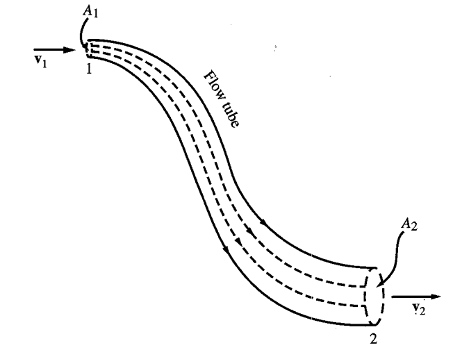
A flow tube is made up of the streamlines that pass through the perimeter of a small cross-sectional area in steady state. The flowing fluid can never cross the boundary of the tube.

INCOMPRESSIBLE FLUID
For an incompressible fluidthe changes in the densities from location to location are so small that we can ignore them.

IDEAL FLUID
An incompressible fluid that has no viscosity is called an ideal fluid.

EQUATION OF CONTINUITY
The mass of fluid that flows into one end of the flow tube in a given time interval must be the same as the mass that flows out the other end in the same time interval.

BERNOULLI’S EQUATION

TORRICELLI’S THEOREM
If you have a container filled with fluid with small hole at the bottom of the container, the fluid leaves through the hole with velocity same as it would experience if dropped from the same height to the hole level.

VENTURI TUBES

(a) The pressure in the pipe is determined by observing the height of water in the tube.
(b) The tube acts like a open-tube manometer and measures the gage pressure of the flowing liquid.z
(c) The height difference of the mercury (corrected for the different heights of fluid above the mercury on the two sides) directly measures P2 P1. This also yields velocity per P2 P1 = ½ dv12.

STAGNATION POINT
The stagnation point is a small region or point right in front of the tube at 2 in figure (c) above, where the fluid is at rest since it must go around one or the other side of the tube.

AERODYNAMICS
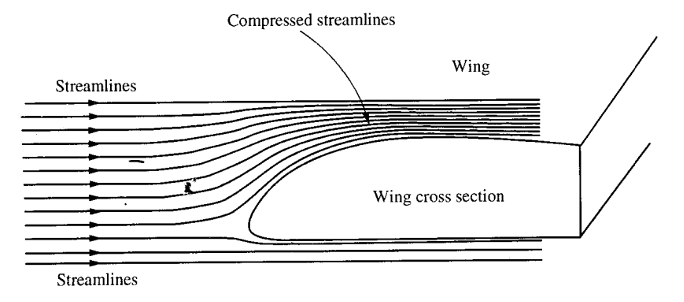
An airplane in motion is supported by the pressure difference between the top and undersides of the wing. Compression of the streamlines above the wing means that the flow tube above the wing has a smaller cross-sectional area and, therefore, greater velocity of the air. This greater velocity implies lower pressure.

COEFFICIENT OF VISCOSITY
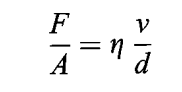
For fluid in steady flow between parallel plates, the stress is proportional to the velocity gradient, where the coefficient of viscosity  is the proportionality constant,

POISEUILLE’S LAW
The volume flow rate depends on the fourth power of the radius of the pipe, as well as on the change in pressure per unit length along the pipe.

STOKE’S LAW
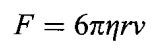
When an object moves through a viscous fluid in such a way that the fluid is in steady flow past it, the viscous forces on the object are, to a good approximation, proportional to the relative velocity and the coefficient of viscosity. The expression for the force will vary with the shape of the object. For sphere,

REYNOLD’S NUMBER

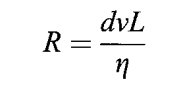
The Reynold’s number is a dimensionless quantity that depends on four factors: the density d of the flowing fluid, the coefficient of viscosity , the average relative velocity of the fluid v, and the characteristic linear dimension L of the solid boundary. For flow through a pipe, L is the diameter of the pipe. For an object moving through a fluid, L can be taken as some average linear dimension of the object facing into the fluid flow. In all cases the expression for the Reynold’s number is

When R exceeds a certain value for the geometry at hand, the flow turns from steady to turbulent. A good rule of thumb for fluids flowing through a pipe is that when R exceeds 2000, the flow becomes turbulent. Similarly for a sphere moving through a fluid, the critical value of R is about 10.

.

JUDAISM: Meaning in Suffering

Reference: Judaism

Note: The original text is provided below.
Previous / Next

Second Isaiah related this general principle to the experience of his people by envisioning a day when the nations of the earth would see that the tiny nation they once scorned (here personified as an individual) had actually been suffering on their behalf.

.

Summary

.

Comments

.

Original Text

From the eighth to the sixth centuries B.C.E., during which Israel and Judah tottered before the aggressive power of Syria, Assyria, Egypt, and Babylon, the prophets found meaning in their predicament by seeing it as God’s way of underscoring the demand for righteousness. God was engaged in a great controversy with his people, a controversy involving moral issues not evident to the secular observer. To correct a wayward child a parent may coax and cajole, but if words fail action may prove to be necessary. Similarly, in the face of Israel’s indifference to God’s commands and pleadings, Yahweh had no alternative but to let the Israelites know who was God—whose will must prevail. It was to make this point that God was using Israel’s enemies against her.

Thus says the Lord:
For three transgressions of Israel,
and for four, I will not revoke the punishment;
because they sell the righteous for silver,
and the needy for a pair of sandals—
Therefore an adversary shall surround the land,
and strip you of your defense;
and your strongholds shall be plundered. (Amos 2:6; 3:11)

Jeremiah takes up the refrain. Because the Jews had forsaken righteousness, it is God’s decision to “make this city a curse for all the nations of the earth” (Jeremiah 26:6).

We can appreciate the moral courage required to come up with this interpretation of impending doom. How much easier to assume that God is on our side, or resign oneself to defeat.

The climax, however, is yet to come. Defeat was not averted. In 721 B.C.E. Assyria “came down like a wolf on the fold” and wiped the Northern Kingdom from the map forever, converting its people into “the Ten Lost Tribes of Israel.” In 586 Judah, the Southern Kingdom, was conquered, though in this case its leadership remained intact as Nebuchadnezzar marched it collectively into captivity in Babylonia.

If ever there was a time when the possibility of meaning seemed unlikely, this was it. The Jews had bungled their opportunity and in consequence had been brought low. Surely now the prophets might be expected to concede their people’s doom with a self-serving “I told you so.”

This retort, a blend of vindictiveness and despair, was not in the prophets’ vocabulary. The most staggering fact in the Jewish quest for meaning is the way in which in this blackest hour, when meaning had been exhausted in the deepest strata the Jews had yet mined, the prophets dug deeper still to uncover an entirely new vein. Not to have done so would have amounted to accepting the prevailing view that the victors’ god was stronger than the god of the defeated, a logic that would have ended the biblical faith and the Jewish people along with it. The rejection of that logic rescued the Jewish future. A prophet who wrote in sixth century Babylonia where his people were captives—his name has been lost, but his words come down to us in the latter chapters of the book of Isaiah—argued that Yahweh had not been worsted by the Babylonian god Marduk; history was still Yahweh’s province. This meant that there must have been point in the Israelites’ defeat; the challenge was again to see it. The point that “Second Isaiah” saw was not this time punishment. The Israelites needed to learn something that their defeat would teach, but their experience would also be redemptive for the world.

On the learning side, there are lessons and insights that suffering illumines as nothing else can. In this case the experience of defeat and exile was teaching the Jews the true worth of freedom, which, despite their early Egyptian captivity, they had come to hold too lightly. Lines have come down to us that disclose the spiritual agony of the Israelites as displaced persons—how heavily they felt the yoke of captivity, how fervently they longed for their homeland.

By the rivers of Babylon—there we sat down
and there we wept when we remembered Zion.
On the willows there we hung up our harps.
For there our captors asked us for songs,
and our tormentors asked for mirth, saying,
“Sing us one of the songs of Zion!”
How could we sing the Lord’s song in a foreign land?
If I forget you, O Jerusalem, let my right hand wither!
Let my tongue cling to the roof of my mouth.(Psalm 137:1–6)

Sometimes a single phrase is enough to convey the poignancy and pathos of their plight: “Is it nothing to you, oh you who pass by”; or “How long, O Lord, how long?” 

When Cyrus, King of Persia, conquered Babylon in 538 and permitted the Jews to return to Palestine, the prophets saw another lesson that only suffering can fully impart: the lesson that those who remain faithful in adversity will be vindicated. In the end their rights will be restored.

Go out from Babylon, declare this
with a shout of joy, proclaim it,
send it forth to the end of the earth;
say, “The Lord has redeemed His servant Jacob.”
(Isaiah 48:20–22)

But what the Jews might themselves learn from their captivity was not the only meaning of their ordeal. God was using them to introduce into history insights that all peoples need but to which they are blinded by ease and complacency. God was burning into the hearts of the Jews through their suffering a passion for freedom and justice that would affect all humankind.

I have given you as a light to the nations,
to open the eyes that are blind,
to bring out the prisoners from the dungeon,
from the prison those who sit in darkness. (Isaiah 42:6–7)

Stated abstractly, the deepest meaning the Jews found in their Exile was the meaning of vicarious suffering: meaning that enters lives that are willing to endure pain that others might be spared it. Second Isaiah related this general principle to the experience of his people by envisioning a day when the nations of the earth would see that the tiny nation they once scorned (here personified as an individual) had actually been suffering on their behalf:

Surely he has borne our infirmities
and carried our diseases;
yet we accounted him stricken,
struck down by God, and afflicted.
But he was wounded for our transgressions,
crushed for our iniquities;
upon him was the punishment that made us whole,
and by his bruises we are healed.
All we like sheep have gone astray;
we have all turned to our own way;
and the Lord has laid on him
the iniquity of us all. (Isaiah 53:4–6)

The deepest meaning the Jews found in their Exile was the meaning of vicarious suffering: meaning that enters lives that are willing to endure pain that others might be spared it.

.

HINDUISM: The Stages of Life

Reference: Hinduism

Note: The original Text is provided below.
Previous / Next

The unwise life is one long struggle with death the intruder—an uneven contest in which age is obsessively delayed through artifice and the denial of time’s erosions.

.

Summary

.

Comments

.

Original Text

People are different. Few observations could be more banal, yet serious attention to it is one of Hinduism’s distinctive features. The preceding sections traced its insistence that differences in human nature call for a variety of paths toward life’s fulfillment. We have now to note the same insistence pressed from another quarter. Not only do individuals differ from one another; each individual moves through different stages, each of which calls for its own appropriate conduct. As each day passes from morning through noon and afternoon into evening, so every life likewise passes through four phases, each possessing distinct aptitudes that dictate distinct modes of response. If we ask, therefore, how should we live? Hinduism answers, that depends not only on what kind of person you are but also on the stage of life you are in.

The first stage India marked off as that of the student. Traditionally, this stage began after the rite of initiation, between the ages of eight and twelve. It lasted for twelve years, during which the student typically lived in the home of the teacher, rendering service for instruction received. Life’s prime responsibility at this stage was to learn, to offer a receptive mind to all that the teacher, standing, as it were, on the pinnacle of the past, could transmit. Soon enough responsibilities would announce themselves copiously; for this gloriously suspended moment the student’s only obligation was to store up against the time when much would be demanded. What was to be learned included factual information, but more; for India—dreamy, impractical India—has had little interest in knowledge for knowledge’s sake. The successful student was not to emerge a walking encyclopedia, a reference library wired for sound. Habits were to be cultivated, character acquired. The entire training was more like an apprenticeship in which information became incarnated in skill. The liberally educated student was to emerge as equipped to turn out a good and effective life as a potter’s apprentice to turn out a well-wrought urn. 

The second stage, beginning with marriage, was that of the householder. Here during life’s noonday, with physical powers at their zenith, interests and energies naturally turn outward. There are three fronts on which they can play with satisfaction: family, vocation, and the community to which one belongs. Normally, attention will be divided between the three. This is the time for satisfying the first three human wants: pleasure, through marriage and family primarily; success, through vocation; and duty, through civic participation.

Hinduism smiles on the happy fulfillment of these wants but does not try to prime them when they begin to ebb. That attachment to them should eventually decline is altogether appropriate, for it would be unnatural for life to end while action and desire are at their zenith. It is not ordained that it do so. If we follow the seasons as they come, we shall notice a time when sex and the delights of the senses (pleasure) as well as achievement in the game of life (success) no longer yield novel and surprising turns; when even the responsible discharge of a human vocation (duty) begins to pall, having grown repetitious and stale. When this season arrives it is time for the individual to move on to the third stage in life’s sequence.

Some never do. Their spectacle is not a pretty one, for pursuits appropriate in their day become grotesque when unduly prolonged. A playboy of twenty-five may have considerable appeal, but spare us the playboys of fifty. How hard they work at their pose, how little they receive in return. It is similar with people who cannot bring themselves to relinquish key positions when a younger generation with more energy and new ideas should be stepping into them. 

Still, such people cannot be censured; for seeing no other frontier to life, they have no option but to hang on to what they know. The question they pose is, bluntly, “Is old age worthwhile?” With medical science increasing life expectancy dramatically, more and more people are having to face that question. Poets have always given their nod to autumn leaves and the sunset years, but their phrases sound suspect. If we rest our case with poetry, “Grow old along with me, the best is yet to be” carries not half the conviction of “Gather ye rosebuds while ye may…. Tomorrow we’ll be dying.” 

Whether life has a future beyond middle age depends in the end not on poetry but on fact, on what the values of life really are. If they are supremely those of body and sense, we may as well resign ourselves to the fact that life after youth must be downhill. If worldly achievement and the exercise of power is best, middle age, the stage of the householder, will be life’s apex. But if vision and self-understanding carry rewards equal to or surpassing these others, old age has its own opportunities, and we can come to happiness at the time when the rivers of our lives flow gently. 

Whether or not the later years do hold such rewards depends on the scene that is disclosed when the curtain of ignorance lifts. If reality is a monotonous and depressing wasteland and self no more than subtle cybernetics, the rewards of vision and self-knowledge cannot possibly rival the ecstasies of sense or the satisfactions of social achievement. We have seen, however, that in Hinduism they are held to be more. “Leave all and follow Him! Enjoy his inexpressible riches,” say the Upanishads. No joy can approximate the beatific vision, and the Self to be discovered is great beyond all report. It follows that succeeding the stages of student and householder, Hinduism will mark with confidence a third stage into which life should move. 

This is the stage of retirement. Any time after the arrival of a first grandchild, the individual may take advantage of the license of age and withdraw from the social obligations that were thus far shouldered with a will. For twenty to thirty years society has exacted its dues; now relief is in order, lest life conclude before it has been understood. Thus far society has required the individual to specialize; there has been little time to read, to think, to ponder life’s meaning without interruption. This is not resented; the game has carried its own satisfactions. But must the human spirit be indentured to society forever? The time has come to begin one’s true adult education, to discover who one is and what life is about. What is the secret of the “I” with which one has been on such intimate terms all these years, yet which remains a stranger, full of inexplicable quirks, baffling surds, and irrational impulses? Why are we born to work and struggle, each with a portion of happiness and sorrow, only to die too soon? Generation after generation swells briefly like a wave, then breaks on the shore, subsiding into the anonymous fellowship of death. To find meaning in the mystery of existence is life’s final and fascinating challenge. 

Traditionally, those who responded fully to this lure of spiritual adventure were known as forest dwellers, for—husband and wife together if she wished to go, husband alone if she did not—they would take their leave of family, the comforts and constraints of home, and plunge into the forest solitudes to launch their program of self-discovery. At last their responsibilities were to themselves alone. “Business, family, secular life, like the beauties and hopes of youth and the successes of maturity, have now been left behind; eternity alone remains. And so it is to that—not to the tasks and worries of this life, already gone, which came and passed like a dream—that the mind is turned.” Retirement looks beyond the stars, not to the village streets. It is the time for working out a philosophy, and then working that philosophy into a way of life; a time for transcending the senses to find, and dwell with, the reality that underlies this natural world.

Beyond retirement, the final stage wherein the goal is actually reached is the state of the sannyasin, defined by the Bhagavad-Gita as “one who neither hates nor loves anything.” 

The pilgrim is now free to return to the world for, the intent of the forest discipline achieved, time and place have lost their hold. Where in all the world can one be totally free if not everywhere? The Hindus liken the sannyasin to a wild goose or swan, “which has no fixed home but wanders, migrating with the rain-clouds north to the Himalayas and back south again, at home on every lake or sheet of water, as also in the infinite, unbounded reaches of the sky.” The marketplace has now become as hospitable as the forests. But though the sannyasin is back, he is back as a different person. Having discovered that complete release from every limitation is synonymous with absolute anonymity, the sannyasin has learned the art of keeping the finite self dispersed lest it eclipse the infinite. 

Far from wanting to “be somebody,” the sannyasin’s wish is the opposite: to remain a complete nonentity on the surface in order to be joined to all at root. How could one possibly wish to make oneself up again as an individual, restore the posturings and costumes of a limiting self-identity, the persona that conceals the purity and radiance of the intrinsic self? The outward life that fits this total freedom best is that of a homeless mendicant. Others will seek to be economically independent in their old age; the sannyasin proposes to cut free of economics altogether. With no fixed place on earth, no obligations, no goal, no belongings, the expectations of body are nothing. Social pretensions likewise have no soil from which to sprout and interfere. No pride remains in someone who, begging bowl in hand, finds himself at the back door of someone who was once his servant and would not have it otherwise. 

The sannyasin saints of Jainism, an offshoot of Hinduism, went about “clothed in space,” stark naked. Buddhism, another offshoot, dressed its counterparts in ochre, the color worn by criminals ejected from society and condemned to death. Good to have all status whisked away at a stroke, for all social identities prevent identification with the imperishable totality of existence. “Taking no thought of the future and looking with indifference upon the present,” read the Hindu texts, the sannyasin “lives identified with the eternal Self and beholds nothing else.” “He no more cares whether his body falls or remains, than does a cow what becomes of the garland that someone has hung around her neck; for the faculties of his mind are now at rest in the Holy Power, the essence of bliss.”

The unwise life is one long struggle with death the intruder—an uneven contest in which age is obsessively delayed through artifice and the denial of time’s erosions. When the fever of desire slackens, the unwise seek to refuel it with more potent aphrodisiacs. When they are forced to let go, it is grudgingly and with self-pity, for they cannot see the inevitable as natural, and good as well. They have no comprehension of Tagore’s insight that truth comes as conqueror only to those who have lost the art of receiving it as friend.

.

Physics I: Chapter 13

Reference: Beginning Physics I

CHAPTER 13: FLUIDS AT REST (HYDROSTATICS)

.

KEY WORD LIST

Hydrostatics, Density, Specific Gravity, Pressure, Hydrostatic Pressure, Gauge Pressure, Hydraulic Press, Open-Tube Manometer, Barometer, Archimedes’ Principle, Surface Tension, Capillarity

.

GLOSSARY

For details on the following concepts, please consult CHAPTER 13.

HYDROSTATICS
Origin: “still water.” Hydrostatic is that branch of physics that deals with the static fluids, usually confined to the equilibrium and pressure of liquids.

DENSITY
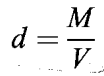
The density d of any substance is defined as the mass per unit volume of the substance. If we have a uniform sample of materials (solid, liquid, or gas) of mass M and volume V, then

SPECIFIC GRAVITY
The specific gravity of a substance is defined as the ratio of the density of the substance to that of water.

PRESSURE
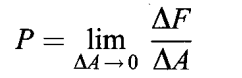
The pressure P on any surface is defined as the force per unit area acting perpendicular to that surface

HYDROSTATIC PRESSURE
The hydrostatic pressure is the pressure in a fluid at rest.

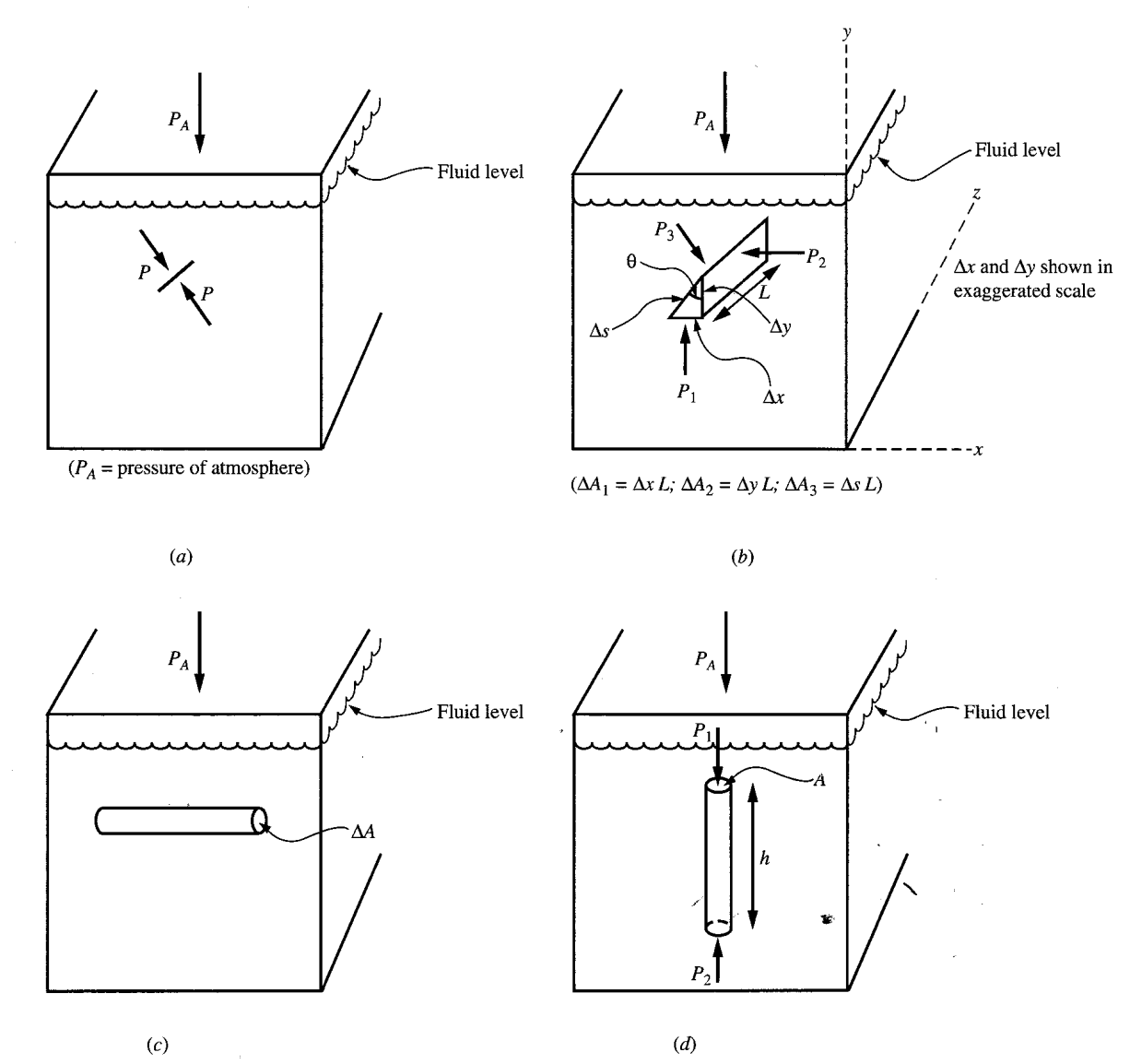
  • For any point in a fluid at rest, the pressure on one side of a small surface is the same as the pressure on other side.
  • The pressure at a given point in the fluid at rest has a definite value that represents the force per unit area on a small surface placed at that point, oriented in any arbitrary direction.
  • The pressure in a fluid at rest is the same at all points on a horizontal plane.
  • The pressure in a fluid at rest varies only with the depth in accord with the equation,

GAUGE PRESSURE
The gauge pressure is the difference between the actual, or absolute pressure P in a fluid, and the pressure exerted by the atmosphere ­PA, which pervades the surface of the earth.

HYDRAULIC PRESS

OPEN-TUBE MANOMETER

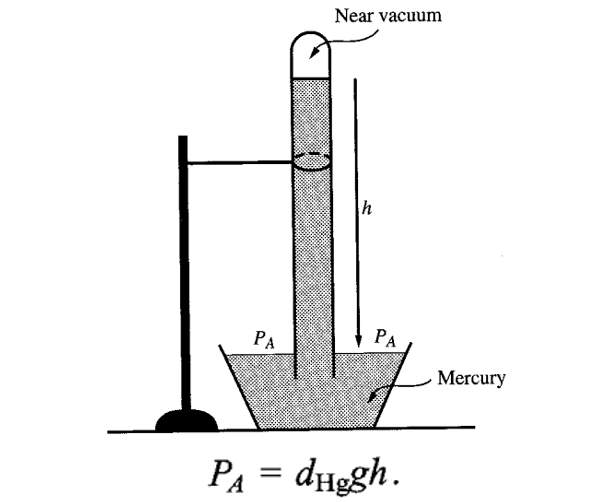
BAROMETER

ARCHIMEDES’ PRINCIPLE
The fact that the buoyant force equals the weight of the displaced liquid is called the Archimedes’ Principle: the law of buoyancy.

SURFACE TENSION
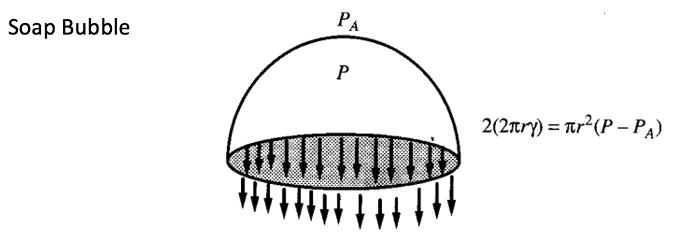
Surface tension is caused by the pull of the molecules below the surface of the liquid on the molecules at the surface. This tends to pull the surface into a smooth and compact layer. The surface tension  is defined as force per unit length exerted by a liquid surface on an object, along its boundary of contact with the object. This force is parallel to the liquid surface and perpendicular to the boundary line of contact. For a straight boundary of length L and a total force F we have

CAPILLARITY
Because of adhesion, the water surface gets pulled toward the wall of the container and bends upward at the point of contact.

.