Category Archives: Physics Book

The Physics Book.

Quantization & the Atom


dl10c

Reference: Disturbance Theory

.
Quantization was the subject of Einstein’s very first paper in 1905, On a Heuristic Point of View about the Creatidn and Conversion of Light for which he was awarded Nobel Prize. Einstein wrote:

The energy of a ponderable body cannot be split into arbitrarily many, arbitrarily small parts, while the energy of a light ray, emitted by a point source of light is according to Maxwell’s theory (or in general according to any wave theory) of light distributed continuously over an ever increasing volume.”
“In fact, it seems to me that the observations on “black-body radiation”, photoluminescence, the production of cathode rays by ultraviolet light and other phenomena involving the emission or conversion of light can be better understood on the assumption that the energy of light is distributed discontinuously in space.”

Basically, according to Einstein, there appears to be a limit to which an electromagnetic cycle could be divided into smaller bits of energy. Per the relationship, E = hv, an electromagnetic cycle cannot have energy less than h. This limits the “size” of light quanta. Therefore, light or electromagnetic energy is not a continuous function in space as postulated by Maxwell. The size of this light quantum increases with the frequency of light.

.

Field and Material Substances

This paper of Einstein has another deep significance. Just like there is a limit to which matter could be subdivided in terms of “mass”, there is also a limit to which electromagnetic phenomena could be subdivided in terms of “energy”. In some respect, the “pure energy” of the electromagnetic phenomena is equivalent to the “mass” of matter. In fact, Einstein derived this equivalence of energy and mass, as E= mc2 in his fifth paper, “Does the inertia of a body depend on its energy context” that he published in 1905.

This equivalence of energy and mass puts the electromagnetic phenomena in the same general category as matter. We may define this general category as “substance”. We may refer to the electromagnetic phenomena as “field-substance” and matter as “material-substance”. This categorization also helps us differentiate the “pure energy” aspect of electromagnetic phenomena from the kinetic and potential energy associated with matter.

The smallest particle of material-substance exists as an atom. When the atom is subdivided into smaller particles we enter into the realm of field-substance. The atom forms the interface between material and field substances. The study of this interface is the subject of Quantum Mechanics.

.

Substance, Emptiness and Space

Newtonian mechanics, as well as the Quantum mechanics, is based on a belief in “particles in void”. According to this viewpoint, space and time exist seperate and independent of substance.

Based purely on extensive experimentation with electricity and magnetism, Faraday favored the alternate belief of “continuum of substance”. According to this viewpoint, space and time are integral characteristics of substance. When there is no substance, there is no space, and no time either. There is only emptiness..

The current interpretation of quantum mechanics is mostly from the viewpoint of “particles in void”. This essay on quantization takes the viewpoint of “continuum of substance”.

The universe thus consists of field-substance, material-substance, and their characteristic space and time. Space is thus part of the universe. This universe is then surrounded by emptiness. This emptiness is not only devoid of all substance but it is also devoid of space and time.

.

The Wave-particle Duality

Since we define electromagnetic phenomena as field-substance, we may refer to the light-quantum, introduced by Einstein, as a “field-particle”. A particle is characterized by how discrete it is as opposed to being continuous.

According to “continuum of substance”, the background is made up of the same field-substance that makes up the field-particle. The field-particle, therefore, appears like a pulse in the background. This imparts wave characteristics to the field-particle. But the increasing frequency differential between the field-particle and the background then also imparts particle characteristic of “discrete-ness”.

Thus, the wave properties dominate at lower frequencies; whereas, the particle properties dominate at higher frequencies. In any case, the field-particle is imbued with both wave and particle characteristics. This wave-particle duality is supported better from the perspective of “continuum of substance.”

.

The Meaning of Quantization

At lower frequencies the field-substance is very flimsy. But as it increases in frequency it becomes increasingly substantial. This process may be called “quantization”. Besides increased substantial-ness of the field-substance, quantization also refers to increased discrete-ness of the field-particle.

The spectrum of quantization parallels the electromagnetic spectrum. At the upper end of this spectrum we have material-particles. The lower end of this spectrum gradually approaches pure emptiness that is devoid of field-substance.

Thus, not only the substantial-ness, but also the very existence of the field-substance depends on its frequency. If there is no frequency there is no field-substance, and consequently no space and time. There is only emptiness.

Emptiness is not arrived at right below the frequency of “one”. Since the unit of time on which the frequency is based is arbitrary, this frequency can be given any number with a smaller unit of time and reduced further. An infinite series of reduced cycles thus exists before emptiness can be arrived at.

.

Particle Physics

The smallest material-particle is the atom. It forms the interface between material and field substances. The moment we break the atom we get particles that are less substantial than the atom. The sub-atomic particles belong to the category of field particles. They exist in the gamma range of the electromagnetic spectrum as obvious from their de Broglie wave-lengths.

The following table is provided at The Disturbance Levels:
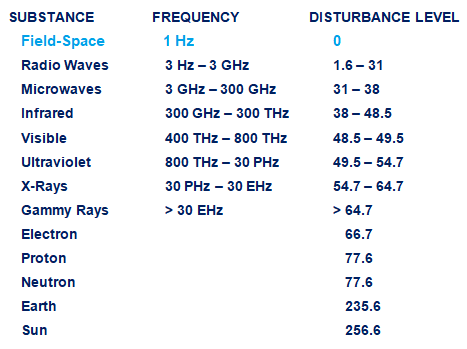
Disturbance Levels

The disturbance level expresses the frequency of electromagnetic radiation as a power of 2. It is calculated per the following formula.

Disturbance level,           D = (log f) / (log 2) = 138.4 + 3.322 log p

Where f is frequency in hertz
And p is momentum of material particles in S.I. Units.

The gamma range starts at the disturbance level of 64.7 (30 EHz). Electron appears at the beginning of the gamma range at a disturbance level of 66.7. The nucleons appear well into the gamma range at a disturbance level of 77.6.

The minimum disturbance level that applies to material particles is then 138.4. Below this level we are dealing with field-particles. Particle physics is then dealing with field-particles and not with material-particles. The mass associated with electrons and nucleons is not due to matter. It represents quantized field-substance.

. 

Charge, Mass and Gravitation

Charge is a field property, whereas, mass is a material property. Both comply with the inverse square law. When we do a dimensional analysis, we find that both charge and mass have the same dimensions (L3 T -2). Thus, charge and mass belong to the same category, which we may identify as the force characteristic of substance Per Faraday. Mass as a force characteristic may be described as the “inertia” of the material particle. On the other hand, charge as a force characteristic may be described as the “quantization” of the field-particle.

The nuclear force among nucleons is much greater than the electromagnetic force among electrons around the nucleus because the quantization In the nucleus is much greater. At quantization lower than that for electromagnetic force the charge is much smaller and not obvious.

From its periphery to its nucleus, the atom consists of all levels of quantizations. The gravitational force represents the weighted average of all such quantization for the whole atom, as compared to the electromagnetic and nuclear forces that are limited to “local” parts within the atom. Therefore, the gravitational force is weaker in strength than the electromagnetic and nuclear forces, but it can act over a much greater range.

.

Quantization, Inertia and Velocity

Quantization of field-particles ends up with the formation of the atoms of the periodic table. Atoms are the beginning of the formation of material-particles. As these atoms combine and collect to form larger material-particles, their quantization is represented by “inertia” as defined by Newton.

If the inertia of a material-particle is infinite it would appear to be still because any attempt to move it will be resisted. But if the inertia is not infinite, the material particle shall exhibit a natural velocity that is the result of its motion balanced exactly by its inertia.

Thus, the lesser is the inertia or quantization of a particle, the greater would be its velocity. This explains why the speed of light is greater by many degrees of magnitude compared to a material body. The quantization associated with the photons of light is infinitesimal compared to the inertia of a material body, such as, earth.

Between two particles of different quantization and/or inertia there will naturally be a relative velocity between them. Two such particles shall attract each other as a result of the gravitational attraction between them, but their relative velocity shall keep them apart. They are then likely to form a system where they will revolve around each other.

Such is the behavior of material bodies that we observe in our cosmos. This confirms the model we have built so far based on the concept of quantization/inertia.

.

The Gravitational Force

As presented above, substance has force characteristics that we perceive as gravitational, electromagnetic and nuclear forces. Faraday looked at force to be synonymous with substance. Please see Faraday: On the Conservation of Force.

Faraday visualized lines of forces extending out from centers of force. The center of force is the electronic region within the atom, when we look at the electromagnetic field. It is the nuclear region within the atom, when we look at the nuclear field. These forces have short ranges as they originate from within the atom.

But when it comes to the gravitational field, the center of force is the whole atom and not some part within it. Thus, the gravitational force applies more to the material-substance; and its range extends without limit.

These force fields interact through their lines of force. These lines of force are curved around their respective center of force. When they interact they try to line up with each other. This results in the centers of forces moving towards or away from each other.

In case of gravitation the lines of forces are around atoms or larger material-particles. Since these particles are clearly discrete, their lines of force always curve away from each other. When they interact, they try to curve toward each other. This generates a force of attraction between the material-particles.

By drawing the gravitational lines of force for two discrete material-particles, it is easy to see why the force of gravitation is always attractive.

.

Field-particle Spin

Beyond this universe of substance there is emptiness of no-substance. Due to the overall symmetry, the surface of the universe must be closed and curved. Any particle in this universe must follow a curved path to remain within the universe.

The lower is the quantization the lesser is the density of the field-substance, and larger is the radius of the curved path that a field-particle may follow. The higher is the quantization, the denser is the field-substance, and smaller is the radius of the curved path that a field-particle follows. We may liken these paths to those in a “whirlpool”. These paths are decreasing in radius and increasing in quantization as the center is approached. Ultimately, the path completely closes upon itself to produce a spinning particle at the center of the “whirlpool”.

All field-particles must have a spin to be able to exist in stand-alone form. A complex particle, such as, an atom, is likely to consist of increasing levels of quantization from its periphery to the center following the whirlpool model. The “electrons” near the nucleus shall have much higher quantization compared to the “electrons” near the periphery. This tells us that “electrons” within the atom are not the same as they appear in their stand-alone form.

The nucleus in an atom shall have a spin. This spin is likely to be discrete, just as the quantization is discrete. The higher is the average quantization, the greater shall be the spin of the nucleus, or a stand-alone field -particle.

.

A New Atomic Model

The “whirlpool” likeness seem to provide a new atomic model for the atom. This same likeness seems to apply to a galaxy. We may compare the spinning black hole at the center of the galaxy to the nucleus of the atom. The rest of the rotating galaxy may be compared to the rotating field-substance around the nucleus.

The field-substance thickens gradually from the periphery of the atom toward its center with decreasing radius and increasing rotation.

As the field-substance thickens, it starts to acquire a structure. This structure first appears as the nucleus. This essentially forms the atom. More complex structures come about with combining of atoms as molecules, and then with increasing number of atoms and molecules combining into gases, liquids, solids, crystals, etc.

This structure is the forming characteristic of the material-substance! which starts with atom. Inside the atom lies the field-substance of layered quantization. The peripheries of the atoms, molecules, etc., eventually extend up to the background and merge into it. Thus, the background of the structured material substance is formed of unstructured field-substance.

The field and material substances exist in equilibrium with each other. It is the flows and ebbs among the quantization and inertial levels of these substances that cause all phenomena.

.

Force, Substance & Spacetime

folding_space_by_ether

According to the postulates of disturbance theory, the universe is a continuum of substance that exists in emptiness. The external characteristics of substance are extension (space) and persistence (time). In emptiness there is neither substance, nor space nor time.

The presence of substance is felt through force to which our perceptions react in terms of touch, sight, hearing, smell and taste. But we are limited in the level of force that we can perceive directly. We then use other tools to perceive indirectly.

When Newton saw force acting between two material objects he explained it in terms of gravity of the masses and the distance between them. But he puzzled about how that force passed from one object to another. He wrote to his friend Richard Bentley:

“That gravity should be innate, inherent, and essential to matter, so that one body may act upon another at a distance, through a vacuum, without the mediation of anything else, by and through which their action and force may be conveyed from one to another, is to me so great an absurdity that I believe no man who has in philosophical matters a competent faculty of thinking, can ever fall into it. Gravity must be caused by an agent, acting constantly according to certain laws; but whether this agent be material or immaterial I have left to the consideration of my readers.”

This gravitational force could be computed without considering any substance filling that space in between. Science continued to develop in this way. It simply treated the space between the objects mathematically according to the Newton’s laws.

Newton’s scientific framework came to be known as “action at a distance” compared to the postulated framework of “continuum of substance”.

.

Lines of Force

Starting at the beginning of 19th century, extensive experimental work was done on electricity and magnetism. At the forefront of this work was Michael Faraday. When conducting these experiments, Faraday could see the effects propagating through the intervening space.

In a letter dated Jan 25 1844, “Electric Conduction and the Nature of Matter”, Faraday expressed that matter seemed to extend itself as “force” to fill the space in an atom, such that there was no empty space. This conclusion came from his observations of electric conduction through different materials. Thus, Faraday saw atoms as centers of force from which lines of force originated, and on which they terminated as well.

Faraday theorized space to consist of electromagnetic lines of force.

.

Light and Aether

It was supposed that light required a medium to travel, and that medium was aether.

In a letter dated April 15, 1846, “Thoughts on Ray Vibration”, Faraday proposed that the vibrations, which were assumed to account for radiation and radiant phenomena, might be seen as occurring in the lines of force which connect particles. In other words, light, radiation or radiant phenomena were part of the force content of space.

Faraday theorized radiant phenomena, such as, light, to constitute the mysterious aether that filled the space.

.

Force and Substance

Newton associated force with acceleration of matter in space. Work was the displacement caused by this force. Energy was the capacity for doing this work.

Faraday saw force as the cause of physical action, and not just the tendency of the body to pass from one place to another. Thus, force formed the very essence of substance for Faraday.  In this sense, it also formed the “inertia” described by Newton as “inner force”.

“The vis insita, or innate force of matter, is a power of resisting by which every body, as much as in it lies, endeavours to preserve its present state, whether it be of rest or of moving uniformly forward in a straight line.”

In a lecture dated February 27, 1857, “On the conservation of Force”, Faraday proposed that all force was conserved. Non-conservation of force implied that the phenomenon was not being viewed completely.  In a later addendum, Faraday clarified force as, “the source or sources of all possible changes amongst the particles or materials of the universe.”  To Faraday, changes implied force. But changes also implied substance.

Faraday saw force as the fundamental substance.

.

Further Research

When we look at spacetime from the viewpoint of the postulates we find that,

Spacetime is the external characteristic of substance. The internal characteristic is force.

Matter is not the only substance; for example, there is definitely a substance that appears as “empty space”. We shall now examine this substance.

.

Faraday & Maxwell 1857

Faraday Maxwell

Reference: A Logical Approach to Theoretical Physics

Faraday’s prime concern was resolution of the problem of gravitation. The explanation for gravity given by Newton in terms of distance did not fully explain the generation and disappearance of gravitational force as two bodies were moved.

Faraday saw “lines of force” as the substance that filled space with varied substantialness. He was looking for a way to explain gravitation with his concept of force as “the source of all possible changes amongst the particles of the universe.”

But this concept was not fully understood by Maxwell, who saw force merely as “the tendency of the body to pass from one place to another”. Maxwell then went on to formulate the concept of electromagnetic field that was based on a mechanical view of force. But he never addressed the problem of gravitation that Faraday was trying to resolve through the principle of conservation of force.

Here is Faraday’s original paper, On the Conservation of Force that he sent to Maxwell.  Here is Maxwell’s response, followed by Faraday’s answer.

This correspondence is presented below with my comments in colored text.

.

 TO PROFESSOR FARADAY

129 Union Street,
Aberdeen, 9th November 1857.

DEAR SIR—I have to acknowledge receipt of your papers on the Relations of Gold to Light, and on the Conservation of Force. Last spring you were so kind as to send me a copy of the latter paper, and to ask what I thought of it.

That question silenced me at that time, but I have since heard and read various opinions on the subject, which render it both easy and right for me to say what I think. And first I pass over some who have never understood the known doctrine of conservation of force, and who suppose it to have something to do with the equality of action and reaction.

Conservation of force is not the same thing as Newton’s third law of motion, which says, “To every action there is always opposed an equal reaction; or the mutual actions of two bodies upon each other are always equal, and directed to contrary parts.”

Now, first, I am sorry that we do not keep our words for distinct things more distinct, and speak of the “Conservation of Work or of Energy” as applied to the relations between the amount of “vis viva” and of “tension” in the world; and of the “Duality of Force” as referring to the equality of action and reaction.

“Vis viva” (Latin for “living force”) is a historical term used for the first known description of what we now call kinetic energy in an early formulation of the principle of conservation of energy.

Maxwell thinks that, to be clearer, the title of Faraday’s paper should be more like “Conservation of Work or Energy”. He doesn’t see that the use of the word “Force” by Faraday is much deeper because it includes the substance of space and matter in the equation of conservation. Maxwell excludes space and matter from the equation of conservation.

Energy is the power a thing has of doing work arising either from its own motion or from the “tension” subsisting between it and other things.

Force is the tendency of a body to pass from one place to another, and depends upon the amount of change of “tension” which that passage would produce.

In his letter Maxwell defines force as, “the tendency of a body to pass from one place to another”. This is not what Faraday meant. In his desire to interpret Faraday mathematically, Maxwell did not quite understand what Faraday was saying.

NOTE: Objects in space have inherent motion, and inherent mass. The source of that motion, and the mass, is not accounted for by the law of conservation of energy. Faraday’s notion of force accounts for them. The Kinetic energy term accounts only for the relative motion.

Now, as far as I know, you are the first person in whom the idea of bodies acting at a distance by throwing the surrounding medium into a state of constraint has arisen, as a principle to be actually believed in. We have had streams of hooks and eyes flying around magnets, and even pictures of them so beset; but nothing is clearer than your descriptions of all sources of force keeping up a state of energy in all that surrounds them, which state by its increase or diminution measures the work done by any change in the system. You seem to see the lines of force curving round obstacles and driving plump at conductors, and swerving towards certain directions in crystals, and carrying with them everywhere the same amount of attractive power, spread wider or denser as the lines widen or contract.

Maxwell did not see force as the source of all possible changes in the universe. He saw force only in limited mechanical terms as described by Newton. Thus he interpreted Faraday’s ideas as a force field of a mechanical nature filling the space. He did not see the effect taking time to travel through the medium as Faraday saw.

You have also seen that the great mystery is, not how like bodies repel and unlike attract, but how like bodies attract (by gravitation). But if you can get over that difficulty, either by making gravity the residual of the two electricities or by simply admitting it, then your lines of force can “weave a web across the sky,” and lead the stars in their courses without any necessarily immediate connection with the objects of their attraction.

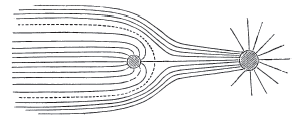
The lines of Force from the Sun spread out from him, and when they come near a planet curve out from it, so that every planet diverts a number depending on its mass from their course, and substitutes a system of its own so as to become something like a comet, if lines of force were visible.

Lines of Force

The lines of the planet are separated from those of the Sun by the dotted line. Now conceive every one of these lines (which never interfere but proceed from sun and planet to infinity) to have a pushing force instead of a pulling one, and then sun and planet will be pushed together with a force which comes out as it ought, proportional to the product of the masses and the inverse square of the distance.

Maxwell’s force field does seem to act as a substance filling the space, but it is assumed to be of mechanical nature. This is pretty much the same idea as that of aether, which was prevalent at that time. Faraday did not agree with the idea of mechanical aether, because his idea of force was not mechanical.

The difference between this case and that of the dipolar forces is, that instead of each body catching the lines of force from the rest, all the lines keep as clear of other bodies as they can, and go off to the infinite sphere against which I have supposed them to push.

Maxwell supposed the lines of force going around the bodies and pushing against an infinite sphere; but Faraday saw lines of force originating and terminating at each atom.

Here then we have conservation of energy (actual and potential), as every student of dynamics learns, and besides this we have conservation of “lines of force” as to their number and total strength, for every body always sends out a number proportioned to its own mass, and the pushing effect of each is the same.

Maxwell saw mechanical force field filling the space, while Faraday saw substance of varying force (inertia) extending out from the bodies.

All that is altered when bodies approach is the direction in which these lines push. When the bodies are distant the distribution of lines near each is little disturbed. When they approach, the lines march round from between them, and come to push behind each, so that their resultant action is to bring the bodies together with a resultant force increasing as they approach.

Maxwell’s lines of force push two objects towards each other from behind, with the resultant force increasing as they approach each other. Faraday saw substance of the bodies extending toward each other and thickening as the two bodies approached.

 Now the mode of looking at Nature, which belongs to those who can see the lines of force, deals very little with “resultant forces,” but with a network of lines of action of which these are the final results, so that I, for my part, cannot realise your dissatisfaction with the law of gravitation, provided you conceive it according to your own principles. It may seem very different when stated by the believers in “forces at a distance,” but there can be only differences in form and conception, not in quantity or mechanical effect, between them and those who trace force by its lines.

Maxwell could not comprehend Faraday’s dissatisfaction with the law of gravitation. He saw lines of forces as a mathematical device that provided an alternative explanation to action at a distance, but nothing more.

But when we face the great questions about gravitation—Does it require time? Is it polar to the “outside of the universe” or to anything? Has it any reference to electricity? or does it stand on the very foundation of matter, mass or inertia? — then we feel the need of tests, whether they be comets or nebulæ, or laboratory experiments, or bold questions as to the truth of received opinions.

But Maxwell did agree with Faraday in terms of greater questions that needs to be resolved in the understanding of inertia, mass, electricity, magnetism, etc., and effect taking time to travel, and that would require more experimentation, and could not be resolved by lines of force.

I have now namely tried to show you why I do not think gravitation a dangerous subject to apply your methods to, and that it may be possible to throw light on it also by the embodiment of the same ideas, which are expressed mathematically in the functions of Laplace and of Sir W. R. Hamilton in Planetary Theory.

Maxwell resolved the issue of aether in electromagnetic terms but he couldn’t come up with the explanation for gravitation that was missing per the principle of Faraday’s conservation of force.

But there are questions relating to the connection between magneto-electricity and certain mechanical effects which seems to me opening up quite a new road to the establishment of principles in electricity, and a possible conformation of the physical nature of magnetic lines of force. Professor W. Thomson seems to have some new lights on this subject.

I can see how Faraday must have been disappointed by this response from Maxwell.

—Yours sincerely,

JAMES CLERK MAXWELL.

.

.

FARADAY TO MR. CLERK MAXWELL

Royal Institution: November 13, 1857

My dear Sir,—If on a former occasion I seemed to ask you what you thought of my paper, it was very wrong, for I do not think anyone should be called upon for the expression of their thoughts before they are prepared and wish to give them. I have often enough to decline giving an opinion, because my mind is not ready to come to a conclusion, or does not wish to be committed to a view that may by further consideration be changed. But having received your last letter, I am exceedingly grateful to you for it; and rejoice that my forgetfulness of having sent the former paper on conservation has brought about such a result. Your letter is to me the first intercommunication on the subject with one of your mode and habit of thinking. It will do me much good, and I shall read and meditate on it again and again.

Faraday is disappointed at not being understood by Maxwell on his principle of the conservation of force. Nevertheless, he seems pleased to hear back from a mathematician like Maxwell.

I dare say I have myself greatly to blame for the vague use of expressive words. I perceive that I do not use the word “force” as you define it, “the tendency of a body to pass from one place to another.” What I mean by the word is the source or sources of all possible actions of the particles or materials of the universe, these being often called the powers of nature when spoken of in respect of the different manners in which their effects are shown.

Faraday was an experimentalist and not a theoretician versed in mathematics. He struggled to get his ideas across that were based on experiments only. Maxwell interpreted Faraday’s intent as conservation of work and energy, which was limited to a mechanical interpretation only. Much later, only Einstein could see that Faraday’s ideas went beyond a simple mechanical interpretation.

In a paper which I have received at this moment from the “Phil. Mag.,” by Dr. Woods, they are called the forces, “such as electricity, heat, &c.” In this way I have used the word “force” in the description of gravity which I have given as that expressing the received idea of its nature and source, and such of my remarks as express an opinion, or are critical, apply only to that sense of it. You may remember I speak to labourers like myself; experimentalists on force generally who receive that description of gravity as a physical truth, and believe that it expresses all and no more than all that concerns the nature and locality of the power,—to these it limits the formation of their ideas and the direction of their exertions, and to them I have endeavored to speak, showing how such a thought, if accepted, pledged them to a very limited and probably erroneous view of the cause of the force, and to ask them to consider whether they should not look (for a time, at least), to a source in part external to the particles. I send you two or three old printed papers with lines marked relating to this point.

Faraday explains further that he was speaking of the ‘force of gravity’ in a broad sense and not in a local sense as implied by the inverse square law. He wanted other experimentalists to consider if the source of gravity could be broader than just being limited to material particles.

 To those who disown the definition or description as imperfect, I have nothing to urge, as there is then probably no real difference between us.

Faraday intuitively felt that reality went beyond the mechanical view of Newton, but he struggled to express it clearly.

I hang on to your words, because they are to me weighty; and where you say, “I, for my part, cannot realise your dissatisfaction with the law of gravitation, provided you conceive it according to your own principles,” they give me great comfort. I have nothing to say against the law of the action of gravity. It is against the law which measures its total strength as an inherent force that I venture to oppose my opinion; and I must have expressed myself badly (though I do not find the weak point), or I should not have conveyed any other impression. All I wanted to do was to move men (not No. 1, but No. 2), from the unreserved acceptance of a principle of physical action which might be opposed to natural truth. The idea that we may possibly have to connect repulsion with the lines of gravitation-force (which is going far beyond anything my mind would venture on at present, except in private cogitation), shows how far we may have to depart from the view I oppose.

Faraday had no problem with the law of action of gravity as expressed by Newton. He only objected to the fact that this law did not fully explain the total measure of inherent forces involved. He simply wanted others to see that something was missing from the natural truth.

There is one thing I would be glad to ask you. When a mathematician engaged in investigating physical actions and results has arrived at his own conclusions, may they not be expressed in common language as fully, clearly, and definitely as in mathematical formula? If so, would it not be a great boon to such as we to express them so—translating them out of their hieroglyphics that we also might work upon them by experiment. I think it must be so, because I have always found that you could convey to me a perfectly clear idea of your conclusions, which, though they may give me no full understanding of the steps of your process, gave me the results neither above nor below the truth, and so clear in character that I can think and work from them.

Faraday feels that mathematical results should be expressed in clear and useful working terms so that non-mathematicians can understand and work with them experimentally.

If this be possible, would it not be a good thing if mathematicians, writing on these subjects, were to give us their results in this popular useful working state as well as in that which is their own and proper to them?

It seems that Faraday’s purpose was to inspire Maxwell to look beyond ‘action at a distance’ as coded in the inverse square law. Maxwell did just that as his life’s work. What a wonderful teamwork.

Ever, my dear Sir, most truly yours,

M. Faraday.

.

Newton: Basic Concepts

Isaac's Apple

Reference: Disturbance Theory

.

From Newton’s Principia for the Common Reader we have the following basic concepts:

Definitions

DEFINITION I: The quantity of matter is the measure of the same, arising from its density and bulk conjointly.

DEFINITION II: The quantity of motion is the measure of the same arising from the velocity and quantity of matter conjointly.

DEFINITION III: The vis insita, or innate force of matter,  is a power of resisting, by which every body, as much as in it lies, continues in its present state, whether it be of rest, or of moving uniformly forwards in a right line.

DEFINITION IV: An impressed force is an action exerted upon a body, in order to change its state, either of rest, or of uniform motion in a right line.

DEFINITION V: A centripetal force is that by which bodies are drawn or impelled, or any way tend, towards a point as to a centre.

DEFINITION VI: The absolute quantity of a centripetal force is the measure of the same, proportional to the efficacy of the cause that propagates it from the centre, through the spaces round about.

DEFINITION VII: The accelerative quantity of a centripetal force is the measure of the same, proportional to the velocity which it generates in a given time.

DEFINITION VIII: The motive quantity of a centripetal force is the measure of the same, proportional to the motion which it generates in a given time.

.

Laws of Motion

LAW I: Every body continues in its state of rest, or of uniform motion in right line, unless it is compelled to change that state by forces impressed upon it.

LAW II: The change of motion is proportional to the motive force impressed; and is made in the direction of the right line in which that force is impressed.

LAW III: To every action there is always opposed an equal reaction: or the mutual actions of two bodies upon each other are always equal, and directed to contrary parts.

Newton is describing the motion resulting from the action of force impressed upon material objects using the geometry of space. This geometry is used to determine the center of gravity and its motion.

.

Maxwell’s Reformulation

Maxwell reformulated the first two laws of motion as follows:

Law IThe centre of mass of the system perseveres in its state of rest, or of uniform motion in a straight line, except in so far as it is made to change that state by forces acting on the system from without.

Law IIThe change of momentum of the system during any interval of time is measured by the sum of the impulses of the external forces during that interval.

.

The Newtonian Principle of Relativity

The Principle of Relativity of Galileo and Newton:

  • Inertial frames are undistinguished: any frame will serve as equally as any other.

.

The Property of Inertia

Newton defines inertia as an innate force of matter (see Definition III above). This property is so fundamental that it establishes the very nature of matter. Here matter refers to any substance. For Newton, light was made up of fine particles and , therefore, it had substance. We may, therefore, define inertia as the measure of “substantialness” of a substance. Therefore,

Any resistance to change in motion means that there is substance.

.

The Inertia of Light

The following conclusion may be derived from the basic concepts stated above.

  • This uniform motion of a body implies a balance between gravitational forces in space and the innate forces of inertia.

  • Any attempt to change this uniform motion immediately activates, per Law III, an inertial force to balance the applied external force. Any excess external force generates acceleration.

  • The “inertial force plus acceleration” is equivalent to the external force at any point. A constant acceleration represents a new state of uniform motion. The acceleration, thus, represents an increase in the inertia of the body. 

  • The acceleration is relative to the body itself and not to some other body or observer. Thus the uniform motion may be described in terms of inertia of the body irrespective of the “velocity” of some external observer.

  • The greater is the acceleration of a body, the harder it is to increase that acceleration further. In other words, the greater is the inertia of a body, the more difficult it is to move it.

  • When a body has infinite inertia it may be impossible to move it. Its “uniform motion” may then be identified as “absolute rest”.

  • The magnitude of the uniform motion of a body thus increases as inertia reduces from an infinite magnitude

  • The large but constant velocity of light implies that it has a very small but finite inertia. This inertia is so small that it could not be detected through the Michelson-Morley’s experiment.

.

Inertia, Geometry & Quantization

Geometry of space

Reference: Disturbance Theory

.

The Space Reference frame (SRF) highlights the dimension of inertia. Newton defines inertia as follows,

“The vis insita, or innate force of matter, is a power of resisting by which every body, as much as in it lies, endeavours to preserve its present state, whether it be of rest or of moving uniformly forward in a straight line.”

The status quo of a body is defined here in terms of rest or uniform motion in a straight line. But a “straight line” only means near zero curvature, which is approached as the radius approaches an infinitely large value.

.

Geometry & Inertia

Straight line relates to geometry of space.  Space is a property of substance. It expresses the extension of substance.  The fundamental substance is an electromagnetic cycle.  Per The Problem of Field,

“Something called “charge” triggers the electromagnetic cycle. This cycle is an oscillation between electrical flow and magnetic rotation. The electrical flow winds up as magnetic rotation. The magnetic rotation then unwinds back as electrical flow.”

The electric flow has the kinetic aspect of forward motion, which provides a sense of extension, or SPACE. The magnetic rotation has the potential aspect of holding motion in place, which provides a sense of duration, or TIME. Thus,

“The electromagnetic cycle consists of an oscillation between the “flow” of space and “rotation” of time. The relationship between space and time would depend on the frequency of oscillation. We perceive the ratio of space to time of an electromagnetic cycle as ‘c’ the speed of light.”

As frequency goes to zero, space would seem to stretch out with its curvature approaching zero. The reverse seems to occur as frequency increases. In other words, the curvature of space seems to increase with frequency. Since frequency contributes to the substantial-ness, or inertia, of the electromagnetic substance, it seems that

The curvature of space increases with increase in inertia.

.

Inertia & Quantization

In the electromagnetic spectrum, space represents the extensions of the electromagnetic substance. The curvature of this space approaches zero towards the bottom of the electromagnetic spectrum. But as we move up the electromagnetic spectrum it starts to become very conspicuous towards the top. This is the basis of quantization.

The greater is the inertia of substance, the more quantized it appears.

This, in a way, was the subject of Einstein’s very first paper in 1905 on light quanta [see Einstein’s Paper on Light Quanta (1905)].

This phenomenon of quantization has been debated as the duality of wave and particle properties of electromagnetic substance. Even though the quantization appears to be particle-like, there is always an underlying continuity. Even a material particle of very high inertia has some degree of continuity with the space around it.

Underlying quantization there is always continuity of substance from higher to lower inertia.

.

Empty Space & Substance

“Empty space” is empty of matter only. When there is no matter, there is electromagnetic substance, which is not easily visible. But if the electromagnetic substance is not there, there won’t be empty space either. We may say that the electromagnetic substance is visible as empty space.

This may shed some light on the concepts of “dark energy” and “dark matter”. Any presence of dark energy and matter shall be accompanied by invisible curvatures in space. The curvatures shall change as the inertia of the electromagnetic substance changes.

Higher levels of inertia means more condensed regions. Therefore, regions of higher inertia shall appear inside the regions of lower inertia, just as higher elevations on a surface appear within lower elevations. Thus,

Contour maps of different inertial levels may be created within the “empty space”.

.

Further Research

Heavenly bodies are like regions of very high inertia that exist within with the regions of very low inertia of space. Very high gradients of inertia shall exist at the interface of matter with space, where continuity must exist.

Further research in this area may lead to a better understanding of gravity beyond the mathematical symbols that are often very confusing.

.