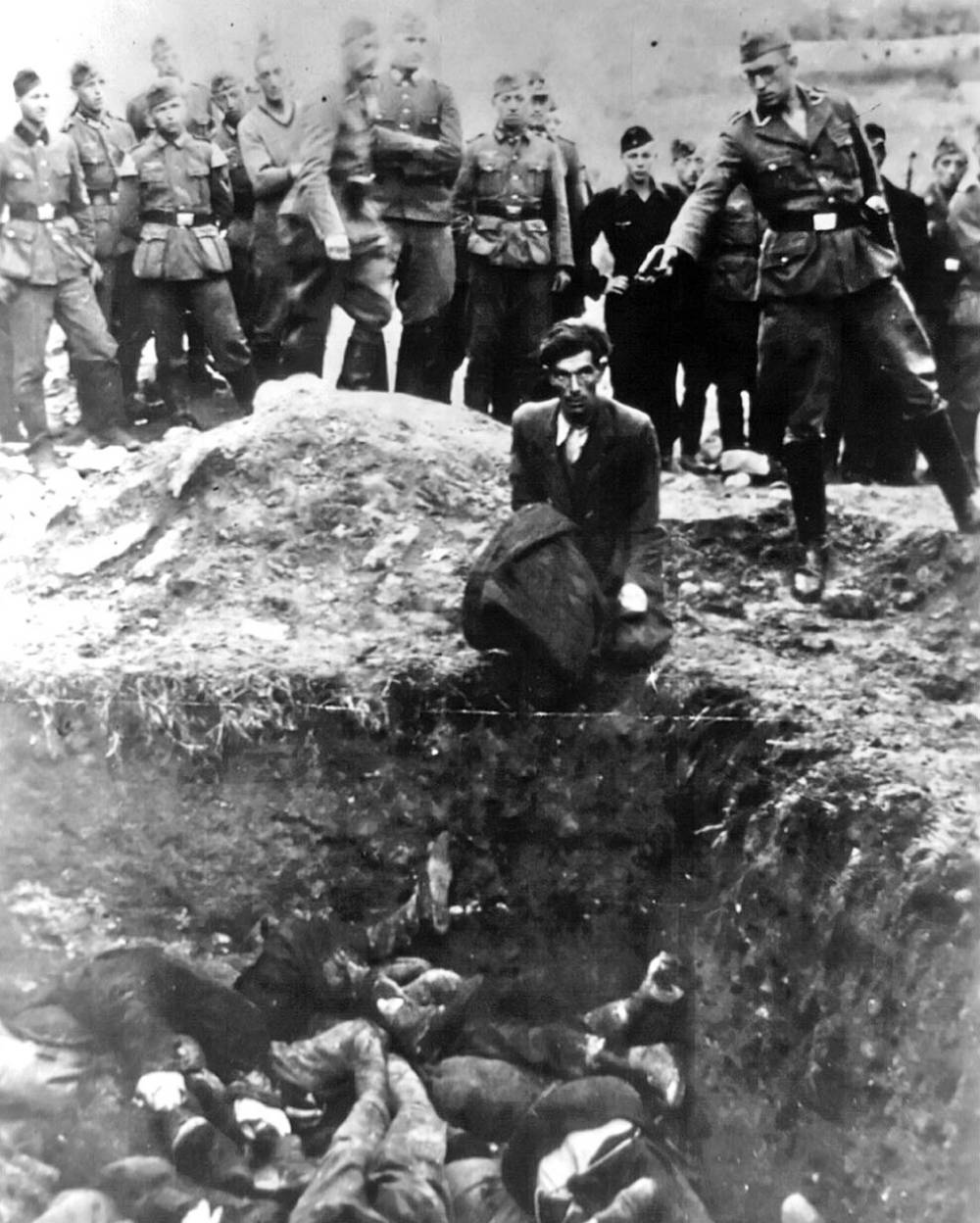
The last Jew in Vinnitsa

amazing_emotional_photos_18

“The last Jew in Vinnitsa” – Member of Einsatzgruppe D (a Nazi SS death squad) is just about to shoot a Jewish man kneeling before a filled mass grave in Vinnitsa, Ukraine, in 1941. All 28,000 Jews from Vinnitsa and its surrounding areas were massacred.

http://www.viralnova.com/these-20-photographs-will-leave-you-speechless-especially-the-6th-one-there-are-no-words/

Evolution from Spirit to Self

spiritself

From Wikipedia:

Spirit

The English word spirit comes from the Latin spiritus, meaning “breath”, but also “spirit, soul, courage, vigor”…  It is distinguished from Latin anima, “soul”

Soul

… related to the notion of being “bound” in death, and the practice of ritually binding or restraining the corpse of the deceased in the grave to prevent his or her return as a ghost…  It could refer to a ghost or spirit of the dead … and to a more philosophical notion of an immortal and immaterial essence left over at death … in English variously translated as “soul, self, life, creature, person, appetite, mind, living being, desire, emotion, passion”…

Self

The self is the subject of one’s own experience of phenomena: perception, emotions, thoughts. In phenomenology, it is conceived as what experiences, and there isn’t any experiencing without an experiencer, the self. The self is therefore an “immediate given”, an intrinsic dimension of the fact of experiencing phenomena.

.

So we have three different concepts here:

  1. Aliveness and vitality in the body that is distinguished from the material body.

  2. An immortal and immaterial essence left over at death that retains desire, emotion, and passions of the person.

  3. The experiencer in a live body, which continues as soul after the death of the body.

.

We find that, initially, the physical and spiritual aspects are seen as coexisting in a person. As religion considered the mysteries of birth and death, much thought was given to what happens at death. It was obvious that the physical body disintegrates after death, but do the spiritual aspects of the person disintegrate too?

Another problem was the wild beast nature latent in every person. Plato started out by considering the Ethical problem. That led to the Political problem; which, in turn, led to the Psychological problem. Plato then came up with a solution to this Psychological problem in terms of setting up internal controls. These controls involved the indoctrination of people into believing in a personal God who can judge, reward or punish them. Plato’s solution provided the groundwork for later religions, such as, Christianity, which provides a system of faith designed to set up internal controls to make people behave properly.

The idea of soul was introduced as part of this system of faith. It was assumed that the spiritual aspect of the person survived death. This was the soul of the person that retained the desires, emotions, and passions. The soul was then rewarded or punished based on the actions committed during the person’s life.

The spiritual aspect, which coexisted with the physical aspect, now came to be viewed as separable from each other. This idea was then projected back to the existence before death, and the soul was seen as living in the body but separate from it. This came to be viewed as the self of the person that is independent of the body.

Here we see an abstract idea of spirit evolving and gradually becoming personified as self.

.

Subject Clearing (old-1)

subject 3

Please see The Book of Subject Clearing

Reference: MINDFULNESS / TRAINING: Word Clearing

When studying a subject one should be able to detect the distortions present in the knowledge being received. This is especially true when one is dealing with the fundamentals of a subject. The distortions can be very pervasive. They may even enter the definitions of words in a dictionary.

The following procedure helps one detect and clear any distortions present in the subject being studied.

  1. List the key words, or concepts, of the subject.

    Look at the subject mindfully starting with its concepts expressed as key words. List the key words on a worksheet as you go through the subject. This list may grow as you get deeper into the subject.

    For example, you may find the key words in the subject of mathematics to be: mathematics, arithmetic, algebra, geometry, number, addition, subtraction, multiplication, division, equation, unknown, variable, space, direction, distance, position, etc.

    Excel example

    NOTE: You may use an Excel Worksheet to list the words and concepts. In the example shown below, the worksheet contains concepts associated with the word SPIRIT. There happens to be more than one concept associated with this word. The sequence of these concepts is maintained by assigning “priorities” to them.

  2. ‘Word clear’ the key words and concepts as you proceed.

    The purpose of study is not to memorize information, but to resolve the inconsistencies or blanks in understanding. ‘Word clear’ the key words as you proceed.

    Study the materials one paragraph at a time. Summarize and reduce each paragraph to its main thought before proceeding to the next. If the paragraph is difficult to reduce to its main thought then look for words in that paragraph that may not have been understood fully. These could be simple words. ‘Word clear’ such words.

    If the difficulty with a paragraph still persists then note down the confusion on your worksheet, and proceed to the next paragraph.

  3. Arrange the key words, or concepts, in proper sequence.

    The key words should be listed starting with those that express the fundamental concepts followed by those, which are derived from earlier concepts.

    Start by arranging the key words, or concepts, in the sequence that they appear in the material. As you gain familiarity, rearrange by words/concepts as they seem to have evolved. Move the words embodying more fundamental concepts toward the top. Move the words embodying derived concepts toward the bottom.

  4. Note the inconsistencies among the concepts.

    As the study of the subject progresses and better understanding comes about, the list of key words may be continually rearranged to achieve a consistency among the concepts. If you notice any inconsistencies, note them down on the worksheet.

    This then motivates a research deeper into the subject.

  5. Clarify the fundamentals of the subject as a priority.

    The consistency among the fundamental concepts in a subject is very important because it affects the consistency of the later concepts. Look closely at the inconsistencies starting from the top. Are there  underlying assumptions? If so then this may reveal gaps in the subject itself.

    There are likely to be many contributors to a subject. For example, many different cultures have contributed to the subject of religion. You may find similar concepts referred to by different words in different languages. Note down all those words and differences among the concepts.

  6. Make the subject as complete as possible.

    There are many examples in the subject of religion where gaps in knowledge are hidden under assumptions and dubious “explanations.” This may be the case with any subject where inconsistencies abound.

    When such assumptions and explanations are ferreted out, then the gaps in knowledge become obvious. Only when such gaps in knowledge stand out in the open and become uncomfortably clear that they can be addressed.

    Fill gaps in the subject with wider research. Make the subject as complete and consistent as possible through experimentation and direct experience.

    Thus, subject clearing can occur.

.

Word Clearing

words3

Reference Dictionaries:
Dictionary.com
Webster’s 1913 edition

.

Words are compressed thoughts. It may not be possible to express the complete meaning of a word through a dictionary, encyclopedia, or some other text because it is continually evolving. But dictionaries do provide origins, different usages, synonymns and other clues to understand a word in a given context.

During the process of learning when there is confusion, the first thing to do is to look up the meaning of the word(s) related to that area of confusion. This is necessary even when one has looked up those words before. One must newly examine the meaning of the words in the present context.

The following procedure is designed to bring about rapid understanding of words in the appropriate context.

  1. Start with looking up the broad concept underlying the word.

    In a dictionary you may find the broad concept listed under ‘history’, ‘origin’, or ‘derivation’ of the word. This may appear either before, or after the definitions. Sometimes you may have to go to a reference, such as, “Dictionary of Word Origins” by John Ayto to get the concept.

    Look for broad concept only. Sometimes you may have to piece together the concept from the derivations given. Ignore most other grammatical details. Once you have grasped the broad concept go to the next step.

    For example, when you look up ARITHMETIC, you may find the underlying concept expressed as “skill with numbers.” As an exercise, check out the concept for the word GEOMETRY.

  2. Locate the definition of the word that fits the context.

    Scan through the definitions provided for that word, and locate the one that seems to be most appropriate. Start with this definition even though you may find another definition more appropriate after some contemplation.

  3. Study the definition until you can visualize it fully.

    Read the definition carefully. Relate it to your experience and visualize it in your mind.

    If the word refers to something concrete then find the actual thing to look at, or a reasonable replica, model or a picture. For example, if the word is ARCHIPELAGO, you may easily find some pictures by searching images on the Internet.

    If the word refers to some feelings or conditions then find some examples or experiences that you can relate to. For example, if the word is EXUBERANT then look at the times when you felt exuberant, or perceived somebody else being exuberant.

    If the word refers to some abstract idea, you can still find examples that illustrate that concept. For example, the word INEFFABLE is very abstract; but you can find enough examples to define it for yourself. Look up the examples that are provided, and then follow them with examples of your own. You may even contemplate on how something is ineffable or not until it starts to make sense. Use your experience to visualize.

    Any time you have difficulty on understanding the meaning take further action per step (6).

  4. Study the remaining definitions for the word.

    Read the other definitions carefully one by one. Make sure you understand them enough to see if they fit within the context. If they do not, then move to the next definition. If a definition fits within the context then study it per step (3) above.

    Once you have gone over rest of the definitions then choose the definition for the word that is most appropriate within the present context.

  5. Use the word with chosen definition in several sentences.

    Once you have the appropriate definition, use the word in several sentences. Do so until you feel comfortable in expressing your ideas through this word with the correct use of grammar.

  6. If there are words in a definition that you do not understand, then look them up.

    This difficulty may arise in steps (3) and (4) above. Examine the definition for words in the definition that may not be correctly or fully understood. Then apply this word clearing procedure to each of those word.

    It is possible to get into long word chains when looking up words in definitions. Keep in mind that the definitions of words only provide approximations. What is important is getting a clear visualization of the underlying concept of the word in the appropriate context. A mindful use of visualization may help you keep the word chains short.

    Keep a record of such words. Cross out a word as soon as its meaning is understood. Sometimes a word may come up again that you had looked up earlier. But this time it may be used differently. It is okay to look up the same word as many times as necessary. Each time you look up a word you may pick up a new dimension of its meaning.

.

The Structure of a Thetan

thetan
Reference: Scientology Fundamentals

Please see The Definition of THETAN

A “photon” is an outcome of an electromagnetic wave acquiring particle like properties. Similarly, thetan seems to be an outcome of theta acquiring individuality.

A particle acquires an identity through its discreteness, form and inertia. Similarly, a thetan seems to acquire a definition through its “discreteness” of individuality and “inertia” of identity.

The wave properties of electromagnetism seem to condense into the form of a particle. Similarly, the awareness properties of theta seem to condense into the form of a thetan.

The thetan seems to be the resultant of awareness vectors formed by considerations, desires and impulses. Thus, a thetan may be defined in terms of complex interactions among the elemental vectors of considerations, desires and impulses.

These elemental vectors seem to make up the thetan’s intention, thetan’s will, and the thetan itself. Their source seems to be beyond the thetan.

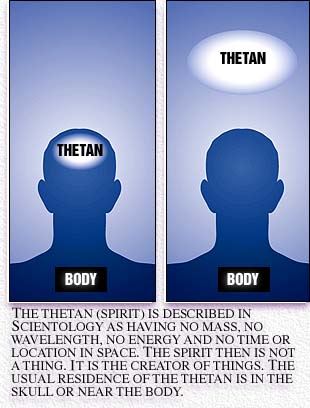
Thetan is the resultant identity. An identity has a localized form, and also a localized occurrence. Thus, a thetan has a location in space and time (see the picture above).

The thetan is considered to be the spirit, which is basically the aliveness of the body.

.