Particle & Void

Per Newton’s Definition I:

DEFINITION I: The quantity of matter is the measure of the same, arising from its density and bulk conjunctly.

Thus air of a double density, in a double space, is quadruple in quantity; in a triple space, sextuple in quantity. The same thing is to be understood of snow, and fine dust or powders, that are condensed by compression or liquefaction and of all bodies that are by any causes whatever differently condensed. I have no regard in this place to a medium, if any such there is, that freely pervades the interstices between the parts of bodies. It is this quantity that I mean hereafter everywhere under the name of body or mass. And the same is known by the weight of each body; for it is proportional to the weight, as I have found by experiments on pendulums, very accurately made, which shall be shewn hereafter.

The quantity of matter depends on how densely its particles are packed in a volume of space. We think of particle as a body of solid matter that is shaped like a ball. According to Wikipedia:

“A particle is a small localized object to which can be ascribed several physical or chemical properties such as volume, density or mass.”

On atomic scale, the nucleus of an atom is a particle; and the rest of atom is void. On a cosmic scale, a celestial body is a particle, and the empty space is void. The void separates the particles, and exists in the interstices of matter. The void is continuous.

Void is defined as the region, which is void of matter. Other than that, void may consist of substance that is not matter A physical substance would be anything that is felt physically. A substance is characterized by force.

The essential characteristic of substance is force. When there is force, there is also substance.

.

The Atomic Particle & Void
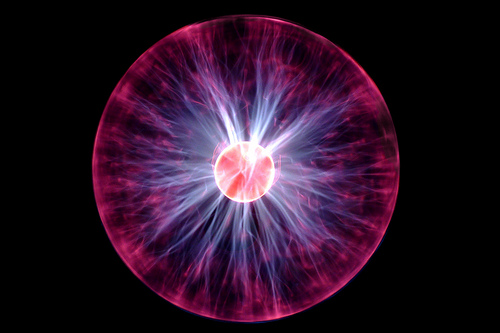
In his paper on Electrical Conduction & Nature of Matter Faraday explains that the property of electrical conductivity requires that atoms be in contact with each other. Therefore, the atomic void that separates the material nuclei must contain the characteristic of force. This indicates the presence of substance in the atomic void. There is no empty space in the atom.

In gases the atoms touch each other just as truly as in solids. In this respect the atoms of water touch each other whether that substance be in the form of ice, water or steam; no mere intervening space is present. Doubtless the centres of force vary in their distance one from another, but that which is truly the matter of one atom touches the matter of its neighbours.

To Faraday, the nuclei were the centers of the force that filled the void of the atom.

Hence matter will be continuous throughout, and in considering a mass of it we have not to suppose a distinction between its atoms and any intervening space. The powers around the centres give these centres the properties of atoms of matter; and these powers again, when many centres by their conjoint forces are grouped into a mass, give to every part of that mass the properties of matter. In such a view all the contradiction resulting from the consideration of electric insulation and conduction disappears.

Matter is substance concentrated in the nucleus, which then spreads out as the void. There is no such thing as empty space.

According to Faraday, the atomic void represents a substance of electromagnetic nature.

An atom consists of a force field that is converging toward the center while increasing in frequency. It gets extremely compacted at the center where it appear as mass of the nucleus. This electromagnetic force is a substance, and it needs to be recognized as such.

.

The Cosmic Particle & Void
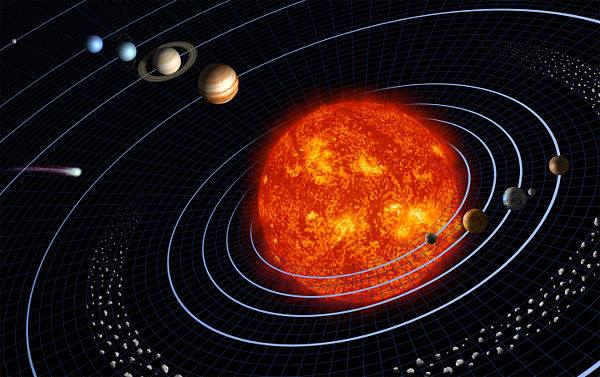
Substance in the cosmic void takes the form of radiation. In his paper on Thoughts on Ray Vibrations, Faraday proposes that the vibrations, by which radiant phenomena is recognized, may simply occur in the lines of force that fill the void.

The view which I am so bold to put forth considers, therefore, radiation as a kind of species of vibration in the lines of force which are known to connect particles and also masses of matter together. It endeavors to dismiss the aether, but not the vibration. The kind of vibration which, I believe, can alone account for the wonderful, varied, and beautiful phaenomena of polarization, is not the same as that which occurs on the surface of disturbed water, or the waves of sound in gases or liquids, for the vibrations in these cases are direct, or to and from the centre of action, whereas the former are lateral. It seems to me, that the resultant of two or more lines of force is in an apt condition for that action which may be considered as equivalent to a lateral vibration; whereas a uniform medium, like the aether, does not appear apt, or more apt than air or water.

This is a bold view put forth by Faraday. It dismisses aether of 19th century physicist but not vibration. These vibrations are direct or to and fro from the centers of action and not lateral like those on the surface of disturbed water, or the waves of sound in gases or liquids. The vibrations visualized by Faraday affected the very substance of space as they propagated through it. 

According to Faraday, the cosmic void represents substance of radiative nature.

Again, radiation is a substance, and it needs to be recognized as such.

.

The Substance of Particle and Void

In 1675, Newton first introduced his opinions regarding aether as follows:

A most subtle spirit which pervades all bodies by the force and action of which spirit the particles of bodies mutually attract one another, at near distances, and cohere, if contiguous;  and electric bodies operate at greater distances, as well repelling as attracting the neighbouring corpuscles; and light is emitted, reflected, refracted, inflected and heats bodies; and all sensation is excited, and the members of animal bodies move at the command of the will, namely, by the vibrations of this spirit, mutually propagated along the solid filaments of the nerves, from the outward organs of sense to the brain, and from the brain into the muscles.

Newton’s idea of aether and immovable space came about as a projection from the background of fixed stars, which he saw as relatively at rest,

Newton saw space to be filled with aetherial substance that was uniform and immovable.

The stars, however, appear to be fixed because of their immense distance and very large inertia. For aether to be immovable it must have infinite inertia. Faraday rejected the idea of aether and proposed radiation, defined by lines of force, to be the substance of space.

Faraday saw space to be filled with radiation that was varied and highly movable.

.

Summary

Faraday’s observations are amply proven by later discoveries. There is substance existing in the void in the form of electromagnetic force and radiation. Thus there is division of substance into matter and radiation.

There is no complete void.

.

Exercise: Walking Meditation #1

This walking meditation extroverts the mind while allowing stresses in the body to unwind. You may practice this meditation when you are having trouble meditating in a sitting position. Make sure you walk in a pleasant and safe place.

Meditation Exercise:

Walking Meditation on Body

Purpose:

To extrovert the mind while letting the body unwind.

Pre-requisites:

Study Walking Meditation.

Instructions:

Find a safe and pleasant environment, such as, a farm, park or a garden where you may spend half an hour without being disturbed. Start walking leisurely. 

Become aware of your natural breathing. Gradually become aware of your body from head to toe. Notice how the various parts of the body are moving. Notice how other parts of the body are being carried along. Observe and experience the body walking, stopping, turning, bending, stretching, etc. Get how the clothes feel on the body.

Start feeling the sensations present in the various parts of the body. Experience them fully one by one. Let any stresses unwind as they may. Do the same with any aches and pains present. Do not force anything. Let it all happen naturally. You let the stresses in the body unwind on their own, so the body starts to become increasingly relaxed.

All this while, you use your breathing as the stabilizing factor. In other words, whenever your attention strays you bring it back to your breathing and start experiencing the body again. Perceive the sensations, aches and pains in the body, just as they are, without interfering.

Continue this exercise for at least 20 minute. Let the stresses unwind as much as possible.

You may repeat this exercise as often as you wish.

End of Exercise:

When attention is extroverted and the body feels lighter, this exercise may be ended.

.

Old Geometry Book

Reference: Course on Mathematics

For application by the student

These sections are taken from PLANE AND SOLID GEOMETRY by George Wentworth and David Eugene Smith, first published in 1888.

G00 – Contents

G01 – Introduction

G02 – BOOK I. Rectilinear Figures

G03 – BOOK II. The Circle

G04 – BOOK III. Proportion. Similar Polygon

G05 – BOOK IV. Area of Polygons

G06 – BOOK V. Regular Polygons and Circles

G07 – Appendix to Plane Geometry

G08 – BOOK VI. Lines and Planes in Space

G09 – BOOK VII. Polyhedrons, Cylinders and Cones

G10 – BOOK VIII. The Sphere

G11 – Appendix to Solid Geometry

G12 – Miscellaneous & Index

.

Troubleshooting Math

To troubleshoot any difficulty you first look at the broad area of that difficulty, and then you gradually narrow it down until you have defined the actual difficulty precisely.

So, to troubleshoot a difficulty in math you start with the broad area of Mathematics.

Mathema (Greek) = Learn
Mathematics = Tools for learning

Mathematics provides you with analytical tools for learning. When you are troubleshooting mathematics, you are troubleshooting the difficulties a person is having with learning analytically. You narrow down to the area of mathematics where the person cannot think analytically.

Mathematics is analytical learning and not just memorizing of materials.

If the student is having trouble with higher mathematics, such as, Trignometry, Analytical Geometry, or Calculus, then start from there. You may explain the area the student does not understand. But if the student cannot understand the explanation analytically, then the troubleshooting may lead to one of the three areas below.

When you select one of these areas, explain it per Math Overview. You do not have to explain that whole document. Keep to the trail of trouble.

Ask, “What part of this area you have most difficulty with?”

Use the answer to narrow down further to the area of difficulty. Quiz the student on the key math vocabulary in that area. From student’s answers you may narrow down the area of difficulty further.

If the student cannot answer the question, simply start with the first lesson
related to that area at Mathematics. Follow student’s attention to fish around for the actual difficulty.

As you narrow down the area of difficulty, keep asking, “What part of this area you have most difficulty with?”

Check the key math vocabulary in the narrowed down area. Soon you’ll reach the actual difficulty. Handle it using the right materials selected from the appropriate level at Mathematics, or from student’s own materials.

Once that area is handled, the student may come up with another area that he or she has attention on. Narrow down to the actual difficulty in that area as above, and handle it.

Otherwise, start all over again from the diagram above. This time you may follow a different trail to a different area of difficulty.

Ultimately, teach the student how to troubleshhoot difficulties. This is the best thing you can ever do for the student.

.

The Background of Modern Physics

Copernicus (1473 – 1543)
Tycho Brahe (1546 – 1601)
Galileo Galilei (1564 – 1642)
Johannes Kepler (1571 – 1630)
René Descartes (1596 – 1650)
Robert Boyle (1627 – 1691)
Robert Hooke (1635 – 1703)
Christian Huygens (1629 – 1695)
Isaac Newton (1642 – 1726)

We start learning physics through mathematics that describes space and time in a material world. The mathematics uses the Cartesian coordinates, which assign continuity and uniformity to space and time. One learns to plot graphs of the relationships between space and time. These graphs describe the paths traced by moving particles of matter.

Matter appears in the form of particles because it is not continuous. Particle ends where void starts. The “void” is the empty space. Particles occupy space by displacing the void.  Particles move in the void. They have certain uniform velocities. These particles accelerate when pushed and their velocities change. When the force of the push goes away the velocity becomes uniform again.

We study the motion of particles in straight lines and in circles and spirals. This requires the consideration of more than one dimension of space. We consider motion to be relative because we can’t image a particle being at absolute rest. We find this subject of mechanics thoroughly explored by Newton, and so we study Newton’s Laws of Motion.

The background of modern physics started with simple concepts of void, particle, motion and force.

These concepts seem to model the big picture of the cosmos adequately, where the laws of motion apply to the satellites, planets and stars in the huge void. With a little modification, these concepts also appear to model the phenomenon of heat. This brings us to the laws of thermodynamics. Furthermore, these concepts are employed to explain the phenomena of sound, light, electricity, and magnetism . We see them used even in the explanation of atomic, nuclear and quantum phenomenon. In the succeeding chapters we shall review these basic concepts.

Physics is characterized by the scientific method, which started with Galileo. This method uses experiements and mathematics to establish consistency between theory and reality. The scientific method starts with certain postulates and assumptions. New discoveries are made when we examine past assumptions and improve upon them. This is where logic comes in.

This work stresses upon that logic.

.