HINDUISM: Coming of Age in the Universe

Reference: Hinduism

Note: The original Text is provided below.
Previous / Next

The universe is like the Kalpataru tree. It grants all wishes, but together with consequences. It wises the soul up as it passes through it.

.

Summary

.

Comments

.

Original Text

With God in pivotal position in the Hindu scheme, we can return to human beings to draw together systematically the Hindu concept of their nature and destiny. 

Individual souls, or jivas, enter the world mysteriously; by God’s power we may be sure, but how or for what reason we are unable fully to explain. Like bubbles that form on the bottom of a boiling teakettle, they make their way through the water (universe) until they break free into the limitless atmosphere of illumination (liberation). They begin as the souls of the simplest forms of life, but they do not vanish with the death of their original bodies. In the Hindu view spirit no more depends on the body it inhabits than body depends on the clothes it wears or the house it lives in. When we outgrow a suit or find our house too cramped, we exchange these for roomier ones that offer our bodies freer play. Souls do the same.

Worn-out garments
Are shed by the body:
Worn-out bodies
Are shed by the dweller. (Bhagavad-Gita, II:22)

This process by which an individual jiva passes through a sequence of bodies is known as reincarnation or transmigration of the soul—in Sanskrit samsara, a word that signifies endless passage through cycles of life, death, and rebirth. On the subhuman level the passage is through a series of increasingly complex bodies until at last a human one is attained. Up to this point the soul’s growth is virtually automatic. It is as if the soul were growing as steadily and normally as a plant and receiving at each successive embodiment a body that, being more complex, provides the needed largess for its new capabilities.

With the soul’s graduation into a human body, this automatic, escalator-like mode of ascent comes to an end. Its entry into this exalted habitation is evidence that the soul has reached self-consciousness, and with this estate come freedom, responsibility, and effort.

The mechanism that ties these new acquisitions together is the law of karma. The literal meaning of karma (as we encountered it in karma yoga) is work, but as a doctrine it means, roughly, the moral law of cause and effect. Science has alerted the West to the importance of causal relationships in the physical world. Every physical event, we are inclined to believe, has its cause, and every cause will have its determinate effects. India extends this concept of causation to include moral and spiritual life as well. To some extent the West has as well. “As a man sows, so shall he reap”; or again, “Sow a thought and reap an act, sow an act and reap a habit, sow a habit and reap a character; sow a character and reap a destiny”—these are ways the West has put the point. The difference is that India tightens up and extends its concept of moral law to see it as absolute; it brooks no exceptions. The present condition of each interior life—how happy it is, how confused or serene, how much it sees—is an exact product of what it has wanted and done in the past. Equally, its present thoughts and decisions are determining its future experiences. Each act that is directed upon the world has its equal and opposite reaction on oneself. Each thought and deed delivers an unseen chisel blow that sculpts one’s destiny.

This idea of karma and the completely moral universe it implies carries two important psychological corollaries. First, it commits the Hindu who understands it to complete personal responsibility. Each individual is wholly responsible for his or her present condition and will have exactly the future he or she is now creating. Most people are not willing to admit this. They prefer, as the psychologists say, to project—to locate the source of their difficulties outside themselves. They want excuses, someone to blame so that they may be exonerated. This, say the Hindus, is immature. Everybody gets exactly what is deserved—we have made our beds and must lie in them. Conversely, the idea of a moral universe closes the door on chance or accident. Most people have little idea how much they secretly bank on luck—hard luck to justify past failures, good luck to bring future successes. How many people drift through life simply waiting for the breaks, for that moment when a lucky lottery number brings riches and a dizzying spell of fame. If you approach life this way, says Hinduism, you misjudge your position pathetically. Breaks have nothing to do with protracted levels of happiness, nor do they happen by chance. We live in a world in which there is no chance or accident. Those words are simply covers for ignorance.

Because karma implies a lawful world, it has often been interpreted as fatalism. However often Hindus may have succumbed to this interpretation, it is untrue to the doctrine itself. Karma decrees that every decision must have its determinate consequences, but the decisions themselves are, in the last analysis, freely arrived at. To approach the matter from the other direction, the consequences of one’s past decisions condition one’s present lot, as a card player finds himself dealt a particular hand while remaining free to play that hand in a variety of ways. This means that the career of a soul as it threads its course through innumerable human bodies is guided by its choices, which are controlled by what the soul wants and wills at each stage of the journey.

What its wants are, and the order in which they appear, can be summarized quickly here, for previous sections have considered them at length. When it first enters a human body, a jiva (soul) wants nothing more than to taste widely of the sense delights its new physical equipment makes possible. With repetition, however, even the most ecstatic of these falls prey to habituation and grows monotonous, whereupon the jiva turns to social conquests to escape boredom. These conquests—the various modes of wealth, fame, and power—can hold the individual’s interest for a considerable time. The stakes are high and their attainment richly gratifying. Eventually, however, this entire program of personal ambition is seen for what it is: a game—a fabulous, exciting, history-making game, but a game all the same.

As long as it holds one’s interest, it satisfies. But when novelty wears off, when a winner has acknowledged with the same bow and pretty little speech the accolades that have come so many times before, he or she begins to yearn for something new and more deeply satisfying. Duty, the total dedication of one’s life to one’s community, can fill the need for a while, but the ironies and anomalies of history make this object too a revolving door. Lean on it and it gives, but in time one discovers that it is going round and round. After social dedication the only good that can satisfy is one that is infinite and eternal, whose realization can turn all experience, even the experience of time and apparent defeat, into splendor, as storm clouds drifting through a valley look different viewed from a peak that is bathed in sunshine. The bubble is approaching the water’s surface and is demanding final release.

The soul’s progress through these ascending strata of human wants does not take the form of a straight line with an acute upward angle. It fumbles and zigzags its way toward what it really needs. In the long run, however, the trend of attachments will be upward—everyone finally gets the point. By “upward” here is meant a gradual relaxation of attachment to physical objects and stimuli, accompanied by a progressive release from self-interest. We can almost visualize the action of karma as it delivers the consequences of what the soul reaches out for. It is as if each desire that aims at the ego’s gratification adds a grain of concrete to the wall that surrounds the individual self and insulates it from the infinite sea of being that surrounds it; while, conversely, each compassionate or disinterested act dislodges a grain from the confining dike. Detachment cannot be overtly assessed, however; it has no public index. The fact that someone withdraws to a monastery is no proof of triumph over self and craving, for these may continue to abound in the imaginations of the heart. Conversely, an executive may be heavily involved in worldly responsibilities; but if he or she manages them detachedly—living in the world as a mudfish lives in the mud, without the mud’s sticking to it—the world becomes a ladder to ascend.

Never during its pilgrimage is the human spirit completely adrift and alone. From start to finish its nucleus is the Atman, the God within, exerting pressure to “out” like a jack-in-the-box. Underlying its whirlpool of transient feelings, emotions, and delusions is the self-luminous, abiding point of the transpersonal God. Though it is buried too deep in the soul to be normally noticed, it is the sole ground of human existence and awareness. As the sun lights the world even when cloud-covered, “the Immutable is never seen but is the Witness; It is never heard but is the Hearer; it is never thought, but is the Thinker; is never known, but is the Knower. There is no other witness but This, no other knower but This.” But God is not only the empowering agent in the soul’s every action. In the end it is God’s radiating warmth that melts the soul’s icecap, turning it into a pure capacity for God.

What happens then? Some say the individual soul passes into complete identification with God and loses every trace of its former separateness. Others, wishing to taste sugar, not be sugar, cherish the hope that some slight differentiation between the soul and God will still remain—a thin line upon the ocean that provides nevertheless a remnant of personal identity that some consider indispensable for the beatific vision.

Christopher Isherwood has written a story based on an Indian fable that summarizes the soul’s coming of age in the universe. An old man seated on a lawn with a group of children around him tells them of the magic Kalpataru tree that fulfills all wishes. “If you speak to it and tell it a wish; or if you lie down under it and think, or even dream, a wish, then that wish will be granted.” The old man proceeds to tell them that he once obtained such a tree and planted it in his garden. “In fact,” he tells them, “that is a Kalpataru over there”.

With that the children rush to the tree and begin to shower it with requests. Most of these turn out to be unwise, ending in either indigestion or tears. But the Kalpataru grants them indiscriminately. It has no interest in giving advice.

Years pass, and the Kalpataru is forgotten. The children have now grown into men and women and are trying to fulfill new wishes that they have found. At first they want their wishes to be fulfilled instantly, but later they search for wishes that can be fulfilled only with ever-increasing difficulty.

The point of the story is that the universe is one gigantic Wishing Tree, with branches that reach into every heart. The cosmic process decrees that sometime or other, in this life or another, each of these wishes will be granted—together, of course, with consequences. There was one child from the original group, however, so the story concludes, who did not spend his years skipping from desire to desire, from one gratification to another. For from the first he had understood the real nature of the Wishing Tree. “For him, the Kalpataru was not the pretty magic tree of his uncle’s story—it did not exist to grant the foolish wishes of children—it was unspeakably terrible and grand. It was his father and his mother. Its roots held the world together, and its branches reached beyond the stars. Before the beginning it had been—and would be, always.”

.

JUDAISM: The Hallowing of Life

Reference: Judaism

[NOTE: In color are Vinaire’s comments.]

The basic manual for the hallowing of life is this Law, the first five books of the Bible, the Torah.

Up to this point in our effort to enter the Jewish perspective, we have been dealing with ideas as these occurred to the Jews in their struggle to make sense out of life. As an entrance to Judaism this serves a purpose, for ideas have a universality that makes them intelligible even to outsiders. We have reached a point, however, where (if we are to move deeper into the understanding of this faith) we must table further consideration of Jewish ideas and look at Jewish practices.

A deeper understand of Jewish faith comes from Jewish practices rather than from Jewish ideas.

We must consider Jewish ceremonies and observances, for it is generally agreed that Judaism is less an orthodoxy than an orthopraxis; Jews are united more by what they do than by what they think. One evidence of this is that Jews have never promulgated an official creed that must be accepted to belong to this faith. Observance, on the other hand—the circumcision of males, for example—is decisive. This emphasis on practice gives Judaism something of an oriental flavor; for whereas the West, influenced by the Greek partiality for abstract reason, emphasizes theology and creed, the East has approached religion through ritual and narrative. The difference is between the abstract and the concrete. Does Plato or Dostoevsky get closer to reality? Is love better expressed through words or an embrace?

Jews are united more by what they do than by what they think. This emphasis on practice gives Judaism something of an oriental flavor.

Before turning to Jewish ritual as such, it will be well to speak briefly of ritual in general, for despite its place in every religion we have thus far not addressed it directly. From a narrowly rational or utilitarian point of view, ritual is nonsense, a waste any way we look at it. All that money lavished on candles, cathedrals, prayer books, and incense; all the time spent in worship and sacrament; all the energy that goes into rising up and sitting down, kneeling and prostration, circumambulation and singing—to what end? It isn’t cost effective, we say. Moreover, it has about it an arbitrariness that makes it almost incomprehensible from the outside. A popular magazine carries a photograph of a chief-of-state rubbing noses with an Eskimo. To Eskimos rubbing noses is a friendship ritual. To us it’s simply funny.

From a narrowly rational or utilitarian point of view, rituals, in general, are nonsense.

Yet with all its arbitrariness and seeming waste, ritual plays a part in life that nothing else can fill, a part that is by no means confined to religion. For one thing, it eases us through tense situations and times of anxiety. Sometimes the anxiety is mild—during introductions, for example. I am introduced to a stranger. Not knowing how he or she will respond, I don’t know how to proceed. What should I say? What should I do? Ritual covers my uncertainty and awkwardness. It tells me to extend my hand and say “How do you do?” or “I’m pleased to meet you.” And in so doing it brings form out of chaos. It provides the moment I need to get my bearings. The awkwardness is over. I have recovered my balance and am ready to explore freer behavior.

Like postulates, rituals also provide some stability to ease us through tense situations and times of anxiety. 

If we need ritual to help us through situations as inconsequential as a casual introduction, how much more when we find ourselves really at a loss. Death is the glaring example. Stunned by tragic bereavement, we would founder completely if we were thrown on our own and had to think our way through the ordeal. This is why death, with its funerals and memorial services, its wakes and sitting shiva, is the most ritualized rite of passage. Ritual, with its prepared score to orchestrate the occasion, channels our actions and feelings at a time when solitude would be unbearable. And in the process it softens the blow. “Ashes to ashes, dust to dust”—the words don’t say whose ashes, for this is everybody; all of us. Ritual also rouses courage: “The Lord giveth and the Lord taketh away; blessed be the name of the Lord!” Finally, ritual sets death in perspective, connecting this particular death with its universal archetype. The deceased takes his or her place in the company of humankind, one step in the endless march of life into death and death into life again, with the continuum stretching both ways toward eternity.

Death, with its funerals and memorial services, its wakes and sitting shiva, is the most ritualized rite of passage. 

From the triviality of an introduction to the trauma of death, ritual smooths life’s transitions as perhaps nothing else can. But it also serves another function. In times of happiness it can intensify experience and raise joy to celebration. Here the examples are birthdays, weddings, and most simply a family’s evening meal. Here, in this best meal of the day, when perhaps for the first time the family is relaxed and together, a blessing can be something more than the starting line for a food race. It can hallow the occasion. The opposite of dead weight, it consecrates a daily pleasure.

Rituals like birthdays, weddings, and most simply a family’s evening meal, can intensify experience and raise joy to celebration.

Against these background observations concerning the place of ritual in life generally, we turn now to its place in Judaism, where it aims to hallow life—ideally, all life. The nineteenth chapter of Leviticus capsules the point when God says to Moses, “You shall be holy for I, your God, am holy!” What does holiness involve? To many moderns the word is empty; but those who feel the stir of wonder and can sense the ineffable pressing in on their lives from every side will know what Plato was talking about when he wrote, “First a shudder runs through you, and then the old awe creeps over you.” Those who have had such experiences will know the blend of mystery, ecstasy, and the numinous, which received classic description in Rudolph Otto’s The Idea of the Holy.

Rituals in Judaism aim to hallow life—to honor it as holy— to feel the awe of ineffable creeping over you.

To speak of the hallowing of life in Judaism is to refer to its conviction that all life down to its smallest element can, if rightly approached, be seen as a reflection of the infinite source of holiness, which is God. The name for this right approach to life and the world is piety, carefully distinguished from piosity, its counterfeit. In Judaism piety prepares the way for the coming of God’s kingdom on earth: the time when everything will be redeemed and sanctified and the holiness of all God’s creation will be transparently evident.

The hallowing of life in Judaism is to refer to its conviction that all life down to its smallest element can, if rightly approached, be seen as a reflection of the infinite source of holiness, which is God. 

The secret of piety consists in seeing the entire world as belonging to God and reflecting God’s glory. To rise in the morning on seeing the light of a new day, to eat a simple meal, to see a stream running between mossy stones, to watch the day slowly turn into evening—even small things like these can mirror God’s majesty. “To the religious man,” writes Abraham Heschel, “it is as if things stood with their backs to him, their faces turned to God.” To accept the good things of life, most of which come to us quite apart from our own efforts, as if they were matters of course without relating them to God, is quite wrong. In the Talmud to eat or drink without first making a blessing over the meal is compared to robbing God of his property. Through all Judaism runs this double theme: We should enjoy life’s goodness, and at the same time we should augment this joy by sharing it with God, just as any joy we feel is augmented when shared with friends. Jewish law sanctions all the good things of life—eating, marriage, children, nature, while elevating them all to holiness. It teaches that people should eat, that they should prepare their tables in the presence of the Lord. It teaches that people should drink, that they should use wine to consecrate the Sabbath. It teaches that people should be merry, that they should dance around the Torah. 

Through all Judaism runs this double theme: We should enjoy life’s goodness, and at the same time we should augment this joy by sharing it with God, just as any joy we feel is augmented when shared with friends. 

If we ask how this sense of the sanctity of all things is to be preserved against the backwash of the world’s routine, the Jew’s chief answer is: through tradition. Without attention, the human sense of wonder and the holy will stir occasionally, but to become a steady flame it must be tended. One of the best ways to do this is to steep oneself in a history that cries aloud of God’s providential acts and mercy in every generation. Against those who would throw the past away with both hands that they may grasp the present more firmly, Judaism accounts the memory of the past a priceless treasure. The most historically minded of all the religions, it finds holiness and history inseparable. In sinking the roots of their lives deep into the past, the Jews draw nourishment from events in which God’s acts were clearly visible. The Sabbath eve with its candles and cup of sanctification, the Passover feast with its many symbols, the austere solemnity of the Day of Atonement, the ram’s horn sounding the New Year, the scroll of the Torah adorned with breastplate and crown—the Jew finds nothing less than the meaning of life in these things, a meaning that spans the centuries in affirming God’s great goodness to God’s people. Even when Jews recall their tragedies and the price their survival has exacted of them, they are vividly aware of God’s sustaining hand. “To live by the Law,” writes a recent Jewish philosopher, “is to live within time the life of eternity.”

The human sense of wonder and the holy must be tended constantly by steeping oneself in a history that cries aloud of God’s providential acts and mercy in every generation. 

The basic manual for the hallowing of life is this Law, the first five books of the Bible, the Torah. When in the traditional synagogue service the time comes for returning the Torah to the Ark, the people recite a line from the Book of Proverbs: “It is a tree of life to those who grasp it.” There is meaning in this simile, for a tree is symbolic of life itself, of the miracle whereby inert elements of sun and rain and soil are drawn into the mystery of growth. So, too, for the Jews, the Torah. It too is a creative power that can elicit and sustain holiness in the lives of those whose flowering world would otherwise become dry stones. “It is a tree of life to those who grasp it.”

The basic manual for the hallowing of life is this Law, the first five books of the Bible, the Torah.

HINDUISM: “Thou Before Whom All Words Recoil”

Reference: Hinduism

Note: The original Text is provided below.
Previous / Next

God is the ultimate postulate. It is Sat, Chit, Ananda—the oneness of existence, the consciousness of things as they are, and the bliss of total comprehension.

.

Summary

.

Comments

.

Original Text

The first principle of Japanese ikebana flower arrangement is to learn what to leave out. This is also the first principle to be learned in speaking of God, the Hindus insist. People are forever trying to lay hold of Reality with words, only in the end to find mystery rebuking their speech and their syllables swallowed by silence. The problem is not that our minds are not bright enough. The problem lies deeper. Minds, taken in their ordinary, surface sense, are the wrong kind of instrument for the undertaking. The effect, as a result, is like trying to ladle the ocean with a net, or lasso the wind with a rope. The awe-inspiring prayer of Shankara, the Thomas Aquinas of Hinduism, begins with the invocation, “Oh Thou, before whom all words recoil.”

The human mind has evolved to facilitate survival in the natural world. It is adapted to deal with finite objects. God, on the contrary, is infinite and of a completely different order of being from what our minds can grasp. To expect our minds to corner the infinite is like asking a dog to understand Einstein’s equation with its nose. This analogy becomes misleading if, pressed in a different direction, it suggests that we can never know the Abysmal God. The yogas, we have seen, are roads to precisely such realization. But the knowledge to which they lead transcends the knowledge of the rational mind; it rises to the deep yet dazzling darkness of the mystical consciousness. The only literally accurate description of the Unsearchable of which the ordinary mind is capable is neti…neti, not this…not this. If you traverse the length and breadth of the universe saying of everything you can see and conceive, “not this…not this,” what remains will be God.

And yet words and concepts cannot be avoided. Being the only equipment at our mind’s disposal, any conscious progress toward God must be made with their aid. Though concepts can never carry the mind to its destination, they can point in the right direction. 

We may begin simply with a name to hang our thoughts on. The name the Hindus give to the supreme reality is Brahman, which has a dual etymology, deriving as it does from both br, to breathe, and brih, to be great. The chief attributes to be linked with the name are sat, chit, and ananda; God is being, awareness, and bliss. Utter reality, utter consciousness, and utterly beyond all possibility of frustration—this is the basic Hindu view of God. Even these words cannot claim to describe God literally, however, for the meanings they carry for us are radically unlike the senses in which they apply to God. What pure being would be like, being infinite with absolutely nothing excluded, of this we have scarcely an inkling. Similarly with awareness and joy. In Spinoza’s formulation God’s nature resembles our words about as much as the dog star resembles a dog. The most that can be said for these words is that they are pointers; our minds do better to move in their direction than in the opposite. God lies on the further side of being as we understand it, not nothingness; beyond minds as we know them, not mindless clay; beyond ecstasy, not agony. 

This is as far as some minds need go in their vision of God: infinite being, infinite consciousness, infinite bliss—all else is at best commentary, at worst retraction. There are sages who can live in this austere, conceptually thin atmosphere of the spirit and find it invigorating; they can understand with Shankara that “the sun shines even without objects to shine upon.” Most people, however, cannot be gripped by such high-order abstractions. That C. S. Lewis is among their number is proof that their minds are not inferior, only different. Professor Lewis tells us that while he was a child his parents kept admonishing him not to think of God in terms of any form, for these could only limit his infinity. He tried his best to heed their instructions, but the closest he could come to the idea of a formless God was an infinite sea of grey tapioca. 

This anecdote, the Hindus would say, points up perfectly the circumstance of the man or woman whose mind must bite into something concrete and representational if it is to find life-sustaining meaning. Most people find it impossible to conceive, much less be motivated by, anything that is removed very far from direct experience. Hinduism advises such people not to try to think of God as the supreme instance of abstractions like being or consciousness, and instead to think of God as the archetype of the noblest reality they encounter in the natural world. This means thinking of God as the supreme person (Ishvara or Bhagavan), for people are nature’s noblest crown. Our discussion of bhakti yoga, the path to God through love and devotion, has already introduced us to God conceived in this way. This, in Pascal’s Western idiom, is the God of Abraham, Isaac, and Jacob, not the God of the philosophers. It is God as parent, lovingly merciful, omniscient, almighty, our eternal contemporary, the companion who understands.

God so conceived is called Saguna Brahman, or God-with-attributes as distinct from the philosophers’ more abstract Nirguna Brahman, or God-without-attributes. Nirguna Brahman is the ocean without a ripple; Saguna Brahman the same ocean alive with swells and waves. In the language of theology, the distinction is between personal and transpersonal conceptions of God. Hinduism has included superb champions of each view, notably Shankara for the transpersonal and Ramanuja for the personal; but the conclusion that does most justice to Hinduism as a whole and has its own explicit champions like Sri Ramakrishna is that both are equally correct. At first blush this may look like a glaring violation of the law of the excluded middle. God may be either personal or not, we are likely to insist, but not both. But is this so? What the disjunction forgets, India argues, is the distance our rational minds are from God in the first place. Intrinsically, God may not be capable of being two contradictory things—we say may not because logic itself may melt in the full blaze of the divine incandescence. But concepts of God contain so much alloy to begin with that two contradictory ones may be true, each from a different angle, as both wave and particles may be equally accurate heuristic devices for describing the nature of light. On the whole India has been content to encourage the devotee to conceive of Brahman as either personal or transpersonal, depending on which carries the most exalted meaning for the mind in question.

God’s relation to the world likewise varies according to the symbolism that is embraced. Conceived in personal terms, God will stand in relation to the world as an artist to his or her handiwork. God will be Creator (Brahma), Preserver (Vishnu), and Destroyer (Shiva), who in the end resolves all finite forms back into the primordial nature from which they sprang. On the other hand, conceived transpersonally, God stands above the struggle, aloof from the finite in every respect. “As the sun does not tremble, although its image trembles when you shake the cup filled with water in which the sun’s light is reflected; thus the Lord also is not affected by pain, although pain be felt by that part of him which is called the individual soul.” The world will still be God-dependent. It will have emerged in some unfathomable way from the divine plenitude and be sustained by its power. “He shining, the sun, the moon and the stars shine after Him; by His light all is lighted. He is the Ear of the ear, the Mind of the mind, the Speech of the speech, the Life of life, the Eye of the eye.” But God will not have intentionally willed the world, nor be affected by its inherent ambiguity, imperfections, and finitude.

The personalist will see little religious availability in this idea of a God who is so far removed from our predicaments as to be unaware of our very existence. Is it not religion’s death to despoil the human heart of its final treasure, the diamond of God’s love? The answer is that God serves an entirely different function for the transpersonalist, one that is equally religious, but different all the same. If one is struggling against a current it is comforting to have a master swimmer by one’s side. It is equally important that there be a shore, solid and serene, that lies beyond the struggle as the terminus of all one’s splashings. The transpersonalist has become so possessed by the goal as to forget all else, even the encouragement of supporting companions.

.

Physics I: Chapter 15

Reference: Beginning Physics I

CHAPTER 15: THERMODYNAMICS I: TEMPERATURE & HEAT

.

KEY WORD LIST

Macroscopic Systems, Thermodynamics, Quasistatic Systems, Thermodynamic Variables, Mechanical Equilibrium, Chemical Equilibrium, Thermal Equilibrium, Thermodynamic Equilibrium, Temperature, Zeroth Law of Thermodynamics, Thermometric Property, Celsius Scale, Ice Point, Steam Point, Fahrenheit Scale, Thermometer, Constant Volume Gas Thermometer, Kelvin Temperature Scale, Rankine Temperature Scale, Triple Point, Coefficient of Linear Expansion, Caloric, Thermal Energy, Heat, Internal Energy, Calorie, British Thermal Unit, Specific Heat, Heat Capacity, Calorimetry, Heat of Fusion, Heat of Vaporization, Heat of Sublimation, P-T Diagram, Evaporation

.

GLOSSARY

For details on the following concepts, please consult CHAPTER 15.

MACROSCOPIC SYSTEMS
These are large systems that are characterized by their having myriad atoms and/or molecules. They depend on the myriad random motions and interactions of the component atoms and molecules, rather than their lockstep behavior.

THERMODYNAMICS
Thermodynamics deals with macroscopic systems. More specifically, it deals with the relations between heat and other forms of energy (such as mechanical, electrical, or chemical energy), and, by extension, of the relationships between all forms of energy.

QUASISTATIC SYSTEMS
Quasistatic systems mean that they are in mechanical, chemical, and thermal equilibrium, or that their properties vary so slowly that they can be described at any instant as if in equilibrium.

THERMODYNAMIC VARIABLES
Thermodynamic variables (or macroscopic variables) are physical properties, such as, volume and internal energy, which describe the system as a whole. Most other thermodynamic variables, such as, pressure and temperature can be defined only if the system is quasistatic.

MECHANICAL EQUILIBRIUM
This is understood to mean not only that the system as a whole does not accelerate, but that within the system the different parts are in mechanical equilibrium with each other —no churning of fluids and no pressure imbalances.

CHEMICAL EQUILIBRIUM
A system in mechanical equilibrium may still undergo change through a chemical reaction. The system is in chemical equilibrium when there is no change in chemical composition taking place.

THERMAL EQUILIBRIUM
A system in mechanical and chemical equilibrium may still undergo change in temperature. Two objects in thermal equilibrium with each other are also said to be at the same temperature.

THERMODYNAMIC EQUILIBRIUM
A system that is in mechanical, chemical and thermal equilibrium with its surroundings, as well as internally is said to be in thermodynamic equilibrium. Thermodynamic equilibrium means that there is no change on the macroscopic level.

TEMPERATURE
Temperature is a numerical value that we assign to each thermal equilibrium state of a system as determined by some agreed-upon procedure.

ZEROTH LAW OF THERMODYNAMICS
If two systems A and B are each found to be in thermal equilibrium with a third system C, then when the two systems A and B are brought into contact with each other, they are themselves found to be in thermal equilibrium.

THERMOMETRIC PROPERTY
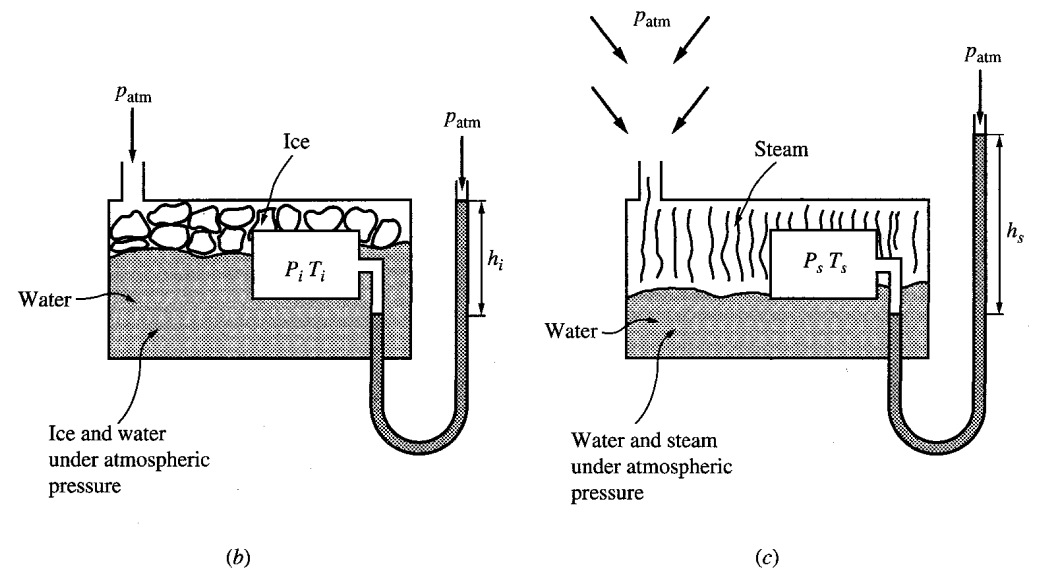
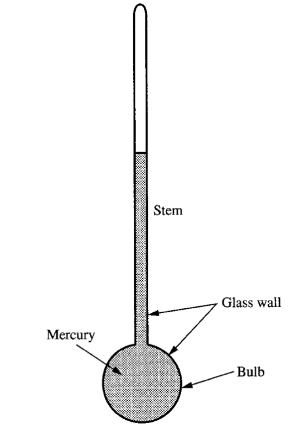
A thermometric property is a property that varies with the thermal equilibrium states in a well-defined and reproducible way. For example, mercury in a sealed hollow bulb attached to a long, thin hollow glass stem. When mercury expands or contracts with change in the thermal equilibrium state, small changes in its volume are observable from its height in the thin stem.

CELSIUS SCALE
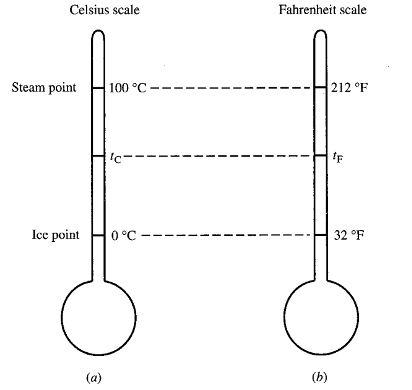
This is the most widely used temperature scale that assigns the number tC = 0°C for the ice point, and tC =100°C for steam point at atmospheric pressure. The distance between these two points is divided into 100 equal marked intervals labeled in 1°C steps.

ICE POINT
The point at which ice and water are in thermal equilibrium at atmospheric pressure.

STEAM POINT
The point at which steam, and water are in thermal equilibrium at atmospheric pressure.

FAHRENHEIT SCALE
On this scale the ice point and steam point are defined as tF = 32°F and tF = 212°F respectively, and the distance between these two points is divided into 180 equal marked intervals labeled in 1°F steps.

THERMOMETER
A thermometer is a temperature-calibrated mercury system, which can be used to measure the temperature of any other object. However, the temperature scale shall be dependent on the material being used to define it.

CONSTANT VOLUME GAS THERMOMETER
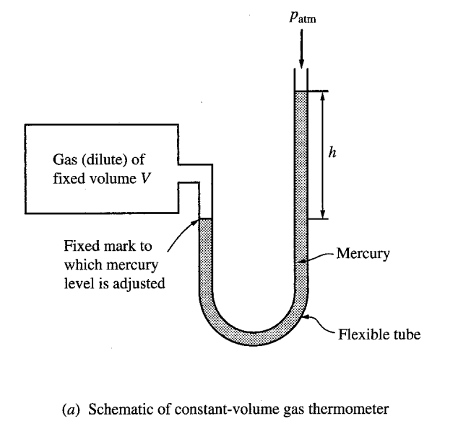
This thermometer consists of a gas confined to a fixed volume, with an open-tube manometer used to measure the pressure of the gas inside. Constant volume gas thermometer is often considered the “standard” against which other thermometers are calibrated.

KELVIN TEMPERATURE SCALE
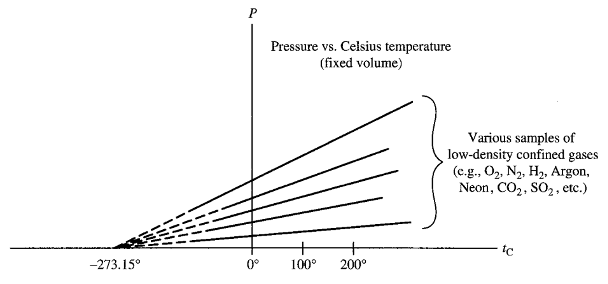
The graphs of pressure vs. temperature of all very low-density gases at fixed volumes are straight lines. When extrapolated these straight lines intersect the temperature axis at the same point: -273.15°C. On the basis of this result, one defines the Kelvin (or absolute) temperature scale. It is same as the Celsius Scale with its zero shifted to “-273.15°C”.

T = tC + 273.15

RANKINE TEMPERATURE SCALE
This is the Kelvin scale using the Fahrenheit degree rather than the Celsius degrees.

TR = tF + 459.67

TRIPLE POINT
The triple point is the temperature, tC = 0.01°C, at which all three phases of water—solid, liquid, and vapor—coexist.

COEFFICIENT OF LINEAR EXPANSION
If we have a rod of length L at a given absolute temperature and we increase the temperature by a small amount ∆T, we find that the length of the rod increases b an amount ∆L that is proportional to the original length L and to the temperature increase ∆T:

L = a LT

The proportionality constant a is called the coefficient of linear expansion; it depends on the material of which the rod is made.

CALORIC
Early scientists believed that some invisible and weightless substance, which they called caloric, flows from a hotter to cooler object until both objects reach thermal equilibrium.

THERMAL ENERGY
It became clear through the efforts of Joule and others that it is not caloric but thermal energy that is transferred between two macroscopic systems in contact.

HEAT
Heat is the thermal energy transfer from one system to another. Heat is actually the statistical “summing up” of the mechanical work done by the random interactions of the individual atoms and molecules of the two systems.

INTERNAL ENERGY
Related to heat is the internal energy that resides in a system due to the random motion and jiggling of the myriad atoms and molecules making up that system.

CALORIE (CAL)
A calorie is defined as the “amount of heat” (thermal energy in transit) necessary (at atmospheric) to raise the temperature of 1 gram of water 1°C. 1 cal = 4.184 J

BRITISH THERMAL UNIT (BTU)
A Btu is the amount of heat necessary to raise 1 lb of water 1°F. The conversion is 1 Btu = 252 cal.

SPECIFIC HEAT (c)
The specific heat is the characteristic amount of heat that flows into a unit mass of a given substance and raises its temperature by 1°. For solids and liquids, heat is transferred under constant atmospheric pressure.

HEAT CAPACITY (C)
Heat capacity is the total amount of heat needed to produce a degree rise in temperature.

CALORIMETRY
Calorimetry is the experimental measurements of specific heats and other heat constants.

HEAT OF FUSION (Lf)
Heat of fusion is the amount of heat added to melt each unit mass of substance at the melting point (under normal atmospheric pressure).

HEAT OF VAPORIZATION (Lv)
Heat of vaporization is the amount of heat added to vaporize each unit mass of substance at the boiling point (under normal atmospheric pressure).

HEAT OF SUBLIMATION (Ls)
Heat of sublimation is the amount of heat added to sublimate each unit mass of substance at the sublimation point (under normal atmospheric pressure).

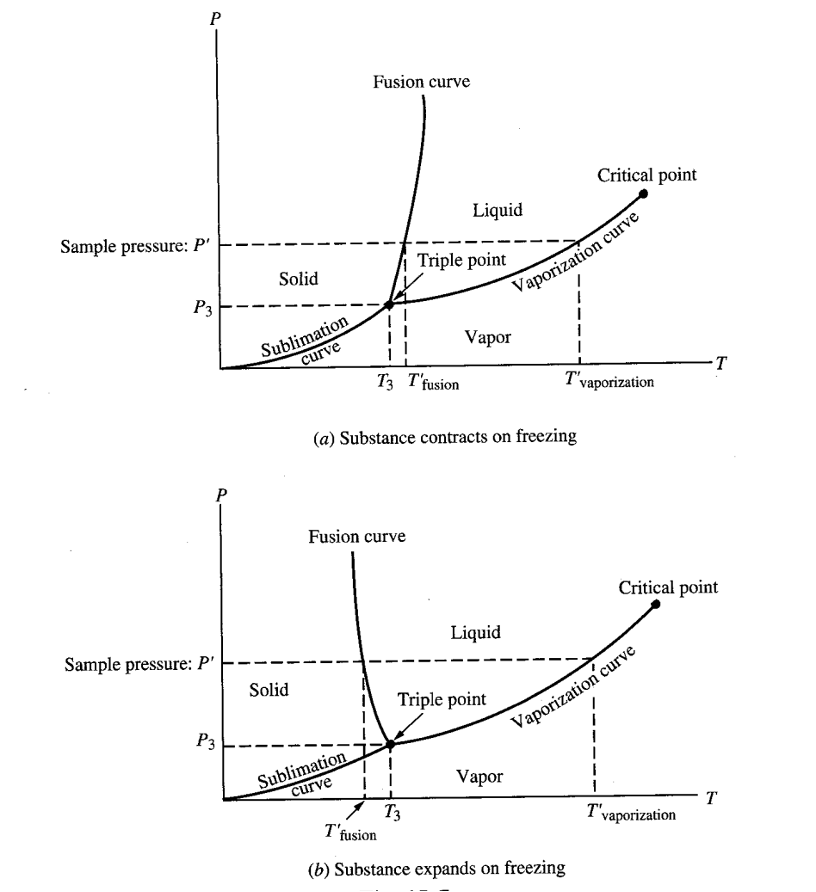
P-T DIAGRAM
The P-T diagram keeps track of phase changes. For a pure substance the diagram will resemble the following.

EVAPORATION
Evaporation takes place at the surface of the liquid in contact with a gas at a given pressure. At temperatures well below the boiling point, molecules from the liquid that are particularly energetic can break free and rise above the liquid to form a vapor. The evaporating molecules take away the thermal energy with them—on average the amount of energy per unit mass is the same order of magnitude as the heat of vaporization for boiling. Thus the evaporation process removes heat from the liquid, cooling it and anything in contact with it.

.

JUDAISM: Meaning in Messianism

Reference: Judaism

[NOTE: In color are Vinaire’s comments.]

Whether we read it in its Jewish, its Christian, its secular, or its heretical version, the underlying messianic theme has always been that of hope. 

Though the Jews were able to find their suffering meaningful, meaning for them did not end there. It climaxed in Messianism. 

We can work our way into this concept by way of an arresting fact. The idea of progress—belief that the conditions of life can improve, and that history can in this sense get somewhere—originated in the West. Insofar as other peoples have come to this notion, they have acquired it from the West.

The idea of progress—belief that the conditions of life can improve, and that history can in this sense get somewhere—originated in the West.

Striking as this fact is, it seems explicable. If we confine ourselves to the two other enduring civilizations—South Asian, centering in India, and East Asian, centering in China and its cultural offshoots—we find that their presiding outlooks were forged by people who were in power; in India these were the brahmins, and in China the literati. By contrast, the West’s outlook was decisively shaped in this matter by the Jews, who for most of their formative period were underdogs. Ruling classes may be satisfied with the status quo, but underdogs are not. Unless their spirits have been crushed, which the Jewish spirit never was, oppressed people hope for improvement. This hope gave the biblical Jews a forward and upward looking cast of mind. They were an expectant people—a people who were waiting, if not to throw off the yoke of the oppressor, then to cross over into the promised land.

The West’s outlook was decisively shaped in this matter by the Jews, who for most of their formative period were underdogs. 

Sweet, sweet the open spreading fields
Lay decked in shining green;
So to the Jews fair Canaan stood,
While Jordan rolled between.

To sum up the matter: Underdogs have only one direction to look, and it was the upward tilt of the Jewish imagination that eventually led the West to conclude that the conditions of life as a whole might improve. 

Oppressed people hope for improvement. The Biblical Jews were waiting, if not to throw off the yoke of the oppressor, then to cross over into the promised land.

Hope has more purchase on the human heart when it is rendered concrete, so eventually Jewish hope came to be personified in the figure of a coming Messiah. Literally, Messiah (from the Hebrew mashiah) means “anointed”; but as kings and high priests were anointed with oil, the terms became a title of honor, signifying someone who had been elevated or “chosen.” During the Babylonian Exile the Jews began to hope for a redeemer who would effect the “ingathering of the exiles” to their native homeland. After the second destruction of the Temple (70 C.E.), the honorific title “Messiah” was used to designate the person who would rescue them from that diaspora. 

During the Babylonian Exile the Jews began to hope for a redeemer who would effect the “ingathering of the exiles” to their native homeland. 

Things, though, are never this simple, and in the course of time the messianic idea became complex. Its animating concept was always hope, and this hope always had two sides to it: the politico-national side (which foresaw the triumph of the Jews over their enemies and their elevation to a position of importance in world affairs), and a spiritual-universal side (in which their political triumph would be attended by a moral advance of worldwide proportions).

They shall beat their swords into plowshares, and their spears
into pruning hooks;
nation shall not lift up sword against nation,
neither shall they learn war any more. (Isaiah 2:4)

These three features of the messianic idea—hope, national restitution, and world upgrade—remained constant, but within this stable framework differing scenarios were scripted. 

The messianic idea had the stable framework of hope, national restitution, and world upgrade.

One important difference concerned the way the messianic age would arrive. Some expected an actual Messiah to appear—a priest or king who, as God’s deputy, would effect the new order. On the other side were those who thought God would dispense with a human agent and intervene directly. The latter view, appropriately called the messianic expectation, hoped for “an age in which there would be political freedom, moral perfection, and earthly bliss for the people of Israel in their own land, and also for the entire human race.” The first concept includes everything in the second, but adds the figure of a lofty and exalted political and spiritual human personality, who comes to prepare the world for the Almighty’s kingdom. 

It hoped for an age in which there would be political freedom, moral perfection, and earthly bliss for the people of Israel in their own land, and also for the entire human race.

A second tension reflected the restorative and utopian impulses within Judaism generally. Restorative Messianism looked for the recreation of past conditions, typically the Davidic monarchy but now idealized. Here hope turned backward to the reestablishment of an original state of things and to a “life lived with the ancestors.” But Messianism also accommodated Judaism’s forward-looking impulse, so there were versions that were utopian in envisioning a state of things that never before existed.

Restorative Messianism looked for the recreation of past conditions, typically the Davidic monarchy but now idealized. But Messianism also envisioned a state of things that never before existed.

Finally, Messianists differed concerning whether the new order would be continuous with previous history or would shake the world to its foundations and replace it (in the End of Days) with an aeon that was supernaturally different in kind. As the power of the Jews dwindled in the face of a rising Europe, and hope of political restoration in Israel seemed increasingly impossible, the expectation of a miraculous redemption strangled political yearnings. Apocalypticism, elements of which are visible in the prophets themselves, replaced hopes for military victory. The Messianic Age would break in at any moment, abruptly and cataclysmically. Mountains would crumble and the seas boil. The laws of nature would be abrogated to make way for a divine order that was unimaginable save that the “birth pangs of the Messianic Age”—its fearful images excited by terrors the Jews were actually experiencing—would be followed by peace. Thus even this apocalyptic version contained a utopian element. Peril and dread were balanced by consolation and redemption.

Finally, there was also an element of the Messianic Age breaking in at any moment, abruptly and cataclysmically, and to be followed by peace. 

In all three of these polarities the alternatives were deeply intertwined, while being contradictory by nature. The messianic idea crystallized and retained its vitality out of the tensions created by its ingredient opposites. Nowhere do we find a pure case of one without the other; only the proportions between them fluctuated, often wildly. The direction in which the pendulum swung was determined by historical events and the individual character of their proclaimers, a number of whom—the “false messiahs”—assumed the messianic title for themselves and in several instances attracted large followings. In periods when the Israelites were still living an independent political life in their own land, ethical perfection and earthly bliss were emphasized; whereas in periods of subjugation and exile the yearning for political freedom was more prominent. In times of national freedom the worldwide, universalistic part of the hope was basic; but in times of trouble and distress the nationalistic element came to the fore. Throughout, however, the political component went arm in arm with the ethical, and the nationalistic with the universal. Political and spiritual longings united, as did hopes for themselves and the world at large. Both themes figure in Zionism, the modern movement for political and spiritual renewal of the Jewish people, which helped the Jews return to Palestine and found the State of Israel in 1948.

Throughout, however, the political component went arm in arm with the ethical, and the nationalistic with the universal. Political and spiritual longings united, as did hopes for themselves and the world at large. 

So we return to the underlying messianic theme, which is hope. Moving into Christianity, it took the form of the Second Coming of Christ. In seventeenth—century Europe it surfaced as the idea of historical progress, and in the nineteenth century it assumed Marxist idiom in the vision of a coming classless society. But whether we read it in its Jewish, its Christian, its secular, or its heretical version, the underlying theme is the same. “There’s going to be a great day!” That says it prosaically. Martin Luther King, Jr., drawing his images from the Prophet Isaiah, said it rhetorically in his address to the audience of 200,000 in the 1968 civil rights March on Washington.

I have a dream today.
I have a dream that one day every valley shall be exalted, every hill
and mountain shall be made low, the rough places will be made plain,
and the crooked places will be made straight, and the glory of the Lord
shall be revealed, and all flesh shall see it together.

The underlying messianic theme has always been that of hope. 

.