
KHTK Postulates for Metaphysics – Part 1 (old)

alone-on-a-boat-fishing

Please see Course on Subject Clearing

I shall start these postulates with what Buddha declared.

KHTK Postulate M-0: The Absolute Truth is that there is nothing absolute in the world, that everything is relative, conditioned and impermanent, and that there is no unchanging, everlasting, absolute substance like Self, Soul, or Ātman within or without.

DEFINITION: Absolute means, “Viewed independently; not comparative or relative; ultimate; intrinsic.”

This postulate may appear self-contradictory to some, but it essentially says, “There are no absolute certainties.” This is reflected in one of the most ancient hymns, The Creation Hymn of Rig Veda.

All certainties are relative. This statement does not degrade any certainty we have. It simply means that one can always come up with a better certainty.

That is how science makes progress. Einstein declared the speed of light to be a universal constant. This is a certainty for now, but there may possibly be a wider context in which the speed of light is a special case.

Similarly, in the field of spirituality, we cannot be absolutely certain that self or soul is permanent. The phenomenon that is described as self or soul must be open to further investigation.

There is no progress possible for a person who believes his certainties to be absolute.

Reference: The Quest for Certainty

.

KHTK Postulate M-1: Awareness is primordial disturbance.

Awareness is known to arise, change and disappear. It may be likened to a disturbance that arises, changes and disappears. We may assume some ground state, which when disturbed gives rise to awareness.

However, the ground state shall forever be unknowable and shall remain only theoretical because there is no awareness to go with it. Awareness arises only when this ground state is disturbed. Therefore, awareness is something relative and not absolute.

Reference: The Ultimate Reality

.

KHTK Postulate M-2: Consciousness (self-awareness) is primordial light.

Awareness is aware by its very nature. This self-awareness is called consciousness.

Since awareness seems to be disturbance, and science recognizes light (electromagnetic wave) as the most basic form of disturbance in nature, there is some justification in associating consciousness with light. It appears that this association of consciousness with light has been made on an intuitive basis since ancient times.

Consciousness may be regarded as something spiritual as opposed to physical. But spiritual and physical states are neither absolute nor independent. This is similar to the case with space and time which are found by the scientific investigation to be neither absolute nor independent.

For a long time space and time were regarded as absolute concepts in themselves. Newtonian mechanics built on that consideration is still very successful but in a limited scope on earth. Einstein’s Theory of Relativity, when considering a cosmic scale, finds space and time to be relative. Similarly, Abrahamic religions have long regarded spiritual and physical states to be absolute in themselves. This has been adequate for a limited understanding of human consciousness. But to understand consciousness on cosmic scale we need to consider spiritual and physical states to be relative. A spiritual state will have physical form, no matter how subtle. And a physical state will have some spiritual characteristics, no matter how subdued.

Thus, we may say with some confidence that self-awareness, or consciousness, has the basic form of light, which represents a disturbance of nearly infinite wave-length of practically zero frequency. Being timeless, its velocity is infinite. Since awareness is relative, consciousness is also relative.

This is a very raw level of consciousness. Soul, self, energy, matter, etc., come later.

Reference: Awareness and Light

.

KHTK Postulate M-3: Awareness, as a disturbance, is a back and forth conversion between perception and knowledge.

As disturbance occurs, there is perception. Perception then acquires meaning. This is knowledge. Knowledge then prompts perception, which then acquires meaning, and so on.

When I am looking at a tiled floor, I perceive a tiled floor because I know it is a tiled floor. It is almost like a tautology. It is a back and forth conversion of perception and knowledge of a tiled floor.

This is the form awareness as a disturbance – a back and forth conversion between perception and knowledge. This parallels light as a disturbance – a back and forth conversion between electric and magnetic fields.

.

KHTK Postulate M-4: Awareness expands and consciousness grows as the frequency of perception/knowledge interchange increases.

Knowledge gives meaning to incoming perception, whereas perception strengthens the knowledge with meaningful patterns. There is a finite frequency, wavelength and period to this interchange. As the frequency of this disturbance increases, more complex awareness comes about, and all that meaning molds consciousness.

The most fundamental level of consciousness (self-awareness) is the primordial light. As frequency increases, the light acquires new characteristics, and capabilities for new interactions. These characteristics express the inherent knowledge, and the interactions express the inherent perceptions.

The answers to questions like, “How this disturbance does come about?” or “How does its frequency increase?” shall have to wait. But we know that awareness seems to grow with intuition, and this intuition is somehow linked to the frequency of perception/knowledge interchange. That is why mindfulness is effective. Mindfulness is essentially seeing things as they are. As one perceives things continually without interfering with them, intuitions come about.

.

KHTK Postulate M-5: The range of frequencies of perception/knowledge interchange generates a spectrum of consciousness.

The increasing frequency of perception/knowledge interchange may be characterized by Disturbance levels. The basic level of disturbance may be defined as having a frequency of 1 (20). At this level the wavelength of the disturbance is practically infinite and the period is non-existent. The basic consciousness would appear as primordial light without characteristics. We may refer to this level as DL0 (Disturbance Level 0).

The subsequent disturbance levels, DL1, DL2, DL3, etc., may be defined in terms of doubling of frequency, such as, 2 (21), 4 (22), 8 (23), etc. Disturbance Level ‘n’ (DLn) will have a frequency of 2n. As disturbance levels increase, the wave-length of light shrinks to create the dimensions of space. The period is manifested to create the dimension of time. These dimensions become manifested with the formation of finite forms.

Please note that Consciousness consists of both spiritual and physical characteristics througout this spectrum.
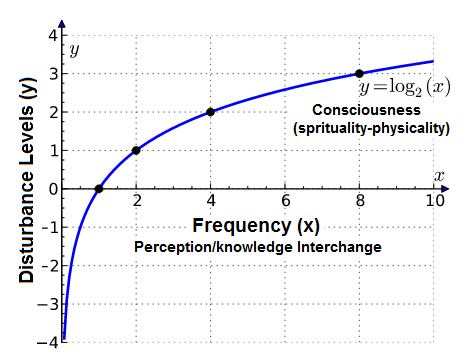
Disturbance Levels

The graph above presents the disturbance levels as a function of frequency of perception/knowledge interchange. The frequencies are plotted along the x-axis, and the disturbance levels are plotted along the y-axis. It can be seen from this graph that negative disturbance levels may be postulated with the halving of frequency. The frequency never reaches the zero of the theoretical ground level.

The disturbance level of zero occurs at the frequency of 1. The disturbance is manifested as consciousness that has both spiritual and physical characteristics.

.

Next: 

KHTK Postulates for Metaphysics – Part 2

KHTK Postulates for Physics

.

Einstein 1938: The Evolution of Physics

books_evolution

e-book: The Evolution of Physics

I am currently studying this book by Einstein to get an insight into his thinking. This book was originally published in 1938 by Cambridge University Press. It was a popular success, and was featured in a Time magazine cover story.

Here is some information on this book from Wikipedia:

Background of collaboration

Einstein agreed to write the book partly as a way to help Infeld financially. Infeld collaborated briefly in Cambridge with Max Born, before moving to Princeton, where he worked with Einstein at the Institute for Advanced Study. Einstein tried to get Infeld a permanent position there, but failed. Infeld came up with a plan to write a history of physics with Einstein, which was sure to be successful, and split the royalties. When he went to Einstein to pitch the idea, Infeld became incredibly tongue-tied, but he was finally able to stammer out his proposal. “This is not at all a stupid idea,” Einstein said. “Not stupid at all. We shall do it.”

Book’s point of view

In the book, Einstein pushed his realist approach to physics in defiance of much of quantum mechanics. Belief in an “objective reality,” the book argued, had led to great scientific advances throughout the ages, thus proving that it was a useful concept even if not provable. “Without the belief that it is possible to grasp reality with our theoretical constructions, without the belief in the inner harmony of our world, there could be no science,” the book declared. “This belief is and always will remain the fundamental motive for all scientific creation.”

In addition, Einstein used the text to defend the utility of field theories amid the advances of quantum mechanics. The best way to do that was to view particles not as independent objects but as a special manifestation of the field itself: “Could we not reject the concept of matter and build a pure field physics? We could regard matter as the regions in space where the field is extremely strong. A thrown stone is, from this point of view, a changing field in which the states of the greatest field intensity travel through space with the velocity of the stone.”

Contents

Preface

I. THE RISE OF THE MECHANICAL VIEW

  1. The great mystery story
  2. The first clue
  3. Vectors
  4. The riddle of motion
  5. One clue remains
  6. Is heat a substance?
  7. The switchback (roller-coaster)
  8. The rate of exchange
  9. The philosophical background
  10. The kinetic theory of matter

II. THE DECLINE OF THE MECHANICAL VIEW

  1. The two electric fluids
  2. The magnetic fluids
  3. The first serious difficulty
  4. The velocity of light
  5. Light as substance
  6. The riddle of colour
  7. What is a wave?
  8. The wave theory of light
  9. Longitudinal or transverse light waves?
  10. Ether and the mechanical view

III. FIELD, RELATIVITY

  1. The field as representation
  2. The two pillars of the field theory
  3. The reality of the field
  4. Field and ether
  5. The mechanical scaffold
  6. Ether and motion
  7. Time, distance, relativity
  8. Relativity and mechanics
  9. The time-space continuum
  10. General relativity
  11. Outside and inside the lift
  12. Geometry and experiment
  13. General relativity and its verification
  14. Field and matter

IV. QUANTA

  1. Continuity—Discontinuity
  2. Elementary quanta of matter and electricity
  3. The quanta of light
  4. Light spectra
  5. The waves of matter
  6. Probability waves
  7. Physics and reality

The third chapter (Field, Relativity) examines lines of force starting with gravitational fields (i.e., a physical collection of forces), moving on to descriptions of electric and magnetic fields. The authors explain that they are attempting to “translate familiar facts from the language of fluids…into the new language of fields.” They state that the Faraday, Maxwell, and Hertz experiments led to modern physics. They describe how “The change of an electric field produced by the motion of a charge is always accompanied by a magnetic field.”

.

Grassroots Learning Revolution

csdlstudents460x300

Reference: Subject: Education

I have a feeling that the stage is being set up for a grassroots revolution in the field of education. Bill Gates is backing Khan Academy to develop internet based course content that is relatively easy to grasp. Ivy League institutions like Harvard, M.I.T., Yale and Stanford are making their course materials available online.

However, a lot more needs to be done beyond just providing the course content on-line to get a revolution going in education. There are already reports like The Online Education Revolution Drifts Off Course. We need a learning revolution at the grassroots level.

The following factors are required for the success of such a revolution.

  1. Rapidly addressing past failures in one’s education.
  2. Generating a passion for learning in the young and old alike.
  3. Setting up the student to start learning on his or her own.
  4. Making course contents available that are easy to assimilate.
  5. Providing a path to researching new knowledge.

Most of these points can now be handled by applications provided at The Book of Subject Clearing. Easily graspable course content is already being made available on Internet. It is the product in (5) above that will ignite the learning revolution.

I am now retired. I can provide assistance to those who want to start on the course in Subject Clearing. I can communicate through the Comment Section of Vinaire’s Blog to answer questions regarding this course. I may even provide demonstrations by arranging upon request online Zoom sessions for Subject Clearing applications. As soon as some people start becoming efficient with these applications they can also join me in assisting new people starting on the Subject Clearing course. Once a passion for learning takes hold the progress will accelerate. Then only the sky will be the limit.

.

Scientology and the Ultimate Reality

Field2

To understand the essence and scope of a subject one must start with an examination of its basic postulates. To understand how ultimate reality is viewed in Scientology one must examine the following postulates.

  1. Scientology Axiom #1: Life is basically a static. DEFINITION: a life static has no mass, no motion, no wavelength, no location in space or in time. It has the ability to postulate and to perceive.

  2. Scientology Factor #1: Before the beginning was a Cause and the entire purpose of the Cause was the creation of effect.

  3. Scientology Pre-Logics #1: Self-determinism is the common denominator of all life impulses.

Axiom #1 claims that a Life Static has no mass, no motion, no wavelength, no location in space or in time, yet it has the ability to postulate and to perceive. It is Aristotle’s unmoved mover, Factor #1 simply posits the same concept as uncaused cause. Here it is an abstract capability from which all creation pours forth. In religion, we are familiar with this concept as God. Pre-logics #1 puts this capability to be the essence of all human and other beings.

Scientology essentially makes people believe that the characteristics associated with God are within the reach of every individual, and that one can actually achieve the state of Godhood through the processing available in Scientology.

The ultimate reality in Scientology is the attaining of beingness, which hitherto was exclusively associated with God.

Thus, a Scientologist believes that he is creating this universe continually in agreement with everyone else; and to enforce his will he must get everyone to agree with him. He entertains the ideal scene of a being who is cause over “matter, energy, space, time and all life.” In other words, his ideal scene is to act like God.

It is very hard to visualize a universe where everyone is acting like God. Such a universe is going to be highly unstable. To get the universe going, all the Gods must agree with each other. And when that happens then there remains no individual will. It becomes a collective like the Borg species of Star Trek.

The other alternative is for each “God” to postulate and perceive one’s own universe in which one can do whatever one wants. Such a “God” becomes out of touch with the physical universe. The physical universe simply does not exist for such a “God.”

At this moment the effort of the Church of Scientology is to survive as a collective in a physical universe that is unknowingly being created by unenlightened WOGS. The “solution” therefore is to assimilate all WOGS into the collective of Scientology by enlightening them the Scientology way. If this effort fails then the alternative would be for Scientology to get absorbed completely in a self-created universe and become totally dissociated with the “physical universe.” These are the ultimate realities in Scientology caused by the desire to identify oneself with a Godlike beingness that can have its way in spite of matter, energy, space, time and other life.

The source of this reality may be traced back to the theistic view prevalent in Abrahamic religions that God is a being, and that one is created in the image of God. When we take this view literally then the pursuit in Scientology starts to make sense.

In Scientology we see the theistic view being taken literally, and being pursued relentlessly.

Let’s look at the alternate view, where God is not viewed as a “being.” This is the atheistic view of the Eastern religions. In this view, God is seen as a power that underlies all manifestations. God is understood to be like a field similar to an electric or a magnetic field, but much more basic. It is from the condensation of such a field that self emerges. This is the field into which self ultimately dissolves.

In this view of God, there is no individuality that creates anything. Things just come together due to underlying laws. Here the ultimate reality is neti-neti (not this, not that), meaning that there is always something beyond to be understood. All phenomena are relative. Nothing can be pinned down in an absolute sense like the last digit of pi. There is no absolute God like that of the theists.

We can postulate anything but the postulate must be consistent with the existing reality to be real. The reality of the universe cannot be ignored. The thrust should always be to understand the reality, which is the universe. That is the thrust of science.

Spiritual and physical are two different aspects of this universe. These aspects do not exist independent of each other. “God” and the “physical universe” exist together. The physical universe may be looked upon as a form of God; and God may be looked upon as the essence of the physical universe. Scientology veers off this philosophy when it postulates “The origin of MEST lies with theta itself, and that MEST, as we know the physical universe, is a product of theta.” This postulate is not real.

Cause and effect do not exist outside this universe. Cause is as much a part of this universe as the effect. There is no uncaused Cause or unmoved mover. Cause and effect are always associated and should be viewed as a single phenomenon.

My view of God fundamentals is as follows:

Underlying all reality there seems to be a primordial field, which when disturbed by a primordial energy, gives rise to awareness. The undisturbed primordial field is the theoretical ground state for this universe. The primordial energy is what generates disturbance in this field. The disturbance arises as awareness that gradually condenses as self. The outer form of this disturbance is electromagnetism that gradually condenses as matter. Life has the characteristics of both awareness (spirituality) and electromagnetism (physicality).

Can the ultimate reality be ever defined? I believe that the pleasure of defining the ultimate reality more accurately will always be there.

.

MarkNR

Shelley & Me Favorite

Here is Mark in a picture that was taken a few years ago with his daughter. Mark is a scientific thinker. He has been an excellent contributor to Vinaire’s Blog. The recent KHTK Postulates for Physics contain elements of his thinking.

.