Substance, Space, Time and the Void

A scientist holding “particles in void” perspective believes that particles of matter exist in a void. He thinks that space is the void because space is empty of matter. But he is aware that space is something that exists, and the actual void must transcend the concept of space. Lacking explanation he treats space mathematically.

A person holding the broader “continuum of substance” perspective sees substance getting quantized in the electromagnetic spectrum. The ultimate quantization of this substance appears as matter at the upper end of the spectrum. The lower end extends toward void. He sees substance thinning out toward the void as follows.

  1. Matter
  2. Quantum particles
  3. Gamma radiation
  4. X-ray radiation
  5. Ultraviolet radiation
  6. Visible radiation
  7. Infrared radiation
  8. Terahertz radiation
  9. Microwave radiation
  10. Radio waves
  11. Space
  12. Void

From matter to quantum particles there is a rapid thinning out of substance. After that the substance appears as really thin radiation. As we look down the electromagnetic spectrum we see the thinning out of radiation. In the other direction we see quantization of substance.

The substance is not just matter. It extends beyond matter as electromagnetic radiation.

The extents of material objects and electromagnetic quanta are described by the dimensions of space. As substance thins out its extents (space) become increasingly diffused.

Space describes the extents of substance.

The duration of material objects and electromagnetic quanta are described by the dimensions of time. As substance thins out its duration (time) become increasingly ephemeral.

Time describes the duration of substance.

Ultimately, as the substance disappears into the void, so do space and time. The void has neither extent nor duration because these properties belong to substance only. The void is, therefore, difficult to visualize. Science has yet to grapple fully with the concept of void.

Space and time do not exist in the void. The void has neither extent nor duration.

The “empty space” is empty of material substance, but it is not empty of electromagnetic substance. It actually represents the extents of electromagnetic substance.

The material objects are described in terms of their mass. The electromagnetic substance is described in terms of its quanta, or frequency. Matter at the upper end is made up of very high frequency. Space at the lower end denotes very low frequency. As frequency approaches zero we approach the void.

A reinterpretation of scientific observations without the filter of the “particles in void” perspective quickly shows that substance is more than just matter.

The “continuum of substance” perspective presents a more real and logical view of substance, space, time, and void.

.

Reference: A Logical Approach to Theoretical Physics

.
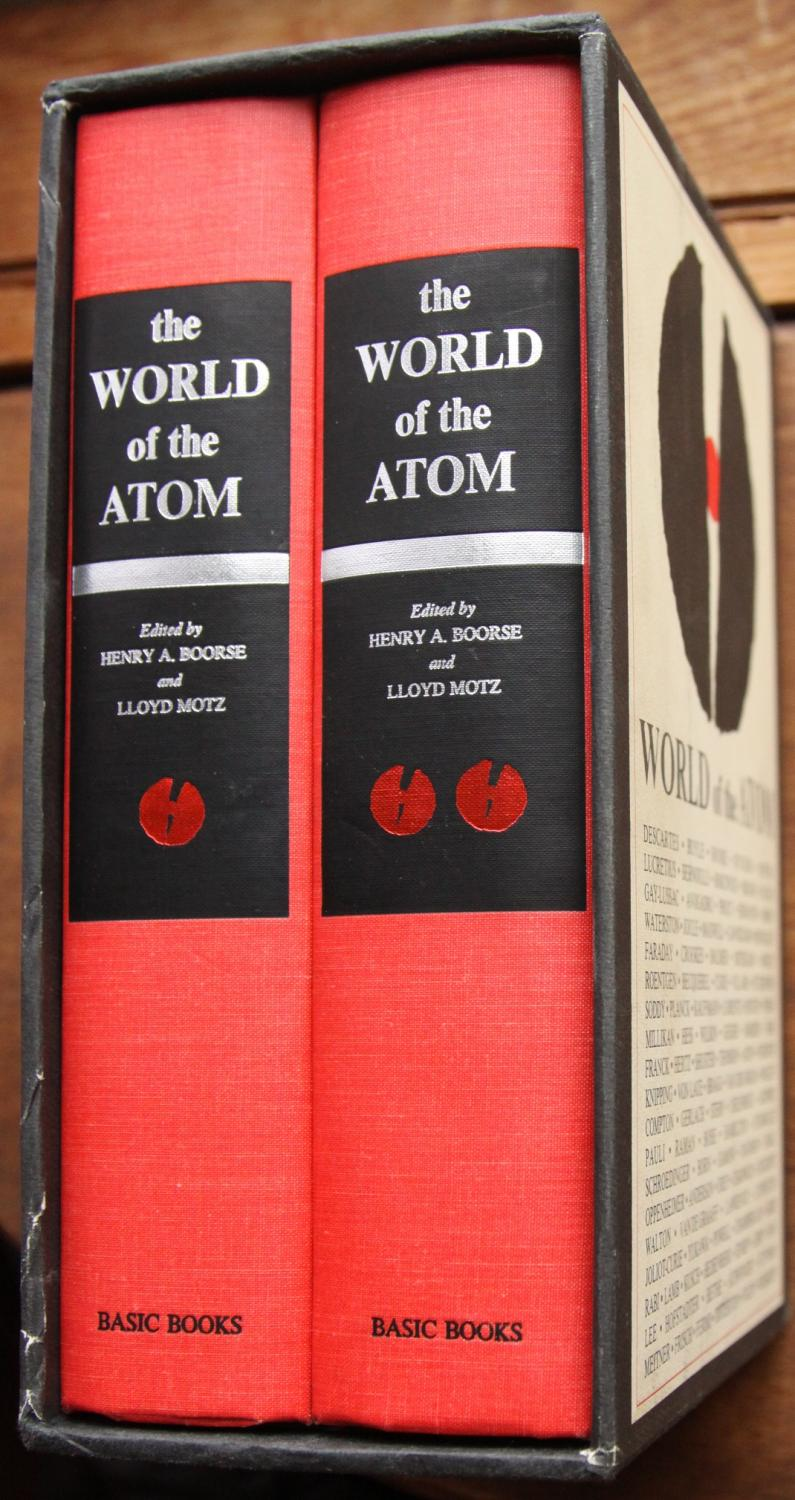
Boorse 1966: The World of Atom

Reference: The Physics Book

REFERENCE BOOK: THE WORLD OF ATOM by Boorse

I : THE FOUNDATIONS OF ATOMIC THEORY

  1. Atomism in Antiquity (Lucretius ca. 99 – 55 B.C.)
  2. Vortices and Particles (Rene Descartes 1596 – 1650)
  3. Particles in the Atmosphere (Robert Boyle 1627 – 1691)
  4. Matter & Motion (Robert Hooke 1635 – 1703)
  5. A Wave Theory of Light (Christian Huygens 1629 – 1695)
  6. Newton on Particles and Kinetics (Isaac Newton 1642 – 1727)
  7. A Kinetic Theory of Gases (Daniel Bernoulli 1700 – 1782)
  8. The Atom as a Center of Force (Roger Joseph Boscovich 1711 – 1787)
  9. Atomic Chemistry Before Dalton (Bryan Higgins 1737-1820, William Higgins 1769 – 1825)

THEORY
The atom is a vortex in a sea of energy substance. The atomic substance is gradually condensing, until it becomes a spinning mass at the center. The atoms are ceaselessly in motion relative to one another.

II : THE FOUNDATIONS OF ATOMIC CHEMISTRY

  1. The Birth of Atomic Theory (John Dalton 1766 – 1844)
  2. The Volume Combination of Gases (Joseph Louis Gay-Lussac 1778 – 1850)
  3. Atoms and Molecules – Avogadro’s Law (Amedeo Avogadro 1776 – 1856)
  4. The Search for Primordial Material (William Prout 1785 – 1850)

THEORY
The atom is a spinning nucleus surrounded by a vortex of energy substance. All its mass is concentrated in the nucleus of negligible volume. All its volume comprises of the energy vortex of negligible mass. All different atoms have masses that are multiples of the mass of hydrogen atom. These atoms combine in simple and definite ratios.

III : THE FOUNDATIONS OF THE KINETIC THEORY OF MATTER

  1. Atoms in Motion (John Herapath 1790 – 1868)
  2. “Active Molecules” – Brownian Motion (Robert Brown 1773 – 1858)
  3. The Tragedy of a Genius (John James Waterston 1811 – 1883)
  4. The Conservation of Energy–The Mechanical Equivalent of Heat (James Prescott Joule 1818 – 1889)
  5. The Range of Molecular Speeds in a Gas (James Clerk Maxwell 1831 – 1879)

THEORY
The atomic and molecular particles have intrinsic motion. This is expressed as inherent kinetic energy. This energy manifests as momentum, heat, chemical activity, and electrical force. It gives rise to the properties of pressure, temperature, volume  and density of gases. The total momentum and energy are conserved.

IV : NEW CONFIRMATION OF CHEMICAL ATOMIC THEORY

  1. Polyatomic Molecules (Stanislao Cannizzaro 1826 – 1910)
  2. The Periodic Table of the Elements (Dmitri Ivanovich Mendeleev 1834 – 1907)

THEORY
Atoms have atomic weights that are multiples of a basic quantity. The properties of the elements are related to their atomic weights in a periodic manner. Therefore, the atoms have a definite internal structure.

V : BEYOND THE ATOM

  1. Atoms and Electricity (Michael Faraday 1791 – 1867)
  2. Electromagnetic Theory (James Clerk Maxwell 1831 – 1879)
  3. Cathode Rays – A “Fourth State of Matter” (William Crookes 1832 – 1919)
  4. A Remarkable Regularity in the Hydrogen Spectrum (Johann Jacob Balmer 1825 – 1898)
  5. The Luminiferous Ether Receives a Mortal Blow (Albert A. Michelson 1852 – 1931, Edward W. Morley 1838 – 1923)

THEORY
Charge within the atom acts as the transitional phase between its nuclear mass and surrounding energy. It is responsible for the chemical force that locks atoms together. It can flow out into vacuum as cathode rays. Atoms extend out in space as electromagnetic vortex of energy and force that fills the space. The regularity of atomic structure is visible in atomic spectra that is produced when atoms absorb and emit electromagnetic radiation, such as light. Light is electromagnetic substance and not a disturbance in some ethereal medium.

VI : THE BEGINNINGS OF MODERN ATOMIC PHYSICS

  1. The Discovery of X-rays (Wilhelm Conrad Roentgen 1845 – 1923)
  2. The Discovery of Radioactivity (Antoine Henri Becquerel 1852 – 1908)
  3. The Discovery of the Electron (J. J. Thomson 1856 – 1940)
  4. The Discovery of Polonium and Radium (Pierre Curie 1859 – 1906, Marie Sklodovska Curie 1867 – 1934)
  5. The Discovery of α-and β-rays from Uranium (Ernest Rutherford 1871 – 1937)
  6. The Discovery of γ-rays (Paul Villard 1860 – 1934)
  7. The Transformation of the Elements (Ernest Rutherford 1871 – 1937, Frederick Soddy 1877 – 1956)
  8. The Quantum Theory of Radiation (Max Planck 1858 – 1947)
  9. Mass Changes with Velocity (Walter Kaufmann 1871 – 1947)
  10. The Electron Theory of Matter (Henrik Anton Lorentz 1853 – 1928)
  11. Einstein’s Legacy (Albert Einstein 1879 – 1955)

THEORY
Nuclear matter is surrounded by charge that exists as a vortex in the sea of electromagnetic radiation. All are different form of substance in that they all possess momentum and inertia. The electromagnetic radiation has extremely small momentum and inertia, and it is not reducible to discrete particles. The charge has greater moment and inertia and appears as discrete fluid-like vortices. Nuclear matter has the highest momentum and inertia and appears as solid discrete point particles.

The substance forms a spectrum from space (extremely thin consistency) to matter (very thick consistency).  X-rays appear with excitations in the deep electronic region. γ-rays are spontaneously emitted from the nuclear region. The latter is accompanied by changes in the nuclear structure. A small amount of matter is equivalent to a very large amount of radiation in terms of energy. The acceleration of charge increases its inertia, which appears as “increase in mass.”

Atoms absorb and emit electromagnetic radiation in amounts proportional to the consistency of the radiation. Quantum refers to the consistency of radiation and the energy of interaction. The radiation is continuous in space. As the consistency of substance increases, it increasingly curves upon itself. It appears to shrink in extent until it appears like a particle. It loses linear velocity, and increases in duration. This was seen as “shrinking of space” and “dilation of time.”

The intrinsic motion of radiation is balanced by its innate inertia. This appears as a constant speed; for example, the speed of light. The speed of light is so large that it appears to be constant from material frames of references. This leads to the correction factor employed by the special theory of relativity. The equivalence of gravitational and inertial mass leads to the theory of gravitation of the general theory of relativity.

VII : NEW IDEAS AND NEW MEASUREMENTS

  1. The “Thomson” Atom (J. J. Thomson 1856 – 1940)
  2. The Determination of Avogadro’s Number (Jean Perrin 1870 – 1942)
  3. The α-Particle and Helium (Ernest Rutherford 1871 – 1937)
  4. Atoms of Electricity (Robert Andrews Millikan 1868 – 1953)

THEORY
A neutral atom consists of both positive and negative charges in equal amounts. The charges in atom do not neutralize because they are part of a stable whirlpool-like configuration. A unit charge at the level of atom may be determined just like the unit mass. The electronic charge may be added or removed to produce negative and positive ions respectively.

VIII : TWO FAR-REACHING DISCOVERIES

  1. The Discovery of Cosmic Rays (Viktor F. Hess 1883 – 1964)
  2. The Cloud Chamber (Charles Thomson Rees Wilson 1869 – 1959)

THEORY
The outer space is not empty of substance.

IX : THE NUCLEAR ATOM

  1. Strange Results from α-Particle Scattering (Hans Geiger 1882 – 1945, Ernest Marsden 1889 – 1970)
  2. The Nuclear Atom (Ernest Rutherford 1871 – 1937)
  3. Atomic Structure (Niels Bohr 1885 – 1962)
  4. The Quantum Theory is Tested (James Franck 1882 – 1964, Gustav Hertz 1887 – 1975)
  5. The discovery of Isotopes (Frederick Soddy 1877 – 1956)
  6. The Positive Rays (J. J. Thomson 1856 – 1940)
  7. Transmutation of an Element (Ernest Rutherford 1871 – 1937)
  8. The Diversity of Atoms (Francis William Aston 1877 – 1945)

THEORY
The atom consists of a small massive nucleus surrounded by a large volume of rapidly revolving electrons. The  electrons have momentum but no mass. They form discrete stationary orbits around the nucleus that have variations in consistency and energy. Exchanges among these stationary orbits generate the spectral lines. The nucleus is made up of protons but there is a mass defect as protons combine. There are isotopes and artificial transmutation can be induced.

X : X-RAYS AND THEIR CONTRIBUTION TO THE RIDDLE OF MATTER

  1. Interference Phenomena (Max von Laue 1879 – 1960, Walter Friedrich 1883 – 1968, Paul Knipping 1883 – 1935)
  2. Bragg’s Law (William Henry Bragg 1862 – 1942, William Lawrence Bragg 1890 – 1971)
  3. Atomic Number (Antonius Van der Broek 1870 – 1926)

THEORY
The number of charges in an element’s atomic nucleus is exactly equal to the element’s place on Mendeleev’s periodic table. 

XI : ATOMIC THEORY DEVELOPS

  1. Atomic Number (Henry G. J. Mosley 1887 – 1915)
  2. Quantum Theory of Radiation and Atomic Processes (Albert Einstein 1879 – 1955)
  3. The Compton Effect (Arthur H. Compton 1892 – 1962)
  4. Space Quantization (Otto Stern 1888 – 1969, Walter Gerlach 1889 – 1979)
  5. Electron Spin (Samuel A. Goudsmit 1902 – 1978, George E. Uhlenbeck 1900 – 1988)
  6. The Exclusion Principle (Wolfgang Pauli 1900 – 1958)
  7. Secondary Radiation (Chandrasekhara Venkata Raman 1888 – 1970)
  8. Statistical Mechanics (S. N. Bose 1894 – 1974)

THEORY
The structure of the atom is increasingly the result of mathematical consistency among experimental observations. The mathematical model defines the structure of the substance that is transitioning from mass of the nucleus into the surrounding vortex of energy.

XII : WAVE MECHANICS

  1. The Principle of Least Action (William Rowan Hamilton 1805 – 1865)
  2. The Wavelengths of Particles (Prince Lois V. de Broglie 1892 – 1987)
  3. A Wave Equation for Particles (Erwin Schrodinger 1887 – 1961)
  4. Statistics and Waves (Max Born 1882 – 1970)
  5. The Uncertainty Principle (Werner Karl Heisenberg 1901 – 1976)
  6. The Barrier around the Nucleus (George Gamow 1904 – 1968)
  7. Electron Waves (Clinton J. Davisson 1881 – 1958, George Paget Thomson 1892 – 1975)
  8. The Electron and Relativity (Paul Adrian Maurice Dirac 1902 – 1984)
  9. “Holes” in the Dirac Theory (J. Robert Oppenheimer 1904 – 1967)
  10. Complementarity (Niels Bohr 1885 – 1962)

THEORY
The mathematical development seems to confirm that electrons are a wavelike flow that has variable consistency. Even the nucleus is a pattern of a very condensed flow.

XIII : NEW PARTICLES AND ATOMIC ACCELERATORS

  1. The positive Electron – The First Particle of Antimatter (Carl D. Anderson 1905 – 1991)
  2. The discovery of the Deuteron (Harold Clayton Urey 1893 – 1981)
  3. Discovery of the Neutron (James Chadwick 1891 – 1974)
  4. Fermi’s Contributions (Enrico Fermi 1901 – 1954)
  5. Artificial Nuclear Disintegration (John Cockcroft 1897 – 1967, Ernest Walton 1903 – 1995)
  6. The Electrostatic Generator (Robert Jemison Van De Graaff 1901 – 1967)
  7. The Cyclotron (Ernest O. Lawrence 1901 – 1958), Milton S. Livingston 1905 – 1986)
  8. The Discovery of Induced Radioactivity (Jean F. Joliot 1900 – 1958, Irene Curie Joliot 1897 – 1956)
  9. Prediction of the Meson (Hideki Yukawa 1907 – 1981)

THEORY
The inside of the nucleus has no charge. It mainly consists of “neutrons.” As the energy levels decrease in the direction of increasing radius the neutron becomes a positively charged proton. Therefore, “protons” seem to exist on the surface of the nucleus. As energy level decreases further with increasing radius, the charge switches polarity, and we have negatively charged electrons. A sharp gradient of decrease in mass exists from proton to electron. Beyond electrons we have the fluid energy of electromagnetic radiation. The charged layer made up of protons and electrons is like a softening solid becoming partially fluid. Therefore, in nature, solid mass is separated from fluid energy by a semi-fluid layer of charge. The solid mass, the electrifying charge, and the fluid energy exist in perfect balance.

XIV : NEWER DEVELOPMENTS IN ATOMIC AND NUCLEAR THEORY

  1. Mesons (Cecil Frank Powell 1903 – 1969)
  2. The Antiproton (Emilio Segrè 1905 – 1989, Owen Chamberlain 1920 – 2006)
  3. Nuclear Magnetic Moment (Isidor I. Rabi 1898 – 1988)
  4. Hydrogen and the Elementary Particles (Willis E. Lamb, Jr. 1913 – 2008)
  5. Magnetic Moment of the Electron (Polykarp Kusch 1911 – 1993)
  6. High Energy Physics (Hans Bethe 1906 – 2005, Julian Schwinger 1918 – 1994, Richard Feynman 1918 – 1988)
  7. The Nuclear Shell (Johannes D. Jensen 1907 – 1973)
  8. Radiocarbon Dating (Willard F. Libby 1908 – 1980)

THEORY
The nucleus forms the extremely small core of the atomic vortex. The rotating orbital within the nucleus are similar to the orbitals in the electronic region, but they are extremely small and tight.

XV : NUCLEAR REACTIONS AND NUCLEAR ENERGY

  1. Nuclear Theory (Werner K. Heisenberg 1901 – 1976)
  2. Energy Production in Stars (Hans A. Bethe 1906 – 2005)
  3. Fission (Lise Meitner 1878 – 1968, Otto R. Frisch 1904 – 1968, Niels Bohr 1885 – 1962)
  4. Chain-Reacting Pile (Enrico Fermi 1901 – 1954)
  5. Power from Fusion (Ernest W. Titterton 1914 – 1990)

THEORY
Nuclear reactions generate the radiation of stars similar to the sun. Future research on nucleus requires closer study of the stars.

XVI : HIGH ENERGY PHYSICS

  1. Parity and Its Ill Fortune (C. N. Yang b. 1922, T. D. Lee b. 1926)
  2. Nuclei and Nucleons (R. Hofstadter 1915 – 1990)
  3. Elementary Particles (H. A. Boorse 1904 – 2003, L. Motz 1909 – 2004)

THEORY
The atom is a vortex of condensing substance.

.

The Subjectivity in Physics

There are different theories in physics, such as, Newton’s mechanics, Maxwell’s electromagnetism and Einstein’s relativity. They cover different aspects of reality. To have a complete picture of reality, these different theories need to be combined to form one consistent reality. Obviously, we do not yet have a unified theory because there are disagreements among physicists and their theories. This is odd because physics takes pride in being objective. But objectivity means consistency and not just agreement.

When we say that physics is objective, we mean that there is a natural continuity, harmony and consistency among all its observations, interpretations and conclusions.

.

Objectivity

The word objective is derived from object that has the sense of “something perceived”. Objectivity means seeing things as they are. Objective reality is not only made tangible through the physical perceptions, but it is also made logically consistent by the mental perception. The objective reality is that which has been tested and verified and cannot be argued with. It is the same for all people because all known inconsistencies have been resolved.

Disagreements can only mean a lack of objectivity. It means that physicists are being subjective.

.

Subjectivity

The word subjective is derived from subject that has the sense of “open to inspection”. It is characterized by inconsistencies that still need to be resolved. As inconsistencies are resolved the subjective reality becomes increasingly objective.

Subjectivity exists when there is difficulty in obtaining direct observations, so gaps are filled with educated guesses and, sometimes, with outright assumptions. Such guesses and assumption must always be open to inspection. Trouble comes when things that are subjective are closed to inspection, mainly by agreement among physicists.

There can be situations where inconsistencies are simply being ignored or justified. In this case, the priority becomes that the inconsistency must be brought to light and acknowledged.

Inconsistencies among theories, lack of proper definitions, and disagreements among physicists are strong indicators of subjectivity.  

.

Summary

The physical perceptions are objective only to the degree they have been tested and verified to be actual. Interpretation of those perceptions and conclusions are objective only to the degree there are no logical inconsistencies.

The criterion for objectivity, therefore, is the consistency, harmony and continuity among all perceptions, interpretations and conclusions.

.

The Meaning of Enlightenment

Buddha achieved enlightenment in a very short time once he started to practice mindfulness meditation.

The words the Buddha uttered involuntarily at this time are recorded variously in the Buddhist scriptures. According to the Kegon sutra, at the moment of enlightenment he spontaneously cried out 1

“Wonder of wonders! Intrinsically all living beings are Buddhas, endowed with wisdom and virtue, but because men’s minds have become inverted through delusive thinking they fail to perceive this.”

The original word for enlightened is Bodhi, which means “awakened”. Zen Buddhism uses the word satori 2 to describe Buddha’s enlightenment as 

“Self-realization, opening the Mind’s eye, awakening to one’s True-nature and hence of the nature of all existence.” 

This provides a scientific definition of enlightenment as follows.

Enlightenment is the realization of the laws underlying our spiritual nature.

.

The Spiritual Nature

Oxford dictionaries, however, define enlightenment as “The action or state of attaining or having attained spiritual knowledge or insight, in particular (in Buddhism) that awareness which frees a person from the cycle of rebirth.” This definition imparts a sense of mystery.

Enlightenment is not some vague spiritual awareness of one’s identity linked to some mysterious cycle of rebirth. Instead, enlightenment is the understanding of the laws that underlie our spiritual nature. These laws determine wisdom and virtue. They also explain how our minds become inverted and deluded.

A human being, whether clever or stupid, male or female, ugly or beautiful, is capable of being awakened to the laws of spiritual nature. There is no perfection other than this state of being awakened. This is the enlightenment that Buddha sought and attained. 

Therefore, you meditate until you directly perceive the laws underlying your spiritual nature.

When you practice meditation its immediate effect is to reduce the turbulence in your mind so you can become more aware. The following chapters guide you step by step on the path to enlightenment through mindfulness meditation.

.

1 Three Pillars of Zenby Philip Kapleau, See Yasutani-Roshi’s Introductory Lecture 1.
2 Ibid., Chapter X, Definition of satori

.

Introduction to Meditation (Old)

Reference: A Scientific Approach to Meditation

Twenty-six hundred years ago Buddha launched a grass-root movement of spiritual awakening, which was so successful that it civilized three-quarters of the world. The essence underlying his approach to meditation is the following two steps.

The first step is to stop interfering with the mind so that all the turmoil ultimately settles down into a quiet state. It is like stop stirring the water so that all the mud finally settles down at the bottom. This happens by itself. All you have to do is stop interfering.

The next step is to start cleaning up the confusions in a systematic manner so there is no turmoil. It is like carefully removing the settled mud, so that it does not get stirred up again. It is a very precise operation.

.

Misconceptions

Wikipedia1 describes meditation as “a practice where an individual uses a technique, such as focusing their mind on a particular object, thought or activity, to achieve a mentally clear and emotionally calm state.” The problem here is that any such technique would definitely interfere with the mind and not let it settle down on its own.

Furthermore, when you look up meditation in a dictionary, it provides synonyms, such as, concentration, contemplation and reflection. The problem is these actions cannot be accomplished until the mind has settled down.

On the website Qura.com2 the following popular explanation is provided:

Mindfulness meditation is a period of time allocated purely to being mindful and still. You practice what you want to do daily in every moment – having focused attention, being aware of thoughts and feelings tugging at you, and train yourself to bring yourself back to your meditation over and over again.

This explanation is almost correct except for this part at the end: “and train yourself to bring yourself back to your meditation over and over again.” Do you force your attention away from these thoughts that are tugging at you, back to your “meditation”? How would you resolve those thoughts then?

It appears that the sequence of steps in meditation is muddled up in most people’s understanding.

.

Mindfulness

The essence of the first step in meditation is mindfulness. Buddha describes mindfulness in Bahiya3 sutra as follows:

In what is seen there must be just the seen; in what is heard there must be just the heard; in what is sensed (as smell, taste or touch) there must be just what is sensed; in what is thought there must be just the thought.

We may express this description scientifically as follows.

Mindfulness is being there and seeing things as they are.

Practice of mindfulness means that you are simply looking without interfering with the mind. As you sit down in meditation various reactions occur, such as, tiredness, drowsiness, boredom, etc. What do you do when the body starts to fall asleep? Do you interfere?

The answer is, “No, you do not interfere.” If the body falls asleep, it would eventually wake up. You simply experience the whole cycle of falling asleep and waking up. Maybe the reaction of sleepiness simply needs to be run out. Once it is out of system, you will be more alert than before. It is just the mud settling down. You may practice mindfulness even between the meditation sessions to help it all settle down.

“Removing the mud” in the second step means resolving the confusions, doubts and perplexities. These anomalies come up by themselves after the turmoil has settled down. You continue with your practice of mindfulness as before. Only now you need a deeper understanding of non-interference. It means that you do not avoid, resist, deny or suppress the confused thoughts and emotions that are coming up. You look at them with full alertness and experience them fully.

The mind then starts to relax and unwind. Past experiences that have long been suppressed start to release. You may be surprised at the memories that come up. It is this past suppression that was not letting the mental turmoil resolve. As the suppression comes off, the thoughts crowding the mind start to resolve. A lot of emotion may also accompany this resolution, but it will all clear up once and for all.

.

Summary

The path to enlightenment starts with establishing the discipline of mindfulness. We may define meditation as follows:

Meditation is the dedicated application of mindfulness to resolve the unsettling thoughts, feelings and sensations crowding one’s mind.

The whole idea in meditation is to BE there and not do anything else but BE there. This means that you do not focus your attention on some object, thought, or activity. You do not concentrate, contemplate or reflect. You are required only to be there and perceive. Let the mind do what it may. This is a subtle point, but understanding it makes all the difference in the world.

As you meditate, you start to see through the mind’s obfuscation. You begin to recognize the things that have been causing the confusion. You start to get realizations. This is how the fundamental discoveries by scientists and philosophers are made.

It is these realizations that ultimately lead you to enlightenment.

The next chapter explains what enlightenment is.

.

See the Wikipedia article on Meditation.
See the question “What is mindfulness meditation? On Quora.com.
Udāna 1.10; Bāhiyasuttaṃ 10

.