Grade 7: Clearing Course

Reference: Clearing Course Instruction Booklet

On this course, Hubbard provides a prepared structure of GPMs to run. He came up with this structure from his research, must probably by auditing himself. Hubbard assumes that this basic structure of reactive bank is the same for every person. 

The first pair of items to be audited on Clearing Course is: TO BE NOBODY……TO BE EVERYBODY. This is presented as Item 1, Part 1, Run 1. In other words, this pair of items is presented as the ultimate core of the reactive mind.

It is important to understand what Hubbard is doing here. Hubbard is assuming that beginning of the reactive mind starts with some imperceptible identity that the thetan has assumed. 

.

The Thetan and The Dynamics

A thetan is a first dynamic entity. From the viewpoint of evolution, the first dynamic is preceded by seven other dynamics. The universe started with the Eighth Dynamic (the God dynamic). But Hubbard assumes that the universe is the product of agreement among thetans (the first dynamic). In other words, Hubbard assumes that humanlike “beingnesses” are the Cause of this universe. 

Hubbard’s conception of Eight Dynamics is a genius concept, but, unfortunately, he sequences them in an inverted fashion because of his human-centric fixation. 

The Eight Dynamics

.

The Eighth Dynamic impulse

The Eighth Dynamic impulse is TO EVOLVE, according to which the other dynamics flow. The “thought form” that this impulse takes, at first, is not a human beingness; but whatever that form is, it ultimately evolves into a human beingness (or thetan).

Therefore, a whole chain of beingesses exists prior to the evolved beingness of the thetan. The intelligence of thetan is a much later phenomenon that was preceded by much trial and error by the impulse to evolve.

Hubbard’s first mention of thetan occurs in the book HISTORY OF MAN, published in 1952. It is essentially an account of the Fifth Dynamic. The Fifth Dynamic is a combination of Seventh and Sixth Dynamics. The Seventh Dynamic is “the impulse to evolve” and not thetans. The Sixth Dynamic is “the basic substance” that evolves and not the evolved form of matter, energy, space and time that we perceive today.

.

Earlier Similar

So, there is much earlier similar that exists prior to Thetan and MEST.

The Clearing Course talks about a mysterious blue light that appears in the mind and causes anaten (analytical attenuation). Most likely this light represents earlier similar items that are missing.

The Clearing Course, therefore, starts at a much later point and not from the bottom of the reactive bank. Not to recognize this is a fundamental error on Hubbard’s part. 

The first pair of items in the reactive bank is most likely to be of the order of TO BE……TO NOT BE.

.

Clearing

[NOTE: I don’t recommend this Grade Level to be run at all as it proceeds from unwarranted assumptions. This Grade is run “blindly” entirely on E-meter.]

The action on the Clearing Course is to keep spotting the light, or calling the same item, again and again until no more reads occur on the E-meter. You don’t have to see the light to spot it or see the thetan or see the object or objects.  You only need to spot the place where you are with the idea of what should be there. GPM Line Plot is not used.

.

Grade 7 Glossary

CHAIN
Anything in the bank that occurs several times will not erase unless it’s the earliest time it occurred.  This is known as the basic on the “chain”.  A number of similar things, early to late in different points of time, make a chain.

ERASURE
You are not seeking RELEASE from the bank at this level.  You are erasing.  Therefore “the bank has blown” is nonsense – one has blown from the bank, so get back in it and run it. Total erasure is the aim.

ITEM 1, PART 1, RUN 1
This is the pair of items that represents the ultimate core of the reactive bank. Apparently, this is the impulse to evolve.

PAIN
Pain only occurs when you have left something charged behind you (earlier).

PART B (is nouns)
Be careful of first one because it is used in the sense of a noun.  Don’t run it otherwise than as a pure noun.

PARTS
The five parts are Parts A, B, C, D, & E as detailed in the section on The Clearing Course Platen. The PARTS go as they do in the first run.  (7s, THEN Basic End Words, THEN Confusion GPM, THEN Objects – hollow, THEN Objects – solid.) 

RELEASE 
You’ll go Release a lot of times.  Ignore it.  We are erasing in R6.  Release can be ignored because the R6 bank is vanishing.  Not true of lower grades.

REPEATER TECHNIQUE
The items are flattened by repeater technique.  Just repeat them until they no longer read.  Get your own reaction off.  Repeat again.  Repeat to no read.  Beware of session suppress and invalidate.

RERUN
If you start getting pain or sickness, you got into a later run or you bypassed some charge and must rerun the earlier area you just did.  Something is still alive.  If in doubt, rerun the lot from the start of the part.  Erase thoroughly.  But if it is a later run, get back into the correct one.

RUN
This row of five parts is called a RUN.  See the section on The Pattern of the Bank. There are four runs.

SICKNESS
Sickness is part of the somatic.  It runs out.

THETAN IN THE ITEM
A thetan is a certain configuration of the impulses that exist. It is a “mental form” opposed to a physical form. The expression “thetan in the item” means the “viewpoint” or “identity” at the moment of the item. One then has to get the earliest moment of one’s own beingness in the bank and spot it.

.

The Pattern of the Bank

The apparent pattern of the bank is as follows (see the section on Clearing Course Platen below):

Part A – The 7s                       (earliest)
Part B – The Basic End Words
Part C – The Confusion GPM           (Run 1)
Part D – The Objects – hollow
Part E – The Objects – solid
 
Part A – The 7s
Part B – The Basic End Words
Part C – The Confusion GPM           (Run 2)
Part D – The Objects – hollow
Part E – The Objects – solid
 
Part A – The 7s
Part B – The Basic End Words
Part C – The Confusion GPM           (Run 3)
Part D – The Objects – hollow
Part E – The Objects – solid
 
Part A – The 7s
Part B – The Basic End Words
Part C – The Confusion GPM           (Run 4)
Part D – The Objects – hollow
Part E – The Objects – solid

.

The Clearing Course Platen

This data is provided for the sake of describing this Grade. This Grade is not used with Subject Clearing approach.

Part A: The 7s

LIGHT (front left)

  1. TO BE NOBODY……TO BE EVERYBODY
  2. TO BE ME……TO BE YOU
  3. TO BE MYSELF……TO BE OTHERS
  4. TO BE AN ANIMAL……TO BE ANIMALS

LIGHT (front left)

  1. TO BE A BODY……TO BE BODIES
  2. TO BE MATTER……TO BE SPACE
  3. TO BE A SPIRIT……TO BE SPIRITS
  4. TO BE A GOD……TO BE GODS

LIGHT (front left)

  1. TO DO NOTHING……TO DO EVERYTHING
  2. TO DO MUCH……TO DO LITTLE
  3. TO DO IT ALL……TO DO NOT ANY
  4. TO DO AMBITIOUSLY……TO DO SLIGHTLY

LIGHT (front left)

  1. TO DO MORE……TO DO LESS
  2. TO DO SPLENDIDLY……TO DO AWFULLY
  3. TO DO WISELY……TO DO FOOLISHLY
  4. TO DO RIGHT……TO DO WRONG

LIGHT (front left)

  1. TO HAVE NOTHING……TO HAVE EVERYTHING
  2. TO HAVE MUCH……TO HAVE LITTLE
  3. TO HAVE ALL……TO HAVE NONE
  4. TO HAVE HUGELY……TO HAVE POORLY

LIGHT (front left)

  1. TO HAVE GREEDILY……TO HAVE PICKINGLY
  2. TO HAVE MIGHTILY……TO HAVE SPARSELY
  3. TO HAVE MAGNIFICENTLY……TO HAVE TAWDRILY
  4. TO HAVE TOTALITY……TO HAVE NEGATIVENESS

LIGHT (front left)

  1. TO STAY EVERYWHERE……TO STAY NOWHERE
  2. TO STAY HERE……TO STAY THERE
  3. TO STAY NEAR……TO STAY FAR
  4. TO STAY UP……TO STAY DOWN

LIGHT (front left)

  1. TO STAY OUT……TO STAY IN
  2. TO STAY BACK……TO STAY FORWARD
  3. TO STAY EARLIER……TO STAY LATER
  4. TO STAY PRESENT……TO STAY ABSENT

LIGHT (front left)

.

Part B: The Basic End Words

The Basic End Words are:

  1. THE NOW
  2. THE PAST
  3. THE FUTURE
  4. THE TIME
  5. THE SPACE
  6. THE MOTION
  7. THE ENERGY
  8. THE MASSES
  9. THE SELF
  10. THE OTHERS
  11. THE LIFE

LIGHT

  1. THE EXISTENCE
  2. THE CONDITIONS
  3. THE EFFECTS
  4. THE PICTURES
  5. THE MIND
  6. THE HISTORIES
  7. THE REACTION
  8. THE GOAL
  9. THE CHAOS
  10. THE UNIVERSE

.

Part C: The Confusion GPM 

Use the above end word in the blanks below.

LIGHT (front left)
Pair: CREATING TO DESTROY _______ …… DESTROYING TO CREATE _______

.

Parts D: The Hollow Objects

LIGHT

  1. 1 hollow [object] going away
  2. 2 hollow [objects] going away
  3. 3 hollow [objects] going away
  4. 4 hollow [objects] going away
  5. 1 hollow [object] coming in
  6. 2 hollow [objects] coming in
  7. 3 hollow [objects] coming in
  8. 4 hollow [objects] coming in

For each set of eight items (preceded by LIGHT), the following hollow objects are used:

  1. Triangle
  2. Circle
  3. Square
  4. Oval
  5. Tetrahedron (three sides and base)
  6. Sphere
  7. Cube
  8. Egg
  9. Prism
  10. Cylinder
  11. Rectahedron (long box)
  12. Flat cylinder 
  13. Pyramid (four sides and base)
  14. Coil
  15. Diamond Box
  16. Oval coil

.

Parts E: The Solid Objects

LIGHT

  1. 1 solid [object] going away
  2. 2 solid [objects] going away
  3. 3 solid [objects] going away
  4. 4 solid [objects] going away
  5. 1 solid [object] coming in
  6. 2 solid [objects] coming in
  7. 3 solid [objects] coming in
  8. 4 solid [objects] coming in

For each set of eight items (preceded by LIGHT), the following solid objects are used:

  1. Circle
  2. Square
  3. Oval
  4. Tetrahedron
  5. Sphere
  6. Cube
  7. Egg
  8. Prism
  9. Cylinder
  10. Rectahedron (long box)
  11. Flat cylinder
  12. Pyramid (four sides and base)
  13. Coil
  14. Diamond Box
  15. Oval coil

.

Grade 6: Dramatization

Reference: Grassroots Scientology

Grade 6 is also called R6EW. Here we have exercises followed by a glossary of key words for Grade 6. The R6EW process is described in detail here: SOLO AUDITING AND R6 EW.

.

Instructions

  1. These processes are run by oneself applying The 12 Aspects of Mindfulness instead of depending on the E-meter.
  2. In response to the commands of these processes, simply look without thinking. Let the mind present you with the answer. If no answer comes up within a reasonable time, you have reached the EP (end phenomenon) for the moment.
  3. These commands tend to be general. The better you understand the command and its scope, the more answers shall come up.
  4. The answers that come up, shall depend on the level of your confront. The higher is your confront the deeper shall be the answers that come up. Your confront improves as you do the processing. After completing a grade, if you repeat it again, you may find some new answers coming up.
  5. “Repetitive to EP” means you contemplate over the command and acknowledge each answer, until no more answers are coming up.
  6. “Run alternately to EP” means that you contemplate over the two commands alternatively, until no more answers are coming up.
  7. “Run the bracket in sequence to EP” means that you sequentially contemplate on the commands provided as a bracket, until no more answers are coming up.
  8. “To EP” is the abbreviation for the above. When there is a single command you run it repetitively. When there are more than one command, you run them as a group, repetitively.

.

EXERCISE

Each command is independently run.

  1. You start with the two commands of Flow 1. 
  2. In response to the first command you write down the “end word” which most closely describes the dramatization. Please study the process in the last few sections of SOLO AUDITING AND R6 EW.
  3. In response to the second command you write down the “end word” which most closely describes the opposite of that dramatization for you.
  4. Consult the synonyms and antonyms for these words in a dictionary until the “pair of these end-words” seems just right to you.
  5. You run these two commands of Flow 1 repeatedly until you exhausted all possible answers. In other words, you have extracted all possible pairs of end-words that are relevant to your case.
  6. You may arrange these pairs in a list in the order that makes most sense to you.
  7. Execute the steps 1-6  for Flow 2 and Flow 3.
  8. You may then combine the lists from all flows and rearrange all the pairs in the order that makes most sense to you.
  9. Hopefully, this process will bring lots of realizations and great relief to you.

R6EW F1:
“What am I dramatizing?” (write down the end word)
“What would oppose that?” (write down the end word)

R6EW F2:
“What have I caused another to dramatize?”
“What would oppose that?”

R6EW F3:
“What are others dramatizing to others?”
“What would oppose that?”

.

Key Word List

Look up these key words in the sequence provided, in the glossary below.

GRADE 6, R6, END WORD, R6EW, DRAMATIZATION

.

Grade 6 Glossary

END WORD
An End Word is the final word of a goal. It is always a noun or a condition made into a noun. For example, with a goal such as “To Grab Books”, Books is the end word. Each end word, however, has many verb or action words related to it, thus making up a series of goals. It is the end word that is the common denominator to the whole of a GPM.  

DRAMATIZATION
Dramatization is thinking or acting in a manner that is dictated by an unassimilated impression contained in the mental matrix. When dramatizing, the individual is like an actor playing his dictated part and going through a whole series of actions. Irrational conduct is the result of dramatization.

GRADE 6
Grade 6 is called R6EW, where R6 means “Routine 6,” which refers to the core of the “Reactive Mind.” EW means “End Words,” which refers to nouns that express dramatizations, such as, “depression.” On this grade you want to find pair of opposite end words, such as, “depression-elation,” that best describe dramatizations that are real to you in present time.  Finding and listing of pairs of end words release one from subconsciously held conflicts. 

R6
R6 is a research designation where ‘R’ stands for ‘Routine’ followed by the research code number. During this research the OT III Implant was discovered: “The pictures contain God, the Devil, angels, space opera, theaters, helicopters, a constant spinning, a spinning dancer, trains and various scenes very like modern England. You name it, it’s in this implant we call in its entirely ‘R6’.” R6 became a synonym for the ‘reactive mind’.

R6EW
R6EW simply consists of this: find an end word, preferably the one you are dramatizing (that would mean the one you would be most stuck in).  If it’s a plus you find its minus, and so on.  It sometimes takes some doing. The main rule is always find the pair, don’t leave one.  If you are in trouble after finding an end word, it’s not that end word that’s troubling you. Also see Grade VI.

.

The words provided in this glossary are specialized for Grade VI. For related words please see

  1. Scientology Technical Dictionary
  2. KHTK Glossary (Metaphysics)

.

Grade 5: Power Processes

Reference: Grassroots Scientology

.

Instructions

  1. These processes are run by oneself applying The 12 Aspects of Mindfulness instead of depending on the E-meter.
  2. In response to the commands of these processes, simply look without thinking. Let the mind present you with the answer. If no answer comes up within a reasonable time, you have reached the EP (end phenomenon) for the moment.
  3. These commands tend to be general. The better you understand the command and its scope, the more answers shall come up.
  4. The answers that come up, shall depend on the level of your confront. The higher is your confront the deeper shall be the answers that come up. Your confront improves as you do the processing. After completing a grade, if you repeat it again, you may find some new answers coming up.
  5. “Repetitive to EP” means you contemplate over the command and acknowledge each answer, until no more answers are coming up.
  6. “Run alternately to EP” means that you contemplate over the two commands alternatively, until no more answers are coming up.
  7. “Run the bracket in sequence to EP” means that you sequentially contemplate on the commands provided as a bracket, until no more answers are coming up.
  8. “To EP” is the abbreviation for the above. When there is a single command you run it repetitively. When there are more than one command, you run them as a group, repetitively.

.

POWER PROCESS (Pr Pr)

Power processes address “source”, “existence” and “condition” in that order. You may run these processes safely using the Subject Clearing approach.

.

SOURCE (Power Process 4)
Here one meditates on “logical” relationships.

  1. Tell me a source.
  2. Tell me about it.
  3. Tell me a no source.
  4. Tell me about it.

“SOURCE” – A Scientology Power Process

.

EXISTENCE (Power Process 5)
Here one meditates on the “reality” of things.

  1. What is?
  2. What isn’t?

“EXISTENCE” – A Scientology Power Process

.

CONDITION (Power Process 6)
Here one meditates on the “conditions” needing resolution.

  1. Tell me an existing condition.
  2. Tell me how you handled it.

“CONDITIONS” – A Scientology Power Process

.

CORRECTIVE PROCESSES

Power processes 1, 2, and 3 are corrective processes and are used when the PC is not running well on Power Process 4, 5, or 6.

Power Process 1: PROBLEM
This process is run when the person is committing present time overts as a solution.

(a) What overt have you committed?
(b) What problem were you trying to solve?
(c) What haven’t you said?
(d) What problem were you trying to solve?

.

Power Process 2: FIXED SOLUTION
This process is run when the pc is collapsed into his bank by former practices. The person is using some practice, opinion or belief as a fixed solution.

(a) “Give me some practices, opinions, or beliefs you have been connected to whether you left them or not.” Run to the first blowdown item.
(b) Then take the blowdown item plus the two items up and two items down from it and assess those five item to one.
(c) Run on the item;

  1. What condition have you encountered in __________________________?
  2. How have you handled it?

.

Power Process 3: GRIEF
This process is run when the pc has been caused grief by auditing or the organization.

(a) What condition have you encountered in Scientology (or auditing or dianetics)?
(b) How have you handled it?

.

POWER PROCESSES ALL FLOWS

Power Process 1

Flow 1

  1. What has another done to you?
  2. What problem was he/she trying to solve?
  3. What hasn’t another said to you?
  4. What problem was he/she trying to solve?

Flow 2

  1. What have you done to another?
  2. What problem were you trying to solve?
  3. What haven’t you said to another?
  4. What problem were you trying to solve?

Flow 3

  1. What has another done to another or others?
  2. What problem were they trying to solve?
  3. What hasn’t another said to another or others?
  4. What problem were they trying to solve?

Flow 0

  1. What have you done to yourself?
  2. What problem were you trying to solve?
  3. What haven’t you said to yourself?
  4. What problem were you trying to solve?

.

Power Process 2

“Give me some practices, opinions or beliefs you have been connected to, whether you left them or not.” Run reading items.

Flow 1

  1. What condition have you encountered in/with ______________?
  2. How have you handled it?

Flow 2

  1. What condition has another encountered in/with ______________?
  2. How has he/she handled it?

Flow 3

  1. What condition have others encountered in/with ______________?
  2. How have they handled it?

Flow 0

  1. What condition have you encountered with yourself because of ______________?
  2. How have you handled it?

.

Power Process 3

For those overwhelmed by a clearing practice.

Flow 1

  1. What condition have you encountered in Scientology (or auditing, clearing, educting, Eductivism, EST, or Dianetics)?
  2. How have you handled it?

Flow 2

  1. What condition has another encountered in Scientology (or auditing, clearing, educting, Eductivism, EST or Dianetics)?
  2. How has he/she handled it?

Flow 3

  1. What condition have others encountered in Scientology (auditing, clearing, educting, Eductivism, EST or Dianetics)?
  2. How have they handled it?

Flow 0

  1. What condition have you encountered in yourself because of Scientology (auditing, clearing, educting, Eductivism, EST or Dianetics)?
  2. How have you handled it? 

.

Power Process 4

Look up the definition of SOURCE. You run the Flows and the commands within them in the sequence given. Each set of command is run repetitively until it is exhausted of all possible answers.

Flow 1

  1. Tell me a source.
  2. Tell me about it.
  3. Tell me a no-source.
  4. Tell me about it.

Flow 2

  1. Tell me a source for another.
  2. Tell me about it.
  3. Tell me a no-source for another.
  4. Tell me about it.

Flow 3

  1. Tell me a source for others.
  2. Tell me about it.
  3. Tell me a no-source for others.
  4. Tell me about it.

Flow 0

  1. Tell me about yourself as a source.
  2. Tell me about it.
  3. Tell me about yourself as a no-source.
  4. Tell me about it.

When there is difficulty in running the SOURCE process, run Power Process 1 instead. The reason is that one may be committing overts in an attempt to resolve some problem and this situation needs to be handled first.

.

Power Process 5

Flow 1

  1. What is?
  2. What isn’t?

Flow 2

  1. What is for another?
  2. What isn’t for another?

Flow 3

  1. What is for others?
  2. What isn’t for others?

Flow 0

  1. What is for yourself?
  2. What isn’t far yourself?

.

Power Process 6

Flow 1

  1. Tell me an existing condition.
  2. Tell me how you have handled it.

Flow 2

  1. Tell me an existing condition for another.
  2. Tell me how he/she has handled it.

Flow 3

  1. Tell me an existing condition for others.
  2. Tell me how they have handled it.

Flow 0

  1. Tell me an existing condition in yourself.
  2. Tell me how you have handled it.

.

POWER PLUS PROCESSES

Power Process 1B
L & N to first B.D. Item, “What person have you known?”
Run terminal in following processes.

Flow 1

  1. What has _________ done for you?
  2. What problem was he/she trying to solve?
  3. What hasn’t __________ said to you?
  4. What problem was he/she trying to solve?

Flow 2

  1. What have you done to _________ ?
  2. What problem were you trying to solve?
  3. What haven’t you said to ________ ?
  4. What problem were you trying to solve?

Flow 3

  1. What has __________ done to others?
  2. What problem was he/she trying to solve?
  3. What hasn’t __________ said to others?
  4. What problem was he/she trying to salve?

 Flow 3A

  1. What have others done to __________ ?
  2. What problem were they trying to solve?
  3. What haven’t others said to ________ ?
  4. What problem were they trying to solve?

Flow 0

  1. What have you done to yourself because of _______?
  2. What problem were you trying to solve?
  3. What haven’t you said to yourself because of __________?
  4. What problem were you trying to solve?

.

Power Process 1C
L & N to first B.D. Item, “What place have you known?”
Run the place found in the following processes.

Flow 1

  1. What has another done to you in _________?
  2. What problem was he/she trying to solve?
  3. What hasn’t another said to you in _________?
  4. What problem was he/she trying to solve?

Flow 2

  1. What have you done to another in _________?
  2. What problem were you trying to solve?
  3. What haven’t you said to another in _________?
  4. What problem were you trying to solve.

Flow 3

  1. What has another done to another in _________?
  2. What problem were they trying to solve?
  3. What hasn’t another said to others in _________?
  4. What problem were they trying to solve?

Flow 0

  1. What have you done to yourself in _________?
  2. What problem were you trying to solve?
  3. What haven’t you said to yourself in _________?
  4. What problem were you trying to solve?

.

Power Process 1D
L & N to first B.D. Item, “What subject would you like to know more about?”
Run the subject found in the same processes as given in 1C (places), Quad flow.

.

DEFINITIONS

ATTENTION
Attention is focusing of the mind. A person’s attention naturally goes to what needs to be resolved. When he can’t resolve it then the attention gets fixed on it at first in an increased effort to resolve it, but upon failing to do that the attention gets scattered all over the place from that point of failure.

GENERALITY
A generality may point out a general pattern, such as, through a mathematical equation. It still needs to be filled with specifics in order to reach a worthwhile conclusion in a situation.

DELUSION
A delusion occurs when one is not seeing things as they are. It could be there but not very obvious, or it could be very obvious. 

.

BUDDHISM: The Silent Sage

Reference: Buddhism

[NOTE: In color are Vinaire’s comments.]

Buddha insisted that he was human in every respect. He made no attempt to conceal his temptations and weaknesses. He admitted that the months when he was first alone in the forest had brought him to the brink of mortal terror.

To understand Buddhism it is of utmost importance to gain some sense of the impact of Buddha’s life on those who came within its orbit. 

It is impossible to read the accounts of that life without emerging with the impression that one has been in touch with one of the greatest personalities of all time. The obvious veneration felt by almost all who knew him is contagious, and the reader is soon caught up with his disciples in the sense of being in the presence of something close to wisdom incarnate. 

Buddha is akin to wisdom incarnate.

Perhaps the most striking thing about him was his combination of a cool head and a warm heart, a blend that shielded him from sentimentality on the one hand and indifference on the other. He was undoubtedly one of the greatest rationalists of all times, resembling in this respect no one as much as Socrates. Every problem that came his way was automatically subjected to cool, dispassionate analysis. First, it would be dissected into its component parts, after which these would be reassembled in logical, architectonic order with their meaning and import laid bare. He was a master of dialogue and dialectic, and calmly confident. “That in disputation with anyone whomsoever I could be thrown into confusion or embarrassment—there is no possibility of such a thing.” 

Buddha had a cool head but a warm heart. He was a master of dialogue and dialectic, and calmly confident.

The remarkable fact, however, was the way this objective, critical component of his character was balanced by a Franciscan tenderness so strong as to have caused his message to be subtitled “a religion of infinite compassion.” Whether he actually risked his life to free a goat that was snagged on a precipitous mountainside may be historically uncertain, but the act would certainly have been in character, for his life was one continuous gift to the famished crowds. Indeed, his self-giving so impressed his biographers that they could explain it only in terms of a momentum that had acquired its trajectory in the animal stages of his incarnations. The Jataka Tales have him sacrificing himself for his herd when he was a stag, and hurling himself as a hare into a fire to feed a starving brahmin. Dismiss these post facto accounts as legends if we must; there is no question but that in his life as the Buddha the springs of tenderness gushed abundant. Wanting to draw the arrows of sorrow from everyone he met, he gave to each his sympathy, his enlightenment, and the strange power of soul, which, even when he did not speak a word, gripped the hearts of his visitors and left them transformed.

The objective, critical component of Buddha’s character was balanced by a strong Franciscan tenderness. He gave his sympathy, his enlightenment, and the strange power of soul to everyone he met.

Socially, the Buddha’s royal lineage and upbringing were of great advantage. “Fine in presence,” he moved among kings and potentates with ease, for he had been one of them. Yet his poise and sophistication seem not to have distanced him from simple villagers. Surface distinctions of class and caste meant so little to him that he often appears not even to have noticed them. Regardless of how far individuals had fallen or been rejected by society, they received from the Buddha a respect that stemmed from the simple fact that they were fellow human beings. Thus many an outcaste and derelict, encountering for the first time the experience of being understood and accepted, found self-respect emerging and gained status in the community. “The venerable Gautama bids everyone welcome, is congenial, conciliatory, not supercilious, accessible to all.”

Buddha moved among kings and potentates with ease, for he had been one of them. Yet his poise and sophistication seem not to have distanced him from simple villagers.

There was indeed an amazing simplicity about this man before whom kings bowed. Even when his reputation was at its highest he would be seen, begging-bowl in hand, walking through streets and alleys with the patience of one who knows the illusion of time. Like vine and olive, two of the most symbolic plants that grow from the meagerest of soils, his physical needs were minimal. Once at Alavi during the frosts of winter he was found resting in meditation on a few leaves gathered on a cattle path. “Rough is the ground trodden by the hoofs of cattle; thin is the couch; light the monk’s yellow robe; sharp the cutting wind of winter,” he admitted. “Yet I live happily with sublime uniformity.” 

There was indeed an amazing simplicity about this man before whom kings bowed. His physical needs were minimal.

It is perhaps inaccurate to speak of Buddha as a modest man. John Hay, who was President Lincoln’s secretary, said it was absurd to call Lincoln modest, adding that “no great human being is modest.” Certainly, the Buddha felt that he had risen to a plane of understanding that was far above that of anyone else in his time. In this respect he simply accepted his superiority and lived in the self-confidence this acceptance bequeathed. But this is different from vanity or humorless conceit. At the final assembly of one of his sangha’s (order’s) annual retreats, the Exalted One looked round over the silent company and said, “Well, ye disciples, I summon you to say whether you have any fault to find with me, whether in word or in deed.” And when a favorite pupil exclaimed, “Such faith have I, Lord, that methinks there never was nor will be nor is now any other greater or wiser than the Blessed One,” the Buddha admonished:

“Of course, Sariputta, you have known all the Buddhas of the past.”
“No, Lord.”
“Well then, you know those of the future?”
“No, Lord.”
“Then at least you know me and have penetrated my mind thoroughly?”
“Not even that, Lord.”
“Then why, Sariputta, are your words so grand and bold?”

Buddha simply accepted his superiority and lived in the self-confidence this acceptance bequeathed. But this is different from vanity or humorless conceit.

Notwithstanding his own objectivity toward himself, there was constant pressure during his lifetime to turn him into a god. He rebuffed all these categorically, insisting that he was human in every respect. He made no attempt to conceal his temptations and weaknesses—how difficult it had been to attain enlightenment, how narrow the margin by which he had won through, how fallible he still remained. He confessed that if there had been another drive as powerful as sex he would never have made the grade. He admitted that the months when he was first alone in the forest had brought him to the brink of mortal terror. “As I tarried there, a deer came by, a bird caused a twig to fall, and the wind set all the leaves whispering; and I thought: ‘Now it is coming—that fear and terror.’” As Paul Dahlke remarks in his Buddhist Essays, “One who thus speaks need not allure with hopes of heavenly joy. One who speaks like this of himself attracts by that power with which the Truth attracts all who enter her domain.” 

Buddha insisted that he was human in every respect. He made no attempt to conceal his temptations and weaknesses. He admitted that the months when he was first alone in the forest had brought him to the brink of mortal terror.

Buddha’s leadership was evidenced not only by the size to which his order grew, but equally by the perfection of its discipline. A king visiting one of their assemblies, which was prolonged into a full-moon night, burst out at last, “You are playing me no tricks? How can it be that there should be no sound at all, not a sneeze, nor a cough, in so large an Assembly, among 1,250 of the Brethren?” Watching the Assembly, seated as silent as a clear lake, he added, “Would that my son might have such calm.”

Buddha’s leadership was evidenced not only by the size to which his order grew, but equally by the perfection of its discipline. 

Like other spiritual geniuses—one thinks of Jesus spotting Zacchaeus in a tree—the Buddha was gifted with preternatural insight into character. Able to size up, almost at sight, the people who approached him, he seemed never to be taken in by fraud and front but would move at once to what was authentic and genuine. One of the most beautiful instances of this was his encounter with Sunita the flower-scavenger, a man so low in the social scale that the only employment he could find was picking over discarded bouquets to find an occasional blossom that might be bartered to still his hunger. When the Buddha arrived one day at the place where he was sorting through refuse, Sunita’s heart was filled with awe and joy. Finding no place to hide—for he was an outcaste—he stood as if stuck to the wall, saluting with clasped hands. The Buddha “marked the conditions of Arahatship [sainthood] in the heart of Sunita, shining like a lamp within a jar,” and drew near, saying, “Sunita, what to you is this wretched mode of living? Can you endure to leave the world?” Sunita, “experiencing the rapture of one who has been sprinkled with ambrosia, said, ‘If such as I may become a monk of yours, may the Exalted One suffer me to come forth!’” He became a renowned member of the order.

The Buddha was able to size up, almost at sight, the people who approached him. He seemed never to be taken in by fraud and front but would move at once to what was authentic and genuine. 

The Buddha’s entire life was saturated with the conviction that he had a cosmic mission to perform. Immediately after his enlightenment he saw in his mind’s eye “souls whose eyes were scarcely dimmed by dust and souls whose eyes were sorely dimmed by dust”—the whole world of humanity, milling, lost, desperately in need of help and guidance. He had no alternative but to agree with his followers that he had been “born into the world for the good of the many, for the happiness of the many, for the advantage, the good, the happiness of gods and men, out of compassion for the world.” His acceptance of this mission without regard for personal cost won India’s heart as well as her mind. “The monk Gautama has gone forth into the religious life, giving up the great clan of his relatives, giving up much money and gold, treasure both buried and above ground. Truly while he was still a young man without gray hair on his head, in the beauty of his early manhood he went forth from the household life into the homeless state.”

The Buddha’s entire life was saturated with the conviction that he had a cosmic mission to perform. Immediately after his enlightenment he saw in his mind’s eye the whole world of humanity, milling, lost, desperately in need of help and guidance. 

Encomiums to the Buddha crowd the texts, one reason undoubtedly being that no description ever satisfied his disciples completely. After words had done their best, there remained in their master the essence of mystery—unplumbed depths their language could not express because thought could not fathom them. What they could understand they revered and loved, but there was more than they could hope to exhaust. To the end he remained half light, half shadow, defying complete intelligibility. So they called him Sakyamuni, “silent sage (muni) of the Sakya clan,” symbol of something beyond what could be said and thought. And they called him Tathagata, the “Thus-come,” the “Truth-winner,” the “Perfectly Enlightened One,” for “he alone thoroughly knows and sees, face to face, this universe.” “Deep is the Tathagata, unmeasurable, difficult to understand, even like the ocean.”

No description of Buddha ever satisfied his disciples completely. What they could understand they revered and loved, but there was more than they could hope to exhaust. To the end he remained half light, half shadow, defying complete intelligibility.

.

Physics II: Chapter 1

Reference: Beginning Physics II

Chapter 1: WAVE MOTION

.

KEY WORD LIST

Wave Motion, Pulse, Amplitude, Transverse Wave, Longitudinal Wave, Velocity Of Propagation, Propagation Constant, Wave Equation, Wavelength, Wave Energy And Power, Wave Reflection, Principle Of Superposition, Interference Patterns, Standing Wave, Nodes And Anti-Nodes, Natural Frequency, Fundamental Frequency, Harmonics, Overtones, Resonant Frequencies, Resonance, Pressure & Displacement Nodes

.

GLOSSARY

For details on the following concepts, please consult Chapter 1.

WAVE MOTION
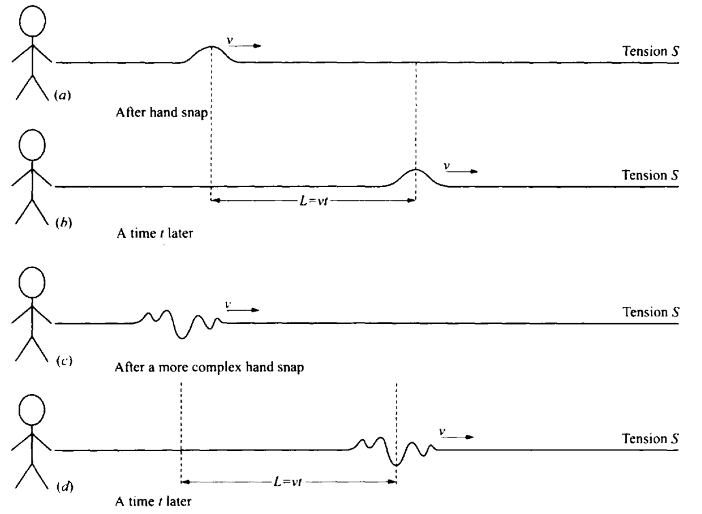
The wave motion is a process in which the physical matter itself does not move over significant distances beyond their initial positions, while the energy can be transferred over large distances. The transferred energy can carry information, so that wave motion allows the transfer of information over large distances as well.

PULSE
A pulse is a single stroke, vibration, or undulation. The molecules move perpendicular to the direction in which the pulse moves. The shape of the pulse travels as one set of molecules after another go through the vertical motion. The pulse carries the vertical kinetic energy of the moving molecules, and the associated potential energy due to momentary stretching of the cord, in the pulse region.

AMPLITUDE
Amplitude is the maximum vertical displacement of the pulse.

TRANSVERSE WAVE
The pulse in a cord is an example of a transverse wave, where molecules move to and fro at right angles to the direction of propagation of the wave.

LONGITUDINAL WAVE
In a longitudinal wave the molecules actually move to and fro along the direction of the propagation of the wave. This would be a pulse of pressure travelling through the air in a pipe. This air pulse is a primitive example of a sound wave.

VELOCITY OF PROPAGATION
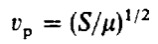
The velocity of propagation vp of the pulse in a cord would increase with increase in tension S in the cord. On the other hand, it would decrease with increase in mass per unit length μ.

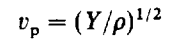
The propagation of sound in a solid would increase with increase in intrinsic stiffness as measured by the Young’s modulus Y, and with decrease in its density ρ.

The propagation of sound in a fluid would increase with increase in its Bulk modulus B, and with decrease in its density ρ.

PROPAGATION CONSTANT
We define the propagation constant for the wave as, k = ω/vp so that

WAVE EQUATION
The vertical position of the cord, at a definite horizontal position x along the cord, at any time t is,

This indicates that the vertical displacement of any point x along the cord, the cord exhibits SHM of the same amplitude and frequency with the term in the sine function involving x acting as a phase constant that merely shifts the time at which the vertical motion passes a given point in the cycle.

WAVELENGTH (λ)
The wavelength is the spatial periodicity of the wave, i.e., the length along the x-axis that one moves to go through one complete cycle of the wave.

WAVE ENERGY AND POWER
For the case of a transverse sinusoidal wave travelling in a cord, or a longitudinal wave travelling in a tube, the energy per unit length is,

And, the power transfer across any point of cross-section is,

WAVE REFLECTION
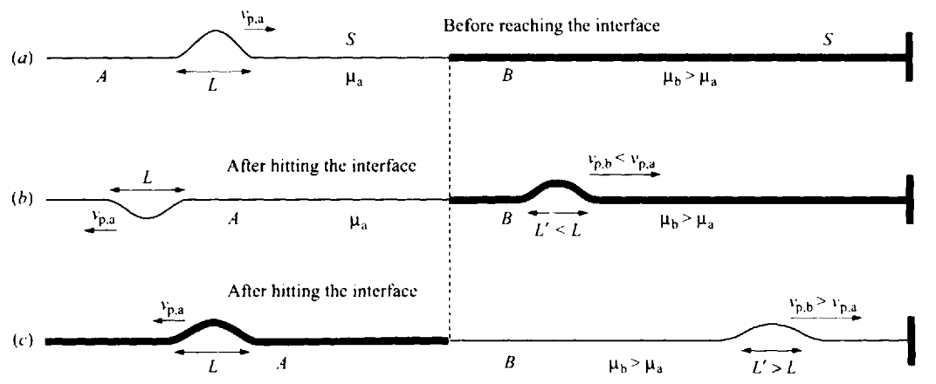
When the far end of the cord is tied down, the reflection is 180° out of phase.

When the far end of the cord is not tied down but free, the reflection is in phase.

A more general case is somewhere in-between these two extremes.

PRINCIPLE OF SUPERPOSITION
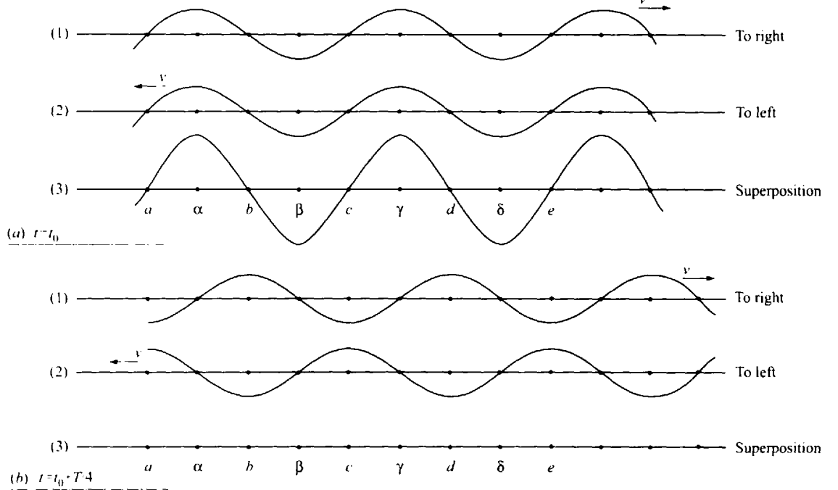
The actual displacement of molecules from their equilibrium position, at any given location in a medium, at any instant of time, when more than one wave is traveling through that medium, is just the vector sum of the displacements that each would separately have caused at the same location at that same instant of time.

INTERFERENCE PATTERNS
When two waves pass the same point in a medium they are said to interfere. If they correspond to long wave trains having the same wavelength, then certain regular patterns can appear, such as points that never move and points that move maximally. Such patterns are called interference patterns.

STANDING WAVE
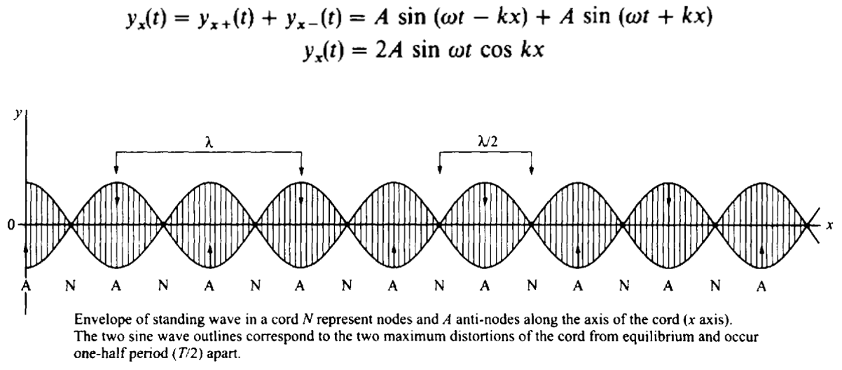
An examination of the actual “superimposed” wave may reveal some points on the cord that seem not to move at all as the waves pass each other, while other points midway between them move up and down with double the amplitude of either wave. The actual wave motion of the cord is therefore not a traveling wave, since in a traveling wave every point in the cord moves up and down in succession. The wave caused by the interference of these two traveling waves is therefore called a standing wave. It has the same frequency.

NODES AND ANTI-NODES
The points that don’t move are called nodes, and the points that move maximally are called anti-nodes.

NATURAL FREQUENCY
Many physical systems, when stimulated can be made to vibrate or oscillate with definite frequencies. In each of these cases there is a single “natural” frequency associated with the system. In more complex structures, many “natural” frequencies of vibration can occur.

FUNDAMENTAL FREQUENCY
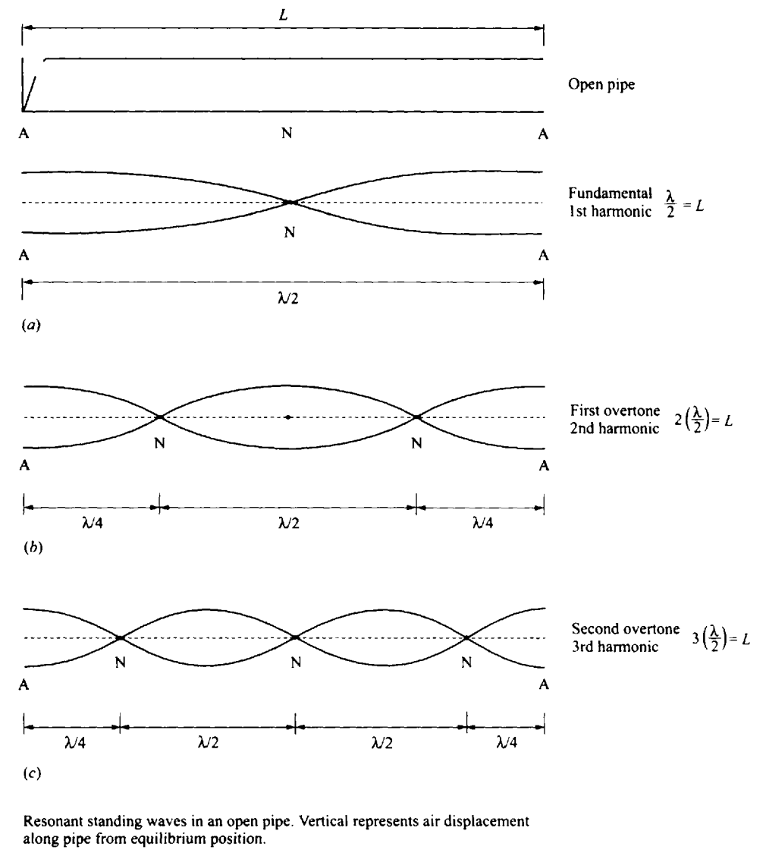
The fundamental frequency, f1, is the lowest possible natural frequency.

HARMONICS
The integer multiples of the fundamental frequency, fn, are called harmonics.

OVERTONES
The overtones are the successive natural frequencies above the fundamental.

RESONANT FREQUENCIES
Such “natural” frequencies, which are characteristic of the particular system or structure, are also called the resonant frequencies of the system.

RESONANCE
If one stimulates the system at one of the resonant frequencies, one can stimulate huge amplitude oscillations, sometimes to the point of destroying the structure. This is because, when stimulating a system at a resonant frequency it is extremely easy to transfer energy to the system.

PRESSURE & DISPLACEMENT NODES
In a longitudinal wave, the pressure variation is zero at the pressure node; and the displacement variation is zero at the displacement node. A pressure node is a displacement anti-node and vice versa.

.