Category Archives: Scientology

TROM: How to Run

Reference: Course on Subject Clearing
Reference: TROM: The Full Package

NOTE: This is a Subject Clearing Version of TROM

TROM (The Resolution of Mind) is a system derived from Scientology that simplifies the handling of the mind. It was put together by Dennis Stephens in the late seventies. The main feature of this system is that it can be applied to oneself without requiring the assistance of an auditor or E-meter. 

The TROM routine consists of 5 levels. The first one is not always necessary except in a few cases, when a person requires his attention to be stabilized in the present time. Only then, one requires the assistance of an experienced auditor. But the other levels, one can do entirely on one’s own. On these levels, one is basically handling one’s postulates that happen to be in conflict. 

It should understood that a person, basically, is a system of postulates; and, he is handling conflicts within himself.

The key word here is POSTULATE, and it is defined as follows:

A postulate is a self-created truth based on which further reasoning is done. The purpose of postulate is to give form to the unknowable to fill the gaps in the knowable. The postulate may develop into a system of postulates and theories. Everything that we know is based on this system of postulates. To be valid, a postulate must be consistent with all other postulates. 

.

Five Levels of TROM

The five levels of TROM are described below. Before you start running these exercises make sure you have completed the section”The Fundamentals” from the Course on Subject Clearing

.

LEVEL ONE 

TROM Level One is the only level that requires another person to run CCH processes on you. These are exercises devoted to improving the reality of the present time. The CCH processes may be found at Grade 1 Exercises. An average person is in pretty good contact with the reality of present time. He may not need this level. 

.

THE REPAIR OF IMPORTANCES (RI)

This is a simple exercise that one should familiarize oneself. Application of this exercise brings relief whenever the going gets rough in your solo work on the subsequent levels. The purpose of this exercise is to replace the old mass (importance) with mass of your own creation.

Commands: 

a) Bring something into existence. 
b) Have another bring something into existence.

Alternate commands: 

a) Create something. 
b) Have another create something.

The simplest creation is just getting an idea. Next level of creation is the visualization of something. The ultimate level of creation is postulating.

Third alternative: 

a) Create an importance. 
b) Have another create an importance.

A simple version is “RI by perception”:

Grasp a solid object with your hands and feel its solidity, temperature, and texture.

All the above commands are done repetitively, one command at a time. The gain is to see things as they are in present time.

.

LEVEL TWO 

These are exercises devoted to the discovery of the past. One compares a past scene to the present to evaluate it properly. It helps one get rid of past repressions and inhibitions by becoming fully aware of them. Compare the “objects” first and then “persons” and “places.”

Commands:

a) Select a past scene. 
b) Select an object from this scene.
c) Find an object in pt (one you can see with your eyes) that is different from the past object.
d) How is it different?

Repeat c) and d) (Its permissible to use the same pt object over and over again if you wish) until no more change; then:

e) Find an object in pt (one you can see with your eyes) that is similar to the object in the past scene.
f) How is it similar?

Repeat e) and f) until no more change, then repeat c) and d). Continue until both c) and d), and e) and f) produce no more change.

g) Select a new past object, either from the same past scene or a different one.

Repeat c) and d), then e) and f) with this new past object until no more change.

Continue the exercise, using more and more significant past objects, until no more change occurs with any past object you care to select. Now do the exercise with past persons. Select them one at a time, and complete the exercise with each person. Continue until no more change occurs with any past person you care to select. Repeat the exercise with “places.” Whenever you start feeling heavy on this level, use the “RI” exercise.

.

LEVEL THREE 

On this level you learn to “timebreak.” Timebreaking is the simultaneous viewing of ‘then’ and ‘now’. Here you view past and present scene as if they are together in the same moment of time. One can then get a true evaluation of their relative importance.

Every so often you’ll come across a scene that just will not Timebreak. Not to worry. Just roll up your sleeves and drop back to Level Two regarding it and start finding some differences and similarities between the scene and present time. There’s something in that scene more than what meets the casual gaze. Suddenly it will flip out easily. Run a bit of RI at this point. 

Commands:

a) Select a past scene. Become simultaneously aware of the scene and pt around you. 
b) Don’t try and Timebreak all of the scene at once. Take it a bit at a time. 
c) Continue to do this until the past scent ‘fades’ – i.e.. begins to ‘fall away’ in intensity compared to present time.
b) Select a new past scene, and repeat a) b) and c).

The nice thing here is that one is staying in the present time, and not diving into the past as in Dianetics. Thus, there is no liability of getting stuck in the past. Use RI exercise liberally when needed.

.

LEVEL FOUR 

These exercises are devoted to the discovery and timebreaking of overwhelm (upset). Each leg of the goal ‘To Know’ has its own overt and motivator, giving us a total of 8 classes in all.

1) Forced to know.
2) Preventing from being known.
3) Prevented from knowing.
4) Forcing to be known.
5) Forced to be known.
6) Preventing from knowing
7) Prevented from being known.
8) Forcing to know.

We work through this list using command such as,

  1. Get the idea of being forced to know.
  2. Get the idea of preventing (something or somebody) from being known.
  3. Get the idea of being prevented from knowing.
  4. Get the idea of forcing (something or somebody) to be known.
  5. Get the idea of being forced to be known.
  6. Get the idea of preventing (something or somebody) from knowing.
  7. Get the idea of being prevented from being known.
  8. Get the idea of forcing (something or somebody) to know.

To remove the command power of any effect from the mind it is only necessary to discharge these various overts and motivators. We work through this list, from 1) to 8), round and round, timebreaking everything that shows up as we go, such as, guilt feelings, blame, shame, and regret. When nothing more is showing up then run RI after completing a command. This level helps one get into a state of total peace and relaxation even while engaged in the activities of life.

The completion of Level Four signals that the student is ready to work with pure postulates. 

.

LEVEL FIVE 
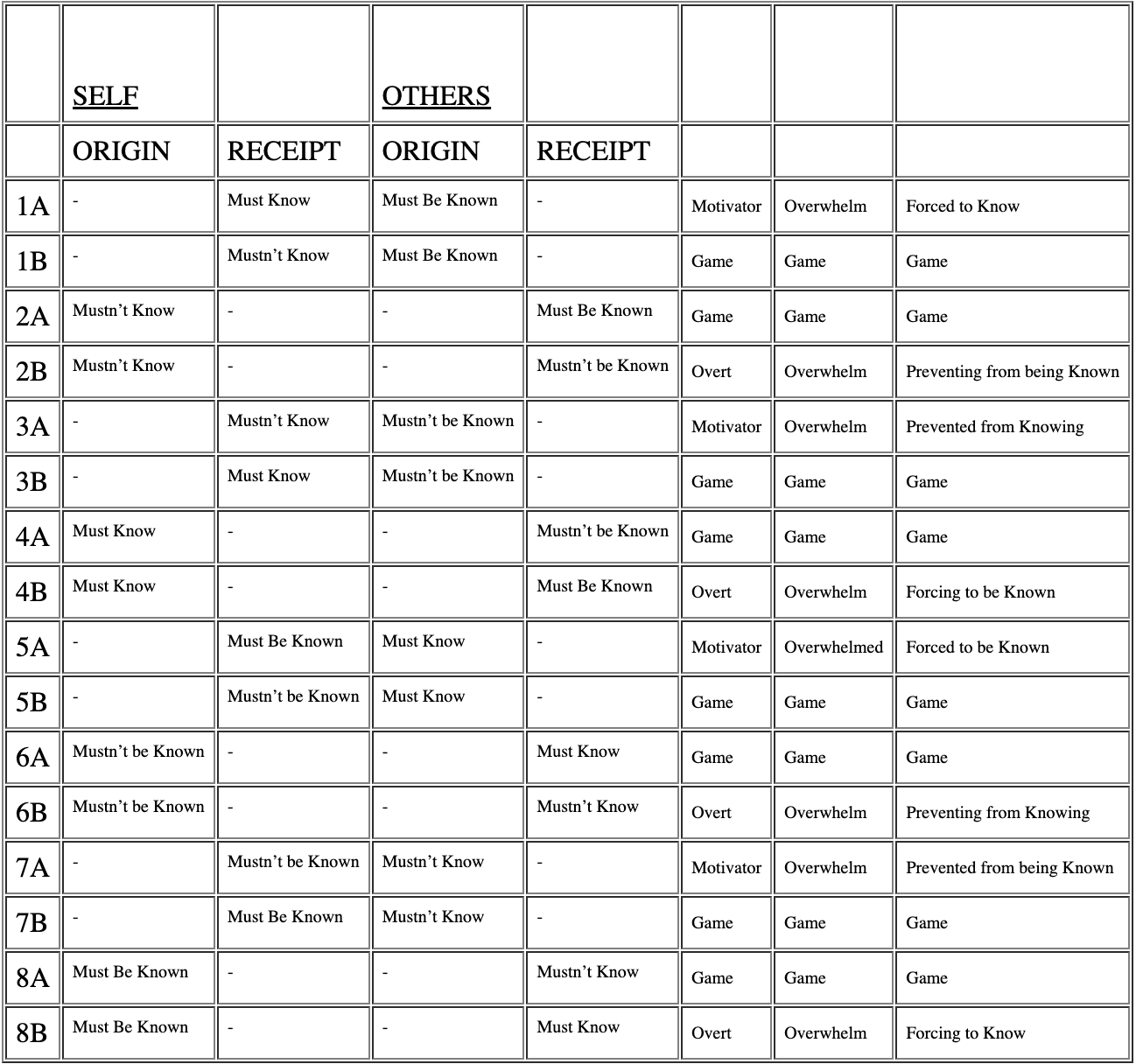
The difference between Level 4 and Level 5 is that Level 4 is more mass oriented which the postulates wrap themselves up in; whereas, Level 5 is pure postulate oriented.

At Level 5, each row of the The Postulate Failure Cycle Chart (see above) forms an exercise. As you do more of Level 4, you start to appreciate the organization provided by this chart to go into the mind more deeply at the pure postulate level.

A pure postulate is like a mathematical relationship. When these relationships are applied to a subject like Physics, they acquire mass. Similarly, pure postulates acquire mass when they are applied to life situations. So, at Level 5, one is dealing with very basic postulates of this universe.

The most basic goal in this universe is “To know.” It is found at the core of all dynamics. One knows by postulating.

Postulating is bringing something into existence. Thus, something is manifested. Once manifested it is known. You can not-know something by altering it. When you alter, you manifest something different on top of what you had manifested earlier. So, the earlier manifestation is hidden under the new manifestation. So, we not-know the earlier manifestation. We only know the new manifestation. This is very solidly the case when there is a shift in valence.

So, there are many, many layers of this alter-is, much like the layers of an onion. This is what life does: “alter-is upon alter-is upon alter-is.”

Auditing (or sorting out of the postulates) is reversing this alter-is. It is like peeling back the layers of the onion one by one. It is discovering the previous layers one at a time. Here we have: “as-is upon as-is upon as-is.”

So, “as-is” is the reverse of “alter-is.” You as-is one layer at a time. In TROM, the layers of alter-is are the 16 rows of the chart above. Row 1A is the top layer of the onion. As you peel it off, you get Row 1B as the next layer. By peeling these layers you get to layer 8B. Below 8B you have another harmonic of layer 1A and so it continues.

.

Running Level 5

How do you “as-is” a layer of this onion? Remember that these layers are made up of an “alter-is” of your postulate. Here we shall look at what happens when we “as-is” a layer.

On the above chart, “Self” and “Other” are just two different viewpoints. Furthermore, the direction of flow is prescribed from “Origin” to “Receipt.”

A layer contains these viewpoints and the flows between them. A viewpoint is like a magnet with two poles called SD and PD. SD is a self-determined postulate. PD is a pan-determined postulate. SD and PD are complementary postulates.

We consider the four most basic postulates (and their complementary postulates) as follows:

Postulate …………………………………… Complementary
Must be known …………………………… (Must know)
Mustn’t be known ……………………….. (Mustn’t know)
Must know ………………………………… (Must be known)
Mustn’t know …………………………….. (Mustn’t be known)

You may identify with the viewpoint called “Self” and mock up another viewpoint called “Other”. You may also mock up two flows as follows:
(1) “Self” as origin and “Other” as receipt.
(2) “Self” as receipt and “Other” as origin.

The PD of the “Origin” is up against the SD of the “Receipt”. The chart only shows the SDs. It doesn’t list the PDs but you can figure them out as the complementary postulates of SDs.

The game is between the PD of the “Origin” and SD of the “Receipt”. An overwhelm (alter-is) occurs when one of these postulates takes over the other postulate completely. The following are the possible overwhelm (alter-is) situations:

(1) You (self) are at origin and your PD takes over the other’s SD. You have committed an overt.
(2) You (self) are at origin and your PD is taken over by the other’s SD. You now have a motivator.
(3) You (self) are at receipt and other’s PD takes over your SD. You now have a motivator.
(4) You (self) are at receipt and your SD takes over the other’s PD. You have committed an overt.

These four situations are mirrored when the postulate and its complementary postulate change places.

When neither takes over then we have an ongoing game, and there are 8 possible games. So, at Level 5 we look at these ongoing games as well.

Thus, the 16 possible compulsive game situations consist of 4 overt overwhelms, 4 motivator overwhelms, 4 origin of games, and 4 receipt of games. Life goes from 8B to 1A, where all four basic postulates regarding an effect may enter into failure both as SD and PD. After these failures, the person must move back to 8B with a different effect to have a game.

We reverse the above cycle of life by processing from 1A towards 8B round and round.

Layer 1A is about “forced to know” same as on Level 4. But here we understand how it came about from layer 1B. From 1B to 1A your SD was taken over by other’s PD. As you become aware of this overwhelm, you revert back to the status of 1B.

At 1B, you are at receipt while playing this game. Then you realize that you have played the same game from origin as in 2A. Your PD was then successful in overcoming other’s SD as in 2B. As you become aware of this overt you realize that you were not in your own valence. So, you flip back into an earlier valence as in 3A, where your SD was overwhelmed in the same way. So, you go on peeling the layers of the onion quite rapidly.

The moment you understand the failures of goal package “to know” as a whole, and how those failures got locked into each other, all the stuck points blow, and you feel complete freedom on the goal “to know.”

In Running Level 5, use RI generously. The key to the resolution of the mind lies in the discovery and creation of complementary postulates. Study “The Tape by Dennis” (the next Section).

.

The Tape by Dennis

“[The best way to follow this is when you have the postulate failure cycle chart in front of you]

“I will go through the chart as if I’m the subject and I’m running Level 5. I’m starting at Level 1A and the goal-package I’m using is the basic To Know goal package. Before I start as given in the manual I’d timebreak all the day’s activities and also I would make sure the Levels 1,2,3, and 4 have been run to no more change. I wouldn’t, of course, attempt Level 5 until those first 4 levels have been run to no more change and also I’ve timebroken the day’s activities.

“Ok, here goes. Level lA. The first thing we need is a little bit of space around us. Now, it doesn’t matter which space you use, you can use the space of the present time universe around you or you can use the space of any past moment in time. It doesn’t matter. You are not limited in any form whatsoever. You just need some space in which to work. It doesn’t have to be present time physical universe space, it can be past physical universe time space. You just need some space there to work.

“So, we are at Level lA and the first thing you would do is put up the postulate, the Other’s postulate “Must be Known”. The postulate is “Must be Known” and that is in the class of not- self. Now, it doesn’t matter where you put the postulate. Most people find it easier to put the postulate into a mass. Even a created mass of your own choice or into a wall, a part of the physical universe, a fence, a passing car. It doesn’t matter where you put it.

“The important thing is that it is a “Must be Known” postulate and it’s in the class of not-self. That is important. You must be certain that it’s in the other’s, the class of other’s to which I will refer for more precision as the class of not-self. So you put up that postulate “Must be Known” in the class of not-self. You yourself then create the postulate “Must Know”. If you go over the column 1 on the chart you see that the level here is “Forced to Know. It’s you being forced to know. Get that? Doesn’t matter what it is, you don’t have to specify as we are just working with the postulates. So you would put up “Must be Known” over tht way in the class of not-self and then get yourself there.

“Don’t see yourself over that way doing this. You get yourself right where you are, right where you are with the “Must Know” postulate. There’s a little danger there that you could say, Oh well, get me over that way. Oh no, that’s wrong. You get right where you are – with the “Must know” postulate. Then you simply timebreak out anything that shows up, any sensations that show up. Your whole situation is of cameo, as a scenario, as a scene, and you timebreak out anything that happens. Anything that shows up, you time break it. Time break it out until it’s gone away and then you put the postulates back up again.

“You put the postulates back up and more scenes show up from the past, you timebreak those back out, have a good look at them, timebreak them out of existence and put the postulates back up again. And you keep on doing this until you can put the postulates up at level 1A with no more change occuring and you can quite happily put up the postulate “Must be Known” in the class of not-self over that way while you’re sitting there with “Must Know”. And you got the idea that you’re being Forced to Know. That’s quite OK. Nothing is happening and it’s all quietened down. Right, now you’re ready to move on. You started to get bored with that level. You’ve done all you can with that level, it’s now time to move on. So we now more from 1A to level 1B.

“Now that is signified by you changing your postulate from “Must Know” to “Mustn’t know”. You’re still at receipt point, but you’re changing your postulate from “Must Know” to “Mustn’t know”. The postulate “Must be known” is still out there in the class of not-self. But now it’s a game. We now have a games condition. We now have the opposition. We now have an opposition situation. We have “Must be Known” in the class of not-self and “Mustn’t Know” in the class of self and they are opposing postulates and that is a games situation. So, you just now hold that. Just hold that situation and timebreak out everything that shows up. Everything that shows up there.

“And you continue with it until there’s no more change. You’ve timebroken out everything you quite happily have that situation there where you have “Must be known” over there in the class of not-self and “Mustn’t know” in the class of self and you can hold that situation. And there’s nothing else, it’s all quietened down. There’s nothing else happening. And you’re getting bored with it, so it’s time to move on. So you now move on from 1B to 2A.

“Now this involves a definite change, you’re going from origin now to receipt. That is a bigger change that happens there between 1B and 2A. When we go from 1B to 2A you start off by still feeling yourself at receipt point. You start off by saying, well, I’m in “Mustn’t know” across to the other person, to the “Must be Known” there. In other words, instead of him being the originator and you being at the receipt at level 2A you’re the originator “Mustn’t know” and you drive him into the receipt of “Must be Known”. In other words, you’re beginning to get at him. So you’re beginning to get at the opponent. So it’s you with “Mustn’t know” and him still holding his postulate of “Must be known”, but instead of him being at the origin point he’s now at the receipt point.

“But it’s still a game. Then again you would do all the necessary timebreaking, the handling of all that shows up, clean everything up until you’re quite bored with that Level, the whole Level 2A. Then you would go to Level 2B where now you are going to actually overwhelm the opponent. You still stay in your “Mustn’t know” postulate, you’re originating your “Mustn’t know” postulate at level 2B and now you drive him, you actually force him, you drive him by the sheer power of the postulate, you drive him from “Must be Known” into “Mustn’t be known”. In other words, you make him comply with your postulate. So he’s driven from “Must be known” he held at level 2A he now goes to “Mustn’t know” at the origin and the opponent with “mustn’t be known” at receipt point there.

“So now we’ve gone through a whole little cycle, haven’t we. We’ve gone through a whole little cycle. We had the complementary postulates at level 1A with “Must be known” and “Must know”. We’ve gone through two game cycles and now we’ve gone back to complementary postulates again. But notice that the postulates have changed. We are now at 2B. At 2B we have “Mustn’t Know” – “Mustn’t be known” and we are back with complementary postulates again. But now you are at the origin point and the “Mustn’t be Known” is at the receipt point.

“Basically the difficulty is a lack of understanding that you’re dealing purely with postulates. You’re not dealing with effects here on the chart, you’re dealing with postulates. That’s all you are putting up, it’s postulates. You’re not putting up effects, you’re not putting up sensations, or you’re not creating people, you’re not mocking up people, you are not mocking up walls, or floors, or situations. You’re simply mocking up postulates. What we’re working with are just postulates. That’s the whole level of level 5, it’s postulates. That is all we are working with at level 5, it’s postulates. We don’t work with anything else, we timebreak out anything else that shows up. We only work with postulates at Level 5.

“It is an incredible thing to work with. At first it seems very strange and so forth, very odd and peculiar to be just working with postulates. But after one gets used to it, when you get into level 5 you get to a point eventually where you wouldn’t dream of working with anything else but postulates because you get the fastest results working with postulates and you always work with just postulates. You simply timebreak out everything else that shows up. Any incidents that show up, or sensations, or emotions or whatever shows up. You simply timebreak them out. So at level 5 you are working purely with postulates. Once you grasp that you have got it. You have got it. You can work then on level 5 and realize what you’re doing.”

.

Summary

A person can end a compulsive game only by adopting a complementary postulate voluntarily. He achieves Nirvana when he can adopt complementary postulates with the whole universe. Therefore, at this level, we only have to return to the person his freedom of choice in the playing of games and the job is done.

A large part of your work will be exercises in developing your PD postulates, and becoming aware of the PD postulates of others.

An easier gradient for Level 5 is SUBJECT CLEARING that helps you first recover those postulates that are underlying the subjects that concerns you the most.

.

The Definition of BODY THETAN (old)

Please see Postulate Mechanics: Dianetics Theory

Scientology provides the following definitions associated with BODY THETAN (BT).

.

Scientology Technical Dictionary

Please see The Definition of THETAN.

Let’s examine the definitions for BODY THETAN given in the OT materials:

“BT 1. By BODY THETAN is meant a thetan who is stuck to another thetan or body but is not in control. BTs stick to pictures, other BTs and clusters. A BT can go into a valence of anything – BTs can be being anything at all.”

A BT is an anomaly that exists at the deep level of beingness. A BT is, therefore, perceived as something like a thetan that is stuck to the body. The BT exists at such a deep level, that it influences all thinking and behavior. It underlies all facsimiles that are addressed on Scientology Grades.

“BT 2. Body thetans are just thetans. When you get rid of one he goes off and possibly squares around, picks up a body or admires daisies. He is in fact a sort of cleared being. He cannot fail to eventually, if not at once, regain many abilities. Many have been asleep for the last 75 million years.” 

A BT is an “individuality” that simply doesn’t fit with rest of the elements of a particular beingness. It may fit with some other package of beingness. This may actually happen.

“BT 3. Huge amounts of charge have already been removed from the case and the body thetans by Clearing and OT 1 and OT 2 to say nothing of engrams and lower grades.” 
… “IMPLANT, 1. a painful and forceful means of overwhelming a being with artificial purpose or false concepts in a malicious attempt to control and suppress him.”
… “IMPLANT, 2. an electronic means of overwhelming the thetan with a significance.”
… “IMPLANT, 3. an unwilling and unknowing receipt of a thought. An intentional installation of fixed ideas, contra-survival to the thetan.”

BTs exist so deep in the psyche that they are said to be “implanted.” BTs do not surface until huge amount of charge in facsimiles and other layers submerging them has been resolved.

“BT 4. The pc cognites he is not running his own incident but a body thetan. This requires only TR 4 as it is only an origin.”

BTs are anomalies embedded in the viewpoint that distort the view of all incidents and other content on the time track. One only needs to discover and acknowledge these anomalies.

“BT 5.  BTs are sometimes not very bright and perceive poorly.”

BTs themselves are difficult to view because they are distorting the view itself.

“BT 6.  If a Pre-OT can put his attention on a BT and blow it off, without even working too hard at it, BTs, with their attention must be sort of blindly in-drawn.”

BTs appears to be lodged deeply but quite loosely in the mental matrix, as they resolve easily when attention is finally put on them.

.

Subject Clearing

Hubbard says, ”One’s body is a mass of individual thetans stuck to oneself or to the body. One has to clean them off by running incident II and Incident I. It is a long job, requiring care, patience and good auditing. You are running beings. They respond like any preclear. Some large, some small. Thetans believed they were one. This is the primary error. Good luck.” Essentially, a body thetan (BT) is a thetan stripped of all its capabilities and reduced to its most pathetic state.

According to Subject Clearing, BTs are misconceptions or postulated anomalies that have become part of a person’s beingness. Examples of BTs are “blind spots” like fixed ideas, false beliefs, biases, and prejudices. A specific blind spot could be a hidden consideration that one is superior to others. Such blind spots distort the person’s viewpoint and he can see neither the present nor the past as it is.

.

Grade 7: Clearing Course

Reference: Clearing Course Instruction Booklet

On this course, Hubbard provides a prepared structure of GPMs to run. He came up with this structure from his research, must probably by auditing himself. Hubbard assumes that this basic structure of reactive bank is the same for every person. 

The first pair of items to be audited on Clearing Course is: TO BE NOBODY……TO BE EVERYBODY. This is presented as Item 1, Part 1, Run 1. In other words, this pair of items is presented as the ultimate core of the reactive mind.

It is important to understand what Hubbard is doing here. Hubbard is assuming that beginning of the reactive mind starts with some imperceptible identity that the thetan has assumed. 

.

The Thetan and The Dynamics

A thetan is a first dynamic entity. From the viewpoint of evolution, the first dynamic is preceded by seven other dynamics. The universe started with the Eighth Dynamic (the God dynamic). But Hubbard assumes that the universe is the product of agreement among thetans (the first dynamic). In other words, Hubbard assumes that humanlike “beingnesses” are the Cause of this universe. 

Hubbard’s conception of Eight Dynamics is a genius concept, but, unfortunately, he sequences them in an inverted fashion because of his human-centric fixation. 

The Eight Dynamics

.

The Eighth Dynamic impulse

The Eighth Dynamic impulse is TO EVOLVE, according to which the other dynamics flow. The “thought form” that this impulse takes, at first, is not a human beingness; but whatever that form is, it ultimately evolves into a human beingness (or thetan).

Therefore, a whole chain of beingesses exists prior to the evolved beingness of the thetan. The intelligence of thetan is a much later phenomenon that was preceded by much trial and error by the impulse to evolve.

Hubbard’s first mention of thetan occurs in the book HISTORY OF MAN, published in 1952. It is essentially an account of the Fifth Dynamic. The Fifth Dynamic is a combination of Seventh and Sixth Dynamics. The Seventh Dynamic is “the impulse to evolve” and not thetans. The Sixth Dynamic is “the basic substance” that evolves and not the evolved form of matter, energy, space and time that we perceive today.

.

Earlier Similar

So, there is much earlier similar that exists prior to Thetan and MEST.

The Clearing Course talks about a mysterious blue light that appears in the mind and causes anaten (analytical attenuation). Most likely this light represents earlier similar items that are missing.

The Clearing Course, therefore, starts at a much later point and not from the bottom of the reactive bank. Not to recognize this is a fundamental error on Hubbard’s part. 

The first pair of items in the reactive bank is most likely to be of the order of TO BE……TO NOT BE.

.

Clearing

[NOTE: I don’t recommend this Grade Level to be run at all as it proceeds from unwarranted assumptions. This Grade is run “blindly” entirely on E-meter.]

The action on the Clearing Course is to keep spotting the light, or calling the same item, again and again until no more reads occur on the E-meter. You don’t have to see the light to spot it or see the thetan or see the object or objects.  You only need to spot the place where you are with the idea of what should be there. GPM Line Plot is not used.

.

Grade 7 Glossary

CHAIN
Anything in the bank that occurs several times will not erase unless it’s the earliest time it occurred.  This is known as the basic on the “chain”.  A number of similar things, early to late in different points of time, make a chain.

ERASURE
You are not seeking RELEASE from the bank at this level.  You are erasing.  Therefore “the bank has blown” is nonsense – one has blown from the bank, so get back in it and run it. Total erasure is the aim.

ITEM 1, PART 1, RUN 1
This is the pair of items that represents the ultimate core of the reactive bank. Apparently, this is the impulse to evolve.

PAIN
Pain only occurs when you have left something charged behind you (earlier).

PART B (is nouns)
Be careful of first one because it is used in the sense of a noun.  Don’t run it otherwise than as a pure noun.

PARTS
The five parts are Parts A, B, C, D, & E as detailed in the section on The Clearing Course Platen. The PARTS go as they do in the first run.  (7s, THEN Basic End Words, THEN Confusion GPM, THEN Objects – hollow, THEN Objects – solid.) 

RELEASE 
You’ll go Release a lot of times.  Ignore it.  We are erasing in R6.  Release can be ignored because the R6 bank is vanishing.  Not true of lower grades.

REPEATER TECHNIQUE
The items are flattened by repeater technique.  Just repeat them until they no longer read.  Get your own reaction off.  Repeat again.  Repeat to no read.  Beware of session suppress and invalidate.

RERUN
If you start getting pain or sickness, you got into a later run or you bypassed some charge and must rerun the earlier area you just did.  Something is still alive.  If in doubt, rerun the lot from the start of the part.  Erase thoroughly.  But if it is a later run, get back into the correct one.

RUN
This row of five parts is called a RUN.  See the section on The Pattern of the Bank. There are four runs.

SICKNESS
Sickness is part of the somatic.  It runs out.

THETAN IN THE ITEM
A thetan is a certain configuration of the impulses that exist. It is a “mental form” opposed to a physical form. The expression “thetan in the item” means the “viewpoint” or “identity” at the moment of the item. One then has to get the earliest moment of one’s own beingness in the bank and spot it.

.

The Pattern of the Bank

The apparent pattern of the bank is as follows (see the section on Clearing Course Platen below):

Part A – The 7s                       (earliest)
Part B – The Basic End Words
Part C – The Confusion GPM           (Run 1)
Part D – The Objects – hollow
Part E – The Objects – solid
 
Part A – The 7s
Part B – The Basic End Words
Part C – The Confusion GPM           (Run 2)
Part D – The Objects – hollow
Part E – The Objects – solid
 
Part A – The 7s
Part B – The Basic End Words
Part C – The Confusion GPM           (Run 3)
Part D – The Objects – hollow
Part E – The Objects – solid
 
Part A – The 7s
Part B – The Basic End Words
Part C – The Confusion GPM           (Run 4)
Part D – The Objects – hollow
Part E – The Objects – solid

.

The Clearing Course Platen

This data is provided for the sake of describing this Grade. This Grade is not used with Subject Clearing approach.

Part A: The 7s

LIGHT (front left)

  1. TO BE NOBODY……TO BE EVERYBODY
  2. TO BE ME……TO BE YOU
  3. TO BE MYSELF……TO BE OTHERS
  4. TO BE AN ANIMAL……TO BE ANIMALS

LIGHT (front left)

  1. TO BE A BODY……TO BE BODIES
  2. TO BE MATTER……TO BE SPACE
  3. TO BE A SPIRIT……TO BE SPIRITS
  4. TO BE A GOD……TO BE GODS

LIGHT (front left)

  1. TO DO NOTHING……TO DO EVERYTHING
  2. TO DO MUCH……TO DO LITTLE
  3. TO DO IT ALL……TO DO NOT ANY
  4. TO DO AMBITIOUSLY……TO DO SLIGHTLY

LIGHT (front left)

  1. TO DO MORE……TO DO LESS
  2. TO DO SPLENDIDLY……TO DO AWFULLY
  3. TO DO WISELY……TO DO FOOLISHLY
  4. TO DO RIGHT……TO DO WRONG

LIGHT (front left)

  1. TO HAVE NOTHING……TO HAVE EVERYTHING
  2. TO HAVE MUCH……TO HAVE LITTLE
  3. TO HAVE ALL……TO HAVE NONE
  4. TO HAVE HUGELY……TO HAVE POORLY

LIGHT (front left)

  1. TO HAVE GREEDILY……TO HAVE PICKINGLY
  2. TO HAVE MIGHTILY……TO HAVE SPARSELY
  3. TO HAVE MAGNIFICENTLY……TO HAVE TAWDRILY
  4. TO HAVE TOTALITY……TO HAVE NEGATIVENESS

LIGHT (front left)

  1. TO STAY EVERYWHERE……TO STAY NOWHERE
  2. TO STAY HERE……TO STAY THERE
  3. TO STAY NEAR……TO STAY FAR
  4. TO STAY UP……TO STAY DOWN

LIGHT (front left)

  1. TO STAY OUT……TO STAY IN
  2. TO STAY BACK……TO STAY FORWARD
  3. TO STAY EARLIER……TO STAY LATER
  4. TO STAY PRESENT……TO STAY ABSENT

LIGHT (front left)

.

Part B: The Basic End Words

The Basic End Words are:

  1. THE NOW
  2. THE PAST
  3. THE FUTURE
  4. THE TIME
  5. THE SPACE
  6. THE MOTION
  7. THE ENERGY
  8. THE MASSES
  9. THE SELF
  10. THE OTHERS
  11. THE LIFE

LIGHT

  1. THE EXISTENCE
  2. THE CONDITIONS
  3. THE EFFECTS
  4. THE PICTURES
  5. THE MIND
  6. THE HISTORIES
  7. THE REACTION
  8. THE GOAL
  9. THE CHAOS
  10. THE UNIVERSE

.

Part C: The Confusion GPM 

Use the above end word in the blanks below.

LIGHT (front left)
Pair: CREATING TO DESTROY _______ …… DESTROYING TO CREATE _______

.

Parts D: The Hollow Objects

LIGHT

  1. 1 hollow [object] going away
  2. 2 hollow [objects] going away
  3. 3 hollow [objects] going away
  4. 4 hollow [objects] going away
  5. 1 hollow [object] coming in
  6. 2 hollow [objects] coming in
  7. 3 hollow [objects] coming in
  8. 4 hollow [objects] coming in

For each set of eight items (preceded by LIGHT), the following hollow objects are used:

  1. Triangle
  2. Circle
  3. Square
  4. Oval
  5. Tetrahedron (three sides and base)
  6. Sphere
  7. Cube
  8. Egg
  9. Prism
  10. Cylinder
  11. Rectahedron (long box)
  12. Flat cylinder 
  13. Pyramid (four sides and base)
  14. Coil
  15. Diamond Box
  16. Oval coil

.

Parts E: The Solid Objects

LIGHT

  1. 1 solid [object] going away
  2. 2 solid [objects] going away
  3. 3 solid [objects] going away
  4. 4 solid [objects] going away
  5. 1 solid [object] coming in
  6. 2 solid [objects] coming in
  7. 3 solid [objects] coming in
  8. 4 solid [objects] coming in

For each set of eight items (preceded by LIGHT), the following solid objects are used:

  1. Circle
  2. Square
  3. Oval
  4. Tetrahedron
  5. Sphere
  6. Cube
  7. Egg
  8. Prism
  9. Cylinder
  10. Rectahedron (long box)
  11. Flat cylinder
  12. Pyramid (four sides and base)
  13. Coil
  14. Diamond Box
  15. Oval coil

.

Grade 6: Dramatization

Reference: Grassroots Scientology

Grade 6 is also called R6EW. Here we have exercises followed by a glossary of key words for Grade 6. The R6EW process is described in detail here: SOLO AUDITING AND R6 EW.

.

Instructions

  1. These processes are run by oneself applying The 12 Aspects of Mindfulness instead of depending on the E-meter.
  2. In response to the commands of these processes, simply look without thinking. Let the mind present you with the answer. If no answer comes up within a reasonable time, you have reached the EP (end phenomenon) for the moment.
  3. These commands tend to be general. The better you understand the command and its scope, the more answers shall come up.
  4. The answers that come up, shall depend on the level of your confront. The higher is your confront the deeper shall be the answers that come up. Your confront improves as you do the processing. After completing a grade, if you repeat it again, you may find some new answers coming up.
  5. “Repetitive to EP” means you contemplate over the command and acknowledge each answer, until no more answers are coming up.
  6. “Run alternately to EP” means that you contemplate over the two commands alternatively, until no more answers are coming up.
  7. “Run the bracket in sequence to EP” means that you sequentially contemplate on the commands provided as a bracket, until no more answers are coming up.
  8. “To EP” is the abbreviation for the above. When there is a single command you run it repetitively. When there are more than one command, you run them as a group, repetitively.

.

EXERCISE

Each command is independently run.

  1. You start with the two commands of Flow 1. 
  2. In response to the first command you write down the “end word” which most closely describes the dramatization. Please study the process in the last few sections of SOLO AUDITING AND R6 EW.
  3. In response to the second command you write down the “end word” which most closely describes the opposite of that dramatization for you.
  4. Consult the synonyms and antonyms for these words in a dictionary until the “pair of these end-words” seems just right to you.
  5. You run these two commands of Flow 1 repeatedly until you exhausted all possible answers. In other words, you have extracted all possible pairs of end-words that are relevant to your case.
  6. You may arrange these pairs in a list in the order that makes most sense to you.
  7. Execute the steps 1-6  for Flow 2 and Flow 3.
  8. You may then combine the lists from all flows and rearrange all the pairs in the order that makes most sense to you.
  9. Hopefully, this process will bring lots of realizations and great relief to you.

R6EW F1:
“What am I dramatizing?” (write down the end word)
“What would oppose that?” (write down the end word)

R6EW F2:
“What have I caused another to dramatize?”
“What would oppose that?”

R6EW F3:
“What are others dramatizing to others?”
“What would oppose that?”

.

Key Word List

Look up these key words in the sequence provided, in the glossary below.

GRADE 6, R6, END WORD, R6EW, DRAMATIZATION

.

Grade 6 Glossary

END WORD
An End Word is the final word of a goal. It is always a noun or a condition made into a noun. For example, with a goal such as “To Grab Books”, Books is the end word. Each end word, however, has many verb or action words related to it, thus making up a series of goals. It is the end word that is the common denominator to the whole of a GPM.  

DRAMATIZATION
Dramatization is thinking or acting in a manner that is dictated by an unassimilated impression contained in the mental matrix. When dramatizing, the individual is like an actor playing his dictated part and going through a whole series of actions. Irrational conduct is the result of dramatization.

GRADE 6
Grade 6 is called R6EW, where R6 means “Routine 6,” which refers to the core of the “Reactive Mind.” EW means “End Words,” which refers to nouns that express dramatizations, such as, “depression.” On this grade you want to find pair of opposite end words, such as, “depression-elation,” that best describe dramatizations that are real to you in present time.  Finding and listing of pairs of end words release one from subconsciously held conflicts. 

R6
R6 is a research designation where ‘R’ stands for ‘Routine’ followed by the research code number. During this research the OT III Implant was discovered: “The pictures contain God, the Devil, angels, space opera, theaters, helicopters, a constant spinning, a spinning dancer, trains and various scenes very like modern England. You name it, it’s in this implant we call in its entirely ‘R6’.” R6 became a synonym for the ‘reactive mind’.

R6EW
R6EW simply consists of this: find an end word, preferably the one you are dramatizing (that would mean the one you would be most stuck in).  If it’s a plus you find its minus, and so on.  It sometimes takes some doing. The main rule is always find the pair, don’t leave one.  If you are in trouble after finding an end word, it’s not that end word that’s troubling you. Also see Grade VI.

.

The words provided in this glossary are specialized for Grade VI. For related words please see

  1. Scientology Technical Dictionary
  2. KHTK Glossary (Metaphysics)

.

Grade 5: Power Processes

Reference: Grassroots Scientology

.

Instructions

  1. These processes are run by oneself applying The 12 Aspects of Mindfulness instead of depending on the E-meter.
  2. In response to the commands of these processes, simply look without thinking. Let the mind present you with the answer. If no answer comes up within a reasonable time, you have reached the EP (end phenomenon) for the moment.
  3. These commands tend to be general. The better you understand the command and its scope, the more answers shall come up.
  4. The answers that come up, shall depend on the level of your confront. The higher is your confront the deeper shall be the answers that come up. Your confront improves as you do the processing. After completing a grade, if you repeat it again, you may find some new answers coming up.
  5. “Repetitive to EP” means you contemplate over the command and acknowledge each answer, until no more answers are coming up.
  6. “Run alternately to EP” means that you contemplate over the two commands alternatively, until no more answers are coming up.
  7. “Run the bracket in sequence to EP” means that you sequentially contemplate on the commands provided as a bracket, until no more answers are coming up.
  8. “To EP” is the abbreviation for the above. When there is a single command you run it repetitively. When there are more than one command, you run them as a group, repetitively.

.

POWER PROCESS (Pr Pr)

Power processes address “source”, “existence” and “condition” in that order. You may run these processes safely using the Subject Clearing approach.

.

SOURCE (Power Process 4)
Here one meditates on “logical” relationships.

  1. Tell me a source.
  2. Tell me about it.
  3. Tell me a no source.
  4. Tell me about it.

“SOURCE” – A Scientology Power Process

.

EXISTENCE (Power Process 5)
Here one meditates on the “reality” of things.

  1. What is?
  2. What isn’t?

“EXISTENCE” – A Scientology Power Process

.

CONDITION (Power Process 6)
Here one meditates on the “conditions” needing resolution.

  1. Tell me an existing condition.
  2. Tell me how you handled it.

“CONDITIONS” – A Scientology Power Process

.

CORRECTIVE PROCESSES

Power processes 1, 2, and 3 are corrective processes and are used when the PC is not running well on Power Process 4, 5, or 6.

Power Process 1: PROBLEM
This process is run when the person is committing present time overts as a solution.

(a) What overt have you committed?
(b) What problem were you trying to solve?
(c) What haven’t you said?
(d) What problem were you trying to solve?

.

Power Process 2: FIXED SOLUTION
This process is run when the pc is collapsed into his bank by former practices. The person is using some practice, opinion or belief as a fixed solution.

(a) “Give me some practices, opinions, or beliefs you have been connected to whether you left them or not.” Run to the first blowdown item.
(b) Then take the blowdown item plus the two items up and two items down from it and assess those five item to one.
(c) Run on the item;

  1. What condition have you encountered in __________________________?
  2. How have you handled it?

.

Power Process 3: GRIEF
This process is run when the pc has been caused grief by auditing or the organization.

(a) What condition have you encountered in Scientology (or auditing or dianetics)?
(b) How have you handled it?

.

POWER PROCESSES ALL FLOWS

Power Process 1

Flow 1

  1. What has another done to you?
  2. What problem was he/she trying to solve?
  3. What hasn’t another said to you?
  4. What problem was he/she trying to solve?

Flow 2

  1. What have you done to another?
  2. What problem were you trying to solve?
  3. What haven’t you said to another?
  4. What problem were you trying to solve?

Flow 3

  1. What has another done to another or others?
  2. What problem were they trying to solve?
  3. What hasn’t another said to another or others?
  4. What problem were they trying to solve?

Flow 0

  1. What have you done to yourself?
  2. What problem were you trying to solve?
  3. What haven’t you said to yourself?
  4. What problem were you trying to solve?

.

Power Process 2

“Give me some practices, opinions or beliefs you have been connected to, whether you left them or not.” Run reading items.

Flow 1

  1. What condition have you encountered in/with ______________?
  2. How have you handled it?

Flow 2

  1. What condition has another encountered in/with ______________?
  2. How has he/she handled it?

Flow 3

  1. What condition have others encountered in/with ______________?
  2. How have they handled it?

Flow 0

  1. What condition have you encountered with yourself because of ______________?
  2. How have you handled it?

.

Power Process 3

For those overwhelmed by a clearing practice.

Flow 1

  1. What condition have you encountered in Scientology (or auditing, clearing, educting, Eductivism, EST, or Dianetics)?
  2. How have you handled it?

Flow 2

  1. What condition has another encountered in Scientology (or auditing, clearing, educting, Eductivism, EST or Dianetics)?
  2. How has he/she handled it?

Flow 3

  1. What condition have others encountered in Scientology (auditing, clearing, educting, Eductivism, EST or Dianetics)?
  2. How have they handled it?

Flow 0

  1. What condition have you encountered in yourself because of Scientology (auditing, clearing, educting, Eductivism, EST or Dianetics)?
  2. How have you handled it? 

.

Power Process 4

Look up the definition of SOURCE. You run the Flows and the commands within them in the sequence given. Each set of command is run repetitively until it is exhausted of all possible answers.

Flow 1

  1. Tell me a source.
  2. Tell me about it.
  3. Tell me a no-source.
  4. Tell me about it.

Flow 2

  1. Tell me a source for another.
  2. Tell me about it.
  3. Tell me a no-source for another.
  4. Tell me about it.

Flow 3

  1. Tell me a source for others.
  2. Tell me about it.
  3. Tell me a no-source for others.
  4. Tell me about it.

Flow 0

  1. Tell me about yourself as a source.
  2. Tell me about it.
  3. Tell me about yourself as a no-source.
  4. Tell me about it.

When there is difficulty in running the SOURCE process, run Power Process 1 instead. The reason is that one may be committing overts in an attempt to resolve some problem and this situation needs to be handled first.

.

Power Process 5

Flow 1

  1. What is?
  2. What isn’t?

Flow 2

  1. What is for another?
  2. What isn’t for another?

Flow 3

  1. What is for others?
  2. What isn’t for others?

Flow 0

  1. What is for yourself?
  2. What isn’t far yourself?

.

Power Process 6

Flow 1

  1. Tell me an existing condition.
  2. Tell me how you have handled it.

Flow 2

  1. Tell me an existing condition for another.
  2. Tell me how he/she has handled it.

Flow 3

  1. Tell me an existing condition for others.
  2. Tell me how they have handled it.

Flow 0

  1. Tell me an existing condition in yourself.
  2. Tell me how you have handled it.

.

POWER PLUS PROCESSES

Power Process 1B
L & N to first B.D. Item, “What person have you known?”
Run terminal in following processes.

Flow 1

  1. What has _________ done for you?
  2. What problem was he/she trying to solve?
  3. What hasn’t __________ said to you?
  4. What problem was he/she trying to solve?

Flow 2

  1. What have you done to _________ ?
  2. What problem were you trying to solve?
  3. What haven’t you said to ________ ?
  4. What problem were you trying to solve?

Flow 3

  1. What has __________ done to others?
  2. What problem was he/she trying to solve?
  3. What hasn’t __________ said to others?
  4. What problem was he/she trying to salve?

 Flow 3A

  1. What have others done to __________ ?
  2. What problem were they trying to solve?
  3. What haven’t others said to ________ ?
  4. What problem were they trying to solve?

Flow 0

  1. What have you done to yourself because of _______?
  2. What problem were you trying to solve?
  3. What haven’t you said to yourself because of __________?
  4. What problem were you trying to solve?

.

Power Process 1C
L & N to first B.D. Item, “What place have you known?”
Run the place found in the following processes.

Flow 1

  1. What has another done to you in _________?
  2. What problem was he/she trying to solve?
  3. What hasn’t another said to you in _________?
  4. What problem was he/she trying to solve?

Flow 2

  1. What have you done to another in _________?
  2. What problem were you trying to solve?
  3. What haven’t you said to another in _________?
  4. What problem were you trying to solve.

Flow 3

  1. What has another done to another in _________?
  2. What problem were they trying to solve?
  3. What hasn’t another said to others in _________?
  4. What problem were they trying to solve?

Flow 0

  1. What have you done to yourself in _________?
  2. What problem were you trying to solve?
  3. What haven’t you said to yourself in _________?
  4. What problem were you trying to solve?

.

Power Process 1D
L & N to first B.D. Item, “What subject would you like to know more about?”
Run the subject found in the same processes as given in 1C (places), Quad flow.

.

DEFINITIONS

ATTENTION
Attention is focusing of the mind. A person’s attention naturally goes to what needs to be resolved. When he can’t resolve it then the attention gets fixed on it at first in an increased effort to resolve it, but upon failing to do that the attention gets scattered all over the place from that point of failure.

GENERALITY
A generality may point out a general pattern, such as, through a mathematical equation. It still needs to be filled with specifics in order to reach a worthwhile conclusion in a situation.

DELUSION
A delusion occurs when one is not seeing things as they are. It could be there but not very obvious, or it could be very obvious. 

.