This paper summarizes a new interpretation of Quantum mechanics that was introduced in an earlier paper, Quantization & the Atom.
.
Postulates
The following postulates form the basis of the interpretation of quantum phenomena being presented here:
The reference point that allows ultimate objectivity in viewing the universe is EMPTINESS.
The UNIVERSE is intrinsically consistent, harmonious and continuous.
These two postulates are derived from the HEART SUTRA of Buddha. They support the perspective of “continuum of substance”.
.
Substance
The substance of this universe may be divided into two major categories:
(1) MATERIAL-SUBSTANCE – This is the structured aspect of substance. The smallest material-particle having the simplest structure is the hydrogen atom. Atoms acquire greater substantial-ness by growing in size. They acquire more complex structures by combining in various ways as molecules and aggregates. The substantial-ness of material-substance is measured in terms of INERTIA.
(2) FIELD-SUBSTANCE – This is the non-structured aspect of substance that starts as a wave of disturbance. This wave congeals into greater substantial-ness as it follows paths of smaller and smaller radius. This leads to a pattern similar to a “whirlpool”. The substantial-ness increases as one approaches the center of this whirlpool formation. The electromagnetic spectrum provides the progression of substantial-ness of field-substance. The substantial-ness of field-substance is measured in terms of QUANTIZATION.
.
Quantization
It may be pure speculation to say that substance starts with disturbance in emptiness; but it is valid to associate basic substance with disturbance; because, at lower quantization, the wave characteristics dominate. The particle characteristics come into picture with increasing quantization, which parallels the increasing frequency of electromagnetic spectrum.
Quantization increases as the disturbance follows a curved path of decreasing radius. Here we have the scenario of galaxy-like whirlpool formation, where quantization is increasing from periphery towards the center. Such a formation may apply to the atom, where maximum quantization at the center converges to form a “solid” nucleus. The ultimate quantization of field-particle thus leads to the formation of a material-particle. For material-particles, increasing quantization appears as increasing inertia.
Any particle with a quantization less than that of the simplest atom is a field-particle. Thus, electrons, protons and neutrons are all field-particles. The stand-alone electron may be regarded as having a whirlpool formation that has yet to form a solid nucleus at the center to give birth to an atom.
.
The Force Characteristics
Charge has the same significance for field-substance, as mass has for material-substance. The difference is that charge is animated and dynamic, whereas, mass is structured. The field and material substances exist in equilibrium with each other. Here charge provides animation to the structure of mass.
The force characteristic, such as, electromagnetic and nuclear forces, originate at the level of field-substance. Their range is limited. But the force characteristic of gravitation appears at the level of material-substance. The range of gravitation is unlimited.
There seems to an inverse relationship between quantization/inertia and natural velocity of a particle. The higher is the inertia, the lesser is the natural velocity. The lower is the quantization, the greater is the natural velocity. The black hole at the center of a galaxy has so much inertia that it anchors the whole galaxy. Its natural velocity may be considered almost zero on an absolute scale. Light, on the other hand, has such a low level of quantization that it’s velocity is almost infinite.
.
Gravitation
The electrical lines of force were postulated by Faraday to originate and terminate at “centers” called charges. Such charges could be light years apart, and yet be connected by a line of force. [See Faraday: Thoughts on Ray Vibrations].
Each point on the electrical line of force, however, is surrounded by a circular magnetic lines of force. This is like the whirlpool formation mentioned earlier. Here the whirlpool is described by the magnetic lines of force, and the center line of the whirlpool is described by the electrical lines of force. The two ends of the electrical line of force ends at two charges. The quantization at each point of electrical line of force is provided by the radius of the magnetic line of force surrounding it. Thus there is a gradient of quantization along the line of force from one end to the other.
The gravitational lines of force between two material particles also carry a gradient of quantization. This force characteristic of this quantization pertains to the whole atom and not to parts within it as do electromagnetic and nuclear force characteristics. The lines of force representing whirlpool formation of the two material particles bend away from each other. But they interact with each other by aligning with each other. This results in material particles as centers of force being dragged toward each other. This is gravitation.
.
Uncertainty in Measurements
A decreasing gradient of quantization means that the field-substance is gradually becoming less substantial. Therefore, it’s characteristics of space and time are simultaneously becoming less substantial. A consolidated point location at a higher quantization may expand into a flimsy region at a lower quantization.
This explanation seems to underlie the Heisenberg principle of uncertainty. Heisenberg is basically saying that a point location no longer remains a point at lower quantization; instead it spreads out producing uncertainty.
But this uncertainty arises in reference to material-point. The lower quantization has its own point location as a field-point. In other words, the uncertainty disappears in reference to the field-point. Thus, we may account for uncertainty when we look within the atom by accounting for the decrease in quantization.
“The energy of a ponderable body cannot be split into arbitrarily many, arbitrarily small parts, while the energy of a light ray, emitted by a point source of light is according to Maxwell’s theory (or in general according to any wave theory) of light distributed continuously over an ever increasing volume.”
“In fact, it seems to me that the observations on “black-body radiation”, photoluminescence, the production of cathode rays by ultraviolet light and other phenomena involving the emission or conversion of light can be better understood on the assumption that the energy of light is distributed discontinuously in space.”
Basically, according to Einstein, there appears to be a limit to which an electromagnetic cycle could be divided into smaller bits of energy. Per the relationship, E = hv, an electromagnetic cycle cannot have energy less than h. This limits the “size” of light quanta. Therefore, light or electromagnetic energy is not a continuous function in space as postulated by Maxwell. The size of this light quantum increases with the frequency of light.
.
Field and Material Substances
This paper of Einstein has another deep significance. Just like there is a limit to which matter could be subdivided in terms of “mass”, there is also a limit to which electromagnetic phenomena could be subdivided in terms of “energy”. In some respect, the “pure energy” of the electromagnetic phenomena is equivalent to the “mass” of matter. In fact, Einstein derived this equivalence of energy and mass, as E= mc2 in his fifth paper, “Does the inertia of a body depend on its energy context” that he published in 1905.
This equivalence of energy and mass puts the electromagnetic phenomena in the same general category as matter. We may define this general category as “substance”. We may refer to the electromagnetic phenomena as “field-substance” and matter as “material-substance”. This categorization also helps us differentiate the “pure energy” aspect of electromagnetic phenomena from the kinetic and potential energy associated with matter.
The smallest particle of material-substance exists as an atom. When the atom is subdivided into smaller particles we enter into the realm of field-substance. The atom forms the interface between material and field substances. The study of this interface is the subject of Quantum Mechanics.
.
Substance, Emptiness and Space
Newtonian mechanics, as well as the Quantum mechanics, is based on a belief in “particles in void”. According to this viewpoint, space and time exist seperate and independent of substance.
Based purely on extensive experimentation with electricity and magnetism, Faraday favored the alternate belief of “continuum of substance”. According to this viewpoint, space and time are integral characteristics of substance. When there is no substance, there is no space, and no time either. There is only emptiness..
The current interpretation of quantum mechanics is mostly from the viewpoint of “particles in void”. This essay on quantization takes the viewpoint of “continuum of substance”.
The universe thus consists of field-substance, material-substance, and their characteristic space and time. Space is thus part of the universe. This universe is then surrounded by emptiness. This emptiness is not only devoid of all substance but it is also devoid of space and time.
.
The Wave-particle Duality
Since we define electromagnetic phenomena as field-substance, we may refer to the light-quantum, introduced by Einstein, as a “field-particle”. A particle is characterized by how discrete it is as opposed to being continuous.
According to “continuum of substance”, the background is made up of the same field-substance that makes up the field-particle. The field-particle, therefore, appears like a pulse in the background. This imparts wave characteristics to the field-particle. But the increasing frequency differential between the field-particle and the background then also imparts particle characteristic of “discrete-ness”.
Thus, the wave properties dominate at lower frequencies; whereas, the particle properties dominate at higher frequencies. In any case, the field-particle is imbued with both wave and particle characteristics. This wave-particle duality is supported better from the perspective of “continuum of substance.”
.
The Meaning of Quantization
At lower frequencies the field-substance is very flimsy. But as it increases in frequency it becomes increasingly substantial. This process may be called “quantization”. Besides increased substantial-ness of the field-substance, quantization also refers to increased discrete-ness of the field-particle.
The spectrum of quantization parallels the electromagnetic spectrum. At the upper end of this spectrum we have material-particles. The lower end of this spectrum gradually approaches pure emptiness that is devoid of field-substance.
Thus, not only the substantial-ness, but also the very existence of the field-substance depends on its frequency. If there is no frequency there is no field-substance, and consequently no space and time. There is only emptiness.
Emptiness is not arrived at right below the frequency of “one”. Since the unit of time on which the frequency is based is arbitrary, this frequency can be given any number with a smaller unit of time and reduced further. An infinite series of reduced cycles thus exists before emptiness can be arrived at.
.
Particle Physics
The smallest material-particle is the atom. It forms the interface between material and field substances. The moment we break the atom we get particles that are less substantial than the atom. The sub-atomic particles belong to the category of field particles. They exist in the gamma range of the electromagnetic spectrum as obvious from their de Broglie wave-lengths.
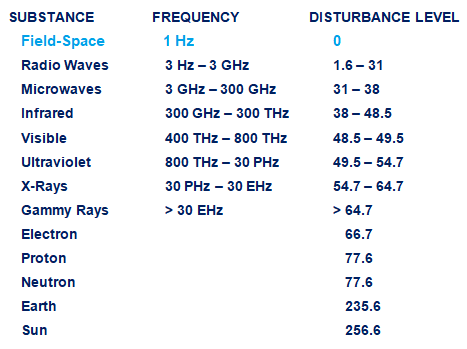
The disturbance level expresses the frequency of electromagnetic radiation as a power of 2. It is calculated per the following formula.
Disturbance level, D = (log f) / (log 2) = 138.4 + 3.322 log p
Where f is frequency in hertz
And p is momentum of material particles in S.I. Units.
The gamma range starts at the disturbance level of 64.7 (30 EHz). Electron appears at the beginning of the gamma range at a disturbance level of 66.7. The nucleons appear well into the gamma range at a disturbance level of 77.6.
The minimum disturbance level that applies to material particles is then 138.4. Below this level we are dealing with field-particles. Particle physics is then dealing with field-particles and not with material-particles. The mass associated with electrons and nucleons is not due to matter. It represents quantized field-substance.
.
Charge, Mass and Gravitation
Charge is a field property, whereas, mass is a material property. Both comply with the inverse square law. When we do a dimensional analysis, we find that both charge and mass have the same dimensions (L3 T -2). Thus, charge and mass belong to the same category, which we may identify as the force characteristic of substance Per Faraday. Mass as a force characteristic may be described as the “inertia” of the material particle. On the other hand, charge as a force characteristic may be described as the “quantization” of the field-particle.
The nuclear force among nucleons is much greater than the electromagnetic force among electrons around the nucleus because the quantization In the nucleus is much greater. At quantization lower than that for electromagnetic force the charge is much smaller and not obvious.
From its periphery to its nucleus, the atom consists of all levels of quantizations. The gravitational force represents the weighted average of all such quantization for the whole atom, as compared to the electromagnetic and nuclear forces that are limited to “local” parts within the atom. Therefore, the gravitational force is weaker in strength than the electromagnetic and nuclear forces, but it can act over a much greater range.
.
Quantization, Inertia and Velocity
Quantization of field-particles ends up with the formation of the atoms of the periodic table. Atoms are the beginning of the formation of material-particles. As these atoms combine and collect to form larger material-particles, their quantization is represented by “inertia” as defined by Newton.
If the inertia of a material-particle is infinite it would appear to be still because any attempt to move it will be resisted. But if the inertia is not infinite, the material particle shall exhibit a natural velocity that is the result of its motion balanced exactly by its inertia.
Thus, the lesser is the inertia or quantization of a particle, the greater would be its velocity. This explains why the speed of light is greater by many degrees of magnitude compared to a material body. The quantization associated with the photons of light is infinitesimal compared to the inertia of a material body, such as, earth.
Between two particles of different quantization and/or inertia there will naturally be a relative velocity between them. Two such particles shall attract each other as a result of the gravitational attraction between them, but their relative velocity shall keep them apart. They are then likely to form a system where they will revolve around each other.
Such is the behavior of material bodies that we observe in our cosmos. This confirms the model we have built so far based on the concept of quantization/inertia.
.
The Gravitational Force
As presented above, substance has force characteristics that we perceive as gravitational, electromagnetic and nuclear forces. Faraday looked at force to be synonymous with substance. Please see Faraday: On the Conservation of Force.
Faraday visualized lines of forces extending out from centers of force. The center of force is the electronic region within the atom, when we look at the electromagnetic field. It is the nuclear region within the atom, when we look at the nuclear field. These forces have short ranges as they originate from within the atom.
But when it comes to the gravitational field, the center of force is the whole atom and not some part within it. Thus, the gravitational force applies more to the material-substance; and its range extends without limit.
These force fields interact through their lines of force. These lines of force are curved around their respective center of force. When they interact they try to line up with each other. This results in the centers of forces moving towards or away from each other.
In case of gravitation the lines of forces are around atoms or larger material-particles. Since these particles are clearly discrete, their lines of force always curve away from each other. When they interact, they try to curve toward each other. This generates a force of attraction between the material-particles.
By drawing the gravitational lines of force for two discrete material-particles, it is easy to see why the force of gravitation is always attractive.
.
Field-particle Spin
Beyond this universe of substance there is emptiness of no-substance. Due to the overall symmetry, the surface of the universe must be closed and curved. Any particle in this universe must follow a curved path to remain within the universe.
The lower is the quantization the lesser is the density of the field-substance, and larger is the radius of the curved path that a field-particle may follow. The higher is the quantization, the denser is the field-substance, and smaller is the radius of the curved path that a field-particle follows. We may liken these paths to those in a “whirlpool”. These paths are decreasing in radius and increasing in quantization as the center is approached. Ultimately, the path completely closes upon itself to produce a spinning particle at the center of the “whirlpool”.
All field-particles must have a spin to be able to exist in stand-alone form. A complex particle, such as, an atom, is likely to consist of increasing levels of quantization from its periphery to the center following the whirlpool model. The “electrons” near the nucleus shall have much higher quantization compared to the “electrons” near the periphery. This tells us that “electrons” within the atom are not the same as they appear in their stand-alone form.
The nucleus in an atom shall have a spin. This spin is likely to be discrete, just as the quantization is discrete. The higher is the average quantization, the greater shall be the spin of the nucleus, or a stand-alone field -particle.
.
A New Atomic Model
The “whirlpool” likeness seem to provide a new atomic model for the atom. This same likeness seems to apply to a galaxy. We may compare the spinning black hole at the center of the galaxy to the nucleus of the atom. The rest of the rotating galaxy may be compared to the rotating field-substance around the nucleus.
The field-substance thickens gradually from the periphery of the atom toward its center with decreasing radius and increasing rotation.
As the field-substance thickens, it starts to acquire a structure. This structure first appears as the nucleus. This essentially forms the atom. More complex structures come about with combining of atoms as molecules, and then with increasing number of atoms and molecules combining into gases, liquids, solids, crystals, etc.
This structure is the forming characteristic of the material-substance! which starts with atom. Inside the atom lies the field-substance of layered quantization. The peripheries of the atoms, molecules, etc., eventually extend up to the background and merge into it. Thus, the background of the structured material substance is formed of unstructured field-substance.
The field and material substances exist in equilibrium with each other. It is the flows and ebbs among the quantization and inertial levels of these substances that cause all phenomena.
It is also intuitively immediately apparent that without a stress tensor for the static gravitational field, the Newtonian forces cannot be derived from an energy tensor. Also, if the energy-momentum conservation concept is not applied to the metric field, it loses all physical value.
Einstein to M. Besso, August 1918
In other words, if the gravitational field is there, then the energy in that field has to be in a state of stress. That is the basis of Newtonian forces. The energy represents physical substance that is in motion. This property is defined by the energy-momentum conservation concept.
.
From the earliest recorded thoughts about physics and philosophy, beginning in ancient times, theories about the constitution of nature have been divided into two opposing conceptual frameworks, one based on the idea of a continuum of substance permeating all space, and the other based on the idea of isolated entities moving through a void of empty space. (See Continuity and the Void).
The void of empty space is difficult to conceive because space, by definition, represents the extents of substance. Empty space, therefore, must consist of invisible substance that has very small consistency (thickness). This substance is energy (mass) of very low quantization. I, therefore, subscribe to the first conceptual framework.
From matter to space, energy is continually diminishing in its consistency. Faraday described it as “lines of force” that were concentrated in atoms, and which spread out in space. Matter does not end abruptly and space starts. However, Newton’s mechanics uses this latter framework from which comes the idea of action at a distance.
Although one view or the other has sometimes been predominant, neither view has ever won unanimous assent, and the “mainstream” view has alternated back and forth between the two frameworks many times throughout the history of science. At the beginning of the scientific revolution, Descartes adopted the philosophy of the continuum, insisting that space and matter are co-extant (indeed, that they are the same thing), so there is no such thing as empty space, and he asserted that objects affect each other only by direct contact. However, the swirling vortices of Descartes were soon discredited by Newton’s theories of dynamics and gravitation. Newton himself was equivocal, but his theories strongly tended to support the idea of isolated particles of matter moving in an empty void, capable of interacting with each other, via the force of gravity, over great distances.
The “continuum of substance” framework gives us a spectrum of a physical substance of varying consistency from space to matter. Matter is the most condensed form of this substance, and space is the least condensed form. We may call this substance energy. The primary characteristic of this substance is force. This was Faraday’s view. The swirling vortices of Descartes may be used as a model for an atom with energy condensing towards the center.
The framework of “isolated entities moving through a void of empty space” is used in Newtonian mechanics. It is a very simplified binary view of the former framework, consisting only of matter and space. Here space is seen as a void (absence of matter). This simplification then provides us with the various concepts of distance, velocity, acceleration, mass, force, and energy of Newtonian mechanics. It defines the force of gravity as action at a distance.
The early theories of electricity and magnetism developed by Coulomb, Ampere, and Oersted, were based on the Newtonian model of gravity, which is to say, they were based on the premise that isolated objects moving in the void of empty space exert forces on each other even when separated by some distance (rather than just when they are in direct contact). This theoretical approach proved very successful, and was developed to a high level, culminating in the work of Weber, Neumann, and others by around 1849. However, simultaneously with those developments, Faraday was investigating the same phenomena of electromagnetism from a completely different perspective, reverting to the idea of contact forces exerted through some kind of substance permeating all of space.
On a macroscopic scale, the Newtonian mechanics, with its theory of “action at a distance” has been rather successful. It has been able to explain the motion of the planets. This theory of force is used successfully even in the explanation of electromagnetic phenomenon. Faraday, however, used the continuum of substance perspective in investigating the electromagnetic phenomenon. His experiments led him to the concept of field consisting of lines of forces. Faraday’s approach takes Newton’s concept of inertia to the level of “innate force of substance” pervading all space.
This approach was taken up by Maxwell, who in 1855 published a paper, “On Faraday’s Lines of Force”, in which he sought to express Faraday’s ideas in mathematical form. Maxwell continued his investigations in a paper entitled “On Physical Lines of Force”, published in 1861, and then another, entitled “A Dynamical Theory of the Electrodynamic Field” in 1864. This work ultimately led to his great and highly influential “Treatise on Electricity and Magnetism”, published in 1875, which is the basis for most treatments of the classical theory of electromagnetism to this day.
Maxwell sought to express Faraday’s ideas of lines of force in mathematical form. But the mathematics used by Maxwell maintained the identity of substance rigidly separate from space as per Newtonian mechanics. Maxwell’s mathematical lines of force did spread out and came together in space, but they did so as an incompressible fluid, and not as a substance thinning out or thickening up on a gradient. The Maxwell’s field is, therefore, based on the “action at a distance” theory of Newton, and not on Faraday’s “continuum of substance” approach.
Nevertheless, the tradition of Weber, et al, has continued, notably with the work of Lorenz, the retarded potentials of Lenard and Weichert, and the absorber theory of Wheeler and Feynman. It is generally conceded today that electrodynamics can be formulated either as a field theory or as a distant-action theory, although one may be more convenient than the other in any given circumstance. This ambiguity arises because, even in field theories, we never actually observe a field, we only observe the behavior of material entities. Based on this behavior, we find it convenient to hypothesize the existence of certain fields, partly as a computational aid, i.e., a simple way of encoding the rules that evidently govern the behavior of material entities. But it is also possible to formulate those laws without reference to any hypothetical fields in empty space, by allowing for distant action, provided we allow the forces to be retarded functions of the relative motions of particles (not just their relative positions).
The current field concepts are a simple way of encoding the rules that evidently govern the behavior of material entities. A retarded function encodes how a disturbance at one point and time produces a causal response at later times. This allows for “action at a distance”.
Maxwell was well aware of the viability of this “fieldless” approach, but was not satisfied with it. He wrote in his 1864 paper
This theory, as developed by W. Weber and C. Neumann, is exceedingly ingenious, and wonderfully comprehensive in its application to the phenomena … The mechanical difficulties, however, which are involved in the assumption of particles acting at a distance with forces which depend on their velocities are such as to prevent me from considering this theory as an ultimate one…
Ironically, the reason given here by Maxwell for being dissatisfied with the distant-action approach to electromagnetism was actually based on a misunderstanding, as Maxwell later acknowledged. He originally thought a velocity-dependent force law must automatically violate the conservation of energy. Indeed, the first such law to be proposed (by Gauss) was subject to this objection. However, the force law of Weber fully satisfies the conservation of energy, so Maxwell’s original stated motivation was unfounded. After realizing this, he amended his reasons for opposing distant action theories. In later treatments he emphasized the requirement (as he saw it) for the electromagnetic energy (and momentum) emitted by one body and absorbed some time later by another body to have some mode of existence between the emission and absorption events. Thus, his mature rationale for fields was that they provide the vehicle for spatially and temporally continuous conservation of energy and momentum during the intervals of communication–which he showed were non-zero, because of the finite speed of propagation of electromagnetic disturbances. Others have considered the sheer simplicity and clarity of the field formulation to be the strongest evidence for the “reality” of the fields. For example, this seems to have been Einstein’s view.
Maxwell’s rationale for fields was that they provide the vehicle for spatially and temporally continuous conservation of energy and momentum during the intervals of communication.Thus, he viewed the field to exist separate from space same as matter. The field was not integrated with space the way Faraday’s lines of force were. Thus, the field is treated in the mechanical sense given by Newton in terms of momentum and energy.
In any case, Maxwell’s understanding of the electrical force that exists between charged particles was based on the idea that even the “empty space” of the vacuum is actually permeated with some kind of substance, called the ether, which consists of individual parts that can act as dielectrics.
The theory I propose may therefore be called a theory of the Electromagnetic Field, because it has to do with the space in the neighbourhood of the electric or magnetic bodies, and it may be called a Dynamical Theory, because it assumes that in that space there is matter in motion, by which the observed electromagnetic phenomena are produced.
Maxwell idea of field is “Space is permeated with a substance called ether.” This is different from field as visualized by Faraday,“Space itself is substance with inherent characteristic of force.” In other words, space was continuous with matter for Faraday, but not for Maxwell.
The simplest component of this theory was the electrostatic field, which Maxwell envisaged as a displacement of the dielectric components at each point in the medium. In simple terms, he pictured ordinary empty space, when devoid of any electric field, as consisting of many small pairs of positive and negative charge elements, and in the absence of an electric field the two opposite charges in each pair are essentially co-located, so there is no net change or electric potential observable at any point. If an electric potential is established across some region of this medium (e.g., empty space), it tends to pull the components of each pair apart slightly. Maxwell termed this an electric displacement in the medium. Of course, the constituent parts of the dielectric pairs attract each other, so the electric displacement is somewhat like stretching a little spring at each point in space.
Dia- in dielectric means “across.” In Maxwell’s conception, an electrostatic field was a polarized “space.” It was as if the “space” was stretched. The “space” appears to be the idealization of the interface between the nucleus and the electronic layer of the atom. Or, it could be seen as the stretching of an atom without its nucleus.
As an aside, it’s interesting that this theory, which supposedly denies the intelligibility of distant action, nevertheless ends up invoking (albeit on a very small scale) what appears to be elementary attraction between distinct and separate entities. It’s clear that Maxwell recognized this aspect of his theory when he wrote
I have therefore preferred to seek an explanation of the facts … without assuming the existence of forces capable of acting directly at sensible distances.
The qualifier “sensible” is obviously intended to side-step the fact that his “explanation of the facts” does still assume the existence of forces capable of acting at a distance, but he excuses this on the grounds that it is not a “sensible” distance. This can certainly be criticized, since if the objection to action at a distance is based on principle, then it isn’t clear why it should be considered more acceptable over short distances than over long distances. Ironically, Maxwell himself even commented on this critically in an article on Attraction written for the 9th edition of the Encyclopedia Britannica in 1875.
If, in order to get rid of the idea of action at a distance, we imagine a material medium through which the action is transmitted, all that we have done is to substitute for a single action at a great distance a series of actions at smaller distances between the parts of the medium, so that we cannot even thus get rid of action at a distance.
and elsewhere he said even more pointedly
…it is in questionable scientific taste, after using atoms so freely to get rid of forces acting at sensible distances, to make the whole function of the atoms an action at insensible distances.
Maxwell didn’t have the right mathematical model to represent Faraday’s ideas correctly. He simply dispersed the Newtonian “matter” over larger space without using the insight of Faraday that force means the presence of substance, and space simply represents the extents of this substance.
Despite these scruples, Maxwell’s theory of electrodynamics, based on forces acting over insensible distances, proved to be tremendously successful. The elaborate and complicated material mechanisms that Maxwell originally conceived to embody the mathematical relations of the field eventually receded in his thinking, as he came to focus more and more on purely abstract energy-based considerations.
We may express the fact that there is attraction between the two bodies by saying that the energy of the system consisting of the two bodies increases when their distance increases. The question, therefore, Why do the two bodies attract each other? may be expressed in a different form. Why does the energy of the system increase when the distance increases?
If the substance is continuous, then increase of distance represents thinning of substance (force) and increasing of motion (velocity). Amount of substance remains the same, but energy increases because work is done to push the two particles apart.
It’s easy to see that Maxwell’s conception of the electric field is quite consistent with this energy-based approach. First, recall that, according to standard electromagnetic theory, the energy density of an electric field in vacuum is (1/2)ε0E2, where E is the magnitude of the electric field at the given point and ε0 is the permittivity of the vacuum. (For the spherical field around a stationary mass point, E drops off as the square of the distance, so the energy density drops off as the fourth power, so the total integrated energy is finite.) Now consider two particles with equal and opposite electric charges, and suppose they are initially co-located at a single position. Their electric fields cancel out, because the union of these oppositely charged particles is an electrically neutral particle. As a result, the dielectric medium surrounding these two particles is “un-stressed”, i.e., none of the tiny springs are displaced at all, so no energy is stored in those springs. Now suppose we separate the two oppositely charged particles by some distance. This displacement results in a net electric field in the surrounding medium. Much of the two fields still cancel out, but not all, so the dielectric elements are displaced, the “springs” are stretched slightly, and the medium now holds some energy. The energy came from the work done to separate the particles, so we see that these two oppositely charged particles exert a force of attraction on each other (through the intermediary of the dielectric medium). The further we separate the particles, the more energy we put into the field, and we approach the energy of two complete isolated fields when the particles are infinitely far apart.
The universal substance is gradient of mass. Charge exists with sudden change in gradient. An electric field exists at the interface between the nucleus and the surrounding electronic layer. Here the substance is stretched suddenly. The magnitude of electric field (E) is the degree of stretch. Energy density is how much energy exists at a location in the stretched space. It is proportional to E2. The constant of proportionality is half of the “permittivity of the vacuum.”
Positive charge is balanced by negative charge elsewhere. Therefore, the net charge is always zero. A single isolated charge has a spherical field around it. The inherent force and consistency of this field drops off rapidly with distance, so the total energy associated with that charge is finite.
For two equal and opposite charges, all lines of force start from one charge and terminate into the other. The lines do not exist when the charges are co-located. There is no charge, field or space. We are not considering the mass and material space in this situation. Separating of these two charges would mean supplying additional forceto create the two charges and the distance between them. Ultimately, we approach the force that forms two isolated charges infinitely far apart. This force must have come from a virtual dimension.
The other case to consider is two particles with the same electric charges, both positive or both negative. Again we start with the two particles co-located, but in this case the fields do not cancel each other, they combine to produce a spherical field of twice the strength (and hence four times the energy) of a single charged particle. Thus the surrounding dielectric medium is already significantly “displaced”, and it contains energy in all those stretched “springs”. If we now separate the two particles by some distance, some cancellation of the fields is introduced (most notably in the region between them, where the fields point in opposite directions), and the fields are less additive in other regions. As a result, the stress and displacement of the dielectric medium is reduced, as is the amount of energy stored in the field. The released energy as the particles move further apart corresponds to a force of repulsion between the two positively (or two negatively) charged particles. The further apart we move the particles, the more energy is removed from the field, and we again approach the energy of the fields of two individual isolated particles. (This is less than the energy of the original single field with twice the strength, because the energy is proportional to the square of the field strength.)
A double charge at a single location would naturally try to spread out to attain equilibrium, and that is why two similar charges repel each other. A single charge cannot spread out further because of its quantum nature (possibly being an energy vortex).
Two equal and opposite charges separated by a distance, and maintained as an isolated system, will not annihilate each other as long as the total force of that isolated system is conserved. Instead, they will start circling around each other. This is the situation within an atom. The force must leak back to the virtual dimension for opposite charges to come together and annihilate each other.
Toward the end of his 1964 paper, Maxwell inserted a brief note regarding the force of gravitation. He had commented previously on the formal similarities between the electric, magnetic, and gravitational fields, but now, after describing his energy-based model for the electric (and magnetic) forces between charges, he faced an obvious difficulty when trying to account for the force of gravity in a similar way.
Gravitation differs from magnetism and electricity in this; that the bodies concerned are all of the same kind, instead of being of opposite signs, like magnetic poles and electrified bodies, and that the force between these bodies is an attraction and not a repulsion, as is the case between like electric and magnetic bodies.
In gravitation, there is an equilibrium of movement as among the bodies of the solar system. The moon revolves around the earth on a path determined by this equilibrium. The objects on earth also want to revolve around the earth, but their equilibrium path is less than the radius of the earth. So, they are pushed against the earth. This is not like the attraction between two opposite charges. It is actually a movement that is restrained, which gives us our weight.
To be more explicit, suppose we regard the force of gravitation as arising from the actions of a field, and suppose the presence of a gravitational field represents a certain energy content. The stronger the field, the more energy it contains. Now if analyze a pair of massive particles, we find that when they are initially co-located, we have a field with twice the intensity of the field of either particle individually, and as we move the particles apart, the integral of the squared field strength (i.e., the total energy content of the field) drops, just as in the case of the electric field of two positively charged particles. Since the energy of the combined gravitational field drops as the particles are moved apart, it follows (by Maxwell’s reasoning) that there is a force of repulsion, not attraction, between the particles. The force of gravity predicted by this simple energy-based reasoning is in the wrong direction. Indeed this reasoning implies that it is impossible for “like” charges to attract each other – at least if their interaction can be represented as a continuous field.
The reasoning applied to electromagnetic field does not apply to the gravitational field. Gravity is a very different phenomenon as explained in the comment above.
The only possibility that Maxwell could see for salvaging the field-based approach to gravity was if we suppose that a massive body contributes negatively to the energy of the gravitational field in its vicinity. It would then be the most negative when the two particles are co-located, and become somewhat less negative as they are moved apart. Since the change in energy as the particles are moved apart would be positive, so this would represent a force of attraction. However, Maxwell was not prepared to contemplate negative energy (notice that, since energy is proportional to the square of the field strength, a negative energy would imply an imaginary field strength), so he suggested that we could postulate a huge positive background energy content for empty space, and then we could suppose that the presence of matter somehow diminishes the energy of this background field in its vicinity. To ensure that the total energy density of the field at any point is never negative, he said the background field stress would need to be at least as great as that of the strongest gravitational field anywhere in the universe. (He apparently ruled out the possibility of point-like masses, which would require the background stress to be infinite.)
The assumption, therefore, that gravitation arises from the action of the surrounding medium in the way pointed out, leads to the conclusion that every part of this medium possesses, when undisturbed, an enormous intrinsic energy, and that the presence of dense bodies influences the medium so as to diminish this energy wherever there is a resultant attraction. As I am unable to understand in what way a medium can possess such properties, I cannot go any further in this direction in searching for the cause of gravitation.
Gravitational field is actually the field of thickness (mass). Maxwell’s energy-based model failed to apply to gravitation because the concept of mass is very different from the concept of charge.
This problem helps to explain why it took longer to devise a viable field theory for gravitation than it did for electromagnetism. Of course, in a sense, a field theory for gravity already existed in the form of the classical scalar potential, which satisfies the (Poisson) field equation
in suitable units, where φ is the potential energy and ρ is the mass density. This equation is identically satisfied by setting φ (r) = k/r + C for any constants k and C, positive or negative, but in order for the φ field to give an attractive force, we must set k to a negative value. This is entirely consistent with Maxwell’s comments, i.e., the potential gravitational energy associated with a configuration of mass particles must decrease as the particles are brought closer together. The only way in this classical context to avoid actual negative energy (which Maxwell deemed necessary) is to set the “background” constant C to a value greater than the largest magnitude of k/r anywhere in the universe. In pre-relativistic physics, people worked with Poisson’s equation without worrying about the meaning of negative energy, they simply set C = 0, accepting the (apparent) fact that gravitational potential energy is negative. This “works” fine for most applications, but it doesn’t satisfy Maxwell’s desire to form an intelligible conception of the gravitational field in terms of ordinary classical dynamics.
In classical dynamics inertia is limited to matter only, and it does not extend to space. Therefore it requires the unusual assumption of the “background void” having an enormous intrinsic energy in order to avoid negative energy. This shows the weakness of distant-action theory of Newtonian mechanics.
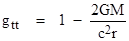
Remarkably, the expression corresponding to the “potential” in the weak field limit of general relativity actually does correspond to something like what Maxwell suggested. The effective classical “potential” for a spherically symmetrical field surrounding a mass M in the weak field limit is (half of) the time-time component of the metric tensor
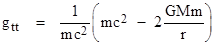
where G is Newton’s gravitational constant and c is the speed of light. The classical pre-relativistic expression for gravitational potential energy per unit mass is -GM/r, so a test particle of mass m is assigned the potential energy -GMm/r. Re-writing gtt in a form that isolates this expression, we have
Thus when Maxwell said that the gravitational medium must possess enormous intrinsic energy, and the leading constant term must (to avoid negative energy) equal “the greatest possible value of the intensity of gravitating force in any part of the universe”, he could have been (as we see in retrospect) referring to the field intensity at the Schwarzschild radius of a black hole, where the gravitational “potential” is comparable to the intrinsic “rest” energy of a test particle. In a sense, the enormous background energy corresponds to the “rest” energy E = mc2 of the test particle, which in turn corresponds to the ratio of proper time to some suitable coordinate time at any location in the field. Of course, there need not always be a “suitable” coordinate time, and hence energy cannot always be unambiguously localized in general relativity. However, in special circumstances such as a spherically symmetric field going to flat Minkowski spacetime at infinity, we have a fairly unambiguous definition of energy.
This unusual assumption, “the gravitational medium must possess enormous intrinsic energy to avoid negative energy,” also appears in the general theory of relativity. This could be the energy in the virtual dimension referred to above.
As an aside, the attractive nature of gravity is sometimes said to be closely related to (if not a direct consequence of) the equivalence principle, according to which the gravitational “charge” m of a given body is identical to the inertia of that body. In the case of electricity, reversing the sign of a particle’s electrical charge will reverse the direction of the applied force, but not of its inertia, so the resulting acceleration is reversed. In contrast, reversing the sign of the mass of a body would not only reverse the direction of the force, it would also reverse the direction of the resulting acceleration relative to the force, so the acceleration would be in the same direction, regardless of the sign of the mass. On the other hand, it could be argued that the gravitational interaction between two “like” particles involves three applications of the sign of mass: The mass producing the field (active charge), the mass responding to the field (passive charge), and the inertial mass of the responding particle. On this basis, reversing the sign of mass would reverse the direction of acceleration. This kind of superficial algebraic conundrum highlights the importance of energy-based reasoning.
The equivalence principle is a basic postulate of general relativity, stating that at any point of space-time the effects of a gravitational field cannot be experimentally distinguished from those due to an accelerated frame of reference.This principle is consistent with Faraday’s conceptualization of force (substance or inertia) and its gradient. The electromagnetic spectrum demonstrates this gradient of force of which neither Newton nor Maxwell was aware. Though Einstein came up with the equivalence principle, he also ignored the gradient of force as gradient of inertia or substance.
The error comes from Newton’s treatment of substance as either there (matter) or not there (space), and no gradient in between. This black and white assumption appears in the consideration of inertia (force) with respect to mass only and not with respect to the electromagnetic substance. From this assumption comes the energy-based approach.The moment we expand this “black and white” mathematical approach of Newton by the “gradient of force-substance” approach of Faraday, we see a host of new solutions to appear.
In his encyclopedia article on “Attraction” Maxwell did suggest one possible representation of the gravitational force in terms of a dynamical field that he hadn’t mentioned in 1864. After explaining how forces (such as electricity and magnetism) that are repulsive between “like” bodies may be represented in terms of a medium in a state of stress “consisting of tension along the lines of force and pressure in all directions at right angles to the lines of force”, he turns again to the vexing problem of gravity.
To account for such a force [of attraction between like bodies] by means of stress in an intervening medium, on the plan adopted for electric and magnetic forces, we must assume a stress of an opposite kind from that already mentioned. We must suppose that there is a pressure in the direction of the lines of force, combined with a tension in all directions at right angles to the lines of force. Such a state of stress would, no doubt, account for the observed effects of gravitation. We have not, however, been able hitherto to imagine any physical cause for such a state of stress.
In electricity and magnetism the forces of attraction and repulsion are there to bring the local gradients of force into equilibrium. If there is a gap in the gradient then the force is one of attraction. If there is overlapping gradient, the force is one of repulsion. Once the gradient is established, there are no electric and magnetic forces. These are local forces only in the gamma range.
When the local gradient of forces is established, the wider equilibrium of gradient (in terms of inertial force over the whole electromagnetic spectrum) still needs to be established among mass objects. The gravitational force of attraction exists because there are gaps in gradients of inertial force between two mass objects.
This is interesting because his theory of electromagnetism is normally regarded as a vector field (corresponding to a spin-1 mediated force), and all such fields are known to yield repulsion for “like” charges, and yet Maxwell seems to be saying that he can conceive of an attractive force “on the [same] plan”, merely by exchanging tension and compression. On the other hand, his specification of both tension and compression in various directions at each point within the medium is more suggestive of a tensor field (i.e., a spin-2 mediated force) rather than a vector field. The usual textbook explanation is that even-order fields (e.g., scalars and tensors) are attractive for like particles, whereas odd-order field (e.g., vectors) are repulsive for like particles, all under the assumption of strict positivity of energy. This shows how prescient was Maxwell in imposing this requirement on his field theories.
The force of repulsion between “like charges” is due to overlapping gradient of force. The repulsion is there to realign two similar gradients that belong to different sections on the overall gradient. See Comments on Electric Charge.
Maxwell ignores the gradient characteristic of energy-substance, and assumes that energy-substance has same characteristic throughout. This ignorance is then justified through complex mathematics.
However, there is one other important premise underlying the modern textbook answer, namely, that we are working in a relativistic context. We’ve already seen that the classical non-relativistic scalar field representation of gravity implies an attractive force only if we assume that the field energy is reduced when masses are brought together, and yet the magnitude of the field strength clearly increases in such circumstances, just as when two identical electric charges are brought together. So, the modern textbook explanation today is that the total mass-energy of a system is indeed reduced when the matter components are in closer proximity, just as Maxwell surmised. Furthermore, the total overall mass-energy of any system, including the “negative” contribution of gravitational potential energy, is always positive, which again is just as Maxwell surmised, when he suggested the existence of a very large “background” energy that is diminished when objects are close together. Of course, this is the very thing that Maxwell said he could not understand. It is perhaps slightly misleading to say the gravitational potential energy is negative. It might be better to say the absence of gravitational potential represents positive energy, except that even in the case of gravitation the energy of the field is said to be proportional to the square of the field strength, which (as noted above) would seem to imply imaginary field strength in order to give negative energy. In view of all this, is it fair to say that we’ve satisfactorily answered the question Maxwell was unable to answer – or have we simply decided to disregard it? Are we any more able than Maxwell to conceive of how bringing two objects together, increasing the magnitude of the field strength, whose square corresponds to field energy, results in a decrease of energy? Are there any alternative conceptual frameworks within which Maxwell’s question could be answered in a more satisfactory way? Part of his difficulty may be attributed to the fact that he didn’t have a unified concept of energy-momentum, but more fundamentally it could be argued that Maxwell couldn’t explain gravity because he didn’t know that the signature of the spacetime metric is negative.
The relativistic context seems to approach the continuum of substance framework rather than the distant-action framework of Newtonian mechanics. Time and distance, hence velocity, seems to relate directly to the consistency of energy-substance. This consistency is increasing on a continuous gradient from space to matter. This gradient is increasing relatively slowly up to the visible spectrum of light, but then it really accelerates beyond X-rays into the quantum area. When two masses are brought together the consistency of energy-substance increases at a high gradient. If the gradient continues to increase we approach the black hole phenomenon.
When two identical electric charges are brought together, we have increase not in the consistency of energy-substance, but in the distortion imposed on that energy-substance. The distortion attempts to reverse itself in the real dimension to attain equilibrium. But the consistency of energy-substance seems to reverse itself in some virtual dimension. The energy-based system confined to the real dimension cannot address this.
The effect of the negative signature of the spacetime metric is discussed in the note on Path Lengths and Coordinates, and more specifically as it relates to the attractiveness of gravity in the note entitled Accelerating in Place. The latter note explains in detail why, if the signature of the spacetime metric was positive, we would indeed expect gravity (for positive mass-energy) to be a repulsive force. The negative signature implies that geodesic worldlines of material particles actually maximize (rather than minimize) its absolute path length. The sign of the accelerations in the geodesic equations depends on the sign of the metric signature, i.e., on whether the time coefficient has the same or opposite sign as the space coefficients. An even more explicit demonstration of this is presented in the discussion of the Newtonian limit of general relativity in Scholium. There it is shown that the direction of gravitational acceleration is determined by the sign of M/k where M is the mass of the gravitating body and k is the signature of the spacetime metric. If we assume a Euclidean, positive definite, spacetime metric, then k = 1 and the only way for gravity to be attractive is with negative mass-energy. Conversely, with a Minkowski metric we have k = -1, so attractive gravity corresponds to strictly positive mass-energy. (See also the note on Potential Energy, Inertia, and Quantum Coherence for thoughts on the energy implications of falling objects in different contexts, and how the energy is transported away.)
We have lot of mathematics here.
It would be interesting to know if Maxwell’s reversal of stresses can be seen as corresponding to a negation of the signature of spacetime. Related to this is the question of how he derived the value of 37,000 tons per square inch for the pressure (and perpendicular tension) that would be required at the Earth’s surface to reproduce the effects of gravity.
It seems that we require out of the box thinking to explain gravity; and that would involve moving away from distant-action framework and toward the continuum of substance framework.
According to the postulates of disturbance theory, the universe is a continuum of substance that exists in emptiness. The external characteristics of substance are extension (space) and persistence (time). In emptiness there is neither substance, nor space nor time.
The presence of substance is felt through force to which our perceptions react in terms of touch, sight, hearing, smell and taste. But we are limited in the level of force that we can perceive directly. We then use other tools to perceive indirectly.
When Newton saw force acting between two material objects he explained it in terms of gravity of the masses and the distance between them. But he puzzled about how that force passed from one object to another. He wrote to his friend Richard Bentley:
“That gravity should be innate, inherent, and essential to matter, so that one body may act upon another at a distance, through a vacuum, without the mediation of anything else, by and through which their action and force may be conveyed from one to another, is to me so great an absurdity that I believe no man who has in philosophical matters a competent faculty of thinking, can ever fall into it. Gravity must be caused by an agent, acting constantly according to certain laws; but whether this agent be material or immaterial I have left to the consideration of my readers.”
This gravitational force could be computed without considering any substance filling that space in between. Science continued to develop in this way. It simply treated the space between the objects mathematically according to the Newton’s laws.
Newton’s scientific framework came to be known as “action at a distance” compared to the postulated framework of “continuum of substance”.
.
Lines of Force
Starting at the beginning of 19th century, extensive experimental work was done on electricity and magnetism. At the forefront of this work was Michael Faraday. When conducting these experiments, Faraday could see the effects propagating through the intervening space.
In a letter dated Jan 25 1844, “Electric Conduction and the Nature of Matter”, Faraday expressed that matter seemed to extend itself as “force” to fill the space in an atom, such that there was no empty space. This conclusion came from his observations of electric conduction through different materials. Thus, Faraday saw atoms as centers of force from which lines of force originated, and on which they terminated as well.
Faraday theorized space to consist of electromagnetic lines of force.
.
Light and Aether
It was supposed that light required a medium to travel, and that medium was aether.
In a letter dated April 15, 1846, “Thoughts on Ray Vibration”, Faraday proposed that the vibrations, which were assumed to account for radiation and radiant phenomena, might be seen as occurring in the lines of force which connect particles. In other words, light, radiation or radiant phenomena were part of the force content of space.
Faraday theorized radiant phenomena, such as, light, to constitute the mysterious aether that filled the space.
.
Force and Substance
Newton associated force with acceleration of matter in space. Work was the displacement caused by this force. Energy was the capacity for doing this work.
Faraday saw force as the cause of physical action, and not just the tendency of the body to pass from one place to another. Thus, force formed the very essence of substance for Faraday. In this sense, it also formed the “inertia” described by Newton as “inner force”.
“The vis insita, or innate force of matter, is a power of resisting by which every body, as much as in it lies, endeavours to preserve its present state, whether it be of rest or of moving uniformly forward in a straight line.”
In a lecture dated February 27, 1857, “On the conservation of Force”, Faraday proposed that all force was conserved. Non-conservation of force implied that the phenomenon was not being viewed completely. In a later addendum, Faraday clarified force as, “the source or sources of all possible changes amongst the particles or materials of the universe.” To Faraday, changes implied force. But changes also implied substance.
Faraday saw force as the fundamental substance.
.
Further Research
When we look at spacetime from the viewpoint of the postulates we find that,
Spacetime is the external characteristic of substance. The internal characteristic is force.
Matter is not the only substance; for example, there is definitely a substance that appears as “empty space”. We shall now examine this substance.
In physics, spacetime is any mathematical model that fuses the three dimensions of space and the one dimension of time into a single four-dimensional continuum. Spacetime diagrams can be used to visualize relativistic effects such as why different observers perceive where and when events occur.
So, spacetime is being perceived as a mathematical abstraction rather than as something real. But spacetime is something real as well.
.
The Reality of Spacetime
Material objects have extension in three dimensions. We call these extensions length, width and height for an object, such as, a box. Such extensions in three dimensions are the characteristic of space. The material object and its spatial dimensions are also persisting. Such persistence is the characteristic of time.
For a material object, the characteristics of space and time appear together. So, such characteristics may be called spacetime.
All material objects are four-dimensional “spacetime” entities.
But are these characteristics present in the absence of material objects?
.
“Empty” Space
There is space inside an empty box. But this space does not define the property of some visible material. Let’s say this box is filled with air. Can this space be defined as the spacetime characteristics of a material substance, such as, air? What happens to this space when we remove the box?
Air exists close to earth only. Beyond earth there is less and less material even as atoms of air, but space seems to acquire much greater extent. This raises doubt about spacetime being the characteristics of material objects or substance.
How can there be “spacetime” empty of matter?
.
The Mystery of Aether
Spacetime appears as the characteristics of matter. Descartes said that there is no such thing as empty space because space represents the extensions of substance. Then space, which is empty of matter, must provide the characteristics of some other substance.
Ancients speculated upon such substance, and called it “aether”. Newton speculated on the existence of aether in the Third Book of Opticks (1718):
“Doth not this aethereal medium in passing out of water, glass, crystal, and other compact and dense bodies in empty spaces, grow denser and denser by degrees, and by that means refract the rays of light not in a point, but by bending them gradually in curve lines?”
But no such substance could be found. What then is the spacetime empty of matter?
Is spacetime (empty of matter) something mathematical only?
.
Further Research
We shall examine the reality of spacetime from the viewpoint of The Postulates.