Category Archives: Science

Beginning Physics II

Reference: Schaum beginning Physics II
Reference: Beginning Physics I

Here are the KEY WORD LIST and GLOSSARY for each chapter of this wonderful reference. The purpose here is to make it easy to understand the subject of Physics. You should buy a copy of this book for easy reference, though each chapter is reproduced below.

.

  1. Chapter 1: WAVE MOTION
  2. Chapter 2: SOUND
  3. Chapter 3: COULOMB’S LAW AND ELECTRIC FIELDS
  4. Chapter 4: ELECTRIC POTENTIAL AND CAPACITANCE
  5. Chapter 5: SIMPLE ELECTRIC CIRCUITS
  6. Chapter 6: MAGNETISM-EFFECT OF THE FIELD
  7. Chapter 7: MAGNETISM-SOURCE OF THE FIELD
  8. Chapter 8: MAGNETIC PROPERTIES OF MATTER
  9. Chapter 9: INDUCED EMF
  10. Chapter 10: INDUCTANCE
  11. Chapter 11: TIME VARYING ELECTRIC CIRCUITS
  12. Chapter 12: ELECTROMAGNETIC WAVES
  13. Chapter 13: LIGHT AND OPTICAL PHENOMENA
  14. Chapter 14: MIRRORS, LENSES AND OPTICAL INSTRUMENTS
  15. Chapter 15: INTERFERENCE. DIFFRACTION AND POLARIZATION
  16. Chapter 16: SPECIAL RELATIVITY
  17. Chapter 17: PARTICLES OF LIGHT AND WAVES OF MATTER
  18. Chapter 18: MODERN PHYSICS

.

Physics I: Chapter 18

Reference: Beginning Physics I

CHAPTER 18: THE FIRST & SECOND LAWS OF THERMODYNAMICS

.

KEY WORD LIST

The First Law of Thermodynamics, P-V Diagram, Quasistatic Processes, Cyclical Process, Isochoric Process, Isobaric Process, Isothermal Process, Adiabatic Process, Carnot Cycle, The Second Law of Thermodynamics, The Engine Statement of The Second Law, Efficiency, The Refrigerator Statement of The Second Law, Co-Efficient of Performance, Carnot Engine, Otto Cycle, Compression Ratio, Entropy, Entropy of The System

.

GLOSSARY

For details on the following concepts, please consult CHAPTER 18.

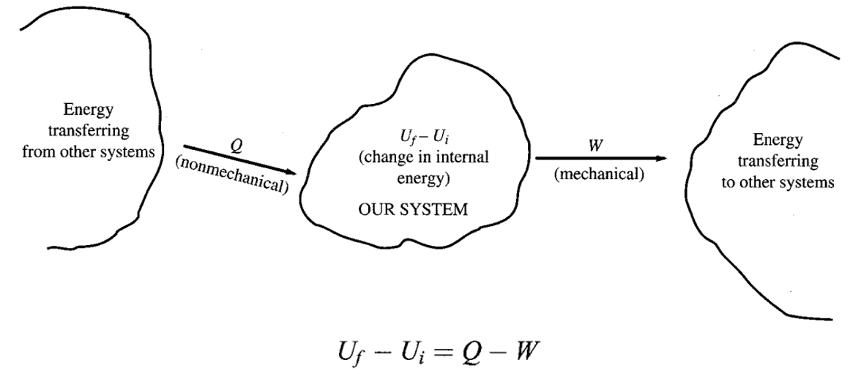
THE FIRST LAW OF THERMODYNAMICS
The first law of thermodynamics is the statement of the law of conservation of energy in its most general form. It presumes that the overall energy of the universe remains the same.

If Ui and Uf are the initial and final total internal energy of the system, respectively, at the beginning and at the end of the process, we must have

Where Q is the algebraic heat entering the system; and W is the algebraic work done by the system on the outside world during the same process.

In other words, energy can only shift from one system to another (by means of work and heat transfer), but the total energy of the universe stays fixed.

P-V DIAGRAM
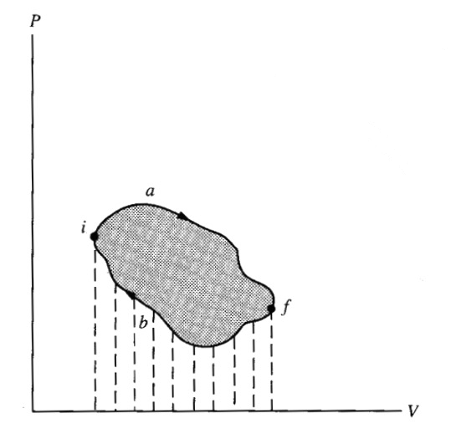
For a quasistatic process, the evolving states of the system can be tracked as a path on a P-V diagram. The work done by the system between the states i and f is the total area under the curve on the P-V diagram.

Reversing a given quasistatic path reverses the sign of the work done and the heat transferred.

QUASISTATIC PROCESSES
The quasistatic processes include a constant-volume (isochoric) process, a constant-pressure (isobaric) process, a constant-temperature (isothermal) process, and a process in which no heat enters or leaves the system (adiabatic process).

CYCLICAL PROCESS
A cyclical process may consist of the same of different quasistatic processes. In a cyclical process the work done is plus or minus the area enclosed by the closed cycle path on the P-V diagram.

ISOCHORIC PROCESS
In an isochoric process the work performed is zero. Therefore, the first law of thermodynamic may be expressed for an isochoric process as,

ISOBARIC PROCESS
The first law of thermodynamic may be expressed for an isochoric process as,

ISOTHERMAL PROCESS
For an ideal gas, in an isothermal process, the internal energy at every point along an isotherm is the same.

ADIABATIC PROCESS
For an adiabatic process the first law takes the form,

For an ideal gas undergoing the adiabatic process, pressure and volume are related by

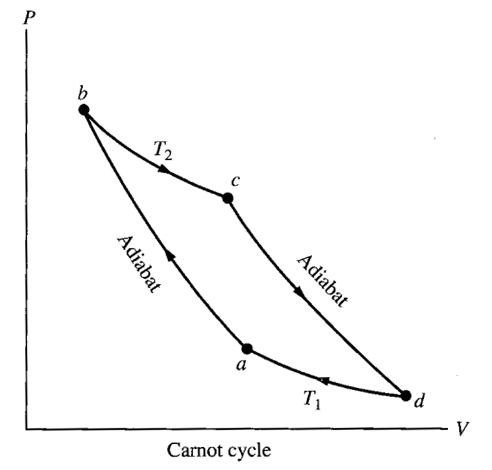
CARNOT CYCLE
A Carnot cycle is a system undergoing a quasistatic cyclical process involving four legs, with two being isotherms and two being adiabats. Such a process is represented on the P-V diagram as follows:

THE SECOND LAW OF THERMODYNAMICS
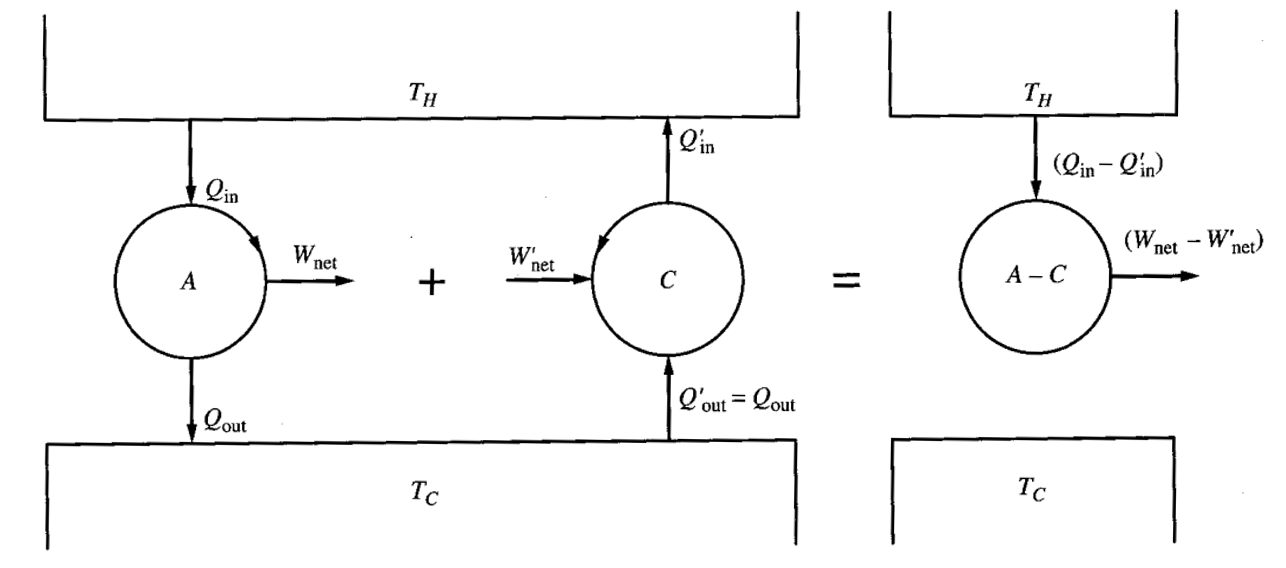
The second law of thermodynamics addresses the question of the feasibility of certain types of energy transfers. To accomplish the removal of thermal energy from a cool body and transfer it to a hot body requires an intermediary system called a refrigerator. To convert thermal energy to mechanical energy requires the services of an intermediary system called a heat engine. These intermediary systems effect the transfer that do not occur naturally. The second law is deeply connected to the concept of randomness, and therefore to the subject of statistical mechanics.

THE ENGINE STATEMENT OF THE SECOND LAW
“It Is Impossible for a cyclical process to have no other effect than to draw thermal energy from some system(s), and to convert it completely into mechanical energy.”

EFFICIENCY
The efficiency of any engine is defined as the ratio of mechanical energy obtained to the thermal energy extracted from the hot reservoir.

THE REFRIGERATOR STATEMENT OF THE SECOND LAW
“It is impossible for a cyclical process to have no other effect than to extract thermal energy from a cooler system and eject that thermal energy to a hotter system(s).”

CO-EFFICIENT OF PERFORMANCE
The co-efficient of performance of a refrigerator is defined as.

CARNOT ENGINE
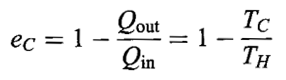
The second law implies that the most efficient engine operating between two fixed temperature reservoirs is a Carnot engine. The efficiency of a Carnot engine is,

OTTO CYCLE
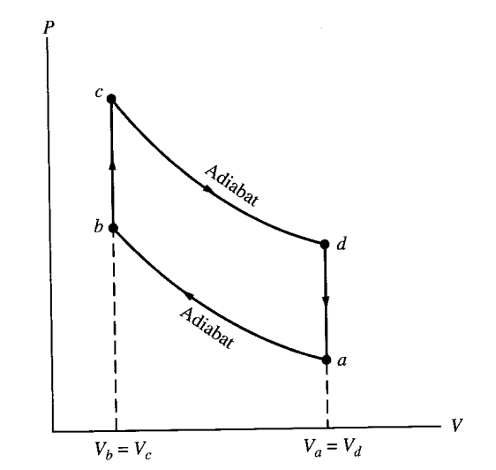
One cylinder of a gasoline engine can be idealized by a quasistatic engine called the Otto cycle, as shown below.

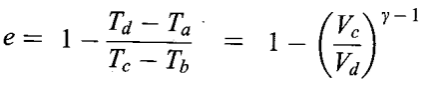
The efficiency of this cycle is,

COMPRESSION RATIO
The compression ratio is the ratio of the largest volume to the smallest volume of the engine cylinder as the piston moves in and out. The greater is the compression ratio, the more efficient is the engine.

ENTROPY
For every equilibrium state of a system there is a definite quantitative measure of the disorder of the system in that state. This quantitative measure assigns a value to each equilibrium state of the system, which is called entropy. The incremental change in the entropy of a system when a small amount of heat is slowly added, is

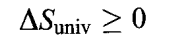
The second law of thermodynamics can be restated in terms of the overall entropy of the universe: In any process or interactions of systems, the overall entropy change of the universe obeys,

where the equality occurs only in the case of quasistatic processes.

ENTROPY OF THE SYSTEM
The macroscopic equilibrium state of a system corresponds to the most probable system state with its specific value of the number of ways that the microscopic variables can arrange themselves so as to produce the value of the macroscopic variables that characterize the equilibrium state. The entropy of the system is formally defined as,

where k is Boltzmann constant and Γ is the number of ways.

.

Physics I: Chapter 17

Reference: Beginning Physics I

CHAPTER 17: TRANSFER OF HEAT

.

KEY WORD LIST

Conduction, Conductors, Insulators, R-Factor, Convection, Radiation, Stefan-Boltzmann Law, Emissivity, Blackbody

.

GLOSSARY

For details on the following concepts, please consult CHAPTER 17.

CONDUCTION
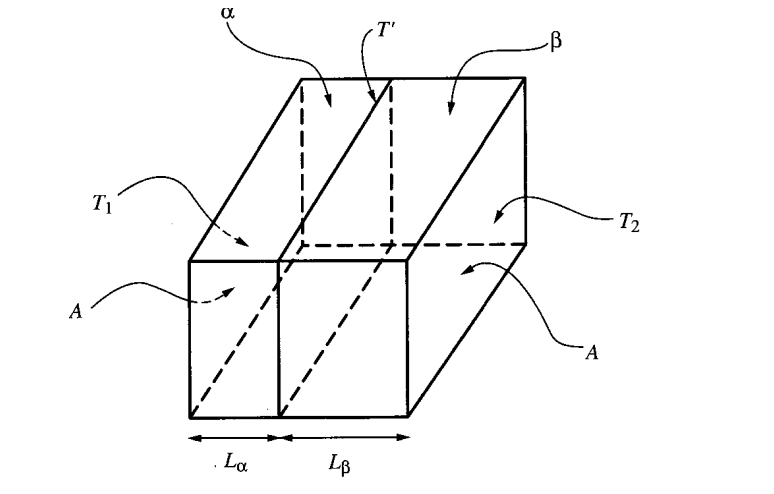
Heat conduction is the direct transfer of thermal energy from one layer of molecules to the next layer. The amount of transferred per unit time across a given cross section of a bar is directly proportional to the temperature difference and to the area and is inversely proportional to the length.

The proportionality constant in this equation is different for each material. It is called the coefficient of thermal conductivity (or conductivity, for short).

CONDUCTORS
Metals generally have larger conductivities than other solids and are therefore called good heat “conductors.”

INSULATORS
Materials that clearly don’t conduct heat well are called insulators.

R-FACTOR
The R-factor of a slab is its length divided by conductivity: R = L/k
Therefore, we have, H/A = ∆T/R, where R = R1 + R2 + R3

CONVECTION
Convection is a mechanism for the transfer of thermal energy that applies to fluids (liquids and gases). Unlike conduction, where there is no macroscopic migration of molecules, in convection the thermal energy is transferred by the motion of material from one place to another.

To a good approximation the rate of convective heat flow is proportional to the area of the contact surface and to the temperature difference between the surface and the bulk of the fluid away from the surface.

H = h A T

where h, the coefficient of convection, depends on the fluid, the geometry, and a variety of other factors (including a slight dependence on T).

If the circulation of the fluid is aided by a fan or pump, it is called forced convection. If the circulation is the consequence of the natural difference in density of the fluid (caused by a temperature difference) at different locations, it is called natural convection.

RADIATION
Radiation is a process that involves electromagnetic waves. Every substance at any temperature emits electromagnetic radiation, which carries energy with it. For a system to be in thermal equilibrium with its surroundings it must absorb as much radiation as it emits.

STEFAN-BOLTZMANN LAW
The total amount of radiation energy emitted per second from an object at uniform temperature and surface area is,

Where ϵ is a dimensionless constant, called the emissivity, with a value between 0 and 1 that varies from substance to substance; and σ is a universal constant called the Stefan-Boltzmann constant with the value

For an object at temperature T1 enclosed in a container with walls at temperature T2, the net rate of flow of thermal energy out of the object is

EMISSIVITY
The emissivity is a dimensionless constant with a value between 0 and 1 that varies from substance to substance. The emissivity is 1 for a good emitter. A good emitter is also a good absorber. At normal temperatures a good absorber-emitter appears black.

BLACKBODY
A perfect or ideal absorber-emitter (e = 1) is called a blackbody, but no real object is a perfect blackbody.

.

The Spectrum of Substance (old-3)

Please see The Spectrum of Substance

Reference: The Physics Book

The substance appears to made up of

  1. Nuclear “particles”
  2. Electronic “fluid”
  3. Electromagnetic “vapor”
  4. Gravitational “field”

The  “material particles” appears to consist of all the above components. The nuclear “particles” have very high mass density. They exist within the continuum of electronic “fluid.” 

The electronic “fluid” has much smaller mass density by several magnitudes. It exists within the continuum of electromagnetic “vapor”. 

The electromagnetic “vapor” has still smaller mass density by several magnitudes. It exists within the continuum of gravitational “field.”

The gravitational “field” has infinitesimal mass density and it fades into the void.

Finally, the void is absence of substance and, therefore, it cannot be sensed.

From nuclear mass to void, there is a spectrum of substance of decreasing mass density.

.

The Structure of Substance

The stability of proton and electron depends on certain equilibrium of mass between these two states. This is equivalent to stability between solid ice and liquid water existing together in equilibrium. The ice-water equilibrium is marked by a certain temperature. Similarly, we may postulate that the equilibrium between the nuclear and electronic mass densities is marked by a certain “temperature” that is maintained within an atom.

Within the electronic region, there are distinct energy levels (stationary states) that are visible in atomic spectra. These levels also seem to indicate steps in the gradient of mass density that are also in equilibrium. There are finer steps within these steps which are called “fine structure.”

Similarly within the electromagnetic region we have different areas that have been categorized as follows:

  1. Gamma radiation
  2. X-ray radiation
  3. Ultraviolet radiation
  4. Visible radiation
  5. Infrared radiation
  6. Terahertz radiation
  7. Microwave radiation
  8. Radio waves

These areas are distinctly different from each other in their properties. Most likely there is a gradient step in mass density where one area ends and another area begins.

The spectrum of substance is marked by steps in mass density that become smaller as mass density becomes smaller.

.

The Nature of Electron & Charge

Reference: The Physics Book

Within the hydrogen atom, the  mass of the surrounding electron is 1/1836 times the mass of the embedded proton, while the volume of the surrounding electron is about 9999 times the volume of the embedded proton. There appears to be a kind of inverse relationship between the mass and volume of subatomic structures.

We postulate that, at the quantum level, the volume is inversely proportional to mass.

We notice that the mass density of electrons is so small that they do not have centers of mass, and the laws of mechanics do not fully apply to them. This also means that the electrons may not exist as discrete “particles” because they cannot be differentiated from one another due to lack of centers of mass. Electrons are more like a “thick” fluid.

The electrons flow like fluids and their mass density appears as their “viscosity.”

The electrons have both mass and fluidity. This generates the idea of electrons being “particles” and “waves” at the same time. But this is an anomaly only if we assume the electrons to be “discrete particles.” 

Electrons are neither discrete particles nor made up of discrete particles.

.

The Position of Electron

Introduced first in 1927 by the German physicist Werner Heisenberg, the uncertainty principle states that the more precisely the position of some particle is determined, the less precisely its momentum can be predicted from initial conditions, and vice versa. There is further explanation available here.

Origins of Uncertainty principle – Possible Flaw

This principle has been applied to the location of an electron within an atom. But since the electrons are not discrete particles, instead they fill the atom like a fluid, they do not have locations. They simply have fluidity with certain viscosity. The quantum numbers assigned to electrons indicate patterns within their fluidity.

Not being discrete particles, the electrons do not have locations within the atom.

.

The Boundary and Charge

The interface between the nucleus and the surrounding electronic fluid comes closest to being the matter-void boundary. At this boundary there is a sudden drop in mass density. This sharp gradient in mass is the source of charge. The charge is a surface phenomenon.

Charge may be compared to the “surface tension” as it exists in drop-like free sub-atomic particles, such as, protons and electrons.

.