Category Archives: Mathematics

The Book of Mathematics

Reference: The Book of Subject Clearing

Pre-Kindergarten

Lesson 1: ORIENTATION & SPATIAL SENSE
Lesson 2: QUANTITY & NUMBER SENSE
Lesson 3: PATTERNS & RELATIONAL SENSE

.

Kindergarten

Lesson 1: Orientation & Spatial Sense
Lesson 2: Numbers & Place Values
Lesson 3: Units & Fractions
Lesson 4: Counting & Measurements
Lesson 5: Numbers & Operations
Lesson 6: Patterns & Relational Sense
Lesson 7: Data Analysis & Probability

.

Primary School

Lesson 1: Numbers
Exercise: Reading Numbers from Dubb
Exercise: Writing Numbers from Dubb

Lesson 2: Addition
Exercise: Addition Problems from Dubb

Lesson 3: Multiplication
Exercise: Multiplication Problems from Dubb

Lesson 4: Subtraction
Exercise: Subtraction Problems from Dubb
Exercise: Integer Problems from Dubb

Lesson 5: Division
Exercise: Short Division Problems from Dubb
Exercise: Long Division Problems from Dubb
Exercise: Arithmetic Expression Problems from Dubbs

Lesson 6: Units
Table: The Units of Measure
Exercise: Problems on Units from Dubb

  1. Long Measure
  2. Square Measure
  3. Rectangles
  4. Cubic Measure
  5. Time Measure
  6. Miscellaneous Tables
  7. Promiscous Examples
  8. Addition of Compound Numbers
  9. Subtraction of Compound Numbers
  10. Time between two Dates
  11. Time in Days between Two Dates
  12. Multiplication of Compound Numbers
  13. Division of Compound Numbers

.

Middle School

Introduction

  1. What is Mathematics?
  2. Mathematics Overview
  3. Counting and Abacus 
  4. The Concept of Numbers
  5. Math Diagnostics

Lesson 1: Number to Integer
Exercise: Problems from Dubb (Word problems)

Lesson 2: Terms & Expression
Exercise: Problems from Dubbs (Word problems)

Lesson 3: Factoring
Exercise: Factoring Problems from Dubb

  1. Prime Factors
  2. Common Prime Factors
  3. Greatest Common Divisor
  4. Least Common Multiple
  5. Word Problems

Lesson 4: Fractions
Exercise: Fraction Problems from Dubb

  1. Integer to Fraction
  2. Mixed Number to Improper Fraction
  3. Improper Fraction to Mixed number
  4. Reducing Fraction to a Denominator
  5. Reducing Fraction to Lowest Terms
  6. Reducing Fraction to LCM & GCD
  7. Addition of Fractions
  8. Subtraction of Fractions
  9. Multiplication of Fractions
  10. Multiplication Word Problems
  11. Division of Fractions
  12. Finding Part of a Number
  13. Reducing Complex Fractions
  14. Complex Fraction Word Problems
  15. Word Problems for Fractions

Lesson 5: Decimals
Exercise: Decimal Problems from Dubb

  1. Writing Decimals
  2. Reading Decimals
  3. Decimals to Common Fractions
  4. Common Fractions to Decimals
  5. Addition of Decimals
  6. Subtraction of Decimals
  7. Multiplication of Decimals
  8. Division of Decimals

Lesson 6: Review of Basics
Make yourself familiar with these basics

  1. Real Numbers
  2. The Basics of Math
  3. Additional Math Concepts
  4. Equations & Transposition

.

Further References

Course in Mathematics

.

Logic in 8th Grade

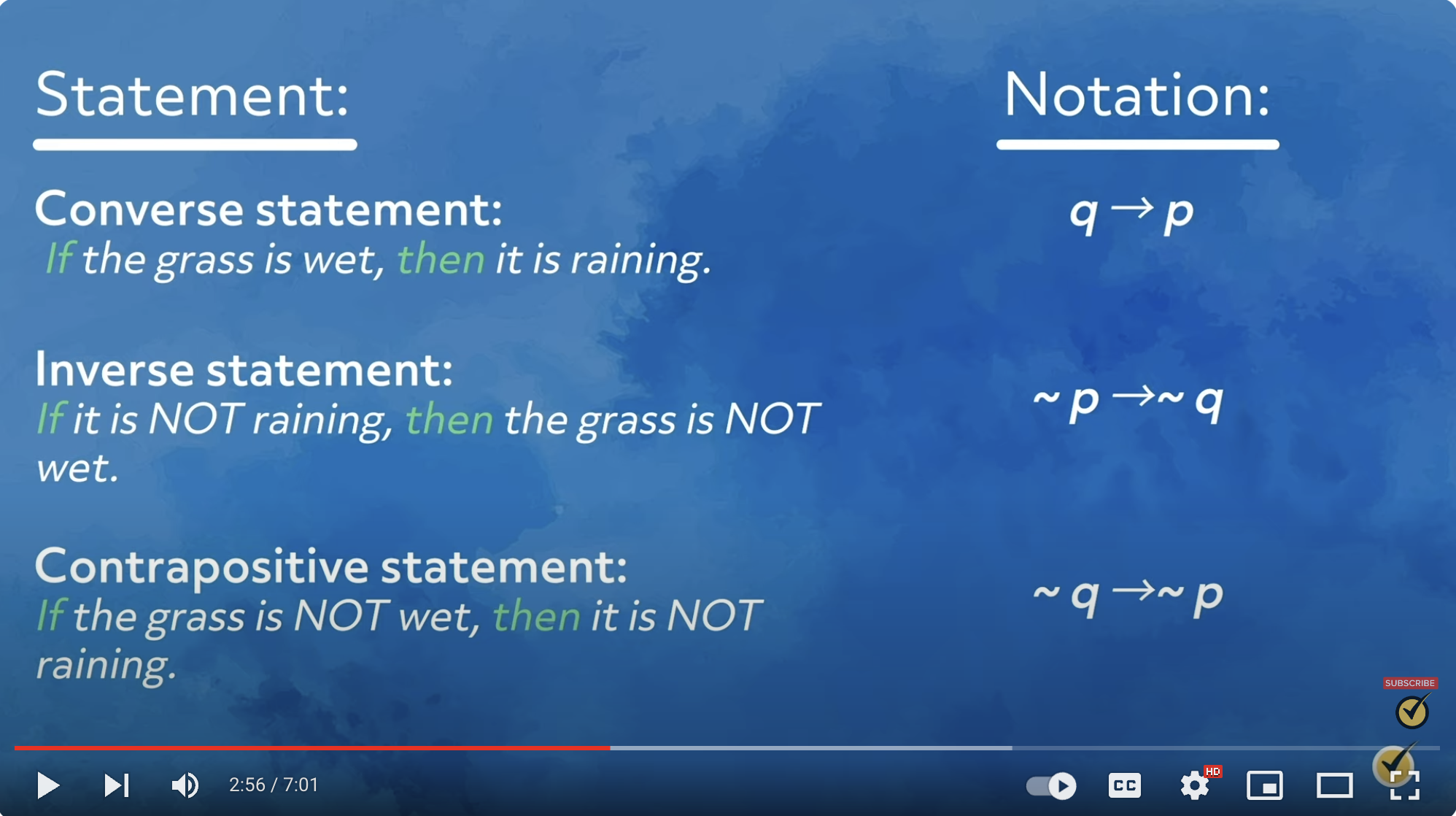
This kind of two-valued logic has always confused me, but it is good to know the following definitions. Hopefully, this will help you get better grades in school.

Tne Contrapositive is converse of the inverse statement.

.

Vertical and Horizontal Asymptotes

HOLES

  1. Factor both the numerator N(x) and the denominator D(x).
  2. Cancel any common factors and simplify the function.
  3. Equate the canceled factor to zero. This will give you the x-value of the hole.
  4. Plug this x-value in the simplified function to find the y-value of the hole.
  5. Plot that hole (or holes) on the graph.

VERTICAL ASYMPTOTES

  1. Plot the remaining zeros of D(x) on the x-axis. Draw vertical dotted lines through them. These are the locations for the vertical asymptotes.
  2. Find the sign of f(x), just before and after the dotted line. This you can do by finding the signs of the factors in the simplified function and resolving them. This will tell you if the graph is going asymptotic upwards or downwards near the dotted vertical line.
  3. Find remaining zeros of N(x) on the x-axis. These are points where the graph crosses the x-axis.

HORIZONTAL ASYMPTOTES

  1. Horizontal asymptotes occurs at either end of the graph as x goes to plus or minus infinity.
  2. For n < m, the horizontal asymptote is y = 0 (the x-axis).
  3. For n = m, the horizontal asymptote is y = an / bm
  4. For n = m+1, the asymptote is a slanted line, y = kx, found by dividing N(x) by D(x).
  5. For n > m+1, there are no asymptotes;
    when n – m is even, both ends of the graph rise up
    when n – m is odd, the left end goes down while the right end rises up.

From the above data you can sketch a rough approximation of the shape of the graph.

.

Matching Polynomials with Graphs

  1. The constant term of the polynomial shows the y-intercept of the graph.
  2. Look at the highest degree of the polynomial. The corresponding graph will have one less bend. For example, if the degree of the polynomial is 3, the corresponding graph shall have two bends.
  3. If all the zeros of the polynomial are real, then the corresponding graph will cross the x-axis as many times as the degree of the polynomial. For example, if the degree of the polynomial is 3, the corresponding graph shall cross the x-axis 3 times.
  4. If the zeros of the polynomial are visible because the polynomial is factored; then, match the zeros to the values where the graph crosses the x-axis.
  5. When two of the zeros are the same; then, the corresponding bend will simply touch the x-axis at that value.
  6. When two of the zeros are imaginary; then, the corresponding bend will not cross or even touch the x-axis.
  7. When all the zeros are real, the constant term of the polynomial shall be the product of the zeros.
  8. When there are two graphs matching the polynomial, take the root that is not common in both the graphs, and plug it in the polynomial. You will know if that zero belongs to the polynomial or not.

.

The Concept of Numbers

Reference: The Book of Mathematics

Introduction

This video explains how to read and write numbers up to trillions.

The NUMBERS are like words. They are made up of DIGITS, just like words are made up of letters.

In English, all the words are written with just twenty-six letters, from A to Z. In mathematics, all the numbers are written with just ten digits, from 0 to 9.

A DIGIT IS LIKE A LETTER. A NUMBER IS LIKE A WORD.

.

Place Values

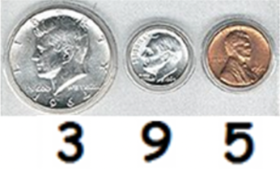
The Rule of Abacus gives us beads of values one, ten, hundred, etc. These values appear in numbers as PLACE VALUES as shown below. This number is made up of 3 hundreds, 9 tens, and 5 ones. It is read as “three hundred ninety-five.”

The place value of “one” may be thought of as a penny (one cent), the place value of “ten” may be thought of as a dime (10 cents), and the place value of “hundred” may be thought of as a dollar (100 cents).

.

Written Numbers

A number written with one digit is called a single-digit number. There are nine single-digit numbers from 1 to 9. 0 (zero) is not a single-digit number because it represents nothing. It is called a place holder.

Example of a single-digit number: 7

A number written with two digits is called a double-digit number. There are ninety double-digit numbers from 10 to 99. You get ninety double-digit numbers by subtracting 9 from 99. You do not subtract 10 because it is included in double-digit numbers.

Example of a double-digit number: 43

A number written with three digits is called a three-digit number. There are nine hundred three-digit numbers from 100 to 999. You get nine hundred three-digit numbers by subtracting 99 from 999. You do not subtract 100 because it is included in three-digit numbers.

Example of a three-digit number: 478

.

Group of Digits

The place values of “one-ten-hundred” make a group. A group contains numbers from 001 to 999. All three places in a group are shown by a digit even if a place has no value.

001 is the same number as 1

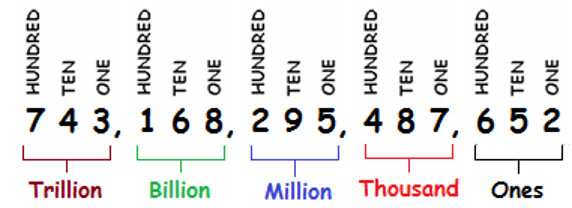
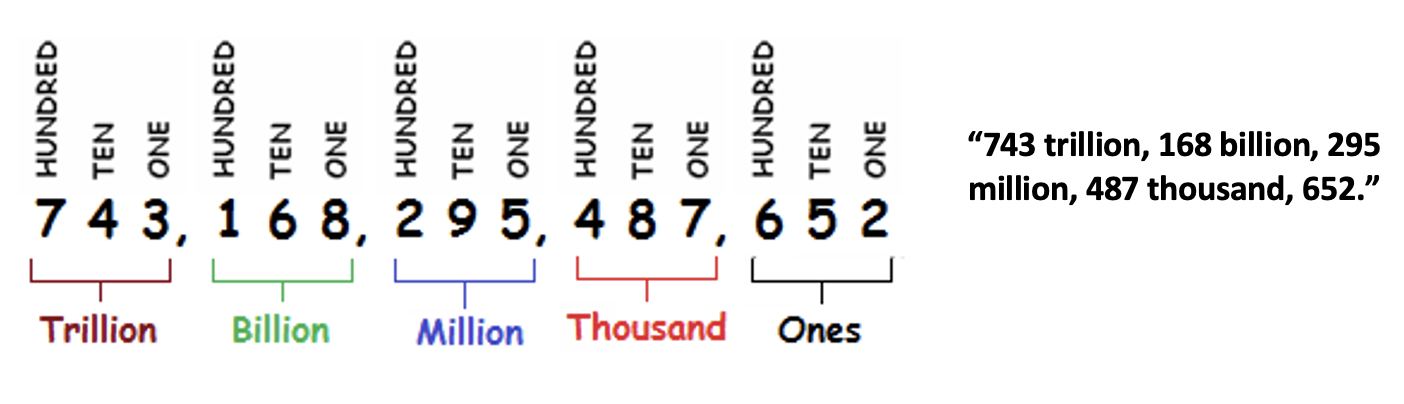
The most used groups are ONES, THOUSANDS, MILLIONS, BILLIONS, and TRILLIONS. These groups are arranged from right to left as shown below. The groups are separated by commas.

From right to left, the place values increase by a factor of ten. So, 10 “hundred” become 1 “thousand”; 10 “hundred thousand” become 1 “million”; 10 “hundred million” become 1 “billion”; and 10 “hundred billion” become 1 “trillion”. This pattern continues with higher place values.

.

Reading & Writing Numbers

Here are some examples of reading and writing numbers.

We do not omit any place in a number. When a place has no count, we put “0” there as a place holder. For example, we write the number “302 trillion, 4 billion, 865 million, and Seven” as follows.

In this number the group “billion” has the value “004” (and not just 4). Since the group “thousand” is altogether missing, we put its value as “000”. The group “ones” has the value “007” (and not just 7).

.

Check your Understanding

1. What are digits?

Digits are symbols used to write numbers.

.

2. How many digits are there?

There are ten different digits—0, 1, 2, 3, 4, 5, 6, 7, 8, and 9.

.

Most likely there is no real elephant in the room with you. You will use the digit ‘0’ in that case to represent the absence of elephants. 

.

4. Give examples for single-digit, double-digit, three-digit, and five-digit numbers.

7 is a single-digit number
32 is a double-digit number
483 is a three-digit number
63,153 is a five-digit number

.

From 10 to 99 (inclusive) there are 90 double-digit numbers.

.

One, ten and hundred

.

Ones, Thousand, Million, Billion, and Trillion

.

6,000,066,060

.

Final Thought

A DIGIT IS LIKE A LETTER. A NUMBER IS LIKE A WORD.

.