Author Archives: vinaire

I am originally from India. I am settled in United States since 1969. I love mathematics, philosophy and clarity in thinking.

Physics II: Chapter 6

ReferenceBeginning Physics II

Chapter 6: MAGNETISM-EFFECT OF THE FIELD

.

KEY WORD LIST

Magnetic Force, Magnetic Field, Circular Motion, Mass Spectrometer, Hall Effect, Semiconductor, Velocity Selector, Magnetic Torque, Magnetic Dipole Moment, Motor

.

GLOSSARY

For details on the following concepts, please consult Chapter 6.

MAGNETIC FIELD (B)
The magnetic field is a vector and is the link between the two moving charges that interact with each other. One of the charges is the source of the field, and this field, in turn, has the effect of exerting a force on the second moving charge. For magnetic field, we use the symbol B.

The unit for a magnetic field is a tesla (T) in our system. A more common unit which is widely used in practice is the gauss (G). One gauss equals 10-4 tesla. The strength of the magnetic field near the surface of the earth is approximately one gauss.

MAGNETIC FORCE (F)
Experimentally we find that, in addition to the electrical force, there is also a force exerted by one moving charge on another moving charge. This force is the magnetic force. The formula for the magnitude of the force is:

Where the charge q is moving with velocity v when the angle between the vectors v and B is φ.

We have used absolute value signs, since the magnitude is always positive. The sign of q does not affect the magnitude of the force. It will, however, affect the direction of the force. Note that the force is zero when the velocity and the magnetic field are along the same line. Also, the largest force occurs when the velocity is perpendicular to the magnetic field.

The magnetic force for a current in the wire is:

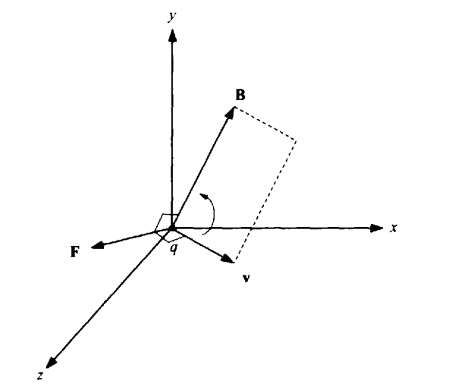
The direction of the force is perpendicular to both v and B, and it is therefore necessary to consider the problem in three dimensions. The force points in the direction a right hand screw moves as it rotates from v to B.
CIRCULAR MOTION
A charged particle moving at constant speed at right angles to a magnetic field executes a circular motion in the plane perpendicular to B, because the force is always perpendicular to the direction of the motion. The magnitude of the magnetic force must equal the centripetal force required and we can therefore say that,
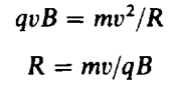
This is a formula for the radius of the circle traversed by the particle of mass, m, charge, q, moving with a velocity, v, in a perpendicular magnetic field, B.

SIGN OF THE CHARGE
If one has a charged particle of unknown sign, one can use the circular motion created by a magnetic field to determine the sign of the charge. It may also be used to determine the mass of a charged particle.

MASS SPECTROMETER
A mass spectrometer is an apparatus for separating isotopes, molecules, and molecular fragments according to mass. The sample is vaporized and ionized, and the ions are accelerated in an electric field and deflected by a magnetic field into a curved trajectory that gives a distinctive mass spectrum.

HALL EFFECT
Hall Effect is the production of a potential difference across an electrical conductor when a magnetic field is applied in a direction perpendicular to that of the flow of current.

SEMICONDUCTOR
A semiconductor is a material which has an electrical conductivity value falling between that of a conductor, such as copper, and an insulator, such as glass. A semiconductor’s resistivity falls as its temperature rises, in contrast to normal conductors (i.e. metals) whose resistivity rises with temperature.

VELOCITY SELECTOR
By using a combination of both electric and magnetic fields, we can produce a mechanism to separate out particles of a particular velocity. This is known as a velocity selector.
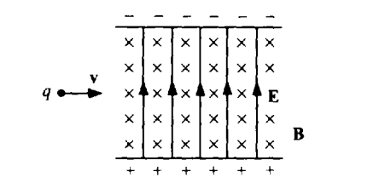
When the electric force is equal and opposite to the magnetic force, E = vB, or v = E/B. For a velocity of v = E/B there is no force to deflect the particle, and it will travel in a straight line. We can choose the velocity we want by varying E, simply by changing the potential difference across the two plates, which is producing the electric field.

MAGNETIC TORQUE
It is useful to define a vector area for the coil, A, whose magnitude is A = ab, and whose direction is perpendicular to the plane of the coil. The ±direction of A is determined by the right-hand rule. Curl the fingers of your right-hand around the coil in the direction of the current. Your thumb then points in the positive A direction. Thus φ is the angle between A (area vector) and B (magnetic field), as can be seen below. We see that in general the torque is given by

where Γ tends to rotate the coil in the same direction as rotating the vector A through φ to B. When A is parallel to B, φ = 0 and the torque is zero.

MAGNETIC DIPOLE MOMENT
We define a new vector, M, the magnetic dipole moment of the coil, whose magnitude is IA and whose direction is the same as A. If the coil consists of several turns, then each turn has a magnetic moment IA, and the entire coil has a magnetic moment NIA, where N is the number of turns in the coil. The torque will turn the coil in the direction of making M point in the direction of B.

Although this result was derived for the special case of a rectangle, the result is valid for any coil shape, with the moment of the coil equaling M = NIA, and the torque on the coil equaling MB sin φ, with the usual counter-clockwise, clockwise conventions.

MOTOR
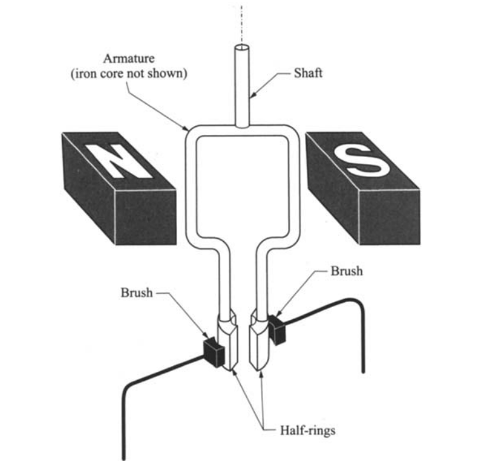
This phenomenon of a torque on a coil can be used to build a motor, which will continuously rotate in the magnetic field. Such motors are built by constructing a coil from many turns (to increase M and thereby, the torque), and suspending the coil on an axis in a constant magnetic field. The direction of the current in the coil is chosen to make the coil rotate in one particular direction, for instance clockwise. When the coil passes the y axis the direction of the torque would normally reverse, making the coil turn counter-clockwise. In order to prevent this from happening, we arrange to have the current direction reverse as the coil passes through the y axis, thus maintaining a clockwise torque. This is accomplished by the split in the rings where the current enters from the source of EMF.
.

The KHTK Universe

Reference: Course on Subject Clearing

Scientology starts with the concept of “Cause.”

KHTK starts with the concept of Unknowable:

Neither the cause nor the beginning of this universe is knowable. There is Inscrutable Power that keeps this universe running eternally; but, neither religion nor science has any clue to it. The Unknowable excites the curiosity to know the true nature of things. Knowledge is then derived from postulating what might be there, and building up a consistent set of postulates. Unknowable simply means that no matter how much you know, there is always something more to know. And that is wonderful because it makes one strive to achieve a deeper understanding. 

In KHTK, the dichotomy of “cause-effect” is simply a part of the universe, but Scientology postulates a “Cause” of the universe, that is separate and independent of the universe. It then gives “Cause” attributes under the concept of “thetan.” It amounts to the assumption that all things are ultimately knowable. Scientology does not have the concept of Unknowable. This is where KHTK differs from Scientology. This is also where the Eastern religions differ from the West.

We may say that when we compare KHTK with Scientology, we are also comparing the Eastern thought with the Western thought.

.

Different Concepts of UNIVERSE 

Scientology defines universe as a “whole system of created things.” This is also the Western concept.

KHTK defines the Universe as follows:

All matter, energy, space, time and thoughts that make up the universe, are the outcome of a consistent set of postulates and the reasoning based on them. The universe includes everything physical, metaphysical, real, imaginary, postulated or speculated. Nothing is excluded. The root meaning of the word UNIVERSE is “entire, all, literally, turned into one.” The Universe is ONE means that the reality, which forms the universe, is continuous, consistent and harmonious.

This is in line with the Buddhist religion and with the Eastern thought in general.

.

Hubbard’s Concept of Universe

In the Chapter, Universes, of his book, Scn 8-8008, Hubbard basically talks about the “MEST Universe.” He seems to equate the MEST universe with the combined “reactive mind” of all beingness out there. This is a very dark rendition of the universe.

In the Chapter, Behavior of Universes, Hubbard talks about how the continual mock up of one’s own universe may resolve the overwhelming influence of the MEST universe. But Hubbard does not define clearly what he means by the “MEST universe” and what does it mean to to create “one’s own universe.”

.

Explanation from KHTK

KHTK explains Hubbard’s terminology as follows:

The system of postulates that is consistent may be referred to as “one’s own universe.” The altered and inconsistent postulates that are superimposed over one’s own universe constitute the “MEST universe.” When one says that the “MEST universe” is based on agreement, the word “agreement” has the connotation of unnatural postulates that are  forced in place, as in conditioning.

.

Summary

Please see the KHTK explanations at Universes, and Behavior of Universes.

The essential difference between Hubbard’s view and KHTK is as follows.

Scientology Factor # 1: Before the beginning was a Cause and the entire purpose of the Cause was the creation of effect.

KHTK Factor # 1: The universe is a consistent set of postulates and reasoning that, together, attempt to define the Unknowable.

.

Physics II: Chapter 5

ReferenceBeginning Physics II

Chapter 5: SIMPLE ELECTRIC CIRCUITS

.

KEY WORD LIST

EMF, Current, Resistance, Resistivity, Current Density, Ohm’s Law, Drift Velocity, Resistors in Series, Resistors in Parallel, Fuse, Terminals, Anode, Cathode, Open Circuit EMF, Internal Resistance, Discharge, Recharge, Work (Recharge), Ammeter, Voltmeter, Null Measurement, Wheatstone Bridge, Power

.

GLOSSARY

For details on the following concepts, please consult Chapter 5.

EMF (V)
The energy per unit charge supplied by the external source in maintaining the voltage is called the EMF (“electromotive force”-although it is not a force, but the name has stuck for historical reasons), and it is the EMF that replenishes the electrical energy lost as the charges flow within the conductor. In a steady state situation the external energy supplied per unit charge returned to the front end of the conductor exactly equals the electrical energy per unit charge expended in moving a unit charge through the conductor (from front to back). Hence the EMF equals the voltage across the conductor. EMF is measured in volts.

CURRENT (I)
The amount of charge that flows through the wire per second is called the current. The symbol we use for current is I, and the unit is ampere (one ampere is one coulomb/s).By our convention, the direction of the current is the direction of flow of positive charge. This means that the current always flows from high to low potential. Mathematically, the current is defined as

I = ∆q/∆t

where ∆q is the effective positive charge passing a cross-section of the conducting wire in the time ∆t, and the direction of I is the direction of flow of positive charge.

RESISTANCE (R)
We define a quantity called the resistance of the wire, R, as the ratio of voltage across the wire to the current flowing through the wire, R = V/I. The wire itself is called a resistor. The unit for R is V/A which we call an ohm (Ω). For most ordinary conducting materials and for ordinary currents, R is very nearly a constant. The Ohm’s law states that the current is directly proportional to the voltage, with R as the constant of proportionality:

V = IR

RESISTIVITY (ρ)
The resistance R is inversely proportional to the area A; and directly proportional to the length d. Therefore,

R = ρd/A,

where the constant of proportionality ρ is called the resistivity of the material. The resistivity ρ depends on the material being used and has the dimensions of Q – m. Materials that conduct electricity very easily have low resistivities and materials that resist the flow of current have high resistivities. The inverse of resistivity is called conductivity.

CURRENT DENSITY (J)
We define the current density J as the current/unit cross-section area so:

J = I/A

OHM’S LAW
Ohm’s law states that the current through a conductor between two points is directly proportional to the voltage across the two points. Introducing the constant of proportionality, the resistance, one arrives at the following mathematical relationship:

I = V/R

where I is the current through the conductor, V is the voltage measured across the conductor and R is the resistance of the conductor. A more basic form of Ohm’s Law is,

J = σE

Where J is the current density, and E is the electric field. The constant of proportionality σ is called conductivity, which is inverse of resistivity ρ.

DRIFT VELOCITY (vD)
The drift velocity is the average velocity attained by charged particles, such as electrons, in a material due to an electric field.

vD = I/neA

Where, I is the current flow, n is free electron density, e is charge of an electron, and A is the cross sectional area

RESISTORS IN SERIES
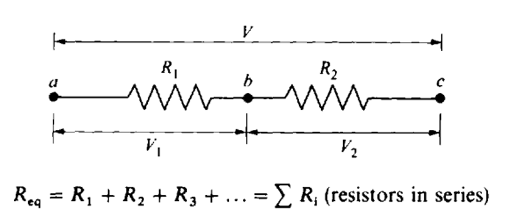
When resistors are connected in series as follows, the current flowing through each resistor is the same. For resistors in series.

RESISTORS IN PARALLEL
When resistors are connected in parallel, each branch has the same potential difference or voltage. For resistors in parallel,

FUSE
A fuse is a device which has very low resistance, and is made of material that will melt (i.e. burn out) when the current gets too high. The fuse burns out before other wires or resistors burn out or get so hot that nearby objects catch fire. When the fuse burns out all current ceases in the series circuit.

TERMINALS
Any source of EMF is a device in which positive and negative charges are separated. The two ends of such a device are called terminals. On one terminal positive charge will accumulate and on the other terminal negative charge will accumulate.

ANODE
The positively charged terminal is called the anode.

CATHODE
The negatively charged terminal is called the cathode.

OPEN CIRCUIT EMF
Open circuit EMF is the potential difference established between the terminals when no current flows because no wire has been connected between the terminals.

INTERNAL RESISTANCE
The open circuit EMF reduces by some amount when the circuit is closed and there is a current. To a good approximation, this reduction is proportional to the current, so EMF = V – Ir, where r is the proportionality constant. As can be seen; r has the same dimensions as resistance and is called the “internal resistance”, Rint, of the source, and treated like any other resistance.

DISCHARGE
A battery “discharging” means that the energy stored in the battery is reduced whenever the battery supplies current to an external circuit.

RECHARGE
In recharging a battery, energy must be delivered to the chemicals within the battery and be stored in the form of chemical energy of the molecules of the medium. To accomplish this one uses a different source of EMF, such as a generator, and applies a voltage across the terminals of the battery from this external source which will try to force current to flow in the desired direction. If the EMF of the external source is greater than the EMF of the battery, then current will flow in the direction determined by the external source. In that case the battery will receive energy and, if the battery is of the type that can be recharged, that energy will be stored in the battery.

WORK (RECHARGE)
The work done in moving a charge q through an EMF, ℇ, is qℇ.

AMMETER
An ammeter is an instrument that measures current. To measure the current in a circuit, it is obvious that one must place the ammeter in series within the circuit so that the same current flows in the meter as in the circuit. It would seem that the current read on the meter will then equal the current in the circuit. In order to minimize the effect of the ammeter on the current we must build our meters to have a very small resistance compared with the resistance R in the circuit we are measuring. Thus ammeters must always have small resistances to be accurate in their measurements.

VOLTMETER
A voltmeter is an instrument that measures voltage. A voltmeter must be connected in parallel with the circuit element whose voltage we seek. In order to minimize the change, we require that very little current be diverted through the voltmeter. This can be accomplished by making the resistance of the voltmeter very large compared to R. If this is not the case, one has to correct the reading to account for the effect of the voltmeter.

NULL MEASUREMENT
It is clear that the ideal way to measure a resistance is to use meters that do not draw any current when they are in the circuit. This would be a case of a null measurement where the result depends on adjusting a dial until the meter reads zero. The corresponding instrument that is used to measure resistance using a null method is the Wheatstone bridge.

WHEATSTONE BRIDGE
In the circuit for the Wheatstone bridge shown below, the unknown resistor is X, and the other resistors M, N and P are known. When the EMF is applied to the circuit, the known resistors are adjusted so that no current flows through the galvanometer G, between points b and c. Then no adjustments are necessary for the resistance of the galvanometer. The unknown resistance X may then be determined in terms of known resistors M, N and P.

POWER
Power is the rate at which energy is dissipated in the external circuit. This power is available for work (turning a motor) or for heat (in an electric heater or light bulb). The electrical energy that a charged particle loses is qV. That rate at which the energy is lost, the power, equals

P = ∆(qV)/∆t = V(∆q/∆t) = VI

If we have a potential difference V across a resistance R, then V = IR and

P = IV = I(IR) = I2R = V2/R

.

KHTK Factor # 4

Reference: The KHTK Factors

KHTK Factor # 4: The being is also a dimension point.

Dimension points are points that are part of some continuous scale or dimension according to the principal of oneness. They are knowable and can be viewed. Anything that is manifested is a dimension point.

Postulates that manifest as goals and behavior characteristics are dimension points. The being, which is constituted of these postulates, is also a dimension point.

A being is a viewpoint as well as a dimension point. Therefore, beings can sense each other. They all are part of the same awareness.

.

Scientology

Compare the above to the following factor in Scientology.

Scientology Factor # 4. The second action of beingness is to extend from the viewpoint, points to view, which are dimension points.

Scientology seems to imply that only viewpoint can be aware and not the dimension points. But all things are dimension points, and they carry viewpoints. Thus, all things are aware of each other in some fashion.

.

Logic

All things react or respond to each other in some way. So they act both as viewpoints as well as dimension points.

.

Physics II: Chapter 4

ReferenceBeginning Physics II

Chapter 4: ELECTRIC POTENTIAL AND CAPACITANCE

.

KEY WORD LIST

Conservative Force, Electric Potential Energy, Electric Potential, Equipotential Surface, Electron-Volt, Capacitance, Capacitor, Parallel Capacitors, Series Capacitors, Energy Of Capacitors, Dielectric, Polarize, Dipoles, Dielectric Constant, Permittivity

.

GLOSSARY

For details on the following concepts, please consult Chapter 4.

CONSERVATIVE FORCE (Newton)
Forces, in general, are able to do work, and the work that they do can be transformed into kinetic energy. For forces that are “conservative” the work done can be expressed in terms of a change in potential energy associated with those forces. In other words, the total work done in moving a particle between two points is independent of the path taken. Equivalently, if a particle travels in a closed loop, the total work done by a conservative force is zero.

ELECTRIC POTENTIAL ENERGY (Joules)
The electric force is conservative, and work can be written in the form of a change in potential energy. The potential energy of two charges q and Q separated by a distance r is then given by:

The zero of potential energy has been chosen when r → ∞. If the charges are of the same sign, then the potential energy increases as the charges approach each other. This follows because an external force must do positive work in forcing the charges closer together against their mutual repulsion. If left to themselves, these charges would seek regions of lower potential energy.

ELECTRIC POTENTIAL (Volt = Joules/coulomb)
We could associate a specific potential energy with each point in space in a manner similar to associating an electric field to each point in space. We can view this as a situation in which the stationary charges provide each point in space with a scalar value, called the potential, V, such that the potential energy of the system will equal qV if the moving charge is at that point in space.

The unit for potential is joules per coulomb, which is the same as volt (V). The quantity ∆V is the “potential difference” between two points in the static electric field. It corresponds to the work needed per unit of charge to move a test charge between the two points. The potential is related to the potential energy in the same manner that the electric field is related to the electric force.

Voltage = Energy / charge

The relationship of electric potential to electric field is as follows:

Potential always decreases as we move along the direction in which the field points.

EQUIPOTENTIAL SURFACE
At every point there is an electric field pointing in some direction. If we move to a different point along that direction, then the potential will change. However, if we move to a different point perpendicular to that direction, the potential will not change. If we move from point to point, always in a direction perpendicular to the electric field at that point, we will sweep out a surface with all points on that surface at the same potential. This surface is called the “equipotential surface”.

A knowledge of how V varies in a region around a point allows us to obtain the magnitude and the direction of the electric field at that point.

E = -∆V/∆d

The minus sign means that E points from high to low potential.

ELECTRON-VOLT
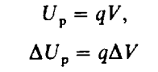
The potential energy of any charge is given by qV, and the change in potential energy that is used in most energy related problems is ∆Up = q ∆V. A positive charge gains energy as it moves to a region of higher potential. A negative charge, such as an electron, will lose energy as it moves to a higher potential. When an electron moves through a difference of potential of one volt it gains or loses e(1) = 1.6 x 10⁻¹⁹ J of energy. This amount of energy is called an electron-volt, or eV. This is a very convenient unit of energy to use whenever one discusses the motion of an electron.

CAPACITANCE
Let us consider the case of two isolated conductors with charge +Q on one and -Q on the other, and a potential difference V between them. Depending on the shape of the conductors and their positions relative to each other, the charges on the conducting surfaces will distribute themselves with some definite (but not necessarily uniform) charge distribution. It is not hard to see that the potential difference V is proportional to the charge Q, as long as the geometry stays the same. We can therefore write Q = CV, and the constant C is called the capacitance of the system. This constant C = Q/V depends on the geometry of the conductors, their size, shape and position, but it does not depend on the charge on the plates. The unit for capacitance is the farad (F).

CAPACITOR
If we build a unit containing two conductors with relatively large surfaces close to each other (but not touching) we call this object a capacitor whose capacitance is C. The name derives from the fact that C represents the capacity of the two conductors to store charge on their surfaces per unit potential difference (per volt) between them. A large capacitance means that the capacitor holds a lot of charge per volt. The most common capacitor geometry is that of two close parallel, conducting plates.

The capacity of a parallel plate capacitor can be written as C = ε0A/d. Thus, doubling the area, or halving the distance between the plates, doubles C as well.

A capacitor has the property that there is no current flow through it, so that, in the steady state it acts like an open circuit. However, the capacitor can become charged as a result of current flowing towards its positive plate, and discharged as a result of charge flowing away from its positive plate. Therefore, current can flow in a DC circuit containing a capacitor, during the time that the capacitor is charging or discharging.

PARALLEL CAPACITORS
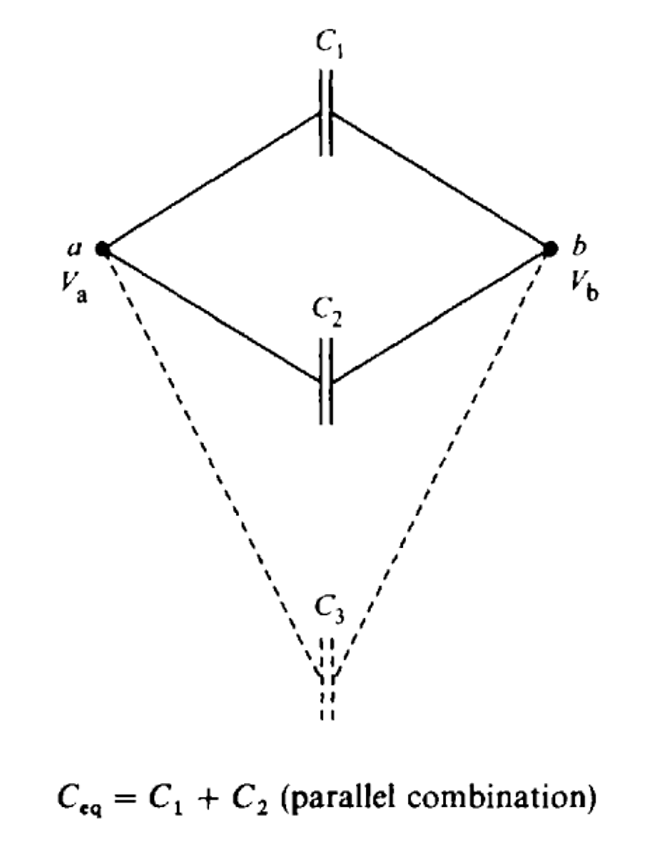
When capacitors are connected in parallel as follows, each branch has the same potential difference or voltage. For two parallel capacitors,

SERIES CAPACITORS
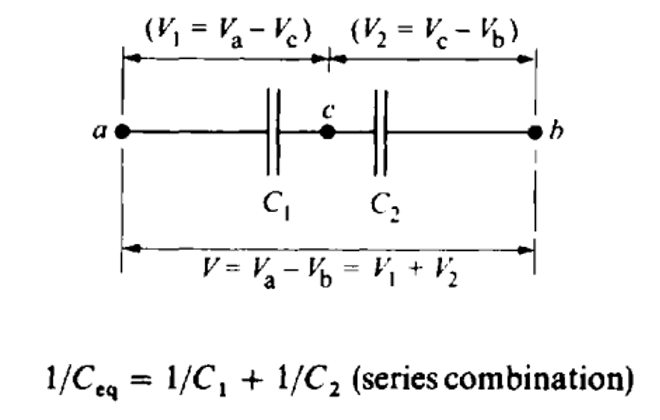
When capacitors are connected in series as follows, the potentials V1 and V2 across the capacitors need not be the same.  Indeed, the total voltage between a and b is V = V1 + V2. If we examine the figure more closely, we note that each capacitor will have the same charge. For two series capacitors,

ENERGY OF CAPACITORS
If a capacitor is charged to a difference of potential V, then the energy stored in a capacitor can be written as

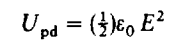
The energy that is stored in a capacitor can be viewed as the energy stored in these electric fields. The entry density within the capacitor may be expressed as,

DIELECTRICS
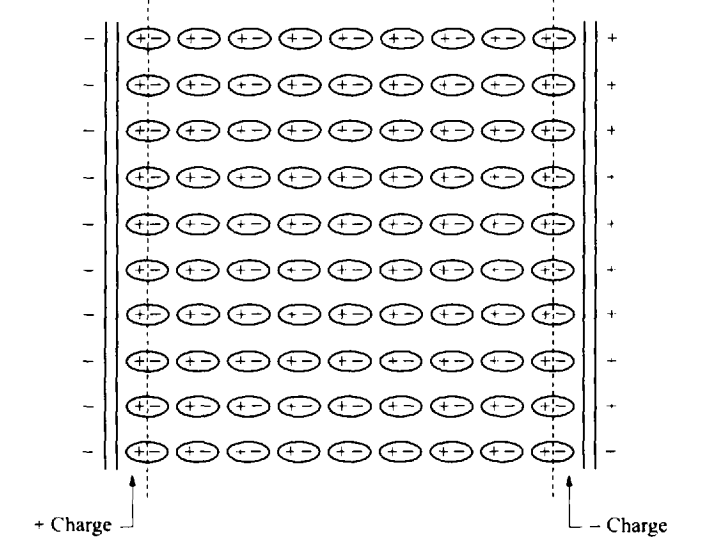
A dielectric is a medium or substance that transmits electric force without conduction. Normal insulating materials are dielectrics. They consist of atoms and molecules that are composed of positively charged nuclei and negatively charged electrons that are tightly bound together with no loose outer electrons that are free to roam. In the presence of an electric field the positive and negative charges in the atoms and molecules are pulled in opposite directions. As a result, the atoms and molecules will become somewhat “polarized” with the positive and negative charges becoming slightly separated from their equilibrium positions. We will then have tiny “dipoles” throughout the material. [See the beginning sketch above.]

POLARIZE
See DIELECTRICS.

DIPOLES
See DIELECTRICS.

DIELECTRIC CONSTANT
If the polarization is proportional to the field, then the new total field will be proportional to the field that would be produced in the absence of the dielectric material. We can then write that E = E0/κ, where E is the total field in the presence of the dielectric, E0 is the field that would be present without the dielectric and κ is the “dielectric constant” of the material. These dielectric constants vary from material to material.

PERMITTIVITY
Permittivity (ε) is a measure of the electric polarizability of a dielectric. A material with high permittivity polarizes more in response to an applied electric field than a material with low permittivity, thereby storing more energy in the material. In electrostatics, the permittivity plays an important role in determining the capacitance of a capacitor. ε0 is called the permittivity of free space. ε = κε0 is called the “permittivity” of the material.

.

Mathematical Results

.