Author Archives: vinaire

I am originally from India. I am settled in United States since 1969. I love mathematics, philosophy and clarity in thinking.

KHTK Factor # 7

Reference: The Factors

KHTK Factor # 7: When gaps are viewed among dimension points, new dimensions are postulated to fill them. Thus there is reasoning.

The dimension point is a point of knowingness in the vast background of the Unknowable. It is created out of postulates. It has substance.

But the earlier postulates as dimension points provide a rough sketch only.  The principle of oneness makes the sketchiness visible. One immediately sees tremendous gaps. New postulates are then made in an attempt to fill these gaps. This cycle keeps repeating. And so the earlier sketch starts to take a more of a recognizable appearance. 

This is the process of creation of the “being” we know as the Universe. First there is the substance in the form of postulates. Next that substance starts to spread out and starts to show gaps. As these gaps starts to get filled, the first appearance that we have is that of continuous space.

So, the primary anomaly is discontinuity (missing knowingness). It is very difficult to spot this anomaly because it is not there to be spotted.

This is the beginning of reason; and the first challenge of reasoning is to spot what is missing.

So the universe starts to form. But we are not quite there yet.

.

Scientology

Compare the above to the following factor in Scientology.

Scientology Factor # 7. And from the viewpoint to the dimension points there are connection and interchange. Thus new dimension points are made. Thus there is communication.

Communication already exists with the ability to view the dimension points. This communication now develops into reasoning to discover more.

.

Logic

Reasoning requires the ability to perceive what is missing. This is impossible to do without a universal criterion, such as, the principle of oneness. Reasoning is qualified by the viewpoint.

.

Physics II: Chapter 7

ReferenceBeginning Physics II

Chapter 7: MAGNETISM-SOURCE OF THE FIELD

.

KEY WORD LIST

Magnetic Field (Source), Field Produced By Currents, Solenoid, Magnetic Field Lines, Composite Fields, Ampere’s Law, Coaxial Cable

.

GLOSSARY

For details on the following concepts, please consult Chapter 7.

MAGNETIC FIELD (SOURCE)
One basic origin of a magnetic field is a moving charge or an equivalent current in a wire. It exerts a force on another moving charge. Another basic source for a magnetic field is an electric field that varies with time.

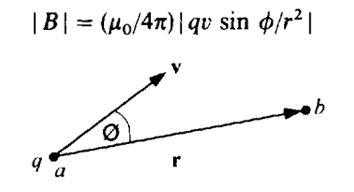
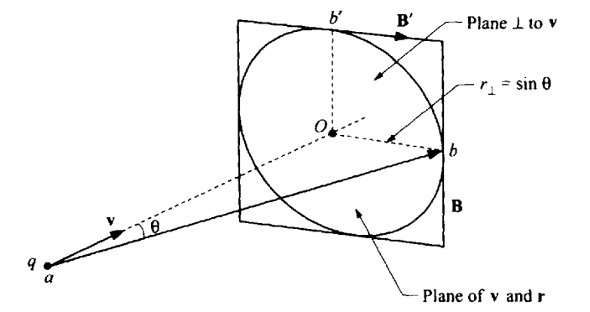
The following is the formula for the magnitude of the field produced by a moving charge q, moving with velocity v, at a point located at a displacement r from the charge.

This is known as the Law of Biot and Savart. The field is zero if φ is zero. The largest magnetic field is produced when φ is 90°. The magnitude of B decreases as 1/r2 with the distance from point a. The field increases with both q and v.

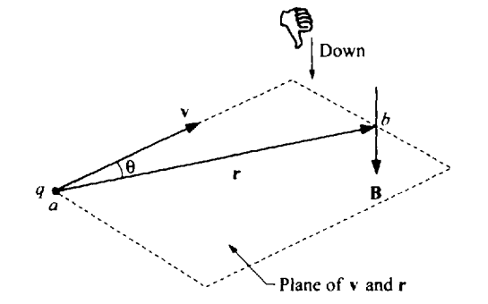
The direction of the field is perpendicular to the plane containing both v and r, and according to the right-hand rule.

If one traces the magnetic field lines, they form concentric circles around the direction of v.

Two charges of the same sign moving parallel to each other in the same direction shall experience magnetic attraction.

FIELD PRODUCED BY CURRENTS
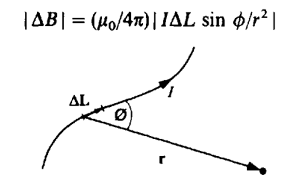
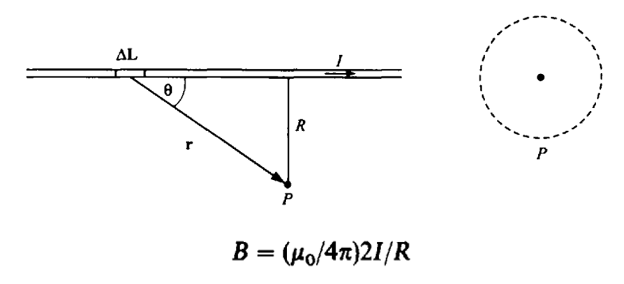
Current flowing in a wire is equivalent to moving charge: qv = I∆L. The magnitude of the magnetic field produced by a current I flowing in a wire of length ∆L at a point located at a distance r from the element is,

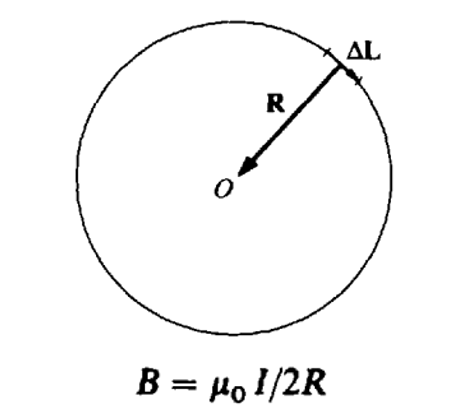
Field at the Center of a Current Carrying Ring

A current I, flowing in the clockwise direction. Then the field at the center of the ring, with direction into the paper is,

For N turns of the coil the field is multiplied by N.

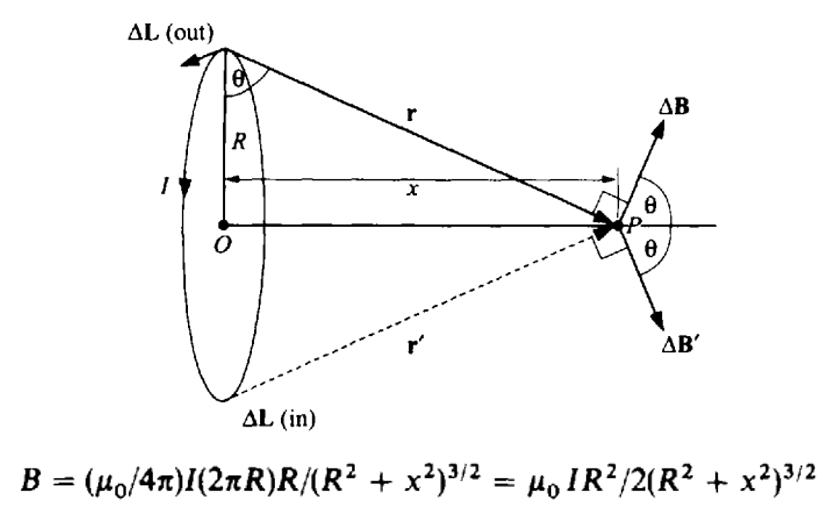
Field Along the Axis of a Ring

The field at the center of the ring, with direction at P to the right is,

Field of a Long Straight Wire

I is the current in the wire and R is the perpendicular distance of the point P from the wire. The direction of the field is into the paper at P.

SOLENOID
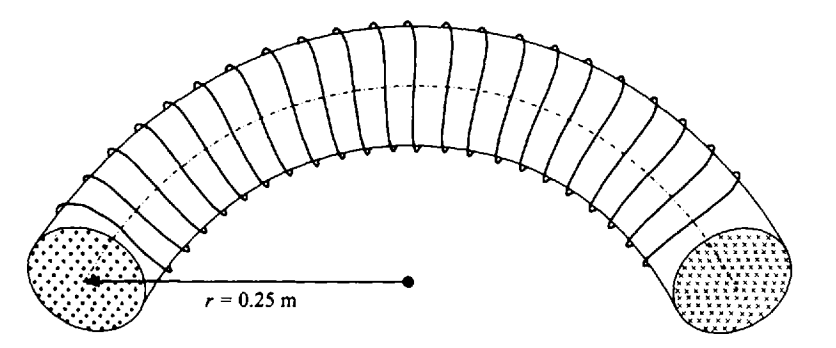
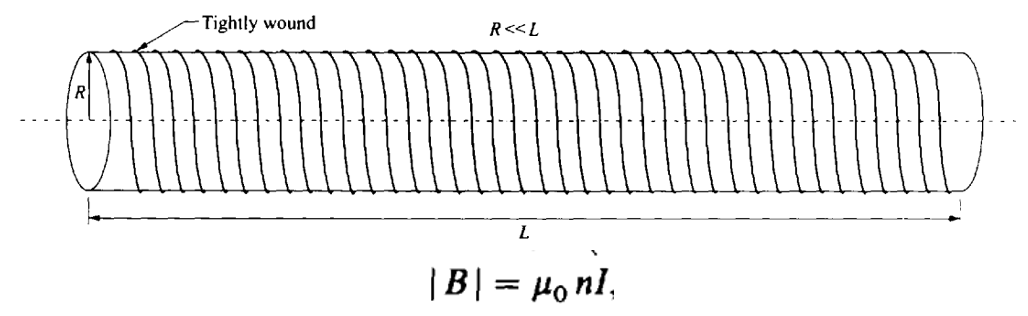
A solenoid
is a wire is continuously wound around a long pipe with adjacent windings close to each other. The field within a long solenoid is the same at any point within the solenoid and is zero (or very small) outside the solenoid.

where n is the number of turns per meter. The direction of the field is parallel to the axis with the direction given by the same right-hand rule used for the ring. The result is the reason that solenoids are so very useful for producing magnetic fields. The field produced is uniform, with the same magnitude and direction everywhere within the solenoid. Furthermore, this uniform field does not depend on the radius of the solenoid, only on the number of windings per unit length. One can, for instance, wind several layers of turns, one on top of the other, to increase n, and each layer will contribute the same field, independent of the radius (as long as the solenoid is truly long).

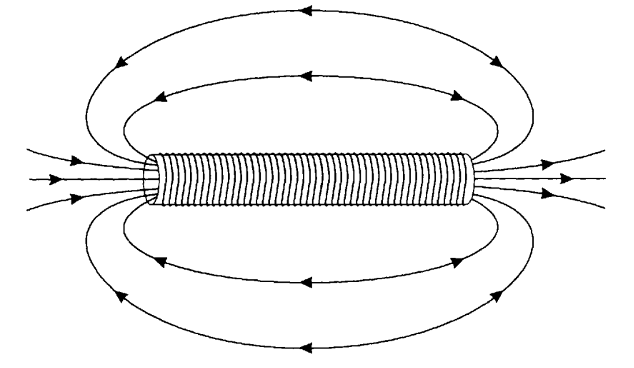
If the solenoid is not infinitely long, but the length is much greater than the radius, then the above result is still nearly true as long as one is not too near to the end of the windings. The field lines inside the solenoid are straight lines, parallel to the axis, until one approaches the ends. Outside the solenoid, the field is no longer zero, and the field lines are as shown above. This happens to be the same field line configuration as for a permanent bar magnet.

MAGNETIC FIELD LINES
The magnetic field lines form closed loops, unlike electric field lines that begin or end at a point charge. The fact that magnetic field lines don’t converge to or diverge from a point is a fundamental property of the magnetic field and can be stated as a general law: “Magnetic field lines never converge to a point or diverge from a point”.

COMPOSITE FIELDS
If several wires each produce magnetic fields, then the actual magnetic field at any point is the vector sum of the fields produced by each wire.

AMPERE’S LAW
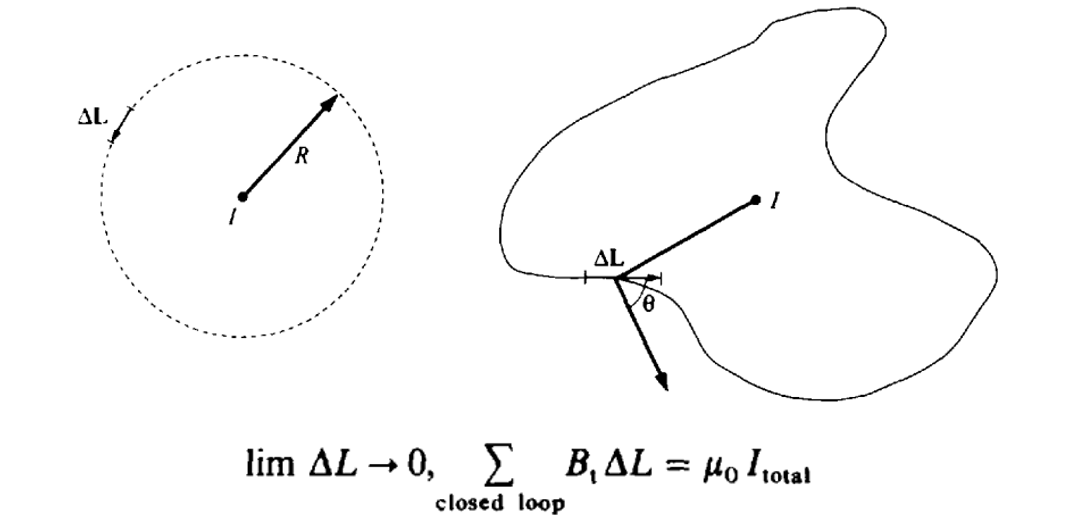
There is a powerful general law relating the magnetic field and the current, which often gives insight into the behavior of the magnetic field, and, in certain circumstances, allows for the compete determination of the field without lengthy calculation. This relationship is given by Ampere’s law.

The line integral of B cos θ ∆L around a closed path equals the total current flowing through the area enclosed by that path. This very important result is Ampere’s law.

COAXIAL CABLE
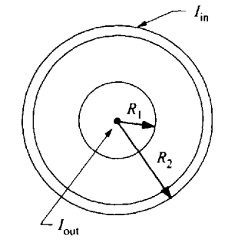
A coaxial cable consists of an inner solid conductor of radius R1, carrying current I out of the paper, and an outer, concentric hollow cylinder, of radius R2, carrying the same current I into the paper, the current being distributed uniformly around the cylinder.

Since the two currents are equal and flow in opposite directions, the field outside the cable is zero.

.

KHTK Factor # 6

Reference: The KHTK Factors

KHTK Factor # 6: The beingness has attention that can roam around, broadened, or focused narrowly.

The beingness, when manifested as a being, is aware and actively manipulating that awareness through postulating. This is also called directing its attention.

The beingness can place its attention on different things physical or mental. Therefore, the attention can roam around and pick things selectively to become aware of.

This attention may be broadened to become aware of a large sphere. The attention may then be focused on parts of that sphere to absorb greater details.

.

Scientology

Compare the above to the following factor in Scientology.

Scientology Factor # 6. The action of a dimension point is reaching and withdrawing.

The whole idea here is that a being can view selectively, or allow itself to be viewed selectively.

.

Logic

The fundamental characteristic of the mind is attention, which it can use to view things broadly or selectively. When attention cannot be controlled, no reasoning is possible.

.

KHTK Factor # 5

Reference: The KHTK Factors

KHTK Factor # 5: The being manifests as space.

Space has to do with distances, extents and dimensions. When there are points to view, or dimension points, there are dimensions and extents. This is space.

There is no empty space, because there must be something with extents and dimensions in order to have space. This something is the substance of postulates. It is also the substance of beings.

Therefore, space represents the primary substance of beings. As beings condense, the space also condenses into energy and matter.

.

Scientology

Compare the above to the following factor in Scientology.

Scientology Factor # 5. Thus there is space created, for the definition of space is: viewpoint of dimension. And the purpose of a dimension point is space and a point of view.

Anything that you view has viewpoint involved. The characteristic of space is “dimension.” Distance is not the only dimensions. There are also the dimensions of color, taste, smell, etc. 

.

Logic

Broadly, space describes all the properties of substance that constitutes the being. These properties can be plotted on dimensional scales.

.

Physics II: Chapter 6

ReferenceBeginning Physics II

Chapter 6: MAGNETISM-EFFECT OF THE FIELD

.

KEY WORD LIST

Magnetic Force, Magnetic Field, Circular Motion, Mass Spectrometer, Hall Effect, Semiconductor, Velocity Selector, Magnetic Torque, Magnetic Dipole Moment, Motor

.

GLOSSARY

For details on the following concepts, please consult Chapter 6.

MAGNETIC FIELD (B)
The magnetic field is a vector and is the link between the two moving charges that interact with each other. One of the charges is the source of the field, and this field, in turn, has the effect of exerting a force on the second moving charge. For magnetic field, we use the symbol B.

The unit for a magnetic field is a tesla (T) in our system. A more common unit which is widely used in practice is the gauss (G). One gauss equals 10-4 tesla. The strength of the magnetic field near the surface of the earth is approximately one gauss.

MAGNETIC FORCE (F)
Experimentally we find that, in addition to the electrical force, there is also a force exerted by one moving charge on another moving charge. This force is the magnetic force. The formula for the magnitude of the force is:

Where the charge q is moving with velocity v when the angle between the vectors v and B is φ.

We have used absolute value signs, since the magnitude is always positive. The sign of q does not affect the magnitude of the force. It will, however, affect the direction of the force. Note that the force is zero when the velocity and the magnetic field are along the same line. Also, the largest force occurs when the velocity is perpendicular to the magnetic field.

The magnetic force for a current in the wire is:

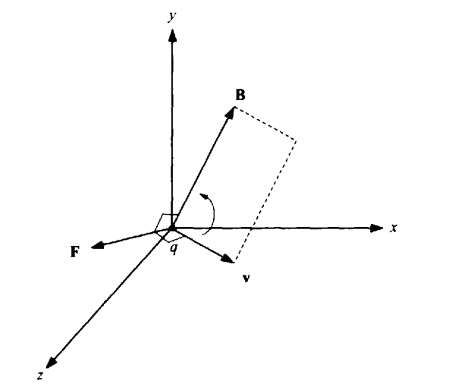
The direction of the force is perpendicular to both v and B, and it is therefore necessary to consider the problem in three dimensions. The force points in the direction a right hand screw moves as it rotates from v to B.

CIRCULAR MOTION
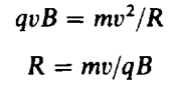
A charged particle moving at constant speed at right angles to a magnetic field executes a circular motion in the plane perpendicular to B, because the force is always perpendicular to the direction of the motion. The magnitude of the magnetic force must equal the centripetal force required and we can therefore say that,

This is a formula for the radius of the circle traversed by the particle of mass, m, charge, q, moving with a velocity, v, in a perpendicular magnetic field, B.

SIGN OF THE CHARGE
If one has a charged particle of unknown sign, one can use the circular motion created by a magnetic field to determine the sign of the charge. It may also be used to determine the mass of a charged particle.

MASS SPECTROMETER
A mass spectrometer is an apparatus for separating isotopes, molecules, and molecular fragments according to mass. The sample is vaporized and ionized, and the ions are accelerated in an electric field and deflected by a magnetic field into a curved trajectory that gives a distinctive mass spectrum.

HALL EFFECT
Hall Effect is the production of a potential difference across an electrical conductor when a magnetic field is applied in a direction perpendicular to that of the flow of current.

SEMICONDUCTOR
A semiconductor is a material which has an electrical conductivity value falling between that of a conductor, such as copper, and an insulator, such as glass. A semiconductor’s resistivity falls as its temperature rises, in contrast to normal conductors (i.e. metals) whose resistivity rises with temperature.

VELOCITY SELECTOR
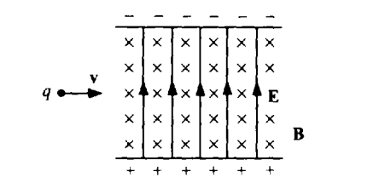
By using a combination of both electric and magnetic fields, we can produce a mechanism to separate out particles of a particular velocity. This is known as a velocity selector.

When the electric force is equal and opposite to the magnetic force, E = vB, or v = E/B. For a velocity of v = E/B there is no force to deflect the particle, and it will travel in a straight line. We can choose the velocity we want by varying E, simply by changing the potential difference across the two plates, which is producing the electric field.

MAGNETIC TORQUE
It is useful to define a vector area for the coil, A, whose magnitude is A = ab, and whose direction is perpendicular to the plane of the coil. The ±direction of A is determined by the right-hand rule. Curl the fingers of your right-hand around the coil in the direction of the current. Your thumb then points in the positive A direction. Thus φ is the angle between A (area vector) and B (magnetic field), as can be seen below. We see that in general the torque is given by

where Γ tends to rotate the coil in the same direction as rotating the vector A through φ to B. When A is parallel to B, φ = 0 and the torque is zero.

MAGNETIC DIPOLE MOMENT
We define a new vector, M, the magnetic dipole moment of the coil, whose magnitude is IA and whose direction is the same as A. If the coil consists of several turns, then each turn has a magnetic moment IA, and the entire coil has a magnetic moment NIA, where N is the number of turns in the coil. The torque will turn the coil in the direction of making M point in the direction of B.

Although this result was derived for the special case of a rectangle, the result is valid for any coil shape, with the moment of the coil equaling M = NIA, and the torque on the coil equaling MB sin φ, with the usual counter-clockwise, clockwise conventions.

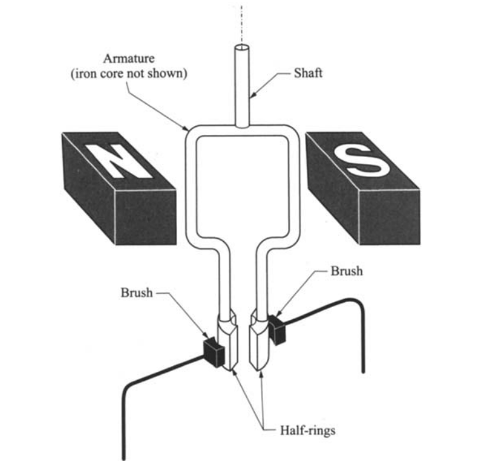
MOTOR
This phenomenon of a torque on a coil can be used to build a motor, which will continuously rotate in the magnetic field. Such motors are built by constructing a coil from many turns (to increase M and thereby, the torque), and suspending the coil on an axis in a constant magnetic field. The direction of the current in the coil is chosen to make the coil rotate in one particular direction, for instance clockwise. When the coil passes the y axis the direction of the torque would normally reverse, making the coil turn counter-clockwise. In order to prevent this from happening, we arrange to have the current direction reverse as the coil passes through the y axis, thus maintaining a clockwise torque. This is accomplished by the split in the rings where the current enters from the source of EMF.

.