Matter, Void and Space (old)

NOTE (06/04/24): Today I shall replace the term “gravity” used in this essay by the term “thought.” I shall also replace the expression “density or mass” by the term “consistency.”

In this essay, we define some common concepts from the viewpoint of physics. The most common concept is MATTER.  Matter is something that can be sensed. The opposite of matter is VOID that cannot be sensed. Matter and void, thus, form a duality.

MATTER – VOID

But there is SPACE that is neither matter nor void. Space is not void because we can sense it. Space is not matter because it still exists as a perfect vacuum when all matter is removed. Space, thus, forms a region between matter and void.

MATTER – SPACE – VOID

In other words, space consists of things that can be sensed but which are not matter. We identify such things as light and gravity. The objective observation is:

Matter is that which is substantial enough to be sensed.

Space is absence of matter, but it still consists of light and gravity that can be sensed.

Void is the absence of anything that can be sensed.

.

Substance

We use the word SUBSTANCE as a broad category for things that are physically substantial enough to be sensed. Matter, light and gravity fall under this category of substance. Traditionally, matter has been viewed as a substance, but not light and gravity. This has been a source of much confusion.

Newton did view light as substance but it was seriously questioned by the wave theory. Faraday did view force (hence gravity) as substance, but it was overruled by Maxwell. Today we are not sure if light and gravity are particles or wave.

What sets matter apart from light and gravity is its property of center of mass. Newton’s mechanics is based on this property. Light and gravity are also substance but they do not have centers of mass. The objective definitions are:

SUBSTANCE is anything that is substantial enough to be sensed.

MATTER is a substance that has the property of center of mass.

LIGHT and GRAVITY are substances that do not have the property of center of mass.

VOID is that which cannot be sensed.

.

Force and Density

A substance is substantial because it can be sensed. That sense of substantiality may be described by the concept of force. And the degree of substantiality may be described by the concept of density or mass. The objective definitions are:

FORCE is the sense of substantiality of substance.

DENSITY or MASS is the degree of substantiality of substance.

.

Space

Space consists of matter, light and gravity. In other words, space consists of substance. Descartes had argued that space is “the sense of extension”. This was explained by Einstein in “Relativity and the Problem of Space” as follows:

Descartes argued somewhat on these lines: space is identical with extension, but extension is connected with bodies; thus there is no space without bodies and hence no empty space. 

Matter has space which it occupies. Similarly, light and gravity also have spaces that they occupy. Space is sensed only because of the substance that occupies it. When there is no substance, there is no space. Beyond space is the void that cannot be sensed. The objective definition is:

SPACE is the property of extension of substance (matter, light and gravity). 

.

Current Physics

The above definitions differ from those used in current physics as follows.

(1) Current physics confines itself to matter, light (electromagnetic radiation) and gravity but it does not categorize them as substance. Therefore, there is no general category in current physics for things that can be physically sensed.

(2) Current physics considers elementary quantum particles to be the ultimate constituents of matter, light and gravity, but it does not look at them as substance either. Therefore, physics goes deep into abstraction where boundaries are blurred between things that can be sensed and those that are merely imagined.

(3) Current physics does not differentiate between space and void because it does not look at space as the extension of things that can be sensed. It treats space as an abstract continuum that can curve and bend like rigid matter. 

(4) In short, current physics reduces matter to the idea of discrete particles, and void to the idea of a malleable continuum. The duality of matter and void is no longer as distinct as it once used to be. 

This brings up the lack of clear definition in current physics for the words particle and continuum. This is taken up in the next chapter.

.
Mind & Objectivity

When the mind operates from the viewpoint of emptiness, it sees things as they are. This is the objective reality. We perceive objective reality directly through our physical perceptions of sight, hearing, touch, taste and smell. The mind then assimilates these perceptions ensuring consistency, harmony and continuity. The enduring aspects of this assimilation, based on generations of experience, become wisdom or common sense.

The degree of mental assimilation depends on consistency, harmony and continuity.

.

Objectivity

The objectivity depends on seeing things as they are. The word objective is derived from object that has the sense of “something perceived”. Objective reality is not only made tangible through the physical perceptions, but also made logically consistent by the mental perception. The objective reality is that which has been tested and verified and cannot be argued with. It is the same for all people when all known inconsistencies have been resolved.

The subjectivity is different for different people and it may be argued with. The word subjective is derived from subject that has the sense of “open to inspection”. Subjective reality depends on individual viewpoint. It is characterized by inconsistencies among viewpoints that still need to be resolved. As inconsistencies are resolved the subjective reality becomes increasingly objective.

There is, however, a misconception that all perceptions processed through the mind are subjective. The fact is that perceptions are assimilated to different degrees in the mind. Completely assimilated perceptions are objective. As the degree of assimilation reduces, so does the objectivity. The conclusion then become increasingly subjective.

Objectivity depends on the assimilation of perceptions in the mind. To the degree perceptions are not assimilated there is subjectivity.

.

Mind & Emptiness

The mind deals with phenomena. A phenomenon is anything that you become aware of.  A phenomenon can be physical, mental, spiritual, real or imaginary. To assess the nature of a phenomenon completely you must view it from a point beyond phenomena.

.

Emptiness

That viewpoint which is beyond all phenomena is the viewpoint of emptiness. The Heart Sutra in Buddhism defines EMPTINESS as no Birth no Death, no Being no Non-being, no Defilement no Purity, no Increasing no Decreasing.  

The viewpoint of emptiness is just that. It is totally fresh. It is completely clean. There are no preconceived notions, no fixed ideas, and no bias. In short, the concept of emptiness is not viewed through any filters. It is simply what it is.

From a scientific viewpoint, emptiness is like the zero of a scale on which all phenomena may be plotted. Emptiness itself is not a phenomenon, just like zero is not a value. Thus, emptiness provides a reference point from which it is possible to give an objective meaning to any phenomena.

The purpose of a reference point is to align everything that follows. In the absence of a reference point things devolve into confusion. It is common to assume an arbitrary reference point just to avoid the immediate confusion, even when it can’t resolve everything.

GOD is such a reference point. It is there to resolve the confusion of physical reality. But it cannot resolve the reality of itself. To understand the reality of GOD a more basic reference point is needed.

Emptiness is that basic reference point. It has the property of being inherently understood because it denotes the absence of all phenomena. No other reference point is required to understand emptiness.

The basis of mind is emptiness. To see things as they are, the mind must view them from the reference point of emptiness.

.

The Electromagnetic Spectrum

The electromagnetic (EM) spectrum is part of the spectrum of substance. (see The Spectrum of Substance). The EM spectrum is made up of the following layers of electromagnetic radiation:

  1. Gamma radiation
  2. X-ray radiation
  3. Ultraviolet radiation
  4. Visible radiation
  5. Infrared radiation
  6. Terahertz radiation
  7. Microwave radiation
  8. Radio waves

Each layer is a continuum of substance. It consists of a range of frequencies. All layers may be arranged on a continuous scale of frequencies. The frequency of EM radiation has certain stability. Any effort to change the frequency activates a restoring force similar to the inertia of matter. Thus, EM radiation appears to maintain its frequency throughout the spectrum.

EM radiation resists its frequency from being changed. This is a form of inertia.

The gamma rays are seen to be emitted by the nucleus, and X-rays from inner electrons. This EM spectrum may be seen to be emitted from the electronic region of the atom. Thus the configuration of the atom exists in equilibrium with the EM spectrum.

The EM spectrum exists in equilibrium with the atom.

Maxwell’s electromagnetic cycles may best be compared to Newton’s corpuscles. Each cycle is infinitely divisible like a corpuscle because unit of time is infinitely divisible. The higher is the “frequency” of light, the denser is the concentration of cycles (corpuscles) that make up the radiation. Therefore, the frequency indicates the density of the radiation. According to The Universal Frame of Reference, the speed of light shall decrease with increase in frequency, but this occurs in infinitely small gradients in the electromagnetic spectrum.

EM radiation forms a continuum in space whose density increases (speed decreases) on a very small gradient as frequency increases.

Common to EM spectrum is the concept of photon. The photon is an energy particle (see Particle, Continuum and Atom). This means that photon is the amount of radiation required in its interaction with the electronic region. This amount is proportional to the frequency (density) of radiation.

A photon is an energy particle of radiation, meaning it is the amount of radiation required in its interaction with the electronic region

Per the relationships, E = hf, and E = mc2, each cycle has energy equal to the Planck’s constant (h), and density equal to the constant (h/c2). As we move up the spectrum, the frequency increases and both wavelength and period shrink together. The radiation (field) becomes increasingly denser and more focused. This is perceived as quantization (condensation of energy into mass) at higher frequencies.

EM radiation becomes denser and more penetrating as frequency increases.

The constants described above ensure the continuity of different regions of the field that are at different frequencies. Therefore, these regions are bounded by smooth gradients of frequency. These gradients manifest as tension (charge) or force. These forces then become part of the field. We recognize these forces as gravitational, electromagnetic, nuclear, etc. These forces differ in their nature depending on the sharpness of the gradient as well as on their relative position in the spectrum.

The gravitational, electromagnetic, and nuclear forces exists in the continuum (field) because of frequency or density gradients.

As forces become stronger with frequency, inertia also increases to balance them. If forces are represented by frequency gradient (increased oscillations relative to itself) then inertia is represented by quantization (increased condensation). Basic inertia appears as permeability and permittivity. It balances the conversion between electric (kinetic and linear) and magnetic (potential and rotational) aspects of a cycle. This shows up in the constant rate of propagation of the electromagnetic disturbance within the field.

The forces within the field are balanced by quantization (inertia).

With increasing frequency gradient the increased quantization seems to develop into a dense structure of mass. This structure appears to be made up of high frequency of infinitesimal cycles. The quantization into mass starts out like “eddies in flow”. This shows the primary characteristic of mass to be rotational. We may identify these “eddies” as the multitudes of quantum particles.

Quantum particles arise out of the condensation of EM radiation.

The rotational nature of mass tends to pin it down and reduce its linear motion. This also increases inertia (density). As the density of quantum particles increases their intrinsic motion decreases (see The Universal Frame of Reference).

Rotation is the characteristics that accompanies increasing condensation into mass, and inertia.

The application of external force invokes inertia, and inertia seems to add to the density of the substance, thus decreasing its intrinsic linear motion. This may describe the conservation of force of Faraday. This appears to contradict Newton’s laws of motion, which describe force in terms of acceleration of an object. This contradiction is resolved when we notice that the “acceleration” in terms of distance cannot be observed when there is no other object around. A continually “accelerated” object simply feels as if it has mass added to it.

External force converts into internal mass or density.

This brings up the difference in the perception of absolute motion from relative motion. This topic is taken up in the next chapter.

.

The Wave-Particle Duality

According to Wikipedia:

Wave–particle duality is the concept in quantum mechanics that every particle or quantum entity may be described as either a particle or a wave. It expresses the inability of the classical concepts “particle” or “wave” to fully describe the behavior of quantum-scale objects.

A quantum entity is an “energy particle”. This means it is simply the energy involved in an interaction at the atomic level. Examples are photon and electron. Quantum physics then assumes that photon and electron are indivisible particles (see Feynman on Quantum Behavior).

Light cannot be a wave because it is not a disturbance in stationary medium, such as, aether. Nor can it be a particle because it cannot be distinguished in space by a center of mass. As described earlier,

Light is a continuum in space that has a certain density represented by its “frequency”.

.

Double-slit Experiment

According to Wikipedia:

In modern physics, the double-slit experiment is a demonstration that light and matter can display characteristics of both classically defined waves and particles…

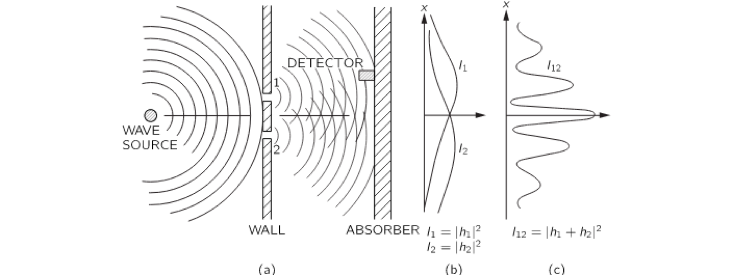
In a double-slit experiment with water waves an interference pattern is observed.

A similar pattern is observed when this experiment is repeated with light instead of water waves. The feature, which is common to both of these instances, is the infinite divisibility of the “flow” arriving at the two slits. In case of the water wave, the disturbance on the surface of water is infinitely divisible being continuous. In the case of light, light itself is an infinitely divisible continuum.

The infinite divisibility of the flow arriving at the double-slit produces the interference phenomenon.

Newton’s corpuscular theory of light considered corpuscles to be infinitely divisible. Therefore, it should never have been dropped in favor of a wave-theory of light that postulated unobserved aether.

.

Assumption in Physics

Physics assumes that light and electron flow arriving at the double-slits are made up of indivisible particles that go through one slit or the other (see Feynman on Quantum Behavior). Quantum mechanics justifies it through the idea of probability but there are no indivisible particles in the first place. Photons and electrons are “energy particles” arising from interactions. They are not indivisible “lumps” in space. The idea of particles is generated as light or electron interacts with the detector in definite amounts to generate clicks.

The wave-particle confusion exists in physics because “energy particles” are thought of as indivisible particles in space.

This is explained in Particle, Continuum and Atom.

.

Quantum Mechanics

Quantum mechanics came about because of the discreteness of energy interactions at the subatomic level.

A material particle also implies discreteness of energy interactions, but, in addition, it implies discreteness of mass in space because of center of mass property. This similarity of energy and mass discreteness does not carry forward from material to subatomic area.

A quantum particle does not imply indivisibility in space.

.