System of Co-ordinates

We always observe the trajectory of a moving body from a viewpoint. Einstein identifies that viewpoint with a material body, such as, a platform or a train. In other words, we can observe the trajectory of a moving body either from the platform or from the train.

This identification of viewpoint with a material body gives us a co-ordinate system. Space is then defined as an extension of this reference body. It expands and contracts just like the reference body. The reference coordinate system is as rigid as the reference body. In other words, it endures in time at the same rate as the reference body. Therefore, the space and time are unique to the reference co-ordinate system.

.

The Principle of Relativity

Einstein states his principle of relativity (in the restricted sense) as follows:

“If, relative to K, K’ is a uniformly moving co-ordinate system devoid of rotation, then natural phenomena run their course with respect to K’ according to exactly the same general laws as with respect to K.”

The theory of special relativity (SR) looks at the uniform motion of K’ with respect to K. The magnitude of this uniform motion may vary.  Since there is no external force causing different uniform motions, these motions must be a characteristic of the co-ordinate system. According to The Logic of Motion these uniform motions are an expression of inertia (mass concentration) associated with the co-ordinate system.

This logic generalizes the classical laws, incorporated in the co-ordinate system, to also include the phenomena of optics and electrodynamics.

This logic, however, was not considered by Einstein. In its place Einstein proposed the principle of relativity. See The Principle of Relativity (In the Restricted Sense).

.

Co-ordinate System at Rest

According to The Logic of Motion, a co-ordinate system of infinite inertia may be regarded as being absolutely at rest. We may call it K0 and choose it as our body of reference. All motion relative to K0 will then be absolute.

Einstein argues that since earth is in motion, it is obviously not K0. Therefore, its motion should play a part in the general laws of nature. But the motion of earth has revealed no physical non-equivalence of different directions. Einstein, therefore, concludes that there is no co-ordinate system that can be absolutely at rest.

The weakness of this argument is that the relative motion of earth is being confused with its absolute motion. The high mass concentration of earth shows its absolute motion is close to zero. It is 4 times denser than the sun. Denser than earth would be a neutron star or a black hole. Their absolute motion shall be still closer to zero.

Einstein’s conclusion that there is no co-ordinate system at absolute rest may be in error.

The higher is the mass concentration, the closer is the co-ordinate system to being at rest.

.
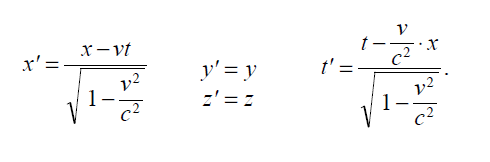
Lorentz Transformations

Lorentz transformation looks at the characteristics of space and time from the viewpoint of the invariant speed of light. The invariance of the speed of light means that it is absolute. It does not depend on anything external to light. It is an intrinsic property.

.

Light as Substance

If light has intrinsic properties, then light may be considered a substance. Newton thought so because he looked at light as made up of corpuscles. Unlike an atom a corpuscle is infinitely divisible. See Corpuscular theory of light – Wikipedia. An “electromagnetic cycle” may be considered a corpuscle. It is infinitely divisible because time can be considered to be infinitely divisible.

The higher is the frequency of light, the greater is the concentration of “electromagnetic cycles”, or corpuscles. These corpuscles cannot be treated as point particles because they do not have center of mass like material particles do. They have to treated as a fluid-like continuum. Therefore, higher concentration of corpuscles would mean, higher density of the fluid-like continuum of light.

We may conclude that light is a continuum with certain density. Its density is represented by a “frequency”. This density indicates that light has mass, but this mass is not structured as it is in matter. This mass displays wave characteristics as it flows at the speed of light.

.

Space and Time

Space may be considered to be a characteristic of substance. Descartes thought that space is defined by the extents of substance. This is obvious for matter. But the space, which is empty of matter, may actually be defined by the extents of light. Here light refers to the whole electromagnetic spectrum.

Similarly, time may be defined by the duration of substance. Matter seems to have almost infinite duration because it endures forever at any location in space. But the duration of light seems to be very small, because it whizzes past any location in space at great speed. The duration of a substance and its absolute speed appear to be inverse of each other. See The Logic of Motion.

.

Speed in Lorentz Equation

The above considerations present motion in absolute terms. They are very likely to provide interesting interpretation to Lorentz transformations and also to Einstein’s theory of special relativity.

The relative motion that we measure as the speed of heavenly bodies and the speed of objects on earth, is not the same thing as the absolute motion that we measure as inverse of density. Therefore, we cannot compare a relative speed to the absolute motion of light because they do not have the same basis. They are like apples and oranges. The “v/c” ratio in Lorentz transform have no consistent basis mathematically.  

The implications of this shall be taken up in the next chapter.

.

The Structure of Mind

Looking at the long history of the universe we observe that there is a continual evolution in terms of increasing order. Underlying this evolution is a power. This same power underlies the mind.

The purpose of the mind, therefore, is to evolve the organism and the environment toward greater order. The primary function of the mind is to coordinate the activities of the body and the environment so they evolve. When there are anomalies, the mind resolves them so there is greater order in terms of consistency, harmony and continuity.

.

The Mental Matrix

Mind is not the same thing as brain. The brain is part of the body’s hardware; mind is the body’s software. To understand the structure of the mind we need to first understand how it operates.

The mind operates by drawing on experience. This experience is derived from the perceptions received continually by the mind. In a normal functioning mind, the perceptions are received through the senses of touch, sight, hearing, taste and smell. These perceptions break down into fine data elements, which are then arranged in a matrix type structure.

A matrix is made up of nodes where each node is in some relationship with every other node. In the mental matrix the nodes are made up of data elements that are related to each other by the properties perceived. For example, in an animal mind, these data elements may be related by the properties of how safe and edible the things perceived are.

The human mind is more complex than the animal mind. The perceptions from the environment get refined rapidly as patterns of data elements. For example, the property “red” may be expressed as part of the color scale. This makes the matrix of the human mind extremely refined and complex. Errors creep in only when perceptions do not get refined and assimilated into this mental matrix.

The mind is a matrix made up of elements derived from the perception of the environment.

.

Earlier Models

The present work proposes this “matrix” model for the mind. Looking at earlier models, we find Freud’s model of conscious and unconscious mind proposed in 1890s, and Hubbard’s model of analytical and reactive mind proposed later in 1950s.

In the matrix model, the greater is the refinement of the data elements and the relationships among them, the higher is the consciousness. Thus human consciousness is much higher than the consciousness in animals. When perceptions from the environment are not refined into patterns of data elements they are just lodged into the mental matrix as “unassimilated nodes”. The person is not conscious of such unassimilated experiences. This describes the concept of “unconscious mind” proposed by Freud.

The “unconscious mind” of Freud is made up of “unassimilated nodes” in the mental matrix.

In the matrix model, thinking occurs as the data elements associate with each other such that continuity, harmony and consistency are maintained at all times throughout the mental matrix. This forms the faculty of the mind to imagine and make projections in an analytical manner. In a refined and well-assimilated matrix the thinking is rational, or analytical. However, as more “unassimilated nodes” are activated in the mental matrix the thinking becomes irrational and reactive. This describes the concept of “reactive mind” proposed by Hubbard.

The “reactive mind” of Hubbard is also made up of “unassimilated nodes” in the mental matrix.

.

Memory

The models of Freud and Hubbard imply that perceptions are stored “as-is” in the mind. However, the “matrix” model describes the storage of perceptions as patterns of data elements well-assimilated within the mental matrix. Since same data elements may be utilized many times in different patterns, the “matrix” model provides a more efficient way of storing perceptions in the mind. A “memory” is a pattern of data elements that is activated by attention. Memory is clear and precise when its pattern is made up of refined and well-assimilated elements. It would be difficult to recall a memory if it contains “unassimilated nodes”.

A “memory” is a pattern of data elements that is activated by attention.

.

Summary

The matrix arrangement ensures that the data elements can be combined in infinity of unique ways to represent all possible experience. These combinations could be the formation of past memories upon recall. Or, they can be the formation of new visualizations needed to sort out anomalies created by “unassimilated nodes”.

The matrix arrangement provides a very efficient organization and storage of experience to support the activities of the mind.

.

Exercise 12: Effortlessness

Reference: The 12 Aspects of Mindfulness

When you let it be, it becomes effortless. Effort comes into play only when there is resistance to letting it be. It is completely safe when you let the body and mind unwind gradually on their own. Trouble occurs only when you become anxious and start to dig for answers.

Purpose:

To let meditation be effortless

Pre-requisites:

Complete Exercise 11: Contemplation.

Instructions:

In this exercise you practice effortlessness. You may do this exercise while sipping coffee in a café or strolling along a river. You may even find a place where you can sit comfortably for a while without being disturbed. Then patiently observe the world go by.

Prepare yourself as in earlier exercises. Observe the environment and the people in a casual, easygoing manner. Observe what is there in the environment using all your senses. Let various forms, sounds, smells, taste, touch, thoughts, emotions, impulses etc. come to you. Do not strain to perceive them.

Become aware of the body and stay aware of it without interfering with its natural movements, such as, that of breathing, or responding to natural impulses. Let physical reactions, such as, twitches in muscles, minor pains and aches, sleepiness, etc., come and go. Experience the body as a whole without resisting it.

Become aware of the mind and stay aware of it without interfering with its natural thought processes. Let your attention be non-judgmental. Let mental reactions, such as, memories, feelings, emotions, thoughts, etc., come and go. Experience the mind as a whole without resisting it.

Simply observe the physical and mental objects necessary to follow the trail of interest. Let the mind contemplate on anomalies (inconsistencies, disharmonies and discontinuities) as they present themselves.

Let your eyes be open, half-closed, or closed naturally and not be controlled. Keep this exercise as effortless as possible.

Continue this exercise for at least 20 minutes. You may repeat this exercise as many times as you wish.

End of Exercise:

When you can meditate effortlessly, then this exercise is passed.

.

Exercise 11: Contemplation

Reference: The 12 Aspects of Mindfulness

When mindfulness is practiced, thinking becomes contemplation. Problems are solved by looking at them non-judgmentally and recognizing the relationships. One looks around to get the missing information instead of trying to “figure it out”.

Purpose:

To contemplate thoughtfully.

Pre-requisites:

Complete Exercise 10: Name and Form.

Instructions:

In this exercise you contemplate thoughtfully. You may do this exercise while sipping coffee in a café or strolling along a river. You may even find a place where you can sit comfortably for a while without being disturbed. Then patiently observe the world go by.

Prepare yourself as in earlier exercises. Observe the environment and the people in a casual, easygoing manner. Observe name, form, characteristics and all possible associations.

When you perceive some anomaly (inconsistency, disharmony or discontinuity) become very alert. Do so even when explanations are provided. Look more closely around the subject area that seems out of place and focus on what does not make sense.

Be non-judgmental and follow the trail of what continues to be puzzling. The trail may take you to some childhood question that never got answered, or to some confusion in school that never got resolved. Apply all aspects of mindfulness to these unresolved questions, confusions and emotions. Consult references from books and Internet as necessary.

The trail may also take you to some traumatic incident that you feel emotional about. Let the attitudes, emotions, sensations and pain purge themselves out. Follow through with what does not make sense to the end of the trail. Exhaust all such trails until the missing piece is found.

Continue this exercise for at least 20 minutes. You may repeat this exercise as many times as you wish.

End of Exercise:

When you can contemplate thoughtfully by following all trails until they are exhausted, then this exercise is passed.

.