Physics I: Chapter 8

Reference: Beginning Physics I

CHAPTER 8: IMPULSE AND LINEAR MOMENTUM

.

KEY WORD LIST

Impulse, Momentum, Conservation of Momentum, Elastic Collision, Inelastic Collision, Coefficient of Restitution, Ballistic Pendulum, Center of Mass

.

GLOSSARY

For details on the following concepts, please consult CHAPTER 8.

IMPULSE
Impulse is the product of the average force acting upon a body and the time during which it acts, equivalent to the change in the momentum of the body produced by such a force.

I = Ft

I may be resolved into x and y components. It is equal to change in momentum,

MOMENTUM
If an object of mass m is moving at a given instant of time with velocity v then,

The concept of linear momentum can be generalized to two or three dimensions.

CONSERVATION OF MOMENTUM
When there are no external forces acting on a system (or when the resultant of external forces acting on a system is zero), the total momentum of the system is conserved. In other words, total final momentum = total initial momentum.

ELASTIC COLLISION
An elastic collision is one in which the total kinetic energy of the colliding objects is the same just before and just after the collision.

INELASTIC COLLISION
An inelastic collision is characterized by a certain disappearance of kinetic energy in the collision process.

COEFFICIENT OF RESTITUTION
The coefficient of restitution (e) is defined as the ratio of the magnitude of the relative velocity after the collision to that before the collision.
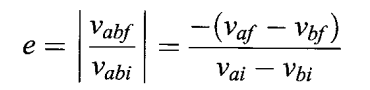
For an elastic collision, e = 1. Generally speaking, the smaller the e value, the more thermal energy is generated and hence the more kinetic energy is lost.

BALLISTIC PENDULUM
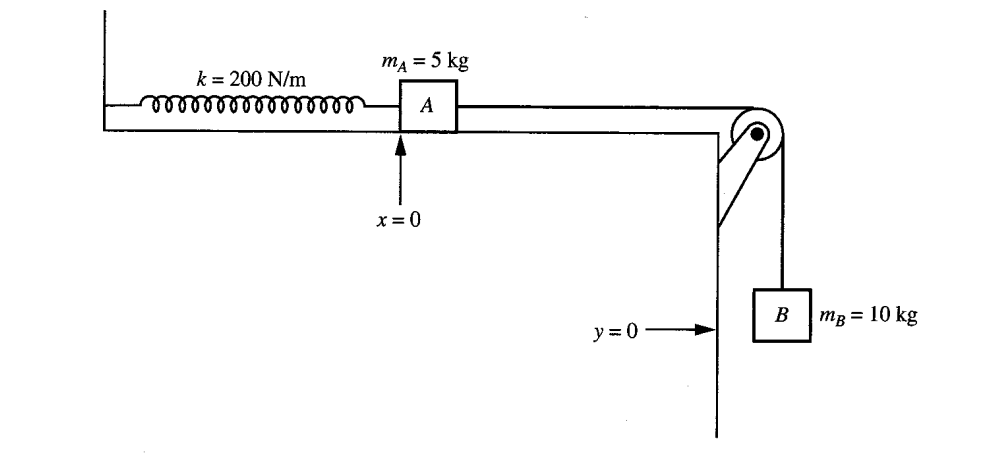
A ballistic pendulum is a device that is used to measure the velocities of small swift projectiles such as bullets. See the sketch above.

CENTER OF MASS
The center of mass is the point at which the entire mass of a body may be considered concentrated for some purposes. It is defined as the position of the average displacement of the particles of the body, weighted according to mass.
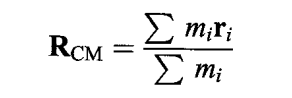
For a rigid body, the center of mass of the body moves as if it was a particle having a mass equal to the total mass of the body acted on by the resultant force on the body. The center of mass is a geometric point fixed in relation to a rigid body, but it is not necessarily in the body. 

.

Physics I: Chapter 7

Reference: Beginning Physics I

CHAPTER 7: ENERGY, POWER AND SIMPLE MACHINES

.

KEY WORD LIST

Thermal Energy, Friction and Thermal Energy, Law of Conservation of Energy, Power, Simple Machine, Mechanical Advantage, Efficiency

.

GLOSSARY

For details on the following concepts, please consult CHAPTER 7.

THERMAL ENERGY
When the motion of particles is of random nature (describable, in fact, only by statistical means) we call the associated energy thermal energy. Such energy manifests itself macroscopically in various ways, most notably as a rise in temperature.

FRICTION AND THERMAL ENERGY
Since friction always does negative work, the system that supplies the force of friction should always gain energy. The source of friction is the interaction between the surface layers of the two objects that are moving past each other. As a result, the random jiggling of the vast number of particles in the surface increases. This is the increase in the thermal energy of the surfaces.

LAW OF CONSERVATION OF ENERGY
If we include in our considerations thermal energy, as well as other forms of energy such as electromagnetic radiation (light) and more subtle form of mechanical energy such as sound, the law of conservation of energy still holds. Energy can be transformed from one type to another within a given system, and it can be transferred from one system to another system, but the total amount of energy remains the same.

POWER
Power is the rate at which work is done; that is, how much work is done per second by a force. The SI unit for power is the watt (W), where 1 W = 1 joule/second.

The instantaneous power is,

SIMPLE MACHINE
A simple machine is any device that allows a small force to move an object against a larger resisting force, or a force in one direction to move an object against a resisting force in another direction. Many simple machines do both. Examples of simple machines are lever, inclined plane and a pulley system.

MECHANICAL ADVANTAGE
The mechanical advantage of a machine is the ratio of the load to the applied force. The bigger the mechanical advantage the smaller is the applied force necessary to accomplish the task.

EFFICIENCY
The efficiency (e) of a simple machine is defined as the ratio,

.

Unknowable and Postulates

Reference: Course on Subject Clearing

(1) Unknowable simply means that you do not know everything in advance. You have certain observations, and among those observations there are many gaps of what you do not know.

(2) You postulate to fill these gaps. This may narrow the gap but some smaller gaps still remain. As you continue to postulate, you develop a system of postulates to explain what you do not know.

(3) Such a system of postulates must be consistent in itself to be able to predict consistently what you do not know. Everything that you know is based on this system of postulates.

(4) When you come across something that your system of postulates could not predict then you have an inconsistency in your system. You then have to recalibrate your system of postulates to be able to account for this new observation.

(5) Something unknowable still remains and it pulls you forward in developing your system of postulates. This continues on an individual basis life after life. It comes to be shared by others and starts to develop on a social basis.

(6) Ultimately, it has to become a universal system of postulates as inconsistencies continue to be resolved.

(7) The unknowable still remains as that which is yet to be explained fully by the universal system of postulates.

.

Physics I: Chapter 6

Reference: Beginning Physics I

CHAPTER 6: WORK AND MECHANICAL ENERGY

.

KEY WORD LIST

Work, Spring Force, Kinetic Energy, Work-Kinetic Energy Theorem, Gravitational Potential Energy, Work-Energy Theorem, Total Mechanical Energy, Conservation of Mechanical Energy, Energy Transfer, Conservative Force, Gravitational Potential away from Earth, Escape Velocity

.

GLOSSARY

For details on the following concepts, please consult CHAPTER 6.

WORK
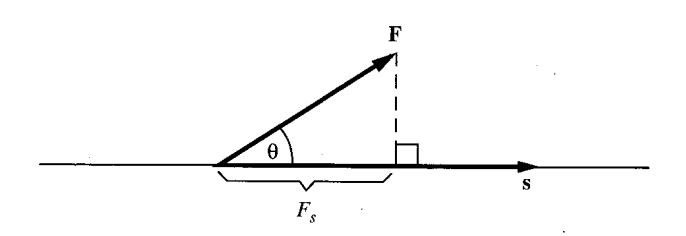
The work WF  due to a constant force F acting on an object while it moves through a displacement s is defined as the component of F along the s direction multiplied by the magnitude of s.

Even though the work involves two vector quantities F and s, it itself has no direction and is thus a scalar. The units of work are those of force times distance. The work is defined so that it can be positive, negative or zero, depending on whether the component of F along s is positive, negative or zero. Total work done is just the work by the resultant force.

SPRING FORCE
A stretched spring exerts a force whose magnitude is proportional to the length of the stretch. The proportionality constant k is called the spring constant:

Fsp = – kx;        F = kx

The work done by F in stretching the spring by a displacement x is

WF = ½ kx2

KINETIC ENERGY
The expression ½ mv2 is called the kinetic energy Ek of the mass m at velocity v. The kinetic energy has the units of work, and the SI units are Joules.

WORK-KINETIC ENERGY THEOREM
The work-kinetic energy theorem is expressed as follows.

Where WT is total work done; Ek is kinetic energy; and Ek is the change in kinetic energy in going from the initial to the final position.

It can be shown, using the calculus, that the work-kinetic energy theorem is still true for the most general possible situation. No matter how complicated the path of motion, and no matter how complicated and numerous the forces are acting on the object, the total work done on the object in any interval equals the final minus the initial kinetic energy for that interval.

GRAVITATIONAL POTENTIAL ENERGY
The expression mgy is called the gravitational potential energy Ep of the mass m at height y.

It can be shown that this equation is true for any path of an object near the earth’s surface. More generally,

WORK-ENERGY THEOREM
The work done by all forces other than gravity on an object equals the sum of the changes in the gravitational potential energy and kinetic energy of the object.

TOTAL MECHANICAL ENERGY
The sum of the potential and kinetic energies at any point is called the total mechanical energy (ET) at that point.

CONSERVATION OF MECHANICAL ENERGY
The total mechanical energy of an object stays constant (“is conserved”) throughout its motion if no forces other than gravity do work.

ENERGY TRANSFER
We can think of the work done by one system on another system as the mechanical transfer of energy between the systems.

CONSERVATIVE FORCE
Conservative force is any force that has the property that the work done by the force depends only on the starting and ending points, and not on what happened in between. The force of gravity near Earth’s surface is clearly such a force. The name “conservative” comes from the fact that if an object moves in a path that returns to the starting point, the total work done by such a force must be zero. We can define a potential energy for the conservative force. The spring force is also a conservative force.

NOTE: A conservative force of gravity is more like a force field in space that generates the same acceleration at all points in space.

GRAVITATIONAL POTENTIAL AWAY FROM EARTH
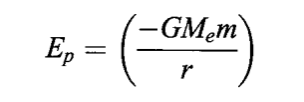
Gravitational force far from Earth’s surface is no longer constant, but it can be shown to be conservative. It thus has a potential energy. The gravitational potential energy is determined as,

ESCAPE VELOCITY
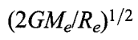
The escape velocity is the smallest burnout velocity for the rocket for no return. It is equal to

.

The Postulate of Eternal Being and God

The starting postulate of “Eternal Being” means that there is something existing without any change. We notice that every part of the universe is changing, but the idea of the universe itself is not. The idea of the universe is that of WHOLENESS or ONENESS. Therefore, the postulate of Eternal Being, simply translates as the postulate of ONENESS of existence.

In philosophy, the postulate of eternal being translates into the continuity, consistency and harmony of the system of postulates. But there is another aspect to this postulate—it is the aspect of aliveness. There is aliveness because there is the ability to postulate and the ability to ensure that all postulates are consistent. Thus, all subsequent postulates build up on these starting postulates in a consistent fashion.

The starting postulates are:

  1. There is the ability to postulate.
  2. This ability keeps all postulates consistent.
  3. The system of postulate generated is continuous, consistent and harmonious.

Therefore, any inconsistency in a system of postulates is an aberration. In order to predict or conclude correctly all inconsistencies must be resolved.

To believe in a human-like intelligence right from the beginning of the universe is an error. Human-like intelligence evolves from the starting postulates outlined above. It is therefore important to interpret the concept of God correctly.

There are warnings in the scriptures about misinterpreting the concept of God. The name of God in the Jewish Scriptures is an enigmatic mystery. People often pronounce the four Hebrew letters (YHWH) as “Yahweh” or “Jehovah”, but the truth is that we don’t really know how to say it. Jewish people, by and large, prefer to avoid using any name of God.

In Islam, God is never portrayed in any image. This is because human bias can easily be projected into one’s view of God.

The starting postulates above are the closest approach to the concept of God.

To give God superhuman type of attributes is an error that comes from the human-centric viewpoint. The human-centric viewpoint is a narrow viewpoint that leads to beliefs, such as, the earth is the center of the universe, the sun revolves around the earth, and the earth is flat. Superhuman attributes may come about with further evolution of humans. But that is something that lies in the future. It has not been realized yet in a consistent fashion.

In Christianity, God is portrayed with human-like images. The Bible portrays God as giving out the commandments in human voice. But these are poetic renditions of God. The actual understanding of God goes much deeper.

.