Reference: Course on Subject Clearing
Reference: TROM: The Full Package
NOTE: This is a Subject Clearing Version of TROM
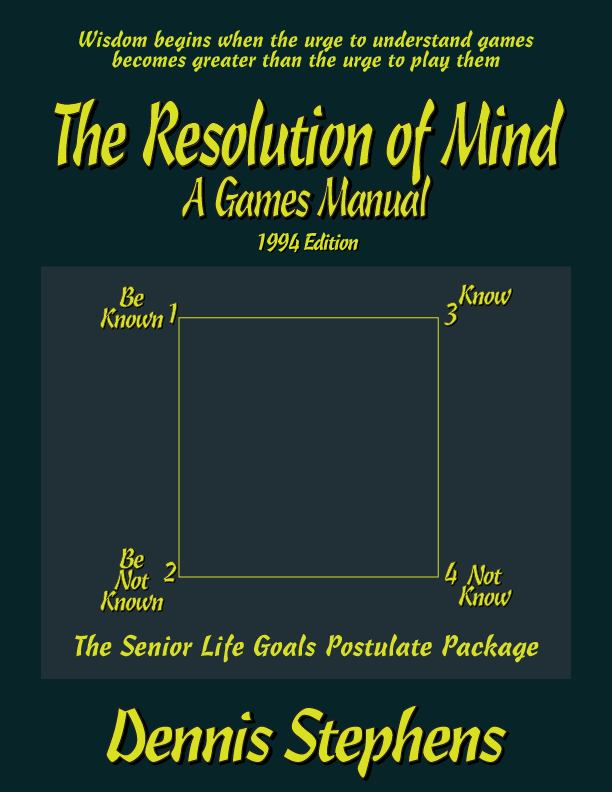
TROM (The Resolution of Mind) is a system derived from Scientology that simplifies the handling of the mind. It was put together by Dennis Stephens in the late seventies. The main feature of this system is that it can be applied to oneself without requiring the assistance of an auditor or E-meter.
The TROM routine consists of 5 levels. The first one is not always necessary except in a few cases, when a person requires his attention to be stabilized in the present time. Only then, one requires the assistance of an experienced auditor. But the other levels, one can do entirely on one’s own. On these levels, one is basically handling one’s postulates that happen to be in conflict.
It should understood that a person, basically, is a system of postulates; and, he is handling conflicts within himself.
The key word here is POSTULATE, and it is defined as follows:
A postulate is a self-created truth based on which further reasoning is done. The purpose of postulate is to give form to the unknowable to fill the gaps in the knowable. The postulate may develop into a system of postulates and theories. Everything that we know is based on this system of postulates. To be valid, a postulate must be consistent with all other postulates.
.
Five Levels of TROM
The five levels of TROM are described below. Before you start running these exercises make sure you have completed the section”The Fundamentals” from the Course on Subject Clearing.
.
LEVEL ONE
TROM Level One is the only level that requires another person to run CCH processes on you. These are exercises devoted to improving the reality of the present time. The CCH processes may be found at Grade 1 Exercises. An average person is in pretty good contact with the reality of present time. He may not need this level.
.
THE REPAIR OF IMPORTANCES (RI)
This is a simple exercise that one should familiarize oneself. Application of this exercise brings relief whenever the going gets rough in your solo work on the subsequent levels. The purpose of this exercise is to replace the old mass (importance) with mass of your own creation.
Commands:
a) Bring something into existence.
b) Have another bring something into existence.
Alternate commands:
a) Create something.
b) Have another create something.
The simplest creation is just getting an idea. Next level of creation is the visualization of something. The ultimate level of creation is postulating.
Third alternative:
a) Create an importance.
b) Have another create an importance.
A simple version is “RI by perception”:
Grasp a solid object with your hands and feel its solidity, temperature, and texture.
All the above commands are done repetitively, one command at a time. The gain is to see things as they are in present time.
.
LEVEL TWO
These are exercises devoted to the discovery of the past. One compares a past scene to the present to evaluate it properly. It helps one get rid of past repressions and inhibitions by becoming fully aware of them. Compare the “objects” first and then “persons” and “places.”
Commands:
a) Select a past scene.
b) Select an object from this scene.
c) Find an object in pt (one you can see with your eyes) that is different from the past object.
d) How is it different?
Repeat c) and d) (Its permissible to use the same pt object over and over again if you wish) until no more change; then:
e) Find an object in pt (one you can see with your eyes) that is similar to the object in the past scene.
f) How is it similar?
Repeat e) and f) until no more change, then repeat c) and d). Continue until both c) and d), and e) and f) produce no more change.
g) Select a new past object, either from the same past scene or a different one.
Repeat c) and d), then e) and f) with this new past object until no more change.
Continue the exercise, using more and more significant past objects, until no more change occurs with any past object you care to select. Now do the exercise with past persons. Select them one at a time, and complete the exercise with each person. Continue until no more change occurs with any past person you care to select. Repeat the exercise with “places.” Whenever you start feeling heavy on this level, use the “RI” exercise.
.
LEVEL THREE
On this level you learn to “timebreak.” Timebreaking is the simultaneous viewing of ‘then’ and ‘now’. Here you view past and present scene as if they are together in the same moment of time. One can then get a true evaluation of their relative importance.
Every so often you’ll come across a scene that just will not Timebreak. Not to worry. Just roll up your sleeves and drop back to Level Two regarding it and start finding some differences and similarities between the scene and present time. There’s something in that scene more than what meets the casual gaze. Suddenly it will flip out easily. Run a bit of RI at this point.
Commands:
a) Select a past scene. Become simultaneously aware of the scene and pt around you.
b) Don’t try and Timebreak all of the scene at once. Take it a bit at a time.
c) Continue to do this until the past scent ‘fades’ – i.e.. begins to ‘fall away’ in intensity compared to present time.
b) Select a new past scene, and repeat a) b) and c).
The nice thing here is that one is staying in the present time, and not diving into the past as in Dianetics. Thus, there is no liability of getting stuck in the past. Use RI exercise liberally when needed.
.
LEVEL FOUR
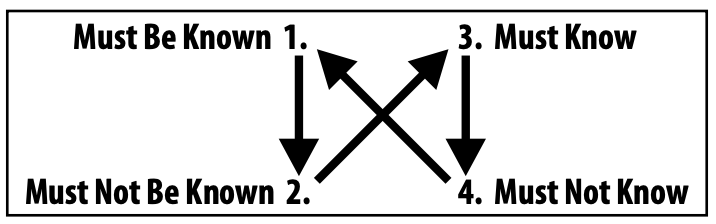
These exercises are devoted to the discovery and timebreaking of overwhelm (upset). Each leg of the goal ‘To Know’ has its own overt and motivator, giving us a total of 8 classes in all.
1) Forced to know.
2) Preventing from being known.
3) Prevented from knowing.
4) Forcing to be known.
5) Forced to be known.
6) Preventing from knowing
7) Prevented from being known.
8) Forcing to know.
We work through this list using command such as,
- Get the idea of being forced to know.
- Get the idea of preventing (something or somebody) from being known.
- Get the idea of being prevented from knowing.
- Get the idea of forcing (something or somebody) to be known.
- Get the idea of being forced to be known.
- Get the idea of preventing (something or somebody) from knowing.
- Get the idea of being prevented from being known.
- Get the idea of forcing (something or somebody) to know.
To remove the command power of any effect from the mind it is only necessary to discharge these various overts and motivators. We work through this list, from 1) to 8), round and round, timebreaking everything that shows up as we go, such as, guilt feelings, blame, shame, and regret. When nothing more is showing up then run RI after completing a command. This level helps one get into a state of total peace and relaxation even while engaged in the activities of life.
The completion of Level Four signals that the student is ready to work with pure postulates.
.
LEVEL FIVE
The difference between Level 4 and Level 5 is that Level 4 is more mass oriented which the postulates wrap themselves up in; whereas, Level 5 is pure postulate oriented.
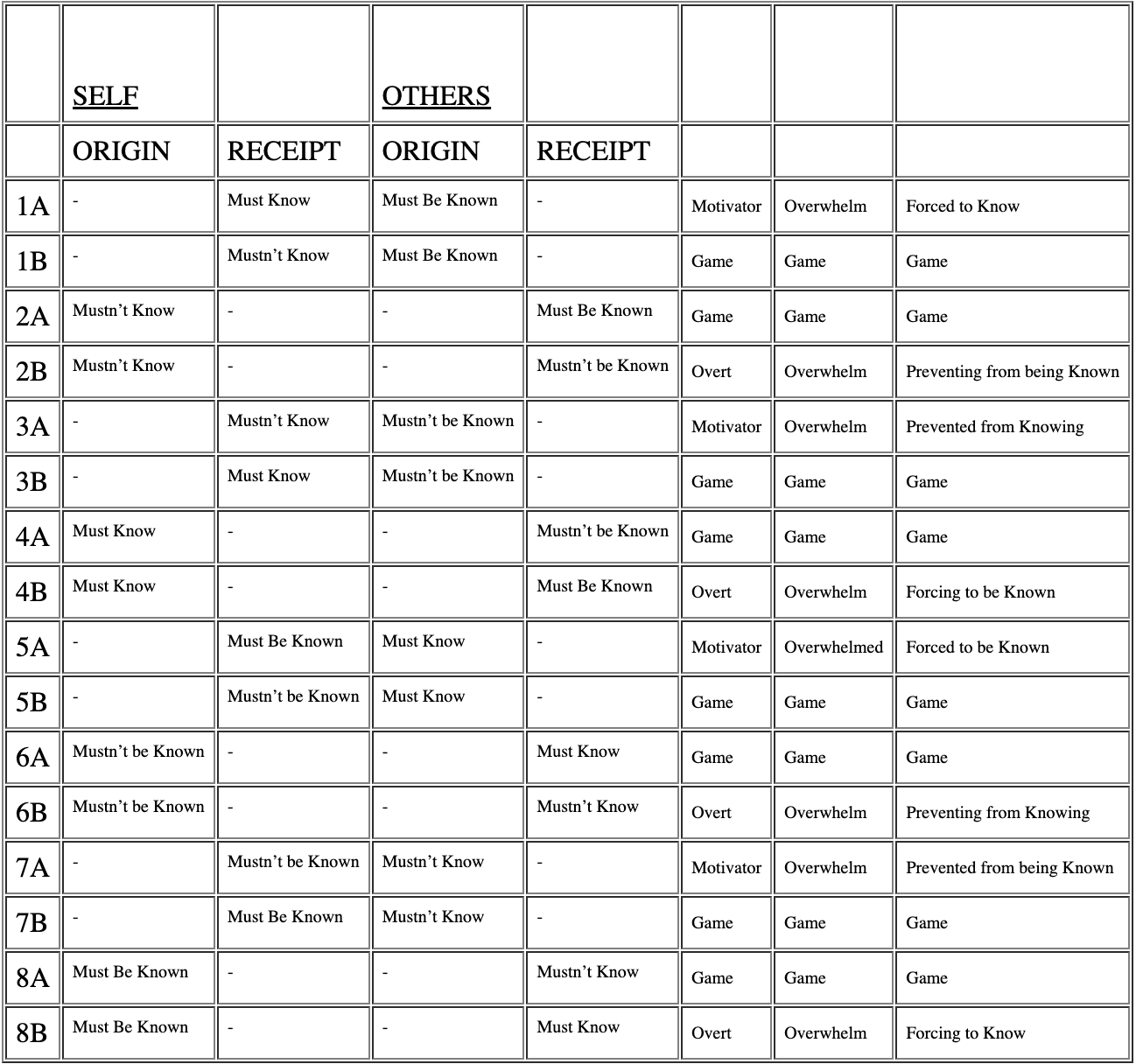
At Level 5, each row of the The Postulate Failure Cycle Chart (see above) forms an exercise. As you do more of Level 4, you start to appreciate the organization provided by this chart to go into the mind more deeply at the pure postulate level.
A pure postulate is like a mathematical relationship. When these relationships are applied to a subject like Physics, they acquire mass. Similarly, pure postulates acquire mass when they are applied to life situations. So, at Level 5, one is dealing with very basic postulates of this universe.
The most basic goal in this universe is “To know.” It is found at the core of all dynamics. One knows by postulating.
Postulating is bringing something into existence. Thus, something is manifested. Once manifested it is known. You can not-know something by altering it. When you alter, you manifest something different on top of what you had manifested earlier. So, the earlier manifestation is hidden under the new manifestation. So, we not-know the earlier manifestation. We only know the new manifestation. This is very solidly the case when there is a shift in valence.
So, there are many, many layers of this alter-is, much like the layers of an onion. This is what life does: “alter-is upon alter-is upon alter-is.”
Auditing (or sorting out of the postulates) is reversing this alter-is. It is like peeling back the layers of the onion one by one. It is discovering the previous layers one at a time. Here we have: “as-is upon as-is upon as-is.”
So, “as-is” is the reverse of “alter-is.” You as-is one layer at a time. In TROM, the layers of alter-is are the 16 rows of the chart above. Row 1A is the top layer of the onion. As you peel it off, you get Row 1B as the next layer. By peeling these layers you get to layer 8B. Below 8B you have another harmonic of layer 1A and so it continues.
.
Running Level 5
How do you “as-is” a layer of this onion? Remember that these layers are made up of an “alter-is” of your postulate. Here we shall look at what happens when we “as-is” a layer.
On the above chart, “Self” and “Other” are just two different viewpoints. Furthermore, the direction of flow is prescribed from “Origin” to “Receipt.”
A layer contains these viewpoints and the flows between them. A viewpoint is like a magnet with two poles called SD and PD. SD is a self-determined postulate. PD is a pan-determined postulate. SD and PD are complementary postulates.
We consider the four most basic postulates (and their complementary postulates) as follows:
Postulate …………………………………… Complementary
Must be known …………………………… (Must know)
Mustn’t be known ……………………….. (Mustn’t know)
Must know ………………………………… (Must be known)
Mustn’t know …………………………….. (Mustn’t be known)
You may identify with the viewpoint called “Self” and mock up another viewpoint called “Other”. You may also mock up two flows as follows:
(1) “Self” as origin and “Other” as receipt.
(2) “Self” as receipt and “Other” as origin.
The PD of the “Origin” is up against the SD of the “Receipt”. The chart only shows the SDs. It doesn’t list the PDs but you can figure them out as the complementary postulates of SDs.
The game is between the PD of the “Origin” and SD of the “Receipt”. An overwhelm (alter-is) occurs when one of these postulates takes over the other postulate completely. The following are the possible overwhelm (alter-is) situations:
(1) You (self) are at origin and your PD takes over the other’s SD. You have committed an overt.
(2) You (self) are at origin and your PD is taken over by the other’s SD. You now have a motivator.
(3) You (self) are at receipt and other’s PD takes over your SD. You now have a motivator.
(4) You (self) are at receipt and your SD takes over the other’s PD. You have committed an overt.
These four situations are mirrored when the postulate and its complementary postulate change places.
When neither takes over then we have an ongoing game, and there are 8 possible games. So, at Level 5 we look at these ongoing games as well.
Thus, the 16 possible compulsive game situations consist of 4 overt overwhelms, 4 motivator overwhelms, 4 origin of games, and 4 receipt of games. Life goes from 8B to 1A, where all four basic postulates regarding an effect may enter into failure both as SD and PD. After these failures, the person must move back to 8B with a different effect to have a game.
We reverse the above cycle of life by processing from 1A towards 8B round and round.
Layer 1A is about “forced to know” same as on Level 4. But here we understand how it came about from layer 1B. From 1B to 1A your SD was taken over by other’s PD. As you become aware of this overwhelm, you revert back to the status of 1B.
At 1B, you are at receipt while playing this game. Then you realize that you have played the same game from origin as in 2A. Your PD was then successful in overcoming other’s SD as in 2B. As you become aware of this overt you realize that you were not in your own valence. So, you flip back into an earlier valence as in 3A, where your SD was overwhelmed in the same way. So, you go on peeling the layers of the onion quite rapidly.
The moment you understand the failures of goal package “to know” as a whole, and how those failures got locked into each other, all the stuck points blow, and you feel complete freedom on the goal “to know.”
In Running Level 5, use RI generously. The key to the resolution of the mind lies in the discovery and creation of complementary postulates. Study “The Tape by Dennis” (the next Section).
.
The Tape by Dennis
“[The best way to follow this is when you have the postulate failure cycle chart in front of you]
“I will go through the chart as if I’m the subject and I’m running Level 5. I’m starting at Level 1A and the goal-package I’m using is the basic To Know goal package. Before I start as given in the manual I’d timebreak all the day’s activities and also I would make sure the Levels 1,2,3, and 4 have been run to no more change. I wouldn’t, of course, attempt Level 5 until those first 4 levels have been run to no more change and also I’ve timebroken the day’s activities.
“Ok, here goes. Level lA. The first thing we need is a little bit of space around us. Now, it doesn’t matter which space you use, you can use the space of the present time universe around you or you can use the space of any past moment in time. It doesn’t matter. You are not limited in any form whatsoever. You just need some space in which to work. It doesn’t have to be present time physical universe space, it can be past physical universe time space. You just need some space there to work.
“So, we are at Level lA and the first thing you would do is put up the postulate, the Other’s postulate “Must be Known”. The postulate is “Must be Known” and that is in the class of not- self. Now, it doesn’t matter where you put the postulate. Most people find it easier to put the postulate into a mass. Even a created mass of your own choice or into a wall, a part of the physical universe, a fence, a passing car. It doesn’t matter where you put it.
“The important thing is that it is a “Must be Known” postulate and it’s in the class of not-self. That is important. You must be certain that it’s in the other’s, the class of other’s to which I will refer for more precision as the class of not-self. So you put up that postulate “Must be Known” in the class of not-self. You yourself then create the postulate “Must Know”. If you go over the column 1 on the chart you see that the level here is “Forced to Know. It’s you being forced to know. Get that? Doesn’t matter what it is, you don’t have to specify as we are just working with the postulates. So you would put up “Must be Known” over tht way in the class of not-self and then get yourself there.
“Don’t see yourself over that way doing this. You get yourself right where you are, right where you are with the “Must Know” postulate. There’s a little danger there that you could say, Oh well, get me over that way. Oh no, that’s wrong. You get right where you are – with the “Must know” postulate. Then you simply timebreak out anything that shows up, any sensations that show up. Your whole situation is of cameo, as a scenario, as a scene, and you timebreak out anything that happens. Anything that shows up, you time break it. Time break it out until it’s gone away and then you put the postulates back up again.
“You put the postulates back up and more scenes show up from the past, you timebreak those back out, have a good look at them, timebreak them out of existence and put the postulates back up again. And you keep on doing this until you can put the postulates up at level 1A with no more change occuring and you can quite happily put up the postulate “Must be Known” in the class of not-self over that way while you’re sitting there with “Must Know”. And you got the idea that you’re being Forced to Know. That’s quite OK. Nothing is happening and it’s all quietened down. Right, now you’re ready to move on. You started to get bored with that level. You’ve done all you can with that level, it’s now time to move on. So we now more from 1A to level 1B.
“Now that is signified by you changing your postulate from “Must Know” to “Mustn’t know”. You’re still at receipt point, but you’re changing your postulate from “Must Know” to “Mustn’t know”. The postulate “Must be known” is still out there in the class of not-self. But now it’s a game. We now have a games condition. We now have the opposition. We now have an opposition situation. We have “Must be Known” in the class of not-self and “Mustn’t Know” in the class of self and they are opposing postulates and that is a games situation. So, you just now hold that. Just hold that situation and timebreak out everything that shows up. Everything that shows up there.
“And you continue with it until there’s no more change. You’ve timebroken out everything you quite happily have that situation there where you have “Must be known” over there in the class of not-self and “Mustn’t know” in the class of self and you can hold that situation. And there’s nothing else, it’s all quietened down. There’s nothing else happening. And you’re getting bored with it, so it’s time to move on. So you now move on from 1B to 2A.
“Now this involves a definite change, you’re going from origin now to receipt. That is a bigger change that happens there between 1B and 2A. When we go from 1B to 2A you start off by still feeling yourself at receipt point. You start off by saying, well, I’m in “Mustn’t know” across to the other person, to the “Must be Known” there. In other words, instead of him being the originator and you being at the receipt at level 2A you’re the originator “Mustn’t know” and you drive him into the receipt of “Must be Known”. In other words, you’re beginning to get at him. So you’re beginning to get at the opponent. So it’s you with “Mustn’t know” and him still holding his postulate of “Must be known”, but instead of him being at the origin point he’s now at the receipt point.
“But it’s still a game. Then again you would do all the necessary timebreaking, the handling of all that shows up, clean everything up until you’re quite bored with that Level, the whole Level 2A. Then you would go to Level 2B where now you are going to actually overwhelm the opponent. You still stay in your “Mustn’t know” postulate, you’re originating your “Mustn’t know” postulate at level 2B and now you drive him, you actually force him, you drive him by the sheer power of the postulate, you drive him from “Must be Known” into “Mustn’t be known”. In other words, you make him comply with your postulate. So he’s driven from “Must be known” he held at level 2A he now goes to “Mustn’t know” at the origin and the opponent with “mustn’t be known” at receipt point there.
“So now we’ve gone through a whole little cycle, haven’t we. We’ve gone through a whole little cycle. We had the complementary postulates at level 1A with “Must be known” and “Must know”. We’ve gone through two game cycles and now we’ve gone back to complementary postulates again. But notice that the postulates have changed. We are now at 2B. At 2B we have “Mustn’t Know” – “Mustn’t be known” and we are back with complementary postulates again. But now you are at the origin point and the “Mustn’t be Known” is at the receipt point.
“Basically the difficulty is a lack of understanding that you’re dealing purely with postulates. You’re not dealing with effects here on the chart, you’re dealing with postulates. That’s all you are putting up, it’s postulates. You’re not putting up effects, you’re not putting up sensations, or you’re not creating people, you’re not mocking up people, you are not mocking up walls, or floors, or situations. You’re simply mocking up postulates. What we’re working with are just postulates. That’s the whole level of level 5, it’s postulates. That is all we are working with at level 5, it’s postulates. We don’t work with anything else, we timebreak out anything else that shows up. We only work with postulates at Level 5.
“It is an incredible thing to work with. At first it seems very strange and so forth, very odd and peculiar to be just working with postulates. But after one gets used to it, when you get into level 5 you get to a point eventually where you wouldn’t dream of working with anything else but postulates because you get the fastest results working with postulates and you always work with just postulates. You simply timebreak out everything else that shows up. Any incidents that show up, or sensations, or emotions or whatever shows up. You simply timebreak them out. So at level 5 you are working purely with postulates. Once you grasp that you have got it. You have got it. You can work then on level 5 and realize what you’re doing.”
.
Summary
A person can end a compulsive game only by adopting a complementary postulate voluntarily. He achieves Nirvana when he can adopt complementary postulates with the whole universe. Therefore, at this level, we only have to return to the person his freedom of choice in the playing of games and the job is done.
A large part of your work will be exercises in developing your PD postulates, and becoming aware of the PD postulates of others.
An easier gradient for Level 5 is SUBJECT CLEARING that helps you first recover those postulates that are underlying the subjects that concerns you the most.
.