Category Archives: Physics

Beginning Physics II

Reference: Schaum beginning Physics II
Reference: Beginning Physics I

Here are the KEY WORD LIST and GLOSSARY for each chapter of this wonderful reference. The purpose here is to make it easy to understand the subject of Physics. You should buy a copy of this book for easy reference, though each chapter is reproduced below.

.

  1. Chapter 1: WAVE MOTION
  2. Chapter 2: SOUND
  3. Chapter 3: COULOMB’S LAW AND ELECTRIC FIELDS
  4. Chapter 4: ELECTRIC POTENTIAL AND CAPACITANCE
  5. Chapter 5: SIMPLE ELECTRIC CIRCUITS
  6. Chapter 6: MAGNETISM-EFFECT OF THE FIELD
  7. Chapter 7: MAGNETISM-SOURCE OF THE FIELD
  8. Chapter 8: MAGNETIC PROPERTIES OF MATTER
  9. Chapter 9: INDUCED EMF
  10. Chapter 10: INDUCTANCE
  11. Chapter 11: TIME VARYING ELECTRIC CIRCUITS
  12. Chapter 12: ELECTROMAGNETIC WAVES
  13. Chapter 13: LIGHT AND OPTICAL PHENOMENA
  14. Chapter 14: MIRRORS, LENSES AND OPTICAL INSTRUMENTS
  15. Chapter 15: INTERFERENCE. DIFFRACTION AND POLARIZATION
  16. Chapter 16: SPECIAL RELATIVITY
  17. Chapter 17: PARTICLES OF LIGHT AND WAVES OF MATTER
  18. Chapter 18: MODERN PHYSICS

.

Physics I: Chapter 18

Reference: Beginning Physics I

CHAPTER 18: THE FIRST & SECOND LAWS OF THERMODYNAMICS

.

KEY WORD LIST

The First Law of Thermodynamics, P-V Diagram, Quasistatic Processes, Cyclical Process, Isochoric Process, Isobaric Process, Isothermal Process, Adiabatic Process, Carnot Cycle, The Second Law of Thermodynamics, The Engine Statement of The Second Law, Efficiency, The Refrigerator Statement of The Second Law, Co-Efficient of Performance, Carnot Engine, Otto Cycle, Compression Ratio, Entropy, Entropy of The System

.

GLOSSARY

For details on the following concepts, please consult CHAPTER 18.

THE FIRST LAW OF THERMODYNAMICS
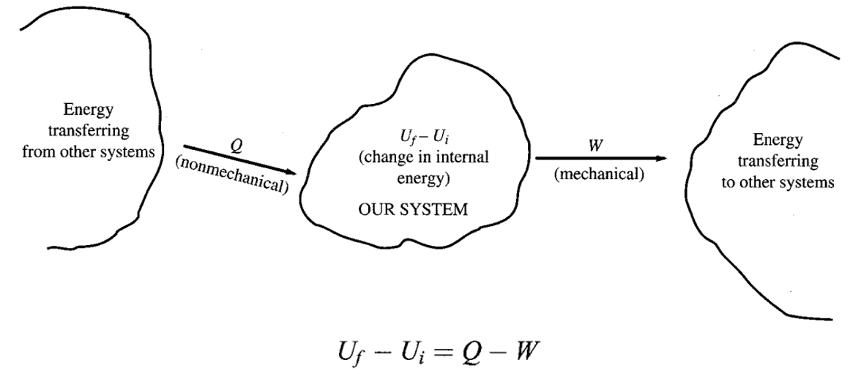
The first law of thermodynamics is the statement of the law of conservation of energy in its most general form. It presumes that the overall energy of the universe remains the same.

If Ui and Uf are the initial and final total internal energy of the system, respectively, at the beginning and at the end of the process, we must have

Where Q is the algebraic heat entering the system; and W is the algebraic work done by the system on the outside world during the same process.

In other words, energy can only shift from one system to another (by means of work and heat transfer), but the total energy of the universe stays fixed.

P-V DIAGRAM
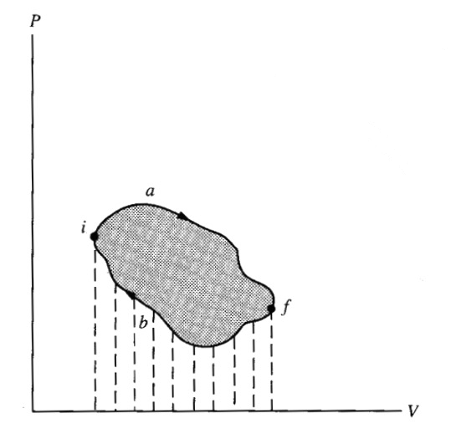
For a quasistatic process, the evolving states of the system can be tracked as a path on a P-V diagram. The work done by the system between the states i and f is the total area under the curve on the P-V diagram.

Reversing a given quasistatic path reverses the sign of the work done and the heat transferred.

QUASISTATIC PROCESSES
The quasistatic processes include a constant-volume (isochoric) process, a constant-pressure (isobaric) process, a constant-temperature (isothermal) process, and a process in which no heat enters or leaves the system (adiabatic process).

CYCLICAL PROCESS
A cyclical process may consist of the same of different quasistatic processes. In a cyclical process the work done is plus or minus the area enclosed by the closed cycle path on the P-V diagram.

ISOCHORIC PROCESS
In an isochoric process the work performed is zero. Therefore, the first law of thermodynamic may be expressed for an isochoric process as,

ISOBARIC PROCESS
The first law of thermodynamic may be expressed for an isochoric process as,

ISOTHERMAL PROCESS
For an ideal gas, in an isothermal process, the internal energy at every point along an isotherm is the same.

ADIABATIC PROCESS
For an adiabatic process the first law takes the form,

For an ideal gas undergoing the adiabatic process, pressure and volume are related by

CARNOT CYCLE
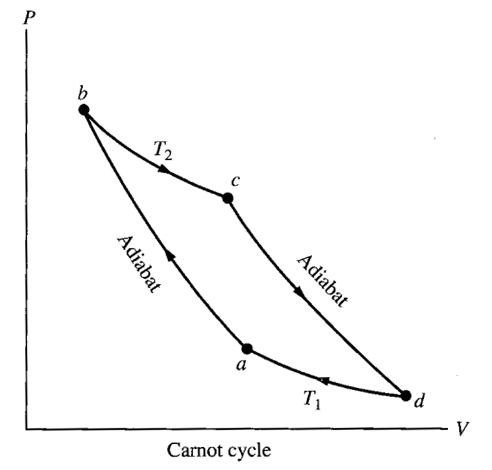
A Carnot cycle is a system undergoing a quasistatic cyclical process involving four legs, with two being isotherms and two being adiabats. Such a process is represented on the P-V diagram as follows:

THE SECOND LAW OF THERMODYNAMICS
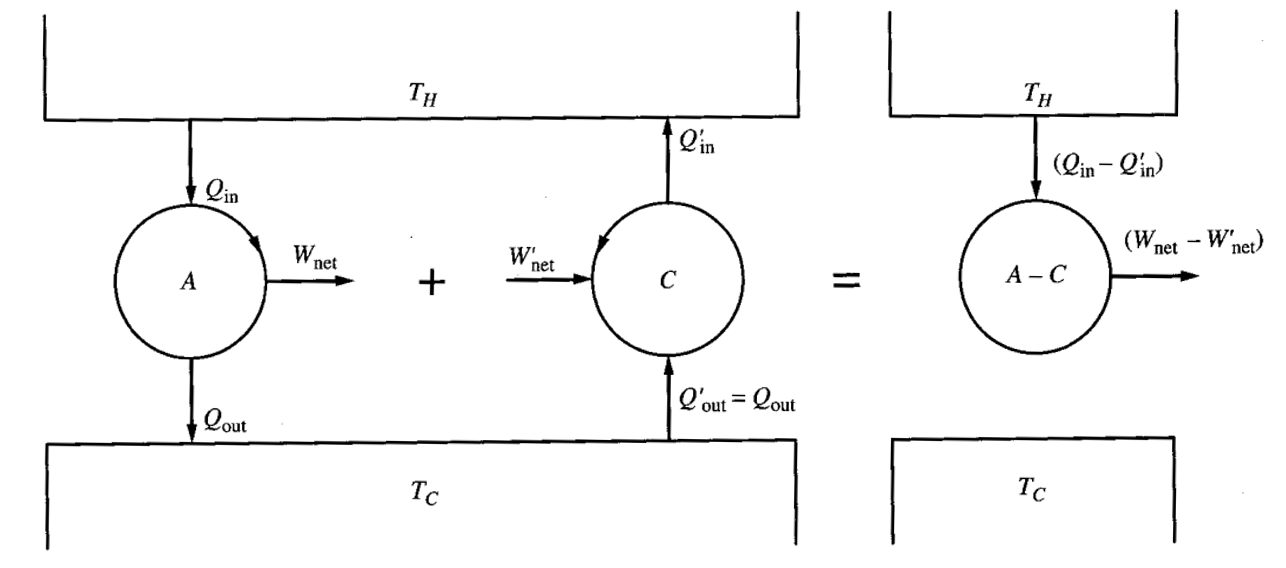
The second law of thermodynamics addresses the question of the feasibility of certain types of energy transfers. To accomplish the removal of thermal energy from a cool body and transfer it to a hot body requires an intermediary system called a refrigerator. To convert thermal energy to mechanical energy requires the services of an intermediary system called a heat engine. These intermediary systems effect the transfer that do not occur naturally. The second law is deeply connected to the concept of randomness, and therefore to the subject of statistical mechanics.

THE ENGINE STATEMENT OF THE SECOND LAW
“It Is Impossible for a cyclical process to have no other effect than to draw thermal energy from some system(s), and to convert it completely into mechanical energy.”

EFFICIENCY
The efficiency of any engine is defined as the ratio of mechanical energy obtained to the thermal energy extracted from the hot reservoir.

THE REFRIGERATOR STATEMENT OF THE SECOND LAW
“It is impossible for a cyclical process to have no other effect than to extract thermal energy from a cooler system and eject that thermal energy to a hotter system(s).”

CO-EFFICIENT OF PERFORMANCE
The co-efficient of performance of a refrigerator is defined as.

CARNOT ENGINE
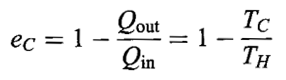
The second law implies that the most efficient engine operating between two fixed temperature reservoirs is a Carnot engine. The efficiency of a Carnot engine is,

OTTO CYCLE
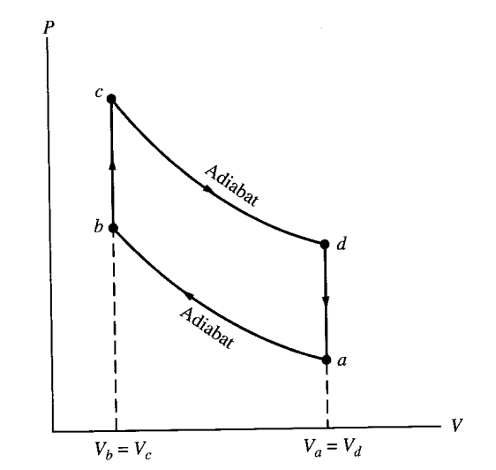
One cylinder of a gasoline engine can be idealized by a quasistatic engine called the Otto cycle, as shown below.

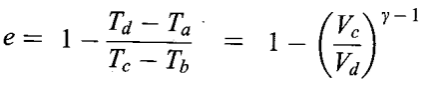
The efficiency of this cycle is,

COMPRESSION RATIO
The compression ratio is the ratio of the largest volume to the smallest volume of the engine cylinder as the piston moves in and out. The greater is the compression ratio, the more efficient is the engine.

ENTROPY
For every equilibrium state of a system there is a definite quantitative measure of the disorder of the system in that state. This quantitative measure assigns a value to each equilibrium state of the system, which is called entropy. The incremental change in the entropy of a system when a small amount of heat is slowly added, is

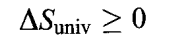
The second law of thermodynamics can be restated in terms of the overall entropy of the universe: In any process or interactions of systems, the overall entropy change of the universe obeys,

where the equality occurs only in the case of quasistatic processes.

ENTROPY OF THE SYSTEM
The macroscopic equilibrium state of a system corresponds to the most probable system state with its specific value of the number of ways that the microscopic variables can arrange themselves so as to produce the value of the macroscopic variables that characterize the equilibrium state. The entropy of the system is formally defined as,

where k is Boltzmann constant and Γ is the number of ways.

.

Physics I: Chapter 17

Reference: Beginning Physics I

CHAPTER 17: TRANSFER OF HEAT

.

KEY WORD LIST

Conduction, Conductors, Insulators, R-Factor, Convection, Radiation, Stefan-Boltzmann Law, Emissivity, Blackbody

.

GLOSSARY

For details on the following concepts, please consult CHAPTER 17.

CONDUCTION
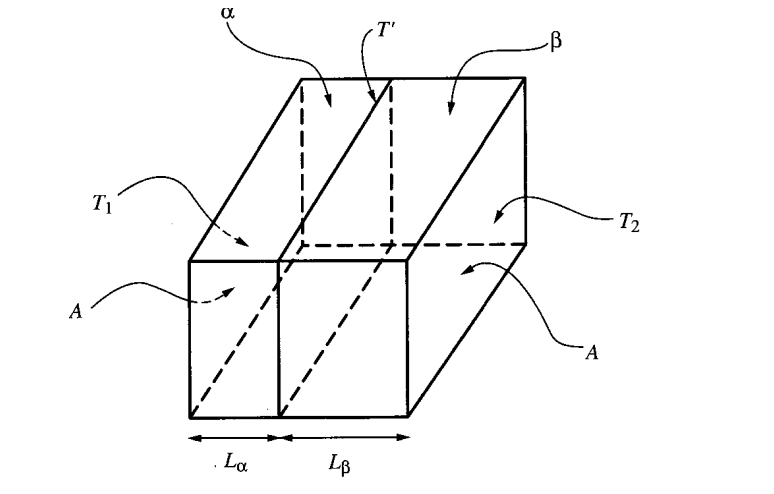
Heat conduction is the direct transfer of thermal energy from one layer of molecules to the next layer. The amount of transferred per unit time across a given cross section of a bar is directly proportional to the temperature difference and to the area and is inversely proportional to the length.

The proportionality constant in this equation is different for each material. It is called the coefficient of thermal conductivity (or conductivity, for short).

CONDUCTORS
Metals generally have larger conductivities than other solids and are therefore called good heat “conductors.”

INSULATORS
Materials that clearly don’t conduct heat well are called insulators.

R-FACTOR
The R-factor of a slab is its length divided by conductivity: R = L/k
Therefore, we have, H/A = ∆T/R, where R = R1 + R2 + R3

CONVECTION
Convection is a mechanism for the transfer of thermal energy that applies to fluids (liquids and gases). Unlike conduction, where there is no macroscopic migration of molecules, in convection the thermal energy is transferred by the motion of material from one place to another.

To a good approximation the rate of convective heat flow is proportional to the area of the contact surface and to the temperature difference between the surface and the bulk of the fluid away from the surface.

H = h A T

where h, the coefficient of convection, depends on the fluid, the geometry, and a variety of other factors (including a slight dependence on T).

If the circulation of the fluid is aided by a fan or pump, it is called forced convection. If the circulation is the consequence of the natural difference in density of the fluid (caused by a temperature difference) at different locations, it is called natural convection.

RADIATION
Radiation is a process that involves electromagnetic waves. Every substance at any temperature emits electromagnetic radiation, which carries energy with it. For a system to be in thermal equilibrium with its surroundings it must absorb as much radiation as it emits.

STEFAN-BOLTZMANN LAW
The total amount of radiation energy emitted per second from an object at uniform temperature and surface area is,

Where ϵ is a dimensionless constant, called the emissivity, with a value between 0 and 1 that varies from substance to substance; and σ is a universal constant called the Stefan-Boltzmann constant with the value

For an object at temperature T1 enclosed in a container with walls at temperature T2, the net rate of flow of thermal energy out of the object is

EMISSIVITY
The emissivity is a dimensionless constant with a value between 0 and 1 that varies from substance to substance. The emissivity is 1 for a good emitter. A good emitter is also a good absorber. At normal temperatures a good absorber-emitter appears black.

BLACKBODY
A perfect or ideal absorber-emitter (e = 1) is called a blackbody, but no real object is a perfect blackbody.

.

Physics I: Chapter 16

Reference: Beginning Physics I

CHAPTER 16: THERMODYNAMICS II: GAS LAWS, THE ATOMIC VIEW, AND STATISTICAL MECHANICS

.

KEY WORD LIST

Molecular Mass, Mole, Avogadro’s Number, Boltzmann Constant, Universal Gas Constant, Ideal Gas Law, Average Kinetic Energy, Mean Square Velocity, Internal Energy, Heat Capacity, Molar Heat Capacity, Equipartition of Energy, Statistical Mechanics, Law of Dulong and Petit

.

GLOSSARY

For details on the following concepts, please consult CHAPTER 16.

MOLECULAR MASS
A mass of any substance whose numerical value in grams is the same as its atomic or molecular mass is called a gram atomic or molecular mass of that substance.

MOLE
One gram atomic or molecular mass of any substance is called a mole of that substance.

AVOGADRO’S NUMBER (NA)
The number of atoms or molecules in a mole of any substance is this a universal constant called Avogadro’s Number.

BOLTZMANN CONSTANT (k)
This is a universal constant:           

k = 1.38 x 10⁻²³ J/(particle. K)

UNIVERSAL GAS CONSTANT (R)

R = NAk = 8.31 J / (mol . K)

IDEAL GAS LAW
For any confined diluted gas:        

PV = nRT

The result from the laws of statistical mechanics is

AVERAGE KINETIC ENERGY
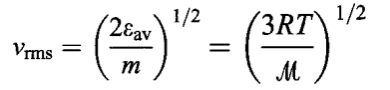
The average translational kinetic energy per molecule in a sample of ideal gas is

This gives a fundamental meaning to the concept of temperature.

MEAN SQUARE VELOCITY
The mean square velocity (v2)av is the average value of the square of the magnitude of velocity of the gas molecules.

At a given temperature the lighter molecules have greater velocities since the average kinetic energy is the same for all gases at a given temperature.

INTERNAL ENERGY (U)
In our infinitesimal “billiard ball” model of a monoatomic gas, the only energy is translational kinetic energy. Therefore, the internal energy is:

If we add some heat to our system, we must have,

HEAT CAPACITY (C)
Heat capacity is the total amount of heat needed to produce a degree rise in temperature. For a constant volume process,

MOLAR HEAT CAPACITY (cv)
The heat capacity per mole for an ideal gas at constant volume:

The heat capacity per mole for an ideal gas at constant pressure:

EQUIPARTITION OF ENERGY
These results, in which each degree of freedom that involves energy (with certain restrictions) contribute the same value (1/2 kT) to the average energy, are called the law of equipartition of energy.

STATISTICAL MECHANICS
Thermodynamics and statistical mechanics thus allowed for the indirect study of the physics of the realm of atoms and molecules, which lead to the realization that Newtonian mechanics does not apply in this realm. This in turn led to the formulation of the new “quantum” mechanics in the early twentieth century.

LAW OF DULONG AND PETIT
A study of the actual values of the molar heat capacities of crystalline solids at constant volume shows that at high temperatures they all have essentially the same molar heat capacity 3R (six degrees of freedom). But all real crystal solids have molar heat capacities that decrease to zero as the Kelvin temperature decreases to zero. This is because the assumption of Newtonian mechanics do not hold.

.

Physics I: Chapter 15

Reference: Beginning Physics I

CHAPTER 15: THERMODYNAMICS I: TEMPERATURE & HEAT

.

KEY WORD LIST

Macroscopic Systems, Thermodynamics, Quasistatic Systems, Thermodynamic Variables, Mechanical Equilibrium, Chemical Equilibrium, Thermal Equilibrium, Thermodynamic Equilibrium, Temperature, Zeroth Law of Thermodynamics, Thermometric Property, Celsius Scale, Ice Point, Steam Point, Fahrenheit Scale, Thermometer, Constant Volume Gas Thermometer, Kelvin Temperature Scale, Rankine Temperature Scale, Triple Point, Coefficient of Linear Expansion, Caloric, Thermal Energy, Heat, Internal Energy, Calorie, British Thermal Unit, Specific Heat, Heat Capacity, Calorimetry, Heat of Fusion, Heat of Vaporization, Heat of Sublimation, P-T Diagram, Evaporation

.

GLOSSARY

For details on the following concepts, please consult CHAPTER 15.

MACROSCOPIC SYSTEMS
These are large systems that are characterized by their having myriad atoms and/or molecules. They depend on the myriad random motions and interactions of the component atoms and molecules, rather than their lockstep behavior.

THERMODYNAMICS
Thermodynamics deals with macroscopic systems. More specifically, it deals with the relations between heat and other forms of energy (such as mechanical, electrical, or chemical energy), and, by extension, of the relationships between all forms of energy.

QUASISTATIC SYSTEMS
Quasistatic systems mean that they are in mechanical, chemical, and thermal equilibrium, or that their properties vary so slowly that they can be described at any instant as if in equilibrium.

THERMODYNAMIC VARIABLES
Thermodynamic variables (or macroscopic variables) are physical properties, such as, volume and internal energy, which describe the system as a whole. Most other thermodynamic variables, such as, pressure and temperature can be defined only if the system is quasistatic.

MECHANICAL EQUILIBRIUM
This is understood to mean not only that the system as a whole does not accelerate, but that within the system the different parts are in mechanical equilibrium with each other —no churning of fluids and no pressure imbalances.

CHEMICAL EQUILIBRIUM
A system in mechanical equilibrium may still undergo change through a chemical reaction. The system is in chemical equilibrium when there is no change in chemical composition taking place.

THERMAL EQUILIBRIUM
A system in mechanical and chemical equilibrium may still undergo change in temperature. Two objects in thermal equilibrium with each other are also said to be at the same temperature.

THERMODYNAMIC EQUILIBRIUM
A system that is in mechanical, chemical and thermal equilibrium with its surroundings, as well as internally is said to be in thermodynamic equilibrium. Thermodynamic equilibrium means that there is no change on the macroscopic level.

TEMPERATURE
Temperature is a numerical value that we assign to each thermal equilibrium state of a system as determined by some agreed-upon procedure.

ZEROTH LAW OF THERMODYNAMICS
If two systems A and B are each found to be in thermal equilibrium with a third system C, then when the two systems A and B are brought into contact with each other, they are themselves found to be in thermal equilibrium.

THERMOMETRIC PROPERTY
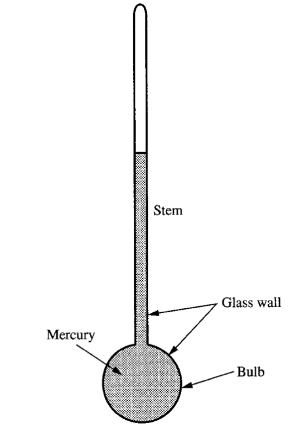
A thermometric property is a property that varies with the thermal equilibrium states in a well-defined and reproducible way. For example, mercury in a sealed hollow bulb attached to a long, thin hollow glass stem. When mercury expands or contracts with change in the thermal equilibrium state, small changes in its volume are observable from its height in the thin stem.

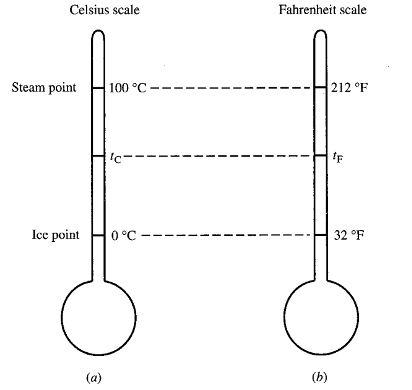
CELSIUS SCALE
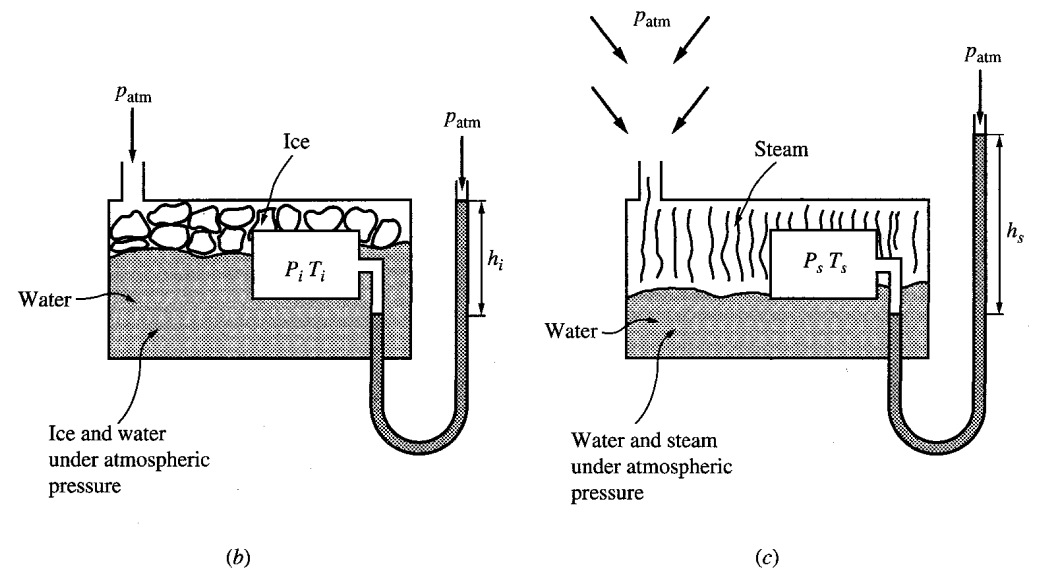
This is the most widely used temperature scale that assigns the number tC = 0°C for the ice point, and tC =100°C for steam point at atmospheric pressure. The distance between these two points is divided into 100 equal marked intervals labeled in 1°C steps.

ICE POINT
The point at which ice and water are in thermal equilibrium at atmospheric pressure.

STEAM POINT
The point at which steam, and water are in thermal equilibrium at atmospheric pressure.

FAHRENHEIT SCALE
On this scale the ice point and steam point are defined as tF = 32°F and tF = 212°F respectively, and the distance between these two points is divided into 180 equal marked intervals labeled in 1°F steps.

THERMOMETER
A thermometer is a temperature-calibrated mercury system, which can be used to measure the temperature of any other object. However, the temperature scale shall be dependent on the material being used to define it.

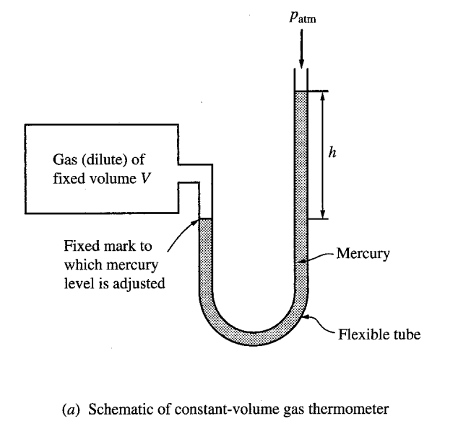
CONSTANT VOLUME GAS THERMOMETER
This thermometer consists of a gas confined to a fixed volume, with an open-tube manometer used to measure the pressure of the gas inside. Constant volume gas thermometer is often considered the “standard” against which other thermometers are calibrated.

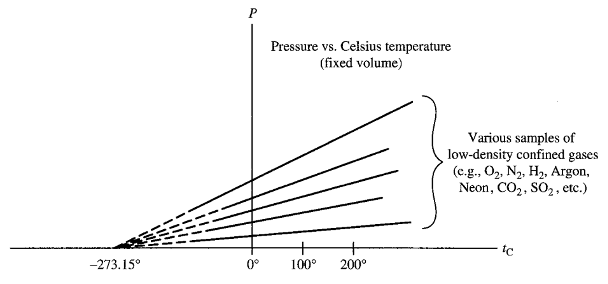
KELVIN TEMPERATURE SCALE
The graphs of pressure vs. temperature of all very low-density gases at fixed volumes are straight lines. When extrapolated these straight lines intersect the temperature axis at the same point: -273.15°C. On the basis of this result, one defines the Kelvin (or absolute) temperature scale. It is same as the Celsius Scale with its zero shifted to “-273.15°C”.

T = tC + 273.15

RANKINE TEMPERATURE SCALE
This is the Kelvin scale using the Fahrenheit degree rather than the Celsius degrees.

TR = tF + 459.67

TRIPLE POINT
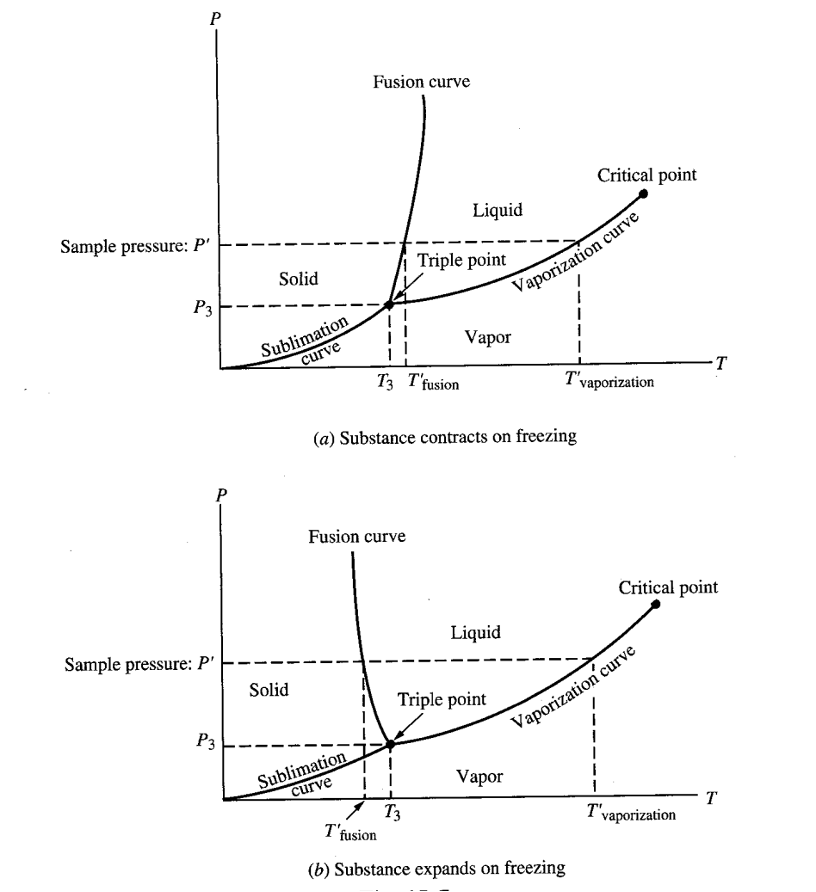
The triple point is the temperature, tC = 0.01°C, at which all three phases of water—solid, liquid, and vapor—coexist.

COEFFICIENT OF LINEAR EXPANSION
If we have a rod of length L at a given absolute temperature and we increase the temperature by a small amount ∆T, we find that the length of the rod increases b an amount ∆L that is proportional to the original length L and to the temperature increase ∆T:

L = a LT

The proportionality constant a is called the coefficient of linear expansion; it depends on the material of which the rod is made.

CALORIC
Early scientists believed that some invisible and weightless substance, which they called caloric, flows from a hotter to cooler object until both objects reach thermal equilibrium.

THERMAL ENERGY
It became clear through the efforts of Joule and others that it is not caloric but thermal energy that is transferred between two macroscopic systems in contact.

HEAT
Heat is the thermal energy transfer from one system to another. Heat is actually the statistical “summing up” of the mechanical work done by the random interactions of the individual atoms and molecules of the two systems.

INTERNAL ENERGY
Related to heat is the internal energy that resides in a system due to the random motion and jiggling of the myriad atoms and molecules making up that system.

CALORIE (CAL)
A calorie is defined as the “amount of heat” (thermal energy in transit) necessary (at atmospheric) to raise the temperature of 1 gram of water 1°C. 1 cal = 4.184 J

BRITISH THERMAL UNIT (BTU)
A Btu is the amount of heat necessary to raise 1 lb of water 1°F. The conversion is 1 Btu = 252 cal.

SPECIFIC HEAT (c)
The specific heat is the characteristic amount of heat that flows into a unit mass of a given substance and raises its temperature by 1°. For solids and liquids, heat is transferred under constant atmospheric pressure.

HEAT CAPACITY (C)
Heat capacity is the total amount of heat needed to produce a degree rise in temperature.

CALORIMETRY
Calorimetry is the experimental measurements of specific heats and other heat constants.

HEAT OF FUSION (Lf)
Heat of fusion is the amount of heat added to melt each unit mass of substance at the melting point (under normal atmospheric pressure).

HEAT OF VAPORIZATION (Lv)
Heat of vaporization is the amount of heat added to vaporize each unit mass of substance at the boiling point (under normal atmospheric pressure).

HEAT OF SUBLIMATION (Ls)
Heat of sublimation is the amount of heat added to sublimate each unit mass of substance at the sublimation point (under normal atmospheric pressure).

P-T DIAGRAM
The P-T diagram keeps track of phase changes. For a pure substance the diagram will resemble the following.

EVAPORATION
Evaporation takes place at the surface of the liquid in contact with a gas at a given pressure. At temperatures well below the boiling point, molecules from the liquid that are particularly energetic can break free and rise above the liquid to form a vapor. The evaporating molecules take away the thermal energy with them—on average the amount of energy per unit mass is the same order of magnitude as the heat of vaporization for boiling. Thus the evaporation process removes heat from the liquid, cooling it and anything in contact with it.

.