Category Archives: Science

Particle & Void

Per Newton’s Definition I:

DEFINITION I: The quantity of matter is the measure of the same, arising from its density and bulk conjunctly.

Thus air of a double density, in a double space, is quadruple in quantity; in a triple space, sextuple in quantity. The same thing is to be understood of snow, and fine dust or powders, that are condensed by compression or liquefaction and of all bodies that are by any causes whatever differently condensed. I have no regard in this place to a medium, if any such there is, that freely pervades the interstices between the parts of bodies. It is this quantity that I mean hereafter everywhere under the name of body or mass. And the same is known by the weight of each body; for it is proportional to the weight, as I have found by experiments on pendulums, very accurately made, which shall be shewn hereafter.

The quantity of matter depends on how densely its particles are packed in a volume of space. We think of particle as a body of solid matter that is shaped like a ball. According to Wikipedia:

“A particle is a small localized object to which can be ascribed several physical or chemical properties such as volume, density or mass.”

On atomic scale, the nucleus of an atom is a particle; and the rest of atom is void. On a cosmic scale, a celestial body is a particle, and the empty space is void. The void separates the particles, and exists in the interstices of matter. The void is continuous.

Void is defined as the region, which is void of matter. Other than that, void may consist of substance that is not matter A physical substance would be anything that is felt physically. A substance is characterized by force.

The essential characteristic of substance is force. When there is force, there is also substance.

.

The Atomic Particle & Void
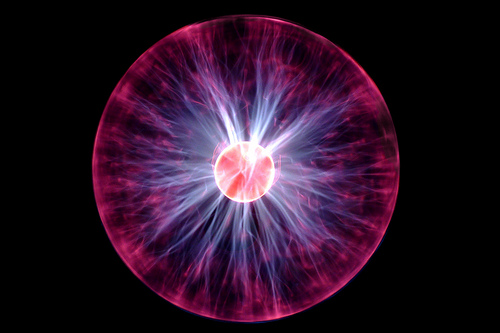
In his paper on Electrical Conduction & Nature of Matter Faraday explains that the property of electrical conductivity requires that atoms be in contact with each other. Therefore, the atomic void that separates the material nuclei must contain the characteristic of force. This indicates the presence of substance in the atomic void. There is no empty space in the atom.

In gases the atoms touch each other just as truly as in solids. In this respect the atoms of water touch each other whether that substance be in the form of ice, water or steam; no mere intervening space is present. Doubtless the centres of force vary in their distance one from another, but that which is truly the matter of one atom touches the matter of its neighbours.

To Faraday, the nuclei were the centers of the force that filled the void of the atom.

Hence matter will be continuous throughout, and in considering a mass of it we have not to suppose a distinction between its atoms and any intervening space. The powers around the centres give these centres the properties of atoms of matter; and these powers again, when many centres by their conjoint forces are grouped into a mass, give to every part of that mass the properties of matter. In such a view all the contradiction resulting from the consideration of electric insulation and conduction disappears.

Matter is substance concentrated in the nucleus, which then spreads out as the void. There is no such thing as empty space.

According to Faraday, the atomic void represents a substance of electromagnetic nature.

An atom consists of a force field that is converging toward the center while increasing in frequency. It gets extremely compacted at the center where it appear as mass of the nucleus. This electromagnetic force is a substance, and it needs to be recognized as such.

.

The Cosmic Particle & Void
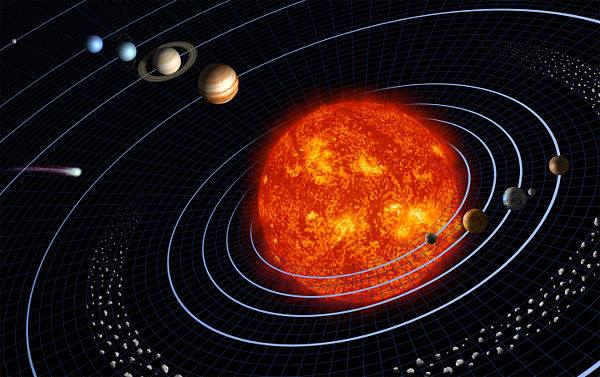
Substance in the cosmic void takes the form of radiation. In his paper on Thoughts on Ray Vibrations, Faraday proposes that the vibrations, by which radiant phenomena is recognized, may simply occur in the lines of force that fill the void.

The view which I am so bold to put forth considers, therefore, radiation as a kind of species of vibration in the lines of force which are known to connect particles and also masses of matter together. It endeavors to dismiss the aether, but not the vibration. The kind of vibration which, I believe, can alone account for the wonderful, varied, and beautiful phaenomena of polarization, is not the same as that which occurs on the surface of disturbed water, or the waves of sound in gases or liquids, for the vibrations in these cases are direct, or to and from the centre of action, whereas the former are lateral. It seems to me, that the resultant of two or more lines of force is in an apt condition for that action which may be considered as equivalent to a lateral vibration; whereas a uniform medium, like the aether, does not appear apt, or more apt than air or water.

This is a bold view put forth by Faraday. It dismisses aether of 19th century physicist but not vibration. These vibrations are direct or to and fro from the centers of action and not lateral like those on the surface of disturbed water, or the waves of sound in gases or liquids. The vibrations visualized by Faraday affected the very substance of space as they propagated through it. 

According to Faraday, the cosmic void represents substance of radiative nature.

Again, radiation is a substance, and it needs to be recognized as such.

.

The Substance of Particle and Void

In 1675, Newton first introduced his opinions regarding aether as follows:

A most subtle spirit which pervades all bodies by the force and action of which spirit the particles of bodies mutually attract one another, at near distances, and cohere, if contiguous;  and electric bodies operate at greater distances, as well repelling as attracting the neighbouring corpuscles; and light is emitted, reflected, refracted, inflected and heats bodies; and all sensation is excited, and the members of animal bodies move at the command of the will, namely, by the vibrations of this spirit, mutually propagated along the solid filaments of the nerves, from the outward organs of sense to the brain, and from the brain into the muscles.

Newton’s idea of aether and immovable space came about as a projection from the background of fixed stars, which he saw as relatively at rest,

Newton saw space to be filled with aetherial substance that was uniform and immovable.

The stars, however, appear to be fixed because of their immense distance and very large inertia. For aether to be immovable it must have infinite inertia. Faraday rejected the idea of aether and proposed radiation, defined by lines of force, to be the substance of space.

Faraday saw space to be filled with radiation that was varied and highly movable.

.

Summary

Faraday’s observations are amply proven by later discoveries. There is substance existing in the void in the form of electromagnetic force and radiation. Thus there is division of substance into matter and radiation.

There is no complete void.

.
The Background of Modern Physics

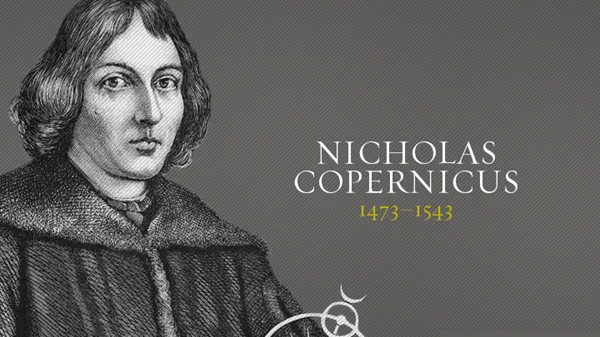
Copernicus (1473 – 1543)
Tycho Brahe (1546 – 1601)
Galileo Galilei (1564 – 1642)
Johannes Kepler (1571 – 1630)
René Descartes (1596 – 1650)
Robert Boyle (1627 – 1691)
Robert Hooke (1635 – 1703)
Christian Huygens (1629 – 1695)
Isaac Newton (1642 – 1726)

We start learning physics through mathematics that describes space and time in a material world. The mathematics uses the Cartesian coordinates, which assign continuity and uniformity to space and time. One learns to plot graphs of the relationships between space and time. These graphs describe the paths traced by moving particles of matter.

Matter appears in the form of particles because it is not continuous. Particle ends where void starts. The “void” is the empty space. Particles occupy space by displacing the void.  Particles move in the void. They have certain uniform velocities. These particles accelerate when pushed and their velocities change. When the force of the push goes away the velocity becomes uniform again.

We study the motion of particles in straight lines and in circles and spirals. This requires the consideration of more than one dimension of space. We consider motion to be relative because we can’t image a particle being at absolute rest. We find this subject of mechanics thoroughly explored by Newton, and so we study Newton’s Laws of Motion.

The background of modern physics started with simple concepts of void, particle, motion and force.

These concepts seem to model the big picture of the cosmos adequately, where the laws of motion apply to the satellites, planets and stars in the huge void. With a little modification, these concepts also appear to model the phenomenon of heat. This brings us to the laws of thermodynamics. Furthermore, these concepts are employed to explain the phenomena of sound, light, electricity, and magnetism . We see them used even in the explanation of atomic, nuclear and quantum phenomenon. In the succeeding chapters we shall review these basic concepts.

Physics is characterized by the scientific method, which started with Galileo. This method uses experiements and mathematics to establish consistency between theory and reality. The scientific method starts with certain postulates and assumptions. New discoveries are made when we examine past assumptions and improve upon them. This is where logic comes in.

This work stresses upon that logic.

.

A Geometry for Outer Space

From Newton’s Principia, page 77 (pdf 83)

II. Absolute space, in its own nature, without regard to anything external, remains always similar and immovable. Relative space is some movable dimension or measure of the absolute spaces; which our senses determine by its position to bodies; and which is vulgarly taken for immovable space; such is the dimension of a subterraneous, an aereal, or celestial space, determined by its position in respect of the earth. Absolute and relative space, are the same in figure and magnitude; but they do not remain always numerically the same. For if the earth, for instance, moves, a space of our air, which relatively and in respect of the earth remains always the same, will at one time be one part of the absolute space into which the air passes ; at another time it will be another part of the same, and so, absolutely understood, it will be perpetually mutable.

Newton made the assumption that space is immovable. But space is absence of matter, and it cannot be assigned such a characteristic as immovability. So there are no positions in space that are automatically fixed. The only thing fixed in space is a theoretical object of infinite mass. The fixity of the location of any other object shall be proportional to its mass (see Motion & Force).

So earth, moon and sun have locations in space with uncertainties attached to them according to their fixity. We may project abstract positions using these locations, such as, a position half-way between the earth and the moon. A projected position shall have uncertainty depending on the actual reference locations.

The location of an abstract position far from any mass shall be totally uncertain. This gives us a new non-Euclidean geometry.

This subject may be called “space geometry”. The uniform absolute speed of a body shall determine the uncertainty associated with its location in space geometry. The distance between two locations shall be determined by the difference in the uncertainties of those locations. Two locations with similar uncertainties shall be at equal distance from the location to no uncertainty.

The gravitational field around a body shall be defined by increasing uncertainties of positions around it.

This geometry shall be based on a universal constant that establishes the absolute motion of a body and the uncertainty of its location. The absolute velocity and mass of a body, or a system, may change but the absolute motion of the body, or the system, shall remain constant.

The “Particles in Void” Framework

ReferenceA Logical Approach to Theoretical Physics

Here is an interesting commentary on the logical framework of physics [Continuity and the Void” by Kevin Brown].

Several early Greek philosophers, including Democritus, imagined the universe as consisting of a multitude of irreducible particles moving in an empty void. On the other hand, Aristotle (c. 350 BC) denied the existence of a “void” (a region of space containing no substance), believing instead that the universe is filled continuously with substance… From this point of view it’s possible for a continuous substance to possess variable density, so the compressibility of air does not imply the existence of empty spaces.

The modern physics is based on the “particles in void” framework. It does not believe that the universe is filled continuously with substance.

“Particles” represent isolated bits of matter that are separated by void. Therefore, there is no continuity among the particles. They are never directly in contact.

Particles have properties that we may perceive. But void is perceived only as a gap among particles. Void has no properties of its own that may be perceived.

There is nothing that continues across the boundary between a particle and void except for geometry. The measures of geometry exist even when there is no substance to measure. Therefore, any possibility of continuum of substance is replaced by geometry in the “particles in void” framework.

Common to particles and void is the mathematical abstraction of geometry.

.

Geometry

Astronomy considers stars and planets as point particles in the sky separated by vast distances. The obvious relationship among them is provided by Geometry. The other consideration is the motion of the moon around the earth, and planets around the sun, which requires the presence of some kind of force between them.

The success of Newton’s universal law of gravity raised the importance of geometry and mathematics, and established “particles in void” as the logical framework of physics. But with this framework arose the problem of “action at a distance”. It required the presence of some mechanism in the void.

This revived the concept of aether as the substance, which permeated the void. Newton wrote [Newton’s Principia” (1686) Translation by Andrew Motte, American edition of 1846, p. 26]:

A most subtle spirit which pervades all bodies…by the force and action of which spirit the particles of bodies mutually attract one another, at near distances, and cohere, if contiguous; and electric bodies operate at greater distances, as well repelling as attracting the neighbouring corpuscles; and light is emitted, reflected, refracted, inflected and heats bodies; and all sensation is excited, and the members of animal bodies move at the command of the will, namely, by the vibrations of this spirit, mutually propagated along the solid filaments of the nerves, from the outward organs of sense to the brain, and from the brain into the muscles.

But the possibility of aether and its actual nature was yet to be corroborated with reality.

Geometry alone could not explain how force got communicated across the void. It then led to the postulate of aether as a substance permeating the void.

.

Electricity and Magnetism

The phenomena of electricity and magnetism were being studied extensively during the 18th and 19th centuries. During this period the atomic theory was being used to explain the chemical structure of matter. The phenomena of electricity and magnetism seemed to explain how force was communicated through the void between atoms.

From his experimental investigation into electricity and magnetism, Faraday formed the view [A speculation touching Electrical Conduction and the Nature of Matter” by Michael Faraday (1844), Philosophical Magazine and Journal of Science, Vol. XXIV, p. 136] that an atom is not a supposed little hard particle separate from the powers around it. An atom is constituted of the powers it has, and it extends as far as its powers extend.

… where is there the least ground (except in a gratuitous assumption) for imagining a difference in kind between the nature of that space midway between the centres of two contiguous atoms and any other spot between these centres? a difference in degree, or even in the nature of the power consistent with the law of continuity, I can admit, but the difference between a supposed little hard particle and the powers around it I cannot imagine…

Hence matter will be continuous throughout, and in considering a mass of it we have not to suppose a distinction between its atoms and any intervening space. The powers around the centres give these centres the properties of atoms of matter; and these powers again, when many centres by their conjoint forces are grouped into a mass, give to every part of that mass the properties of matter. In such a view all the contradiction resulting from the consideration of electric insulation and conduction disappears.

Thus, in matter the atoms touch each other and there is no void among them.

But is there a similar situation with the bodies in the heavens? Do these bodies touch each other with their power of gravity that is extended as aether?

.

Light and Gravity

The phenomena of light and gravity were studied extensively by Newton himself in the 17th century. This study was carried forward in 18th and 19th centuries, but no connection was ever made between light and gravity.

Faraday, however, stated the following [Thoughts on Ray Vibrations”, Lecture by Michael Faraday (1846),  Experimental Researches in Electricity, Vol III, M. Faraday, p447-452]:

The view which I am so bold to put forth considers, therefore, radiation as a kind of species of vibration in the lines of force which are known to connect particles and also masses of matter together. It endeavors to dismiss the aether, but not the vibration …

The aether is assumed as pervading all bodies as well as space: in the view now set forth, it is the forces of the atomic centres which pervade (and make) all bodies, and also penetrate all space. As regards space, the difference is, that the aether presents successive parts of centres of action, and the present supposition only lines of action; as regards matter, the difference is, that the aether lies between the particles and so carries on the vibrations, whilst as respects the supposition, it is by the lines of force between the centres of the particles that the vibration is continued.

According to Faraday, there was no separate substance, such as, aether. Matter itself extended as lines of force filling all space between the material bodies. Radiation was the vibrations in these lines of force.

Faraday looked at radiation, such as, light, to be the extension that carried the force of matter.

In short, the idea of “void” was unsustainable. First, the theoretical concept of “aether”, and then, a more realistic idea of “force carrying radiation” were simply the attempts to discover the nature of “space”, which was thought to be void of matter.

.

Preface: Physics Book (old)

See UNIVERSE: Basic Definitions

It has been a while since any major contribution has been made to physical sciences in terms of fundamental theoretical research. It has not been easy to examine physical phenomena at the atomic levels. There are more mathematical explanations than real explanations in modern scientific investigations.

Newton used mathematics to “describe” the void, which could not be realistically described. Maxwell used mathematics to “describe” aether, which was postulated by the wave theory of light. Einstein used mathematics to “describe” space and time in an effort to explain gravity. The increasing use of mathematics in quantum mechanics and particle physics has only resulted in further losing touch with reality.

Although Newtonian mechanics, Maxwell’s Electromagnetic theory, Einstein’s theory of Relativity, and now Quantum mechanics and Particle physics predict remarkably verifiable results in selected areas, they are not integrated enough to predict verifiable results for all physical phenomena.

The very fact that the fundamental theories of physics cannot be reconciled indicates that there are basic assumptions underlying physics that are inconsistent with reality.

The subject of physics started out considering material substance moving in a complete void. It stumbled over the question: “How do material objects influence each other across the void?” Any influence requires contact. The void does not allow any contact.

From the study of electricity and magnetism arose the idea of invisible force fields that could transmit force. This idea of field has changed considerably from Faraday’s lines of force to the abstract mathematical objects of quantum physics. But the interaction between matter and void has yet to be described realistically without using the prop of mathematical symbolism.

This book is written on the premise that physics is taking certain concepts for granted, which needs to be examined more closely.

The subject of physics started out with the consideration that there is matter existing in a void. Therefore, the first two concepts that need to be examined more closely are matter and void.

The Part I of this book traces the discoveries in the subject of physical sciences. Part II then looks at this subject for assumptions.

[NOTE: This is a work in progress.]

.