Category Archives: Science

Einstein 1938: Vectors

Reference: Evolution of Physics

This paper presents Chapter I, section 3 from the book THE EVOLUTION OF PHYSICS by A. EINSTEIN and L. INFELD. The contents are from the original publication of this book by Simon and Schuster, New York (1942).

The paragraphs of the original material (in black) are accompanied by brief comments (in color) based on the present understanding.  Feedback on these comments is appreciated.

The heading below is linked to the original materials.

.

Vectors

All motions we have been considering are rectilinear, that is, along a straight line. Now we must go one step farther. We gain an understanding of the laws of nature by analyzing the simplest cases and by leaving out of our first attempts all intricate complications. A straight line is simpler than a curve. It is, however, impossible to be satisfied with an understanding of rectilinear motion alone. The motions of the moon, the earth and the planets, just those to which the principles of mechanics have been applied with such brilliant success, are motions along curved paths. Passing from rectilinear motion to motion along a curved path brings new difficulties. We must have the courage to overcome them if we wish to understand the principles of classical mechanics which gave us the first clues and so formed the starting-point for the development of science.

Rectilinear motion is a special case of curvilinear motion.

Let us consider another idealized experiment, in which a perfect sphere rolls uniformly on a smooth table. We know that if the sphere is given a push, that is, if an external force is applied, the velocity will be changed. Now suppose that the direction of the blow is not, as in the example of the cart, in the line of motion, but in a quite different direction, say, perpendicular to that line. What happens to the sphere? Three stages of the motion can be distinguished: the initial motion, the action of the force, and the final motion after the force has ceased to act. According to the law of inertia, the velocities before and after the action of the force are both perfectly uniform. But there is a difference between the uniform motion before and after the action of the force: the direction is changed. The initial path of the sphere and the direction of the force are perpendicular to each other. The final motion will be along neither of these two lines, but somewhere between them, nearer the direction of the force if the blow is a hard one and the initial velocity small, nearer the original line of motion if the blow is gentle and the initial velocity great. Our new conclusion, based on the law of inertia, is: in general the action of an external force changes not only the speed but also the direction of the motion. An understanding of this fact prepares us for the generalization introduced into physics by the concept of vectors.

We need to look at inertia as an internal force that works to restore the natural velocity of the body.

We can continue to use our straightforward method of reasoning. The starting-point is again Galileo’s law of inertia. We are still far from exhausting the consequences of this valuable clue to the puzzle of motion.

Let us consider two spheres moving in different directions on a smooth table. So as to have a definite picture, we may assume the two directions perpendicular to each other. Since there are no external forces acting, the motions are perfectly uniform. Suppose, further, that the speeds are equal, that is, both cover the same distance in the same interval of time. But is it correct to say that the two spheres have the same velocity? The answer can be yes or no! If the speedometers of two cars both show forty miles per hour, it is usual to say that they have the same speed or velocity, no matter in which direction they are travelling. But science must create its own language, its own concepts, for its own use. Scientific concepts often begin with those used in ordinary language for the affairs, of everyday life, but they develop quite differently. They are transformed and lose the ambiguity associated with them in ordinary language, gaining in rigorousness so that they may be applied to scientific thought.

From the physicist’s point of view it is advantageous to say that the velocities of the two spheres moving in different directions are different. Although purely a matter of convention, it is more convenient to say that four cars travelling away from the same traffic roundabout on different roads do not have the same velocity even though the speeds, as registered on the speedometers, are all forty miles per hour. This differentiation between speed and velocity illustrates how physics, starting with a concept used in everyday life, changes it in a way which proves fruitful in the further development of science.
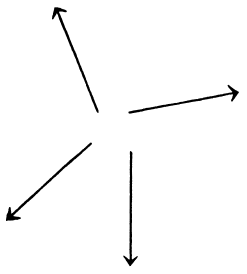
Science introduces the word velocity to account for both speed and the direction of motion.

If a length is measured, the result is expressed as a number of units. The length of a stick may be 3 ft. 7 in.; the weight of some object 2 lb. 3 oz.; a measured time interval so many minutes or seconds. In each of these cases the result of the measurement is expressed by a number. A number alone is, however, insufficient for describing some physical concepts. The recognition of this fact marked a distinct advance in scientific investigation. A direction as well as a number is essential for the characterization of a velocity, for example. Such a quantity, possessing both magnitude and direction, is called a vector. A suitable symbol for it is an arrow. Velocity may be represented by an arrow or, briefly speaking, by a vector whose length in some chosen scale of units is a measure of the speed, and whose direction is that of the motion.

Mathematics introduces the word vector for a quantity possessing both magnitude and direction.

If four cars diverge with equal speed from a traffic roundabout, their velocities can be represented by four vectors of the same length, as seen from our last drawing. In the scale used, one inch stands for 40 mph. In this way any velocity may be denoted by a vector, and conversely, if the scale is known, one may ascertain the velocity from such a vector diagram.

If two cars pass each other on the highway and their speedometers both show 40 mph, we characterize their velocities by two different vectors with arrows pointing in opposite directions. So also the arrows indicating “uptown” and “downtown” subway trains in New York must point in opposite directions. But all trains moving uptown at different stations or on different avenues with the same speed have the same velocity, which may be represented by a single vector. There is nothing about a vector to indicate which stations the train passes or on which of the many parallel tracks it is running. In other words, according to the accepted convention, all such vectors, as drawn below, may be regarded as equal; they lie along the same or parallel lines, are of equal length, and finally, have arrows pointing in the same direction.

The next figure shows vectors all different, because they differ either in length or direction, or both. The same four vectors may be drawn in another way, in which they all diverge from a common point. Since the starting-point does not matter, these vectors can represent the velocities of four cars moving away from the same traffic roundabout, or the velocities of four cars in different parts of the country travelling with the indicated speeds in the indicated directions.
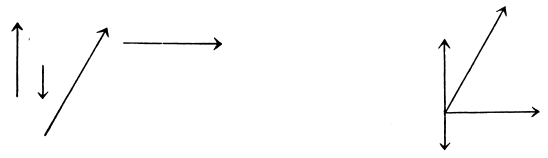
The consideration of vector is geometrical.

This vector representation may now be used to describe the facts previously discussed concerning rectilinear motion. We talked of a cart, moving uniformly in a straight line and receiving a push in the direction of its motion which increases its velocity. Graphically this may be represented by two vectors, a shorter one denoting the velocity before the push and a longer one in the same direction denoting the velocity after the push. The meaning of the dotted vector is clear; it represents the change in velocity for which, as we know, the push is responsible. For the case where the force is directed against the motion, where the motion is slowed down, the diagram is somewhat different. Again the dotted vector corresponds to a change in velocity, but in this case its direction is different. It is clear that not only velocities themselves but also their changes are vectors. But every change in velocity is due to the action of an external force; thus the force must also be represented by a vector. In order to characterize a force it is not sufficient to state how hard we push the cart; we must also say in which direction we push. The force, like the velocity or its change, must be represented by a vector and not by a number alone. Therefore: the external force is also a vector, and must have the same direction as the change in velocity. In the two drawings the dotted vectors show the direction of the force as truly as they indicate the change in velocity.

Not only the velocity, but the change in velocity, and the force responsible for that change, are also vectors.

Here the sceptic may remark that he sees no advantage in the introduction of vectors. All that has been accomplished is the translation of previously recognized facts into an unfamiliar and complicated language. At this stage it would indeed be difficult to convince him that he is wrong. For the moment he is, in fact, right. But we shall see that just this strange language leads to an important generalization in which vectors appear to be essential.

The concept of vector is essential for further development of this subject.

.

Final Comment

The path of any particle is curvilinear; but as inertia decreases and radius increases the natural path and velocity of the particle becomes more rectilinear. A velocity accounts for both speed and direction of the particle. Mathematics introduces the word vector for a quantity possessing both magnitude and direction. Force is also a vector.

An external force may change the particle’s speed and direction, but its mass (inertia) will try to restore it back to its original speed and direction.

LAW OF INERTIA: Inertia is the internal force that resides in the particle. This internal force is continuous, whereas, the external forces are intermittent. Therefore, this internal force prevails in the long run. Inertia not only keeps the motion uniform but it also brings the uniform velocity in balance with the mass.

.

Einstein 1938: The First Clue

Reference: Evolution of Physics

This paper presents Chapter I, section 2 from the book THE EVOLUTION OF PHYSICS by A. EINSTEIN and L. INFELD. The contents are from the original publication of this book by Simon and Schuster, New York (1942).

The paragraphs of the original material (in black) are accompanied by brief comments (in color) based on the present understanding.  Feedback on these comments is appreciated.

The heading below is linked to the original materials.

.

The First Clue

Attempts to read the great mystery story are as old as human thought itself. Only a little over three hundred years ago, however, did scientists begin to understand the language of the story. Since that time, the age of Galileo and Newton, the reading has proceeded rapidly. Techniques of investigation, systematic methods of finding and following clues, have been developed. Some of the riddles of nature have been solved, although many of the solutions have proved temporary and superficial in the light of further research.

Science really took off three hundred years ago with the age of Galileo and Newton.

A most fundamental problem, for thousands of years wholly obscured by its complications, is that of motion. All those motions we observe in nature that of a stone thrown into the air, a ship sailing the sea, a cart pushed along the street are in reality very intricate. To understand these phenomena it is wise to begin with the simplest possible cases, and proceed gradually to the more complicated ones. Consider a body at rest, where there is no motion at all. To change the position of such a body it is necessary to exert some influence upon it, to push it or lift it, or let other bodies, such as horses or steam engines, act upon it. Our intuitive idea is that motion is connected with the acts of pushing, lifting or pulling. Repeated experience would make us risk the further statement that we must push harder if we wish to move the body faster. It seems natural to conclude that the stronger the action exerted on a body, the greater will be its speed. A four-horse carriage goes faster than a carriage drawn by only two horses. Intuition thus tells us that speed is essentially connected with action.

A fundamental problem is motion. Intuition tells us that push is needed to generate motion from a position of rest. The harder is the push the greater is the speed.

It is a familiar fact to readers of detective fiction that a false clue muddles the story and postpones the solution. The method of reasoning dictated by intuition was wrong and led to false ideas of motion which were held for centuries. Aristotle’s great authority throughout Europe was perhaps the chief reason for the long belief in this intuitive idea. We read in the Mechanics, for two thousand years attributed to him:

The moving body comes to a standstill when the force which pushes it along can no longer so act as to push it.

The discovery and use of scientific reasoning by Galileo was one of the most important achievements in the history of human thought, and marks the real beginning of physics. This discovery taught us that intuitive conclusions based on immediate observation are not always to be trusted, for they sometimes lead to the wrong clues.

Aristotle observed that the default motion of an object was to be at rest when it was not being pushed or pulled.

But where does intuition go wrong? Can it possibly be wrong to say that a carriage drawn by four horses must travel faster than one drawn by only two?

Let us examine the fundamental facts of motion more closely, starting with simple everyday experiences familiar to mankind since the beginning of civilization and gained in the hard struggle for existence.

Suppose that someone going along a level road with a pushcart suddenly stops pushing. The cart will go on moving for a short distance before coming to rest. We ask: how is it possible to increase this distance? There are various ways, such as oiling the wheels, and making the road very smooth. The more easily the wheels turn, and the smoother the road, the longer the cart will go on moving. And just what has been done by the oiling and smoothing? Only this: the external influences have been made smaller. The effect of what is called friction has been diminished, both in the wheels and between the wheels and the road. This is already a theoretical interpretation of the observable evidence, an interpretation which is, in fact, arbitrary. One significant step farther and we shall have the right clue. Imagine a road perfectly smooth, and wheels with no friction at all. Then there would be nothing to stop the cart, so that it would run for ever. This conclusion is reached only by thinking of an idealized experiment, which can never be actually performed, since it is impossible to eliminate all external influences. The idealized experiment shows the clue which really formed the foundation of the mechanics of motion.

The object comes to rest by default because of external friction. In the absence of external friction the object keeps moving.

Comparing the two methods of approaching the problem, we can say: the intuitive idea is the greater the action, the greater the velocity. Thus the velocity shows whether or not external forces are acting on a body. The new clue found by Galileo is: if a body is neither pushed, pulled, nor acted on in any other way, or, more briefly, if no external forces act on a body, it moves uniformly, that is, always with the same velocity along a straight line. Thus, the velocity does not show whether or not external forces are acting on a body. Galileo’s conclusion, the correct one, was formulated a generation later by Newton as the law of inertia. It is usually the first thing about physics which we learn by heart in school, and some of us may remember it:

Every body perseveres in its state of rest, or of uniform motion in a right line, unless it is compelled to change that state by forces impressed thereon.

Inertia of the body maintains its uniform state of motion. External forces interrupt and change that motion. But what is inertia?

We have seen that this law of inertia cannot be derived directly from experiment, but only by speculative thinking consistent with observation. The idealized experiment can never be actually performed, although it leads to a profound understanding of real experiments.

From the variety of complex motions in the world around us we choose as our first example uniform motion. This is the simplest, because there are no external forces acting. Uniform motion can, however, never be realized; a stone thrown from a tower, a cart pushed along a road can never move absolutely uniformly because we cannot eliminate the influence of external forces.

Today we can eliminate the external forces completely by doing the experiment in outer space.

In a good mystery story the most obvious clues often lead to the wrong suspects. In our attempts to understand the laws of nature we find, similarly, that the most obvious intuitive explanation is often the wrong one.

Human thought creates an ever-changing picture of the universe. Galileo’s contribution was to destroy the intuitive view and replace it by a new one. This is the significance of Galileo’s discovery.

But a further question concerning motion arises immediately. If the velocity is no indication of the external forces acting on a body, what is? The answer to this fundamental question was found by Galileo and still more concisely by Newton, and forms a further clue in our investigation.

To find the correct answer we must think a little more deeply about the cart on a perfectly smooth road. In our idealized experiment the uniformity of the motion was due to the absence of all external forces. Let us now imagine that the uniformly moving cart is given a push in the direction of the motion. What happens now? Obviously its speed is increased. Just as obviously, a push in the direction opposite to that of the motion would decrease the speed. In the first case the cart is accelerated by the push, in the second case decelerated, or slowed down. A conclusion follows at once: the action of an external force changes the velocity. Thus not the velocity itself but its change is a consequence of pushing or pulling. Such a force either increases or decreases the velocity according to whether it acts in the direction of motion or in the opposite direction. Galileo saw this clearly and wrote in his Two New Sciences:

… any velocity once imparted to a moving body will be rigidly maintained as long as the external causes of acceleration or retardation are removed, a condition which is found only on horizontal planes; for in the case of planes which slope downwards there is already present a cause of acceleration; while on planes sloping upwards there is retardation; from this it follows that motion along a horizontal plane is perpetual; for, if the velocity be uniform, it cannot be diminished or slackened, much less destroyed.

If the velocity is changing, then a force is acting on the body. When the force is removed, the last velocity is rigidly maintained. Can we make the value of uniform velocity anything we want? Isn’t this something arbitrary?

By following the right clue we achieve a deeper understanding of the problem of motion. The connection between force and the change of velocity and not, as we should think according to our intuition, the connection between force and the velocity itself is the basis of classical mechanics as formulated by Newton.

We have been making use of two concepts which play principal roles in classical mechanics: force and change of velocity. In the further development of science both of these concepts are extended and generalized. They must, therefore, be examined more closely.

Force and change in velocity are the keynotes of classical mechanics.

What is force? Intuitively, we feel what is meant by this term. The concept arose from the effort of pushing, throwing or pulling from the muscular sensation accompanying each of these acts. But its generalization goes far beyond these simple examples. We can think of force even without picturing a horse pulling a carriage! We speak of the force of attraction between the sun and the earth, the earth and the moon, and of those forces which cause the tides. We speak of the force by which the earth compels ourselves and all the objects about us to remain within its sphere of influence, and of the force with which the wind makes waves on the sea, or moves the leaves of trees. When and where we observe a change in velocity, an external force, in the general sense, must be held responsible. Newton wrote in his Principia:

An impressed force is an action exerted upon a body, in order to change its state, either of rest, or of moving uniformly forward in a right line.

This force consists in the action only; and remains no longer in the body, when the action is over. For a body maintains every new state it acquires, by its vis inertiae only. Impressed forces are of different origins; as from percussion, from pressure, from centripetal force.

Is this statement true: “For a body maintains every new state it acquires, by its vis inertiae only.” Can we make a body uniformly moving at any velocity we want?

If a stone is dropped from the top of a tower its motion is by no means uniform; the velocity increases as the stone falls. We conclude: an external force is acting in the direction of the motion. Or, in other words : the earth attracts the stone. Let us take another example. What happens when a stone is thrown straight upward? The velocity decreases until the stone reaches its highest point and begins to fall. This decrease in velocity is caused by the same force as the acceleration of a falling body. In one case the force acts in the direction of the motion, in the other case in the opposite direction. The force is the same, but it causes acceleration or deceleration according to whether the stone is dropped or thrown upward.

The definition of force seems to be evolving still. Please see the final comments below.

.

Final Comment

A more fundamental problem than motion is the recognition of substance. Substance precedes motion because there cannot be motion with nothing to move. This substance was assumed to be matter. But we attribute velocity to light without recognizing there is a substance that is moving. Substance is sensed because it has inertia (internal force). Inertia balances motion. The velocity of light is finite because it has inertia. Light is perceived as energy. The concept of “energy” includes both inertia and motion.

In other words, inertia is the core characteristic of substance. Not only is there external force, but there is also the internal force (inertia) that influences the motion of the body. Light has internal force because it can be observed upon impact.

Scientific reasoning tells us that beyond making the motion uniform, the internal force must also determine the magnitude of that uniform velocity. Thus the new velocity induced by external forces is not rigidly maintained as stated by Newton’s laws of motion. The uniform velocity most likely adjusts itself to a value in balance with the mass (inertia) of the body, when there are no external forces.

.

Einstein 1938: The Great Mystery Story

Reference: Evolution of Physics

This paper presents Chapter I, section1 from the book THE EVOLUTION OF PHYSICS by A. EINSTEIN and L. INFELD. The contents are from the original publication of this book by Simon and Schuster, New York (1942).

The paragraphs of the original material (in black) are accompanied by brief comments (in color) based on the present understanding.  Feedback on these comments is appreciated.

The heading below is linked to the original materials.

.

The Great Mystery Story

In imagination there exists the perfect mystery story. Such a story presents all the essential clues, and compels us to form our own theory of the case. If we follow the plot carefully, we arrive at the complete solution for ourselves just before the author’s disclosure at the end of the book. The solution itself, contrary to those of inferior mysteries, does not disappoint us; moreover, it appears at the very moment we expect it.

Can we liken the reader of such a book to the scientists, who throughout successive generations continue to seek solutions of the mysteries in the book of nature? The comparison is false and will have to be abandoned later, but it has a modicum of justification which may be extended and modified to make it more appropriate to the endeavour of science to solve the mystery of the universe.

This great mystery story is still unsolved. We cannot even be sure that it has a final solution. The reading has already given us much; it has taught us the rudiments of the language of nature; it has enabled us to understand many of the clues, and has been a source of joy and excitement in the oftentimes painful advance of science. But we realize that in spite of all the volumes read and understood we are still far from a complete solution, if, indeed, such a thing exists at all. At every stage we try to find an explanation consistent with the clues already discovered. Tentatively accepted theories have explained many of the facts, but no general solution compatible with all known clues has yet been evolved. Very often a seemingly perfect theory has proved inadequate in the light of further reading. New facts appear, contradicting the theory or unexplained by it. The more we read, the more fully do we appreciate the perfect construction of the book, even though a complete solution seems to recede as we advance.

Consistency of clues is the key to the advance toward a final solution.

In nearly every detective novel since the admirable stories of Conan Doyle there comes a time when the investigator has collected all the facts he needs for at least some phase of his problem. These facts often seem quite strange, incoherent, and wholly unrelated. The great detective, however, realizes that no further investigation is needed at the moment, and that only pure thinking will lead to a correlation of the facts collected. So he plays his violin, or lounges in his armchair enjoying a pipe, when suddenly, by Jove, he has it! Not only does he have an explanation for the clues at hand, but he knows that certain other events must have happened. Since he now knows exactly where to look for it, he may go out, if he likes, to collect further confirmation for his theory.

Collections of facts must be followed by pure thinking to correlate the facts.

The scientist reading the book of nature, if we may be allowed to repeat the trite phrase, must find the solution for himself; for he cannot, as impatient readers of other stories often do, turn to the end of the book. In our case the reader is also the investigator, seeking to explain, at least in part, the relation of events to their rich context. To obtain even a partial solution the scientist must collect the unordered facts available and make them coherent and understandable by creative thought.

A solution requires making the unordered facts coherent and understandable by creative thought.

It is our aim, in the following pages, to describe in broad outline that work of physicists which corresponds to the pure thinking of the investigator. We shall be chiefly concerned with the role of thoughts and ideas in the adventurous search for knowledge of the physical world.

This book is about the role of thoughts and ideas in the search for knowledge of the physical world.

.

Final Comment

.

Einstein 1938: Preface

Reference: Evolution of Physics

This paper presents Preface from the book THE EVOLUTION OF PHYSICS by A. EINSTEIN and L. INFELD. The contents are from the original publication of this book by Simon and Schuster, New York (1942).

The paragraphs of the original material (in black) are accompanied by brief comments (in color) based on the present understanding.  Feedback on these comments is appreciated.

The heading below is linked to the original materials.

.

Preface

Before you begin reading, you rightly expect some simple questions to be answered. For what purpose has this book been written? Who is the imaginary reader for whom it is meant?

It is difficult to begin by answering these questions clearly and convincingly. This would be much easier, though quite superfluous, at the end of the book. We find it simpler to say just what this book does not intend to be. We have not written a textbook of physics. Here is no systematic course in elementary physical facts and theories. Our intention was rather to sketch in broad outline the attempts of the human mind to find a connection between the world of ideas and the world of phenomena. We have tried to show the active forces which compel science to invent ideas corresponding to the reality of our world. But our representation had to be simple. Through the maze of facts and concepts we had to choose some highway which seemed to us most characteristic and significant. Facts and theories not reached by this road had to be omitted. We were forced, by our general aim, to make a definite choice of facts and ideas. The importance of a problem should not be judged by the number of pages devoted to it. Some essential lines of thought have been left out, not because they seemed to us unimportant, but because they do not lie along the road we have chosen.

This book sketches in broad outline the attempts of the human mind to find a connection between the world of ideas and the world of phenomena.

Whilst writing the book we had long discussions as to the characteristics of our idealized reader and worried a good deal about him. We had him making up for a complete lack of any concrete knowledge of physics and mathematics by quite a great number of virtues. We found him interested in physical and philosophical ideas and we were forced to admire the patience with which he struggled through the less interesting and more difficult passages. He realized that in order to understand any page he must have read the preceding ones carefully. He knew that a scientific book, even though popular, must not be read in the same way as a novel.

The book is a simple chat between you and us. You may find it boring or interesting, dull or exciting, but our aim will be accomplished if these pages give you some idea of the eternal struggle of the inventive human mind for a fuller understanding of the laws governing physical phenomena.

Essentially, one is looking for harmony, consistency, and continuity in one’s perception of all phenomena that there is.

A. E.
L. I.

.

Final Comment

,

Motion & Force

With the understanding of substance as matter and radiation, we have a better understanding of particle and void. As we break down the particle of matter it ultimately reduces to radiation.

Per Newton’s Definition II:

DEFINITION II: The quantity of motion is the measure of the same, arising from the velocity and quantity of matter conjunctly.

The motion of the whole is the sum of the motions of all the parts; and therefore in a body double in quantity, with equal velocity, the motion is double; with twice the velocity, it is quadruple.

A body of matter moves in space at a uniform velocity. This velocity is shared by all particles that make up that body. The total motion of the body is the sum of the motion of all its particles. The measure of a velocity is consistent only when it is relative to the velocity of a standard reference body.

Velocities are absolute when measured relative to a reference-body at absolute rest.

.

The Immovable Space

The background of stars appears to be fixed against which the planets move. Newton, therefore, used this background of stars as the reference-body at rest. Newton, however, was not sure if the stars were at rest; so he postulated the background of space to be immovable.  

The background of stars, however, appears to be fixed because of their remoteness and fixity. We observe bodies of lesser mass revolving around bodies of larger mass. Theoretically, a body of infinite mass shall be fixed relative to all bodies of lesser mass. The absolute space of Newton, then, must consist of infinite mass to be immovable.

Theoretically, infinite mass provides us with a reference-body at absolute rest.

.

Inertia

Per Newton’s Definition III:

DEFINITION III: The vis insita, or innate force of matter, is a power of resisting, by which every body, as much as in it lies, endeavours to persevere in its present state, whether it be of rest, or of moving uniformly forward in a right line.

This force is ever proportional to the body whose force it is; and differs nothing from the inactivity of the mass, but in our manner of conceiving it. A body, from the inactivity of matter, is not without difficulty put out of its state of rest or motion. Upon which account, this vis insita, may, by a most significant name, be called vis inertia, or force of inactivity. But a body exerts this force only, when another force, impressed upon it, endeavours to change its condition; and the exercise of this force may be considered both as resistance and impulse; it is resistance, in so far as the body, for maintaining its present state, withstands the force impressed; it is impulse, in so far as the body, by not easily giving way to the impressed force of another, endeavours to change the state of that other. Resistance is usually ascribed to bodies at rest, and impulse to those in motion; but motion and rest, as commonly conceived, are only relatively distinguished ; nor are those bodies always truly at rest, which commonly are taken to be so.


The body, when pushed, changes in velocity; but this change is inversely proportional to the mass. The velocity of a body of large mass may only be changed with difficulty. Newton viewed this as a resistance put up by the body and called it the “force of inertia”. He then postulated that the inertia keeps the body moving at a uniform velocity in a straight line, in the absence of external forces. In other words,

Inertia smooths out the deviations from the uniform velocity of the body.

But deviations from uniform velocity can occur only when the body is being pushed around randomly. This means that mass of the body is smoothing out deviations from uniform velocity.

The body settles upon a certain uniform velocity because of the measure of its mass.

.

Force

Per Newton’s Definition IV:

DEFINITION IV: An impressed force is an action exerted upon a body, in order to change its state, either of rest, or of moving uniformly forward in a right line.

This force consists in the action only; and remains no longer in the body, when the action is over. For a body maintains every new state it acquires, by its vis inertia only. Impressed forces are of different origins as from percussion, from pressure, from centripetal force.

The impressed force, or push, will definitely influence the uniform velocity of the body, but that velocity shall be restored back by inertia soon after the push is over. This restoration shall occur as argued in the section above. But, according to Newton, the velocity increased by the momentary push is now maintained by inertia. This could only mean that the momentary push has somehow overcome part of the inertia for the time being.

External force overcomes a body’s inertia when the body undergoes acceleration.

The body, however, returns to its uniform velocity when the force is removed as argued in the previous section. This means that the absolute uniform velocity of a body is determined by its mass. This conclusion is supported by following observations:

  • A body of lesser mass uniformly revolves around a body of greater mass.
  • Radiation with no mass has velocities much greater than bodies with mass.
  • A body of infinite mass shall be completely fixed relative to all other bodies.

When the external force is removed, the body’s inertia is restored, and so is restored its absolute uniform velocity.

This conclusion is supported by Faraday’s principle of Conservation of Force. Both mass and absolute uniform velocity is manifestation of force, and the total force is conserved.

.

The Cosmic Geometry

Per Newton’s Definition V:

DEFINITION V: A centripetal force is that by which bodies are drawn or impelled, or any way tend, towards a point as to a centre.

Of this sort is gravity, by which bodies tend to the centre of the earth; magnetism, by which iron tends to the loadstone; and that force, whatever it is, by which the planets are perpetually drawn aside from the rectilinear motions, which otherwise they would pursue, and made to revolve in curvilinear orbits… It is necessary, that the force be of a just quantity, and it belongs to the mathematicians to find the force, that may serve exactly to retain a body in a given orbit, with a given velocity; and vice versa, to determine the curvilinear way, into which a body projected from a given place, with a given velocity, may be made to deviate from its natural rectilinear way, by means of a given force…

A centripetal force requires a fixed location. Therefore, we need to examine the subject of location.

Locations in real space correspond to the points in mathematical space. The space occupied by rigid matter has locations that are approximated by uniformly spaced grid points of a Euclidean space. This space is treated as homogenous.

Only the space occupied by matter comes close to being fixed and homogenous like the mathematical space of Euclidian Geometry.

Such homogenous space was also the idea underlying the postulate of aether. Newton assumes space to be immovable from his observation of the fixed stars. Stars did not move because they were far and had much greater mass. Relative to these stars planets moved because they were closer and had lesser mass. For space to be immovable, it must be fixed everywhere like stars. This requires infinite mass (like stars) filling the void. This is not so.

Space not occupied by matter is not homogenous as observed by fixed and moving locations in the sky.

That is why the idea of aether is rejected. In reality, only those locations in the void are fixed that are infinite in mass. Locations lesser in mass are less fixed.

The fixity of a location in the void depends on the mass at that location.

The positions in the void are not fixed automatically. A moving location, such as a planet of finite mass, does not mean that it is changing position in space. It is the position in space that itself is changing as location relative to more fixed locations. The locations in the void, whether fixed or moving, are the positions that define the space.

The geometry of the real space has mass and motion integral to it.

When the mass at a location in space is less than infinity, there is a certain degree of uncertainty associated with that location. This uncertainty is expressed in terms of its distance from a completely fixed point of infinite mass, as well as its absolute uniform velocity.

Uncertainty of locations shall determine their distances and velocities from completely fixed locations (axes).

By the very nature of this geometry, a less fixed point will revolve around a more fixed point at a distance with velocity determined by its mass. The radiation of void has no mass; therefore, its location is completely uncertain. Its radius of revolution would be infinite. It would appear to move in a straight line at near infinite velocity. That is light.

Light quanta of no mass shall appear to move in straight lines at near infinite velocity by virtue of this geometry.

In general, the points in the void shall be fixed in proportion to their mass or inertia. The location of a body is determined by its center of mass.

The uncertainty of a location is expressed by its curvature and velocity.

.

Summary

A location in the void is as fixed as its mass or inertia. Radiation has no mass but it is a substance and, therefore, it has some inertia. Since this inertia is very small compared to the inertia of mass, the velocity of radiation is many degree of magnitude greater than the velocity of bodies with mass.

Newton, essentially, chose his reference-body (the background of fixed stars) as a body of near infinite inertia and near zero velocity. Einstein, on the other hand, chose his reference-boy (light) as a body of near zero inertia and near infinite velocity.

Newton’s approach gives us a near absolute scale of velocity. Einstein’s approach gives us a near absolute scale of inertia.

Finally,

The universe is so arranged that any perturbation will right itself. This law of inertia modifies Newton’s laws of motion.

.