Category Archives: Science

Physics I: Chapter 13

Reference: Beginning Physics I

CHAPTER 13: FLUIDS AT REST (HYDROSTATICS)

.

KEY WORD LIST

Hydrostatics, Density, Specific Gravity, Pressure, Hydrostatic Pressure, Gauge Pressure, Hydraulic Press, Open-Tube Manometer, Barometer, Archimedes’ Principle, Surface Tension, Capillarity

.

GLOSSARY

For details on the following concepts, please consult CHAPTER 13.

HYDROSTATICS
Origin: “still water.” Hydrostatic is that branch of physics that deals with the static fluids, usually confined to the equilibrium and pressure of liquids.

DENSITY
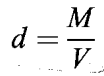
The density d of any substance is defined as the mass per unit volume of the substance. If we have a uniform sample of materials (solid, liquid, or gas) of mass M and volume V, then
SPECIFIC GRAVITY
The specific gravity of a substance is defined as the ratio of the density of the substance to that of water.

PRESSURE
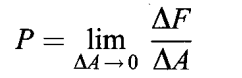
The pressure P on any surface is defined as the force per unit area acting perpendicular to that surface
HYDROSTATIC PRESSURE
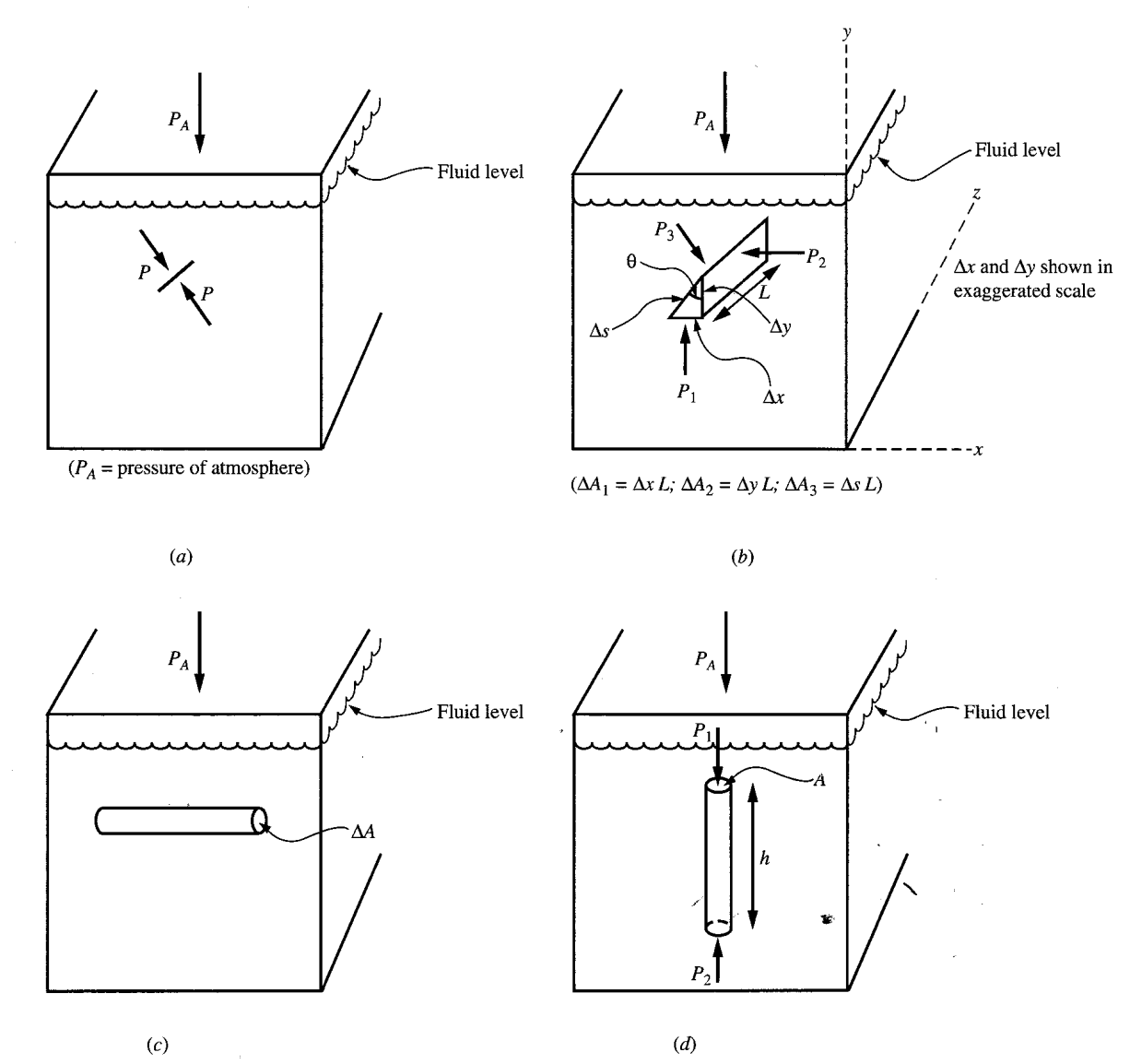
The hydrostatic pressure is the pressure in a fluid at rest.

  • For any point in a fluid at rest, the pressure on one side of a small surface is the same as the pressure on other side.
  • The pressure at a given point in the fluid at rest has a definite value that represents the force per unit area on a small surface placed at that point, oriented in any arbitrary direction.
  • The pressure in a fluid at rest is the same at all points on a horizontal plane.
  • The pressure in a fluid at rest varies only with the depth in accord with the equation,

GAUGE PRESSURE
The gauge pressure is the difference between the actual, or absolute pressure P in a fluid, and the pressure exerted by the atmosphere ­PA, which pervades the surface of the earth.

HYDRAULIC PRESS

OPEN-TUBE MANOMETER

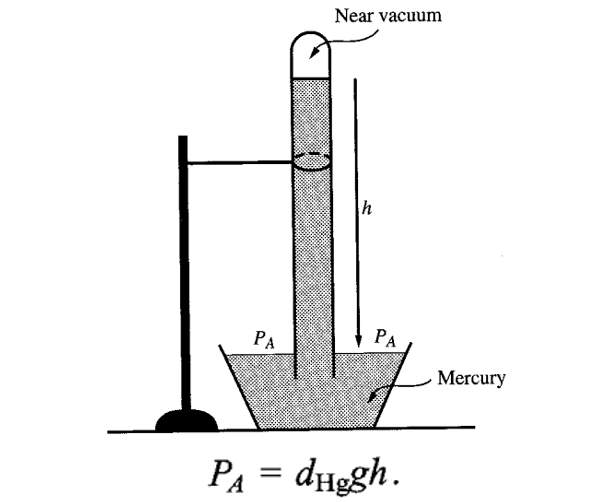
BAROMETER
ARCHIMEDES’ PRINCIPLE
The fact that the buoyant force equals the weight of the displaced liquid is called the Archimedes’ Principle: the law of buoyancy.

SURFACE TENSION
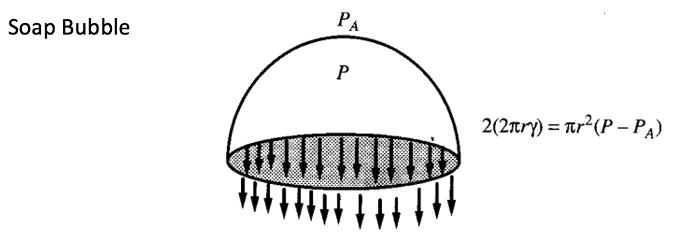
Surface tension is caused by the pull of the molecules below the surface of the liquid on the molecules at the surface. This tends to pull the surface into a smooth and compact layer. The surface tension  is defined as force per unit length exerted by a liquid surface on an object, along its boundary of contact with the object. This force is parallel to the liquid surface and perpendicular to the boundary line of contact. For a straight boundary of length L and a total force F we have

CAPILLARITY
Because of adhesion, the water surface gets pulled toward the wall of the container and bends upward at the point of contact.

.

Faraday’s Intuition on Substance

Scientists today have the same difficulty with reality that Maxwell had. But Faraday, the greatest experimental scientist of the century, had his feet firmly planted in reality

Scientists today seem to discount the broad concept of substance as in the following post.

Energy Is Not A Substance And How To Easily Understand This

Here are my responses to this article:

Sascha, if you are saying that energy is not a material substance then you are right; but if you say energy is not a substance than you have the concept of substance very narrowly defined. Light is “something.” It is not made of material substance, but it is made of energy substance because it has momentum that can be sensed and measured.

Kinetic energy cannot exist by itself. Something must be in motion for kinetic energy to exist. When there is nothing, then there is no motion and no kinetic energy. So, there is substance underlying kinetic energy, which is not always material substance. The concept of substance from its derivation is “that which stands under.”

In your cart example, what flowed from the body to the carts was force. Force was recognized by Faraday as the most basic substance. Einstein loved Faraday. Faraday was the greatest experimental scientist of his time. He was very much in touch with reality unlike the mathematical scientists of today. You may want to study the following from Faraday.

Faraday: Electrical Conduction & Nature of Matter
Faraday: On the Conservation of Force
Faraday: Thoughts on Ray Vibrations

It was the concept of force as SUBSTANCE that Maxwell disagreed with Faraday on. Faraday was not a mathematician like Maxwell. Maxwell did discover wonderful relationships by applying mathematics to Faraday’s concept of field; but Faraday’s intuition of field being a substance was right. Maxwell missed that. See

Faraday & Maxwell

To understand whether energy is a substance or not, one needs to define the word SUBSTANCE first.

SUBSTANCE
Origin: “That which stands under.” A thing is made of substance. The substance is a spectrum that extends from tangible matter to intangible light to ephemeral thought. This whole spectrum of substance is substantial enough to be sensed one way or another. The substance may be divided broadly as material substance, energy substance and thought substance.

I think that most people limit the definition of substance to material substance only. This is just a narrow viewpoint.

MATERIAL SUBSTANCE
The material substance comes in the forms of solids, liquids and gases. All of these forms of material substance can be reduced to discrete particles. These discrete material particles have a solid form and a center of mass. The ultimate material particles are protons and neutrons.

The general characteristics of substance is that it can be sensed and measured.

ENERGY SUBSTANCE
The energy substance is that which fills the atom beyond its nucleus. It is real. It is much more than just mathematical symbolism. Einstein demonstrated the existence of atoms in his 1905 paper.

Thanks for letting me express my broader viewpoint.

.
Physics I: Chapter 12

Reference: Beginning Physics I

CHAPTER 12: SIMPLE HARMONIC MOTION (SHM)

.

KEY WORD LIST

Simple Harmonic Motion, Periodic Motion, Period, Frequency, Reference Circle, Time Interval, SHM Time Equations, Spring Motion, Torsional Motion, Simple Pendulum

.

GLOSSARY

For details on the following concepts, please consult CHAPTER 12.

SIMPLE HARMONIC MOTION (SHM)
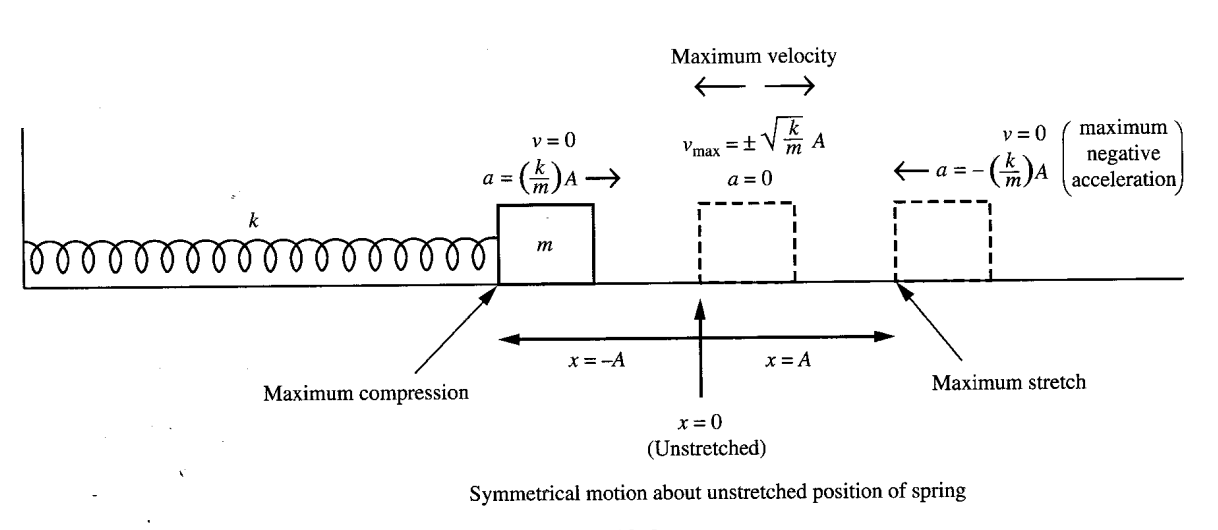
It is the back-and-forth type vibratory motion of an object that is subjected to Hooke’s Law type force, which is a restoring force that is proportional to the displacement from the equilibrium position (F = -kx). Since the force is varying, the acceleration of the object, and its velocity is also varying.

The uniformity of circular motion and rotation does not occur in SHM.

PERIODIC MOTION
Periodic motion is motion repeated in equal intervals of time.

PERIOD (T)
The period (T) is defined as the time to make one complete repetition of the motion. Thus, T is the time interval from when the object traverses any position x moving in a given direction to the next time the object traverses position x moving in the same direction.

FREQUENCY (f)
The frequency f of the periodic motion is the number of repetitions per second. It is the reciprocal of the period: f = 1/T.

REFERENCE CIRCLE
Consider a particle undergoing uniform circular motion on a circle about the origin of a coordinate system.

As the particle moves around the circle, its shadow moves back and forth along the x-axis. Finding the time equations for the shadow’s motion is equivalent to finding the time equations for SHM. For this reason, this circle is called the reference circle for SHM.

TIME INTERVAL

SHM TIME EQUATIONS

In general,

SPRING MOTION

TORSIONAL MOTION

SIMPLE PENDULUM

.

Physics I: Chapter 11

Reference: Beginning Physics I

CHAPTER 11: DEFORMATION OF MATERIALS & ELASTICITY

.

KEY WORD LIST

Stress, Strain, Elastic, Elastic Limit, Hooke’s Law, Young’s Modulus, Ultimate Strength, Force Constant, Shear Deformation, Twisting Deformation, Pressure, Bulk Modulus, Compressibility

.

GLOSSARY

For details on the following concepts, please consult CHAPTER 11.

STRESS
Force needed for certain stretch is proportional to the cross-sectional area of the rod. If we define stress as the ratio of the force to the cross-sectional area, we have a quantity that measures the effectiveness of the force in accomplishing a given stretch, independent of the cross-sectional area of the rod. The dimensions of the stress are force per area (pascal = 1 N/m2). A given stress will give rise to a definite strain in a rod of a certain material irrespective of either the thickness or the length of the rod.

STRAIN
A given force will cause a stretch that is proportional to the length of the unstretched rod. We define strain as the ratio of the change in the length of the rod to the unstretched length of the rod. The strain due to a given force will be the same for any length of rod of the same material and cross-section. The strain is thus a measure of the stretch of the rod that is independent of the length of the rod. The strain is dimensionless.

ELASTIC
Any material that returns to its original shape after the distorting forces are removed is said to be elastic.

ELASTIC LIMIT
For a rod of any given material there is a stress beyond which the material will no longer return to its original length. This boundary stress is called the elastic limit.

HOOKE’S LAW
For stresses below the elastic limit it is found that, to a good approximation, the strain is proportional to the stress; for example, if we double the stress, the strain would double. This is called the Hooke’s Law.

YOUNG’S MODULUS
In the elastic region stress/strain = constant.  The constant is called the Young’s modulus (Y). Its value depends on the material. Young’s modulus has dimensions of stress, and can be measured in pascals.

If a force tends to compress a rod rather than stretch it, the relationship of stress to strain still holds with the same Young’s modulus. In that case, the change in length represents a compression rather than stretch.

ULTIMATE STRENGTH
If one applies stress to a rod beyond the elastic limit, the rod will retain some permanent strain when the stress is removed. If the stress gets too great, the rod will break. The stress necessary to just reach the breaking point is called the ultimate strength of the material.

FORCE CONSTANT
For a rod of definite cross section (A) and length (L), the applied force (F) is proportional to the elongation ( L), and can therefore be expressed as F = kx, where k is the force constant of the system.

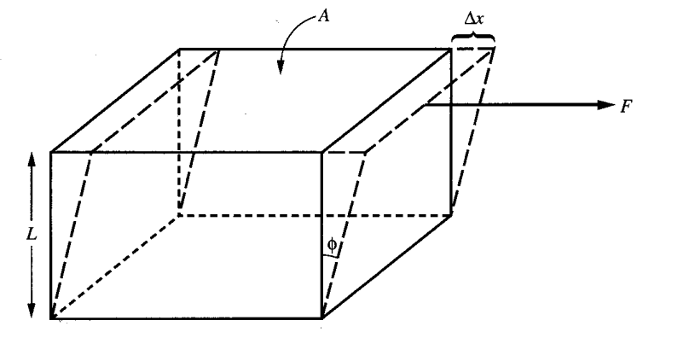
SHEAR DEFORMATION

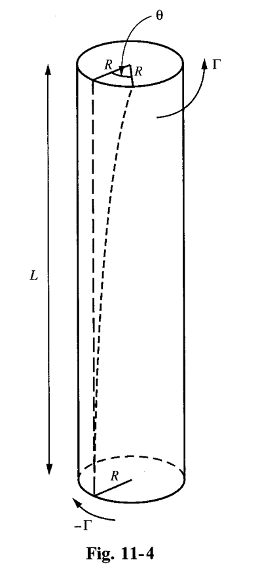
TWISTING DEFORMATION

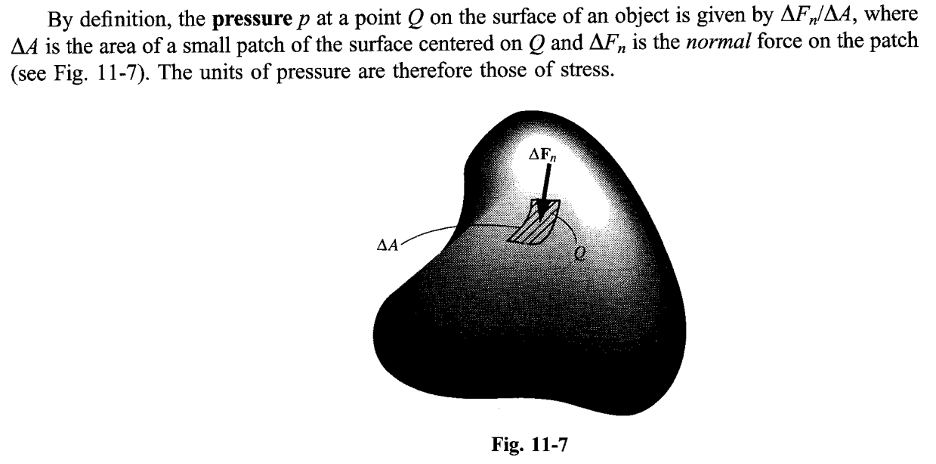
PRESSURE

BULK MODULUS

COMPRESSIBILITY

.

Physics I: Chapter 10

Reference: Beginning Physics I

CHAPTER 10: RIGID BODIES II: ROTATIONAL MOTION 

.

KEY WORD LIST

Rotational Motion, Angular Displacement, Angular Velocity, Angular Acceleration, Period, Frequency, Torque, Moment of Inertia, Linear and Angular Relationships, Table of Analogs, Conservation of Angular Momentum, CM Frame

.

GLOSSARY

For details on the following concepts, please consult CHAPTER 10.

ROTATIONAL MOTION
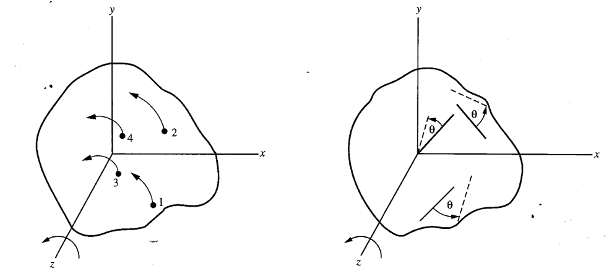
In the following sketch, a body in x-y plane is rotating around the z-axis. The orientation of the rigid body can be completely specified by giving the orientation angle  of a single chosen line segment etched in the body.

ANGULAR DISPLACEMENT
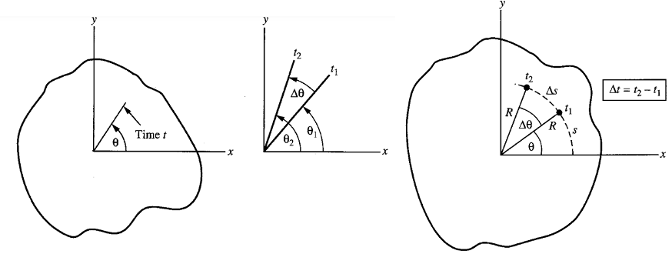
The angle  is called the angular displacement of the rigid body. By convention, the angle  is considered positive when it is measured counterclockwise from the x-axis.

ANGULAR VELOCITY
To get an idea of how fast the body is rotating, we define the average angular velocity in a given time interval as follows:

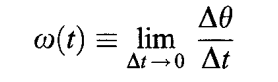
The instantaneous angular velocity is defined as the limit of average angular velocity as follows:

The angular velocity is positive for counterclockwise rotation. For constant angular velocity, we have

ANGULAR ACCELERATION
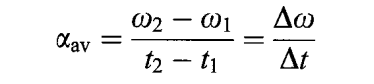
The average angular acceleration is the rate of change of the angular velocity.

The instantaneous angular acceleration is,

Thus, we have for constant acceleration,

PERIOD
The time to make one complete revolution is called the period of the motion. For constant angular velocity, the period stays the same from one revolution to the next.

FREQUENCY
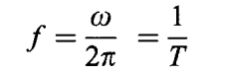
The frequency is the number of revolutions per second.

TORQUE
We consider the axis of rotation fixed in the z-direction. Then the torque is along the z-axis, and the forces causing this torques and their displacements lie in the x-y plane. All the internal torques in a rigid body add up to zero. Thus, the only torque left is due to external forces,

MOMENT OF INERTIA
We define the moment of inertia of a body about the z-axis as,

LINEAR AND ANGULAR RELATIONSHIPS
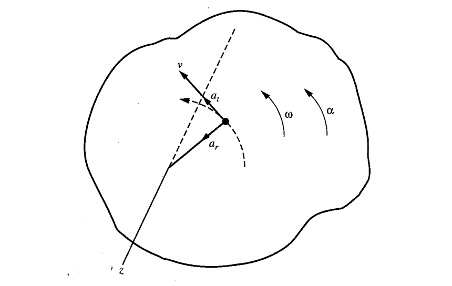
At any instant, the angular and linear properties are related as follows:

DISPLACEMENT:                   s = R             and              s = R

VELOCITY:                              v = R            and              v = R

ACCELERATION:                    at = R          and              ar = 2 R

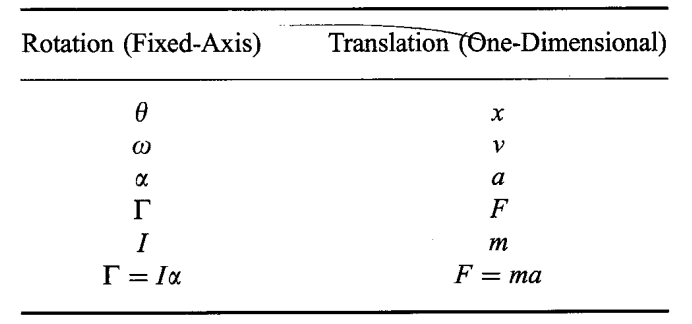
TABLE OF ANALOGS
Work done in rotation a rigid body, Kinetic energy in rotation, Work-energy theorem applied to a rotating object, the power of rotation, angular impulse, and angular momentum are all rotation analogs of the definitions for linear motion.

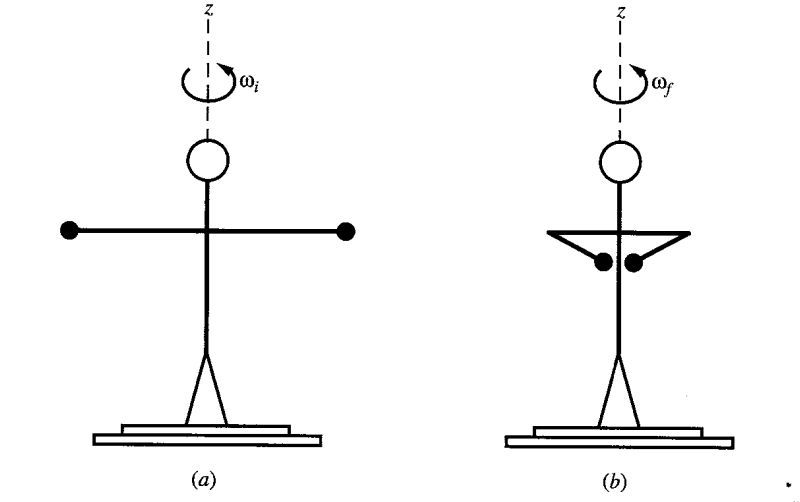
CONSERVATION OF ANGULAR MOMENTUM
If the resultant external vector torque (about the origin) for a system of particles is zero, then the vector sum of the angular momenta of all the particles stays constant in time.

For the special case of objects rotating about a fixed axis: If the total external torque about the axis is zero, then the total component of angular momentum along that axis does not change.

CM FRAME
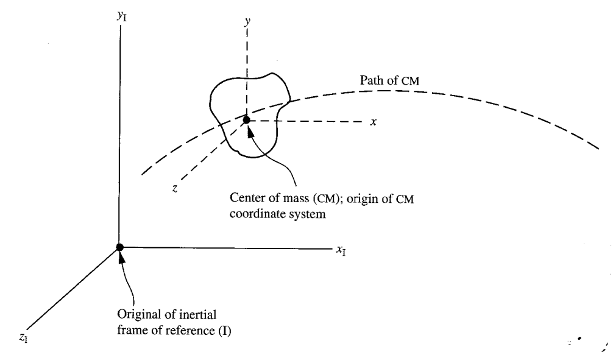
The CM Frame is a coordinate system whose origin is fixed at the CM (Center of Mass) of the object. The CM Frame moves with the object, but its axes remain parallel to the axes of a coordinate system fixed in an inertial frame.

The translation of the object is the same as the translation of the CM. The rotation of the object is about an axis that passes through the CM. If the direction of this axis of rotation remains fixed, then all the laws of rotation hold.

The total kinetic Energy of an object in the inertial frame is given by,

.