Author Archives: vinaire

I am originally from India. I am settled in United States since 1969. I love mathematics, philosophy and clarity in thinking.

Physics II: Chapter 9

ReferenceBeginning Physics II

Chapter 9: INDUCED EMF

.

KEY WORD LIST

Generator, Motional EMF, Induced EMF, Magnetic Flux, Faraday’s Law, Lenz’s Law, Alternating Current, Direct Current, Induced Electric Fields

.

GLOSSARY

For details on the following concepts, please consult Chapter 9.

GENERATOR
When a wire moves through a magnetic field an EMF is generated in the wire, which has the ability to move charges through the wire. This means that it is possible to build an apparatus that makes use of magnetic effects to produce EMFs that drive electrical circuits connected to the apparatus. The apparatus is called a generator, and, like a battery, it pumps positive charges within the apparatus toward the high-potential end of the apparatus, so that, in an external circuit, the charges produce a current flowing from the high- to the low-voltage terminals. As in a battery, the voltage produced by the generator on open circuit is its EMF.

MOTIONAL EMF
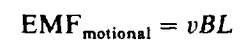
An EMF produced in wires moving through a magnetic field is called motional EMF. For a wire of length L, with uniform electric field E, the potential difference is Vba = EL, and using the relation result E = vB, we have for our moving wire:
INDUCED EMF
An EMF produced in stationary wires that are situated in a changing magnetic field is called induced EMF. Its characteristics are given by Faraday’s law.

MAGNETIC FLUX
It is a concept similar to electric flux. As in the case of electric flux one can visualize the magnetic flux by drawing magnetic field lines, with the number of field lines passing through a unit area perpendicular to the lines proportional to B at that location.

In the following diagram there is a small planar area A represented by a vector A that has a magnitude equal to the area, and a direction perpendicular to the plane of the area. We use the notion of circulating current and the right and rule to determine the positive direction of A. For a magnetic field B that passes through the area in the positive direction at an angle θ to A, we define the magnetic flux as
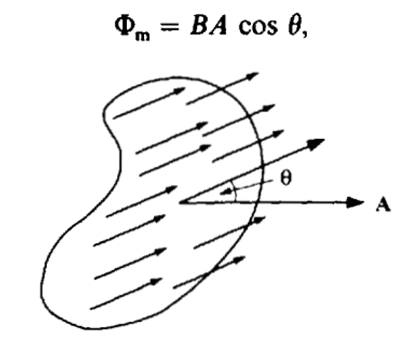
The total magnetic flux through any area is just proportional to the total number of field lines through that area. The unit for magnetic flux is T – m2, which is given the name Weber (Wb).

FARADAY’S LAW
This law says that whenever there is a change in flux within a circuit there will be an EMF induced in the circuit. This EMF depends on the time rate of change of the flux through the circuit,
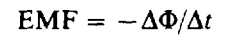
where ∆φ is the change in magnetic flux through the circuit in a short time interval, ∆t. The minus sign is necessary to assure that the correct direction is given for the EMF. The requirement of the minus sign is called Lenz’s law.

LENZ’S LAW
This law states that the EMF produced by a changing flux is always in a direction to produce a current whose own flux is in the opposite direction to the initial change in flux.

ALTERNATING CURRENT
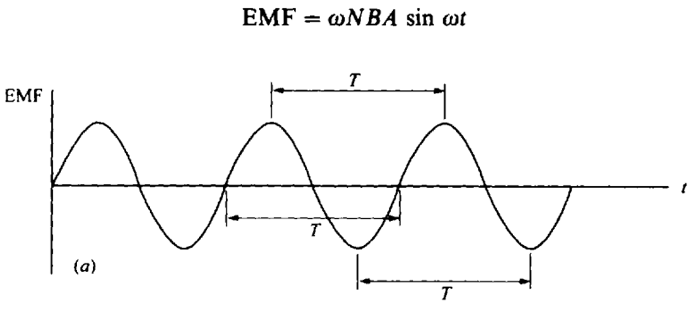
One can generate an EMF by rotating a coil with an angular velocity ω in a magnetic field B. Then the angle θ = ωt. The flux (φ) through a single turn of the coil is given by BAcos θ, or BAcos ωt.

By differentiating, we get the EMF to be,

The EMF varies as sin ωt. The EMF produced in this manner will change its direction and then change back again at an angular frequency ω, or at a frequency f = ω/2π and period T = 2π/ω. This is what we call an alternating voltage which produces an alternating current (AC). Thus, by rotating a coil in a magnetic field, we can easily generate an AC voltage. The magnitude of the voltage can be increased by constructing the coil out of many turns, N, of wire, in which case the voltage becomes,
DIRECT CURRENT
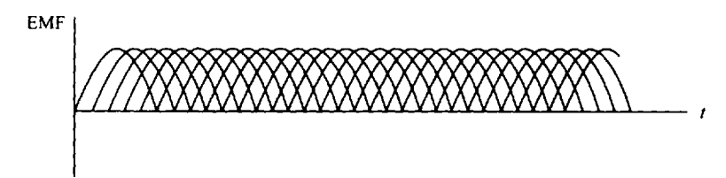
It is also possible to construct generators to produce DC (direct current) voltage. To accomplish this, we reverse the connection to the outside wires every time the direction of the EMF in the coil reverses direction. The resultant EMF in the outside circuit will then take the form shown below.
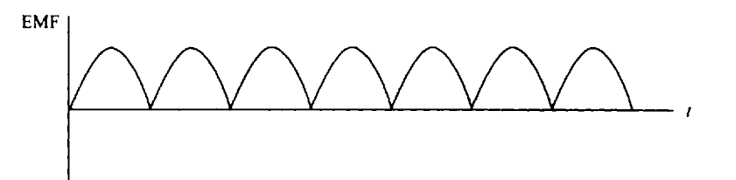
Secondly, we use several coils (armature), in which each coil will produce a voltage which reaches its maximum at a different time, and the total voltage will vary very little with time.
INDUCED ELECTRIC FIELDS
Any changing magnetic field actually produces a new type of electric field in the vicinity of the circuit that pushes the charges and creates the EMF in the stationary circuit. This new electric field is fundamentally different from the “electrostatic” field produced by point charges. . Thus, Faraday’s law has profound implications for our concept of the electric field.

.

KHTK Factor # 10

Reference: A Course on the Factors

KHTK Factor # 10: And thus there is mind.

The beingness expands when new postulates are made. It consolidates (contracts) when those postulates are assimilated according to the principle of oneness.

The intelligent beingness of mankind is the outcome of much expansion and consolidation. It did not exist in the beginning as “thetans” or “God.” All that existed in the beginning was a potential of such beingness.

The beingness has evolved from inanimate minerals to self-animated cells, to increasingly sophisticated plant and animal life, finally culminating into the mankind. The potential is unfolding even today. We don’t know what the ultimate form of beingness would be like? The crown jewel of such expansion and consolidation, so far, is the intelligent mind of the human beings.

However, the aberrations that exist in beingness today indicate a lack of full consolidation per the principle of oneness.

So the purpose of this human mind is to achieve full consolidation of all existing postulates by resolving anomalies.

ANOMALY
An anomaly is any violation of the principle of oneness, such as, discontinuity (missing data), inconsistency (contradictory data), or disharmony (arbitrary data).

.

Scientology

Compare the above to the following factor in Scientology.

Scientology Factor # 10. And thus there is life.

Life is a very general concept. The KHTK Factor is much more specific.

.

Logic

The ultimate stage in this expansion and consolidation is likely to be the Unknowable knowing itself. It will be only one iteration of the universe, among infinite iterations possible.

.

KHTK Factor # 9

Reference: A Course on the Factors

KHTK Factor # 9: And thus there is computation.

With postulates, viewpoints, dimension points, and more postulates we have the beginning of mental activity. As this activity increases, there come about additional elements in the form of projections, opinions, conclusions, facts, data, etc.

Each postulate adds something that should be taken into consideration along with the principle of oneness. Additional constraints build up to the degree postulate are not assimilated per the criterion of oneness. 

With increasing constraint, new postulates start to become increasingly complex and stimulus-response in nature. We may see it as thought, which is freer, condensing into energy, which is subject to the laws of electromagnetism. We see this gradual condensation documented in the Tone scale of Scientology. 

Thus, comes about all this mental computation to deal with this complexity. The complexity is directly proportional to the lack of assimilation per the criterion of oneness.

.

Scientology

Compare the above to the following factor in Scientology.

Scientology Factor # 9. And thus there is energy.

Energy is condensed thought that has become more stimulus-response in nature. Here Hubbard is talking about mental energy that is reflected in physical energy.

.

Logic

Thought being highly flexible can deal with an incredibly large number of variables. Energy deals with lesser number of condensed variables, and matter deals with the least number of variables that combine into very predictable laws of mechanics. Thus, there are different levels of computations.

.

KHTK Factor # 8

Reference: A Course on the Factors

KHTK Factor # 8: And thus there is cognition.

Cognition is the act or process of knowing, the end product of which is knowledge. 

Cognition comes from using the criterion of oneness as the starting point to perceive what might be missing. 

Here we are looking at the beginning of mind.

.

Scientology

Compare the above to the following factor in Scientology.

Scientology Factor # 8. And thus there is light.

Light makes up only one of the senses. Underlying the senses is cognition.

.

Logic

The mind is an inherent property of the being. The two are not separate in reality, though they are studied as two different subjects.

.

Physics II: Chapter 8

ReferenceBeginning Physics II

Chapter 8: MAGNETIC PROPERTIES OF MATTER

.

KEY WORD LIST

Magnetization, Orbital Motion, Spin, Diamagnetic Material, Paramagnetic Material, Ferromagnetism, Magnetic Poles, Magnetization Vector, Magnetic Intensity Vector, Magnetic Susceptibility, Superconductor

.

GLOSSARY

For details on the following concepts, please consult Chapter 8.

MAGNETIZATION
A magnetic field can change the properties of the material in which it is created, and result in having the material produce its own field, which has to be added to the original field. This modification of the properties of a material is called “magnetization” of the material.

ORBITAL MOTION
In order for a magnetic field to have any effect, a material must consist of moving charged particles. All materials consist of a collection of atoms and molecules. The orbital motion may be thought of as electrons circulating about a nucleus within an atom.

SPIN
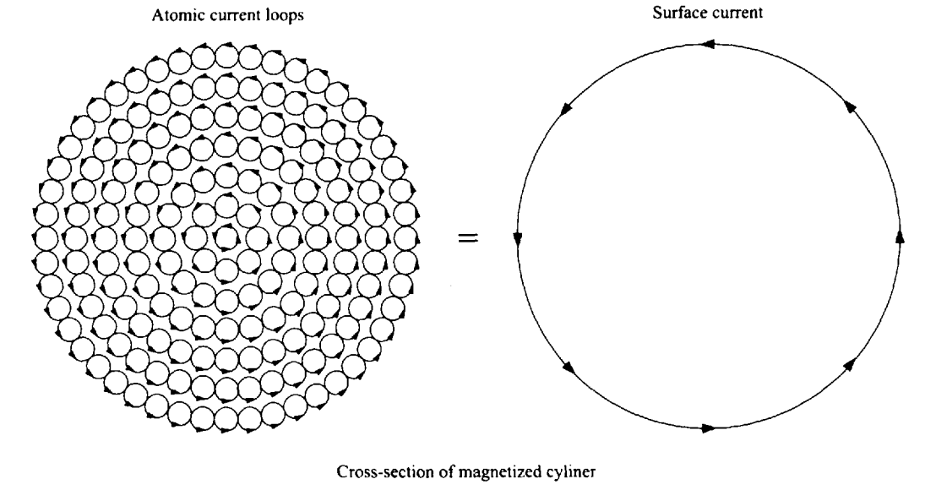
In addition to orbiting the nucleus, the electrons spin on their axes and, as a consequence, have an additional “spin” angular momentum and “spin” electric current loops. In either case, orbital or spin, magnetic fields can be set up by the atomic current loops, and an external magnetic field can exert forces on the electrons, and thereby modify their motion.

DIAMAGNETIC MATERIAL
An external magnetic field generally induces      currents and associated magnetic moments in the atoms of a material. These magnetic moments, in turn, produce their own magnetic fields, which, by Lenz’s law, are in a direction opposite to the original field. The materials in which this is the dominant effect are called diamagnetic materials, in the same manner as materials that produce electric fields opposed to the original electric field are dielectric materials. In general, such induced magnetic fields in an atom are very small and the external field is reduced by a tiny amount as a consequence of diamagnetism. While diamagnetism is present in all atoms, it dominates only in those atoms in which the orbital and spin angular moments average out to zero.

PARAMAGNETIC MATERIAL
In paramagnetic materials there is a net orbital and/or spin angular momentum and a net effective current loop for the atom. Such an “effective” current loop gives the atom a definite overall magnetic dipole moment. An external magnetic field exerts a torque on such a magnetic moment and the torque tries to line up the moment parallel to the magnetic field. The lined-up moments will then produce their own magnetic field in the same direction as the original field, thus increasing the magnetic field. Paramagnetic materials are more common than diamagnetic materials, especially since they dominate in materials where both effects are present.

FERROMAGNETISM
Certain materials, notably iron, nickel and cobalt, exhibit ferromagnetism at room temperature. This means that the magnetic interactions between the magnetic moments of neighboring atoms is strong enough, even at room temperature, to align the moments in the same direction. If an external field is applied to the ferromagnetic material it has the effect of causing the domains of aligned moments to rotate and point in the same direction, the direction of the magnetic field. Once they have been aligned, they tend to remain aligned even if the external field that originally caused them to align is removed. The material has now become a permanent magnet.

MAGNETIC POLES
The field produced by a solenoid is nearly the same in shape as the electric field produced by oppositely charged particles located at the ends of the bar. We therefore often talk of the bar as being composed of two opposite magnetic poles (the substitute for electric charges), one called a north pole and the other called a south pole.

The north pole is the apparent source of magnetic field lines (as is a positive charge for electric field lines), and the south pole is a sink for the lines. In actuality the lines do not terminate at the poles, but continue in straight lines within the material, forming closed loops. The designation of north or south pole arises from the fact that the bar tends to line up in the magnetic field of the earth with the north pole facing in the northerly direction. As in the case of electric charges, opposite poles attract, and similar poles repel each other.

MAGNETIZATION VECTOR
The magnetization vector, M, is the total magnetic moment per unit volume. Thus, a material in a magnetic field can become magnetized, with a magnetization M = ΣM/V). The magnetic field, BM produced by the magnetic dipoles in the material is related to the magnetization as follows.

MAGNETIC INTENSITY VECTOR (H)
It is the part of the magnetic field in a material that arises from an external current and is not intrinsic to the material itself. The definition of H is:

H = B/μ0 − M

where B is the actual magnetic field within a material considered as a concentration of magnetic field lines per unit cross-sectional area; μ0 is the magnetic permeability; and M is the magnetization vector. The magnetic field H might be thought of as the magnetic field produced by the flow of current in wires and the magnetic field B as the total magnetic field including also the contribution M made by the magnetic properties of the materials in the field. When a current flows in a wire wrapped on a soft-iron cylinder, the magnetizing field H is quite weak, but the actual average magnetic field (B) within the iron may be thousands of times stronger because B is greatly enhanced by the alignment of the iron’s myriad tiny natural atomic magnets in the direction of the field.

MAGNETIC SUSCEPTIBILITY
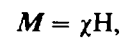
In general, except for material that becomes a permanent magnet, the magnetization is proportional to the magnetic field, and therefore to the magnetic intensity as well. We can therefore write that,

Where χ is called the magnetic susceptibility of the material. Then

where μ is the permeability of the material, κm, is the relative permeability of the material, and μ = μ0κm, with κm = 1 + χ. This means that for these materials, we can calculate B if we know H, merely by multiplying H by μ.

SUPERCONDUCTOR
Some materials, at sufficiently low temperatures lose all their resistivity. These materials are called superconductors. They also set up surface currents in a magnetic field, which themselves produce an exactly opposite field, and thereby cancel any field which tries to be established in its interior. Thus, a superconductor can be considered to be a perfect diamagnet.

.