Author Archives: vinaire

I am originally from India. I am settled in United States since 1969. I love mathematics, philosophy and clarity in thinking.

The Human Existence

Previous: Evolution of the Universe
Next: The Creation Myth

The main topic of mindfulness discussion in the fifth class on Mindfulness Course is THE HUMAN EXISTENCE.

.

THE HUMAN ORGANISM

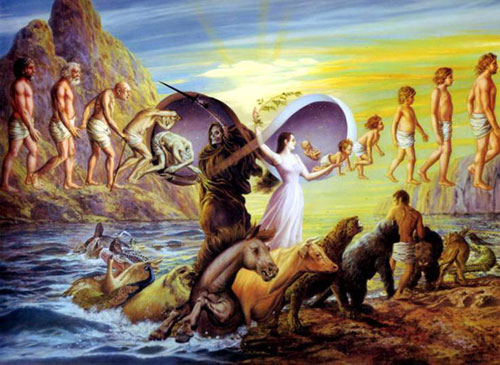
  1. A human is a life organism that consists of a body and a mind. The component of spirit is added to it with the evolution of intelligence at this level.

  2. The body is associated with physical attributes. The mind and spirit are associated with metaphysical attributes. It is considered that in some way the human spirit, with a portion of the mind, can be cleanly separated from the human body, but this is only a subjective feeling. In truth, the physical and metaphysical attributes are well-integrated as they are in the rest of the universe.

  3. The basic physical attributes are space and time that evolve into energy and matter. These attributes may be abbreviated as MEST (matter, energy, space and time). The human body is essentially MEST, which is continuous with all other MEST in the universe at the level of electromagnetic energy, space and time.

  4. The basic metaphysical attributes are awareness and desire that evolve into consciousness and identity. These attributes may be abbreviated as ICAD (identity, consciousness, awareness and desire). The human mind and spirit are essentially ICAD, which is continuous with all other ICAD in the universe at the level of consciousness, awareness and desire.

  5. There appears to be an equivalency between “matter and identity”; “energy and consciousness”; “awareness and space”; and “desire and time”. Thus, evolution occurs in tandem between physical and metaphysical attributes. In addition, there are likely to be parallels between physical and metaphysical laws.

  6. The metaphysical attributes are generally represented by “life”. The physical attributes are represented as the “physical universe”. However, the physical universe is the outer form of life; just as life is the inner essence of the physical universe. Life and the physical universe are integrated and cannot be separated.

.

THE HUMAN MIND

  1. The human mind is an experiential matrix, where free association and postulation takes place to align all experience. It is made up of ICAD (identity, consciousness, awareness and desire). The mind is anchored to the human body, but it covers the whole universe as its scope.

  2. The mind receives perceptions from the environment and aligns them within the existing experiential matrix. This alignment is then reflected in the efforts of the human organism, which deals with the efforts in the environment. This cycle is continuous and dynamic.

  3. When the perceptions received in the mind can be well aligned and thus assimilated within the experiential matrix then they reflect in the rational behavior of the human organism. When the perceptions cannot be so assimilated, they reflect as reactive or irrational behavior.

  4. The perceptions that do not align with the experiential matrix simply get lodged there as received. Thereafter, such “unassimilated experience” gets activated whenever similar perceptual content appears in the environment. This then leads to reactivity in behavior.

  5. The unassimilated experience in the mind has its own “limited context” inside the wider context of the mind. When activated, this limited context determines the response of the human organism. It often appears as “alternate personality” in contrast to the personality of the mind.

  6. The personality of the mind has a much larger assimilated context of the experiential matrix. So, it appears that the larger and better aligned is the context the more rational ia the response.

  7. One may say that there is a “universal experiential field” in which the inanimate objects are reflected by their properties according to the laws of physics. The additional properties of animation of living organisms are also reflected therein, integrated with inanimate properties. This is the mind of the universe.

  8. This universal experiential field surrounds the experiential matrix of the human mind. When the experiential matrix of the mind is integrated with the surrounding experiential field then the context of the human mind expands to become universal. This universal context then provides the most rational response.

  9. It seems that there is a Law of Rationality as follows:

RATIONALITY OF THE MIND DEPENDS ON THE UNIVERSALITY OF THE CONTEXT IT USES.

.

HUMAN LIFE & DEATH

  1. The human organism is part of the universe. We may say that the human body is part of the universal body, the human mind is part of the universal mind, and human soul is part of the universal soul, which we identify as God.

  2. The human body, mind and soul are well-integrated. None of these three components can exist independently of the other two. When the human organism dies, all three components (body, mind and soul) decompose into finer existence.

  3. The physical and metaphysical attributes of the human organism correspond to each other. When the physical attributes disintegrate and regenerate; the corresponding metaphysical attributes also disintegrate and regenerate.

  4. All three components (body, mind and soul) come into existence at birth. Majority of physical and metaphysical attributes come from the parents, but some may be absorbed from the environment.

  5. At birth, it is rare that a body, mind and soul, which existed before, come back into existence. Physical and metaphysical attributes, which existed before, may reappear in different combinations; but the personality, or soul, disintegrates just like the body, and never reincarnates.

.

Evolution of the Universe

a-lei-da-simetria_1

Previous: The Universal Context
Next: The Human Existence

The main topic of mindfulness discussion in the fourth class on Mindfulness Course is EVOLUTION OF THE UNIVERSE.

.

THE CREATION

  1. The attributes of this universe are simply there as perceived by us. We perceive interactions among these attributes. We see these interactions producing new attributes.

  2. We basically perceive a CHANGE flanked by cause and effect. These “changes” appear in chain, or as a network. We do not perceive some “absolute nothing” before change.

  3. A CHANGE is always from a relative nothing to something. This applies to any idea of creation. A creation is basically a change.

  4. The idea that “God created this world” can only mean that God evolved into this world. God and this world is, therefore, a single system called the universe.

.

THE EVOLUTION OF MATTER

  1. In this universe, the forms appear; they survive; and then they perish giving way to new forms. All forms perish ultimately. No form survives forever.

  2. It appears that the goal is to bring order into chaos, and not to seek immortality for some particular form. The dynamic principle of existence, therefore, seems to be evolution and not mere survival.

  3. In evolution, discreteness arises from continuous background. That background is continuous space. Discreteness arises as frequency of electromagnetic energy, which evolves into resonances of electrons, and then into particles of nucleons. Particles then form larger discrete objects.

  4. Just because discrete objects appear separate from each other, it does not mean that they are not connected at the fundamental level of energy and space. As an abstraction, whole numbers appear to be discrete, but they are connected by fractions and irrational numbers on a continuous number line.

  5. The universe, thus, remains a vast single continuous system no matter how chaotic it appears.

.

THE EVOLUTION OF LIFE

  1. The RNA and DNA molecules have enough electrons to acquire the property of programmable circuits. Life begins as these circuits acquire natural programming that leads to animation.

  2. Life is the property of natural animation. It is manifested in material structures called cells. Cells are the building blocks of living organisms.

  3. The living organism and all its attributes are part of the universe. The attributes seem to be harmoniously integrated. However, we categorize them as physical and metaphysical.

  4. The physical attributes characterize the body of the organism. The metaphysical attributes characterize the animation of the organism, and are further characterized as the mind and spirit of the organism.

  5. We may consider the universe to be a living organism. The physical attributes manifest as the form of the universe. The metaphysical attributes manifest as the mind and spirit of the universe, which may be identified as God.

.

THE EVOLUTION OF THINKING

  1. In inanimate objects, the “thinking” is in terms of reaction. By reaction is meant, that there is only one option in how to respond to some stimuli.

  2. As animation enters into the picture, the reaction expands into a series of responses. This is the case with plant life. Multiple optional responses to the same stimuli are still lacking.

  3. When there is more than one option on how to respond to same stimuli, then we have analytical thinking. Such thinking seems to appear with animal life. Here we see the organisms of the same specie responding differently to the same stimuli.

  4. There is greater analytical thinking at the level of highly evolved animal life. But it is not random. There seems to be a consistency associated with it.

  5. Analytical can be seen as the result of enhanced biological programming, which initially brought about animation.

.

THE EVOLUTION OF INTELLIGENCE

  1. Biological programming, at its highest level, is able to modify itself based on the feedback. This ability manifests as intelligence at the level of humans.

  2. Intelligence is the ability to recognize differences, similarities and identities. It takes decision on the basis of observing things as they are. This is the highest level of evolution so far.

  3. However, this intelligence can easily be suppressed by force and reduced to analytical, and then reactive thinking. A person remains in these lower modes of thinking when stressed.

  4. Further evolution may lead to intelligence that is robust and immune to stress. For this to occur, the current intelligence needs to understand its own evolution.

  5. Intelligence goes back to analytical thinking to reactive thinking to some fundamental alignment, which precipitates from chaos. There seems to be some sort of settling down or reaching of equilibrium.

.

THE LAW OF EQUILIBRIUM

  1. There seems to be a Law of Equilibrium as the fundamental law of the universe. A form of this law appears as the law of entropy in Thermodynamics.

  2. It is the Law of Equilibrium that brings about the evolution from “static reactivity” of material objects, to “animated reactivity” of plant life, to “analytical thinking” of animal life, to “intelligence” of humans.

  3. Looking on the cosmic scale, there was no intelligence at the beginning of the universe. The idea, “There was intelligence at the beginning in the form of God,” seems to be subjective. There seems to be only the Law of Equilibrium in the beginning.

  4. The infinity of GOD has evolved from the zero of the Law of Equilibrium, which Buddha called NIRVANA.

.

Now we shall be looking more closely at the human existence.

The Universal Context

mirror_by_shewolf294-d7aet38

Previous: Confusion and Faith
Next: Evolution of the Universe

The main topic of mindfulness discussion in the third class on Mindfulness Course is UNIVERSAL CONTEXT. We take up this topic because confusion can be completely eliminated only in the universal context.

.

SUBJECTIVE & OBJECTIVE

  1. Faith helps align the confusions in life. The wider is the context of faith the greater order it brings to life.

  2. There are uncountable narrow personal contexts. Faiths, which are limited to those contexts, bring order only within those contexts. Faith limited to narrow personal context is SUBJECTIVE.

  3. When expanded, narrow contexts converge to the same universal context. Faith that is valid throughout the universal context brings complete order. Such universally broad faith is OBJECTIVE.

.

THE SCOPE OF UNIVERSAL CONTEXT

  1. By definition, the universal context includes everything. There is nothing beside the universal context.

  2. The universal context shall include multiverses, parallel universes, the physical universe and even the gods or God.

  3. Thus, the universal context includes all attributes, physical and metaphysical.

.

THE ORIENTATION POINT OF THE UNIVERSE

  1. The universal context increases in attributes with evolution. We may, therefore, have a scale of universal attributes that goes from zero to infinity.

  2. The reference point of “zero attributes” is theoretical because absolute nothingness does not exist. This reference-point is useful in measuring evolution on a universal scale.

  3. This universe is continually changing physically and metaphysically. No form in it survives forever. Therefore, it is always in motion.

  4. We may, therefore, call the reference point of this universe, STATIC, which will be a point of no motion. All motion in the universe shall be relative to this static. All attributes of the universe shall converge to static.

  5. The STATIC of no attributes shall act as the orientation point for the universe of infinite attributes.

.

NIRVANA AND GOD

  1. Nirvana in Buddhism is expressed as accessing that “still center” around which the self is built. Attaining nirvana literally means “blowing out, extinction, disappearance”. It implies that no attributes are left. We may identify nirvana with the STATIC described above.

  2. God is generally described in terms of omniscience (infinite knowledge), omnipotence (unlimited power), omnipresence (present everywhere), divine simplicity, and as having an eternal and necessary existence. We may identify God with infinite attributes – the other end of the scale described above.

  3. We may put all the physical attributes in the category of the physical universe; and all the metaphysical attributes in the category of God. But these categories are for convenience only. In actuality, all the physical and metaphysical attributes are well-integrated.

.

In the next class we shall look at the evolution of the universe.

.

Confusion & Faith

confetti

Previous: Mindfulness Meditation
Next: Mindfulness Approach

The main topic of mindfulness discussion in the second class on Mindfulness Course is CONFUSION & FAITH. We start with this topic because it is something common to all our experience.

.

CONFUSION & STABLE DATUM

  1. Confusion is natural. It appears in the universe as chaos. The process of evolution converts this chaos into order. 

  2. Confusion is common to all our experience. Bringing order to this confusion helps us evolve. That is what life is all about.

  3. To speed up our own evolution it is important to understand the concept of confusion. 

  4. Confusion is RANDOM MOTION. An example would be the swirling confetti that is falling from above. It is very difficult to track down each and every piece of that confetti.

  5. If you can hold on to just one piece of confetti, you can then track the motion of all other confetti relative to it. Therefore, in order to start handling confusion, you must find something that is stable, and which you can hold on to.

  6. FAITH acts as that stable datum to which you can align the confusing data of life. The faith does not have to be correct or true. It just have to be relatively stable. Thus, people do acquire all kind of strange faiths.

.

FAITH & UNIVERSAL CONTEXT

  1. The stability of faith depends on the context to which it appiles. A faith may be workable in a limited context, but not in a different or larger context. The larger is the context to which a faith applies, the better it is.

  2. To bring better order to life, one needs to examine and upgrade one’s faith continually so that it is workable within larger contexts. One can always improve upon one’s faith.

  3. The best faith is that which can be held constant in the largest context possible, which is the UNIVERSE.

.

In the next class we shall discuss the nature of the universal context, or the UNIVERSE.

.

Dianetics Axioms & Glossary

Reference: Scientology Research

The Dianetics Axioms

L. Ron Hubbard found that man is obeying very definite laws and rules which could be set forward in axioms. The very first and most fundamental of these is: The dynamic principle of existence is survive. That is the basic axiom of Dianetics.

.

Executive Summary 2025

.

Dianetics Axioms 1 – 15

Dianetics Axioms 16 – 30

Dianetics Axioms 31 – 45

Dianetics Axioms 46 – 60

Dianetics Axioms 61 – 75

Dianetics Axioms 76 – 90

Dianetics Axioms 91 – 105

Dianetics Axioms 106 – 120

Dianetics Axioms 121 – 135

Dianetics Axioms 136 – 150

Dianetics Axioms 151 – 165

Dianetics Axioms 166 – 180

Dianetics Axioms 181 – 194

.

Glossary

ABERRATION
Aberration exists to the degree that plus or minus randomity exists in the environment, or in the past data of an organism, group or species. Aberration is caused by what is done to the individual, not what the individual does, plus his self-determinism about what has been done to him.

ABSOLUTES
Absolute good and absolute evil do not exist in this universe. That which is good for an organism allows it to evolve, and even assists its evolution. That which is evil inhibits the organism’s ability to assimilate.

AESTHETICS
Aesthetic lies in the awareness of continuity, consistency and harmony in higher level complexities of form.

AFFINITY
Affinity is the seeking of continuity of awareness.

AFFINITY, REALITY, COMMUNICATION
Affinity, reality and communication (ARC) are the components of the thinking and behavior of the organism. These aspects of behavior go hand-in-hand and, together, they seek oneness of all phenomena.

ARBITRARY
An arbitrary factor or force is not aligned with the natural laws. The introduction of an arbitrary brings about the disharmony of plus or minus randomity.

ASSIMILATION
Every thought is preceded by unknowable sensation. Thought is used to give meaning to sensations and make all those meanings consistent with each other. This is called assimilation of sensations into perceptions. Assimilation produces optimum motion.

ATTENTION
Attention is a motion which must remain at an optimum effort. Attention is aberrated by becoming unfixed and sweeping at random or becoming too fixed without sweeping.

BEHAVIOR
Behavior is modified by counter-efforts which have impinged on the organism. Reactions come from unassimilated sensations; whereas, learned analytical behavior comes from assimilated sensations.

COMMUNICATION
Communication is the seeking of harmony among all organisms and manifestations.

CONTINUITY, CONSISTENCY, HARMONY
Continuity, consistency and harmony (CCH) are the components of optimized motion.

CONTROL CENTER
The control center is the seat of awareness generated from the inherent optimum motion of the organism. When the control center is overwhelmed by randomity, it becomes unconscious. Randomity that overcomes the control center may appear as an alternative personality. The organism is unaware of such alternative personality.

COUNTER-EFFORT
Effort sensed that is not in alignment with the efforts of the organism.

DATA
Data of plus or minus randomity depends for its confusion on former plus or minus randomity or absent data.

DEATH
Death is the equivalent of life losing its complex organized motion (self-animation). Death of a life organism or its race or species is a normal aspect of continuing evolution.

DELUSION
Delusion is the outcome of misalignment of one’s postulates due to randomity in an area.

DREAM
Dreams are the resymbolization of areas of randomity and of the efforts to bring assimilation in those areas.

EFFORT
All effort of the organism is force directed toward converting randomity of motion into optimum motion. The important factor is applying just the right effort to balance the counter-effort. 

EMOTION
Free emotional response depends on optimum motion. It depends upon absence of or non-restimulation of engrams.

ENGRAM
The engram is a severe area of plus or minus randomity of sufficient volume to cause unconsciousness. Past engrams are restimulated by the control center’s perception of circumstances similar to that engram in the present environment. Presence of engrams fix emotional responses.

EVOLUTION
In Scientology, evolution is brought about through the agency of life organisms, or theta. Evolution involves the process of optimization of motion.

FIXATION
The organism is naturally focused on future evolution. Lack of assimilation forces its attention to fixate on the present and past. The control center becoming fixated is the primary source of aberration.

HAPPINESS
Happiness consists in assimilating hitherto unassimilated sensations that have been resistive. An individual as happy as he can learn new things and evolve.

INTELLIGENCE
Intelligence depends on the ability to observe discontinuity, inconsistency, or disharmony in an area of randomity and follow it up until it is resolved.

LAMBDA
The Greek letter LAMBDA is the symbol assigned to LIVING ORGANISM in Scientology; but it is not in much use.

LANGUAGE
Language is the symbolization of effort. Language depends for its force upon the force which accompanied its definition. Fix emotional responses of theta facsimiles become part of symbols of a language. This can influence one’s thinking and behavior.

LIFE
The essence of life is a form having inherent motion. Even light has inherent motion, and electron too. Both light and electron are, therefore, elementary forms of life. As life starts to evolve its inherent motion starts to become increasingly complex and self-animated.

LIFE ORGANISM
In Scientology, a life organism is composed of matter and energy in space and time, animated by THETA. Lower level organisms form a food chain to sustain higher level organisms. Actually, a life organism is a highly complex structure with inherent self-animation, that depends upon optimum motion. It can assimilate complex motion in its environment and learn from it.

LIFE STATIC
(See Static) In Scientology, the life static is postulated as the source of life. It has the ability to postulate and to perceive. It is concerned wholly with motion. It mobilizes and animates matter into living organisms. Thus, it is engaged in a conquest of the physical universe. It does so by by learning and applying the physical laws of the physical universe.

MEST
MEST is the symbol assigned to PHYSICAL UNIVERSE in Scientology. This symbol is created from the first letters of the words MATTER, ENERGY, SPACE and TIME. The designation is in use.

MIND
In Scientology, mind is the THETA command post of an organism, and it is concerned wholly with the estimation of effort. But the mind is more like a matrix of postulates in which all postulates and motion is assimilated and optimized. The mind receives sensations from the environment. Sensations are assimilated into perceptions. Perceptions are assimilated into knowingness. 

NATURAL LAWS
Natural laws are the manifestation of optimum motion. The components of optimum motion are continuity, consistency and harmony.

OCCLUSION
Occlusion arises from plus or minus randomity that has not been assimilated. The environment can occlude the central control of any organism and assume control of the motor controls of that organism.

PAIN
Pain is the randomity produced by sudden or strong counter-efforts. It is stored as that randomity in the mental matrix. When restimulated, it can reinflict itself upon the organism. Past pain becomes ineffective upon the organism when the randomity of its area is addressed and aligned. Later areas of plus or minus randomity cannot be realigned easily until earlier areas are realigned.

PERSISTENCE
Persistence obtains in the ability of the mind to put solutions into physical action toward the realization of goals.

PHI
The Greek letter PHI is also the symbol assigned to PHYSICAL UNIVERSE in Scientology; but it is not in much use.

PHYSICAL UNIVERSE
In Scientology, the physical universe is the universe of matter, energy, space and time. The Life static is not an integral part of it; instead it impinges upon it as life. However, spirituality appears to be an integral part of the universe because the universe is made up of substance with inherent motion.

RANDOMITY
Randomity is the randomness of effort vectors, and the resulting misalignment, which keeps the motion going. It is the ratio of predicted and unpredicted motion a person has. He likes 50/50.

REALITY
Reality is the seeking of consistency of perception.

REASON
The basic goal of reason is is to establish optimum motion. It does that by straightening out any discontinuity, inconsistency or disharmony in motion. Reason fails when the attention underlying it becomes fixated.

RECALL
The purpose of recall is to make better sense out of what is being perceived in the present to evaluate the immediate future. Ultimately, it has to do with assimilation of experience. It involves the process of reconstructing perceptions from knowingness and unassimilated sensations. An organism can recall everything which it has sensed and perceived.

RESTIMULATION
Restimulation is occasioned by some part of the early recording being approximated in the environment in the present. This calls up the old area of randomity. The body, confused, registers the old counter-effort.

RIGHTNESS
According to Scientology, rightness is proper calculation of effort. However, any “calculation” occurs by itself as motion is optimized.

SANITY
Optimum motion is manifested as sanity or rationality. The reduction in the sanity of an organism is proportional to the amount of unassimilated sensations that are reactivated in it. It means a decrease in the alignment of its motion. Therefore, any gain of aligned energy, matter or organisms increases the sanity, freedom and longevity of the organism.

SELF-DETERMINISM
Self-determinism is the inherent drive within the organism to establish optimum motion (maximal continuity, consistency and harmony). A self-determined effort proceeds from assimilated efforts.

SENSATIONS
Sensations get assimilated as elements of mental matrix. These elements then combine to provide perceptions. Only unassimilated sensations appear as recordings. These recordings are occluded because they have not been converted to perceptions. They are perceived for the first time during the moments of their assimilation.

STATIC
Scientifically, static is the motionless reference point from which all motion can be assessed, just like all numbers can be assessed from the reference point of zero. The reasoning is that one can become fully aware of all motion from a motionless reference point. However, Scientology considers static to be a motionless AGENT that can control all motion. Thus, Scientology postulates anthropomorphic properties for the static.

SURVIVE
In Scientology, the Life static has for its dynamic goal, survival and only survival. Optimum survival behavior consists of effort on the dynamics in accordance with the natural laws. Life is surviving with the purpose to evolve. The inherent motion, or self-animation, of life is always evolving towards greater complexity.

THETA
(See Life Static) The Greek letter THETA is the symbol assigned to LIFE STATIC in Scientology. THETA is the anthropomorphic view of the concept of static. It is the SPIRITUAL AGENT which is bringing order into the chaos of the physical universe. However, THETA actually represents the resultant vector at any moment of the complex inherent motion of a life organism. Its inherent tendency is to optimize motion towards greater continuity, consistency and harmony.

THETA FACSIMILE
According to Scientology, a theta facsimile is a theta recording of physical universe, entities or actions. A datum is a THETA FACSIMILE of physical action. A conclusion is the THETA FACSIMILES of a group of combined data. Past randomity can impose itself upon the present organism as Theta facsimiles.

THOUGHT
According to Scientology, thought is a kind of static, and it is accomplished by THETA FACSIMILES (please see). But thought is a very light substance that provides form to the universe. Thought appears whenever there is something that does not make sense. It follows the path of reason. The process of thought is to assimilate the incoming sensation, such that, things are perceived as they are. When this happens then correct conclusions and right actions follow.

UNCONSCIOUSNESS
Unconsciousness is an excess of randomity imposed by a counter-effort of sufficient force to cloud the awareness and direct function of the organism through the mind’s control center.

VALENCE
A valence is a facsimile personality made capable of force by the counter-effort of the moment of receipt into the plus or minus randomity of unconsciousness.

WORTH
The worth of any organism consists of its value to the evolution along any dynamic.

WRONGNESS
According to Scientology, wrongness is always miscalculation of effort. However, any “miscalculation” occurs when fixed ideas increase the misalignment of motion.

.