Please see Faraday 1846: Thoughts on Ray Vibrations
.
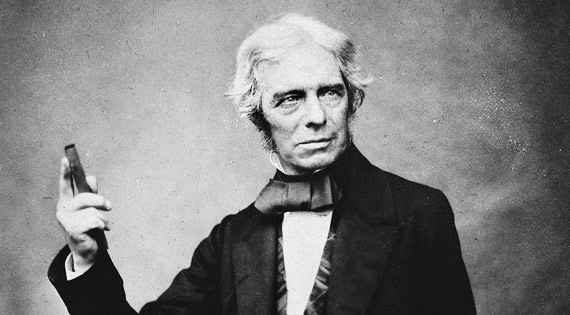
This is a letter written by Michael Faraday to Richard Philips on April 15, 1846. It is available at “Experimental Researches in Electricity”, Vol III, M. Faraday, p447-452.
I have added my comments (indented and in a different color) to each paragraph of this letter.
.
To Richard Phillips, Esq.
Dear Sir,
At your request I will endeavor to convey to you a notion of that which I ventured to say at the close of the last Friday-evening Meeting, incidental to the account I gave of Wheatstone’s electro-magnetic chronoscope; but from first to last understand that I merely threw out as matter for speculation, the vague impressions of my mind, for I gave nothing as the result of sufficient consideration, or as the settled conviction, or even probable conclusion at which I had arrived.
Faraday was chairing a Friday lecture at the “Royal Institution,” by Charles Wheatstone, on a device Wheatstone had invented for measuring very short time intervals. Half an hour before the talk the lecturer went home (for whatever reason), leaving Faraday with an assembled audience but no lecturer. [This allegedly started a custom in the Royal Institution to lock speakers in an office half an hour before their talks]. Faraday knew enough about the subject to give a good account of Wheatstone’s “chronoscope,” leaving ample time to spare. To fill time, Faraday then added his own lecture, with the above title.
The point intended to be set forth for consideration of the hearers was, whether it was not possible that vibrations which in a certain theory are assumed to account for radiation and radiant phaenomena may not occur in the lines of force which connect particles, and consequently masses of matter together; a notion which as far as is admitted, will dispense with the aether, which in another view, is supposed to be the medium in which these vibrations take place.
Faraday was an experimentalist and not a theorist. Other physicists and mathematicians saw action at a distance; but Faraday saw effect propagating through a medium. In his mind cause and effect were joined through continuous lines of force. Thus, all particles and masses were connected together through lines of force, which carried change from one point to another. It was generally understood that radiation propagated in space between masses through vibrations. Here Faraday is speculating that all radiation could be the result of vibrations of change carried through lines of force from one point to another. This concept could then replace the idea of aether as a medium in space.
The Disturbance Theory sees space itself as the “medium” that extends throughout the universe as a fabric like the lines of force. This makes radiation a disturbance in the fabric of space.
You are aware of the speculation [M. Faraday, Phil Magazine, 1844, Vol XXIV, p136; or Exp.Res.II.284] which I some time since uttered respecting that view of the nature of matter which considers its ultimate atoms as centres of force, and not as so many little bodies surrounded by forces, the bodies being considered in the abstract as independent of the forces and capable of existing without them. In the latter view, these little particles have a definite form and a certain limited size; in the former view such is not the case, for that which represents size may be considered as extending to any distance to which the lines of force of the particle extend: the particle indeed is supposed to exist only by these forces, and where they are it is. The consideration of matter under this view gradually led me to look at the lines of force as being perhaps the seat of vibrations of radiant phenomena.
Faraday viewed the atoms of matter as “centers” that were connected by lines of force, much like nodes in a network. He didn’t see them as “bodies” surrounded by forces, because a “body” to an experimentalist is an abstract notion. When you determine the form and size of such a body experimentally you are dealing with forces only. Thus, the size may be considered as extending to any distance to which the lines of force of the particle extend: the particle indeed is supposed to exist only by these forces, and where they are it is. Faraday’s view of radiation is consistent with his view of matter.
Disturbance theory is also consistent in its view of matter and radiation in a similar way. Radiation is simple disturbance propagating in space. A particle of matter is a complex disturbance concentrated at a point.
Another consideration bearing conjointly on the hypothetical view both of matter and radiation, arises from the comparison of the velocities with which the radiant action and certain powers of matter are transmitted. The velocity of light through space is about 190,000 miles in a second; the velocity of electricity is, by the experiments of Wheatstone, shown to be as great as this, if not greater: the light is supposed to be transmitted by vibrations through an aether which is, so to speak, destitute of gravitation, but infinite in elasticity; the electricity is transmitted through a small metallic wire, and is often viewed as transmitted by vibrations also. That the electric transference depends on the forces or powers of the matter of the wire can hardly be doubted, when we consider the different conductibility of the various metallic and other bodies; the means of affecting it by heat or cold; the way in which conducting bodies by combination enter into the constitution of non-conducting substances, and the contrary; and the actual existence of one elementary body, carbon, both in the conducting and non-conducting state. The power of electric conduction (being a transmission of force equal in velocity to that of light) appears to be tied up in and dependent upon the properties of the matter, and is, as it were, existent in them.
The consistency of Faraday’s view on matter and radiation is also borne out of the fact that the velocity of electricity in a metallic wire is comparable to the velocity of light. Both are viewed as being transmitted by vibrations. Light is apparently transmitted through aether, which, while lacking gravitation, is infinitely elastic. Electricity is transmitted through a metallic wire, which is subject to forces of gravitation but limited in elasticity. Gravitation and elasticity as forces are seen as balancing each other out.
In Disturbance theory the velocity of light is represented by wavelength to period ratio that remains constant between radiation and matter. Only the frequency is much higher for matter making it a much more complex disturbance.
I suppose we may compare together the matter of the aether and ordinary matter (as, for instance, the copper of the wire through which the electricity is conducted), and consider them as alike in their essential constitution; i.e. either as both composed of little nuclei, considered in the abstract as matter, and of force or power associated with these nuclei, or else both consisting of mere centres of force, according to Boscovich’s theory and the view put forth in my speculation; for there is no reason to assume that the nuclei are more requisite in the one case than in the other. It is true that the copper gravitates and the aether does not, and that therefore the copper is ponderable and the aether is not; but that cannot indicate the presence of nuclei in the copper more than in the aether, for of all the powers of matter gravitation is the one in which the force extends to the greatest possible distance from the supposed nucleus, being infinite in relation to the size of the latter, and reducing the nucleus to a mere centre of force. The smallest atom of matter on the earth acts directly on the smallest atom of matter in the sun, though they are 95,000,000 miles apart; further, atoms which, to our knowledge, are at least nineteen times that distance, and indeed in cometary masses, far more, are in a similar way tied together by the lines of force extending from and belonging to each. What is there in the condition of the particles of the supposed aether, if there be even only one such particle between us and the sun, that can in subtility and extent compare to this?
It is logical to consider aether and metallic wire alike in their essential constitution, either as little bodies or as centers of force. The difference shall only be in terms of degree. Matter has power of gravitation, which is a force that extends to the greatest possible distance from the supposed nucleus, reducing the nucleus to a center of force. Aether is that intervening distance.
In the Disturbance theory, matter is disturbance of extremely high frequencies that is concentrated, whereas, aether is simply the disturbed space in between.
Let us not be confused by the ponderability and gravitation of heavy matter, as if they proved the presence of the abstract nuclei; these are due not to the nuclei, but to the force super-added to them, if the nuclei exist at all; and, if the aether particles be without this force, which according to the assumption is the case, then they are more material, in the abstract sense, than the matter of this our globe; for matter, according to the assumption, being made up of nuclei and force, the aether particles have in this respect proportionately more of the nucleus and less of the force.
Atom being a little body is an abstract notion. It does not necessarily provide the reason for solidity and gravitation of matter. It can just as well be a center of force. In case of aether there is simply less solidity and gravitation.
In Disturbance theory, space acquires inertia when disturbed. The higher is the frequency and complexity of disturbance, the greater is its inertia.
On the other hand, the infinite elasticity assumed as belonging to the particles of the aether, is as striking and positive a force of it as gravity is of ponderable particles, and produces in its way effects as great; in witness whereof we have all the varieties of radiant agency as exhibited in luminous, caloric, and actinic phaenomena.
Aether has less solidity and gravitation, but it has infinite elasticity. This is as striking a “force” as gravity, and produces in its way effects as great. This balance points to a conservation of force, where force is defined as the ability to produce effect.
In Disturbance theory, the frequency and complexity of disturbance increases from the consideration of aether to matter, but it is the same space throughout that is disturbed.
Perhaps I am in error in thinking the idea generally formed of the aether is that its nuclei are almost infinitely small, and that such force as it has, namely its elasticity, is almost infinitely intense. But if such be the received notion, what then is left in the aether but force or centres of force? As gravitation and solidity do not belong to it, perhaps many may admit this conclusion; but what are gravitation and solidity? certainly not the weight and contact of the abstract nuclei. The one is the consequence of an attractive force, which can act at distances as great as the mind of man can estimate or conceive; and the other is the consequence of a repulsive force, which forbids for ever the contact or touch of any two nuclei; so that these powers or properties should not in any degree lead those persons who conceive of the aether as a thing consisting of force only, to think any otherwise of ponderable matter, except that it has more and other forces associated with it than the aether has.
Less gravitation and more elasticity simply means less concentration of force because it is more spread out. Solidity and gravitation are there because of concentration of force. It is basically a matter of degree. Lack of such concentration then leads to greater elasticity.
In Disturbance theory such concentration is described in terms of frequency. Solidity is the result of high frequency, whereas, gravity is the consequence of steeply changing frequency. Elasticity, on the other hand, is the consequence of low frequency.
In experimental philosophy we can, by the phaenomena presented, recognize various kinds of lines of force; thus there are the lines of gravitating force, those of electro-static induction, those of magnetic action, and others partaking of a dynamic character might be perhaps included. The lines of electric and magnetic action are by many considered as exerted through space like the lines of gravitating force. For my own part, I incline to believe that when there are intervening particles of matter (being themselves only centres of force), they take part in carrying on the force through the line, but that when there are none, the line proceeds through space. Whatever the view adopted respecting them may be, we can, at all events, affect these lines of force in a manner which may be conceived as partaking of the nature of a shake or lateral vibration. For suppose two bodies, A B, distant from each other and under mutual action, and therefore connected by lines of force, and let us fix our attention upon one resultant of force, having an invariable direction as regards space; if one of the bodies move in the least degree right or left, or if its power be shifted for a moment within the mass (neither of these cases being difficult to realise if A and B be either electric or magnetic bodies), then an effect equivalent to a lateral disturbance will take place in the resultant upon which we are fixing our attention; for, either it will increase in force whilst the neighboring results are diminishing, or it will fall in force as they are increasing.
The lines of force proceed through space. When there are intervening particles (centers of force), they take part in carrying the force through the line. In all events, these lines of force can be vibrations. If one end of the line of force is vibrated, the effect then proceeds through the line to the other end.
In Disturbance theory, the frequency of vibration along a path changes to accommodate the higher frequency of the mass encountered. It then returns to its original frequency after passing the mass, unless it is changed in some way by that mass.
It may be asked, what lines of force are there in nature which are fitted to convey such an action and supply for the vibrating theory the place of the aether? I do not pretend to answer this question with any confidence; all I can say is, that I do not perceive in any part of space, whether (to use the common phrase) vacant or filled with matter, anything but forces and the lines in which they are exerted. The lines of weight or gravitating force are, certainly, extensive enough to answer in this respect any demand made upon them by radiant phaenomena; and so, probably, are the lines of magnetic force: and then who can forget that Mossotti has shown that gravitation, aggregation, electric force, and electro-chemical action may all have one common connection or origin; and so, in their actions at a distance, may have in common that infinite scope which some of these actions are known to possess?
All we see in space are forces and the lines in which they are exerted. This is probably what aether is. Gravitational force that is spread out all over the space can be accounted for this way. The electromagnetic force also spreads out all over the space as light and can be accounted for this way. Though Faraday only speculated upon it, it was later found to be true.
In Disturbance theory, the frequency of disturbance accounts for the electromagnetic force; and the changes in frequency (gradients of frequency) account for the gravitational forces.
The view which I am so bold to put forth considers, therefore, radiation as a kind of species of vibration in the lines of force which are known to connect particles and also masses of matter together. It endeavors to dismiss the aether, but not the vibration. The kind of vibration which, I believe, can alone account for the wonderful, varied, and beautiful phaenomena of polarization, is not the same as that which occurs on the surface of disturbed water, or the waves of sound in gases or liquids, for the vibrations in these cases are direct, or to and from the centre of action, whereas the former are lateral. It seems to me, that the resultant of two or more lines of force is in an apt condition for that action which may be considered as equivalent to a lateral vibration; whereas a uniform medium, like the aether, does not appear apt, or more apt than air or water.
Faraday asserts boldly that all lines of force are made up of vibrations, and they account for electromagnetic, gravitational and other forces. He was way ahead of his time in making these speculations as substitution for the theory of aether. Much of these speculations have been verified now in science.
The Disturbance theory is simply making an attempt to formalize these speculations of Faraday to come up with a unified theory.
The occurrence of a change at one end of a line of force easily suggests a consequent change at the other. The propagation of light, and therefore probably of all radiant action, occupies time; and, that a vibration of the line of force should account for the phaenomena of radiation, it is necessary that such vibration should occupy time also. I am not aware whether there are any data by which it has been, or could be ascertained whether such a power as gravitation acts without occupying time, or whether lines of force being already in existence, such a lateral disturbance at one end as I have suggested above, would require time, or must of necessity be felt instantly at the other end.
Faraday maintained that instantaneous action at a distance was not possible and that the transmission of effect took time. The effect was transmitted through the lines of force. This is what radiation is. Light as well as gravitational effects shall take time to propagate through space. These speculations have since been verified as true by science.
The Disturbance theory concurs with the above as it looks at space as the fabric of the universe.
As to that condition of the lines of force which represents the assumed high elasticity of the aether, it cannot in this respect be deficient: the question here seems rather to be, whether the lines are sluggish enough in their action to render them equivalent to the aether in respect of the time known experimentally to be occupied in the transmission of radiant force.
The transmission of effect through radiation in space shall take time depending on how sluggish the lines of force are. Faraday is speculating here on the inertia in the lines of force.
In Disturbance theory, the greater is the frequency and complexity of the disturbance in space, the higher is the inertia. The inertia associated with mass is the resistance that space puts up to the propagation of mass as a complex disturbance. The radiation in gamma range of the electromagnetic spectrum is more complex and it shall take more time to propagate through space.
The aether is assumed as pervading all bodies as well as space: in the view now set forth, it is the forces of the atomic centres which pervade (and make) all bodies, and also penetrate all space. As regards space, the difference is, that the aether presents successive parts of centres of action, and the present supposition only lines of action; as regards matter, the difference is, that the aether lies between the particles and so carries on the vibrations, whilst as respects the supposition, it is by the lines of force between the centres of the particles that the vibration is continued. As to the difference in intensity of action within matter under the two views, I suppose it will be very difficult to draw any conclusion, for when we take the simplest state of common matter and that which most nearly causes it to approximate to the condition of the aether, namely the state of the rare gas, how soon do we find in its elasticity and the mutual repulsion of its particles, a departure from the law, that the action is inversely as the square of the distance!
We imagine aether to pervade all bodies and space. As regards bodies it lies between atoms. So, aether neither makes up the space nor the bodies. Here lies the difference with lines of force that make up the space as well as the bodies.
In Disturbance theory, there is no separate aether. There is only space and disturbances in space. Atoms of matter are simply made of complex disturbances.
And now, my dear Phillips, I must conclude. I do not think I should have allowed these notions to have escaped from me, had I not been led unawares, and without previous consideration, by the circumstances of the evening on which I had to appear suddenly and occupy the place of another. Now that I have put them on paper, I feel that I ought to have kept them much longer for study, consideration, and, perhaps final rejection; and it is only because they are sure to go abroad in one way or another, in consequence of their utterance on that evening, that I give shape, if shape it may be called, in this reply to your inquiry. One thing is certain, that any hypothetical view of radiation which is likely to be received or retained as satisfactory, must not much longer comprehend alone certain phaenomena of light, but must include those of heat and of actinic influence also, and even the conjoined phaenomena of sensible heat and chemical power produced by them. In this respect, a view, which is in some degree founded upon the ordinary forces of matter, may perhaps find a little consideration amongst the other views that will probably arise.
Faraday knew that these were speculations based on his experimental studies, and more experiments were needed to fully verify them. However, he felt certain that any view of radiation must also include, in addition to light, the phenomenon of heat, and the chemical effects produced by radiation; for this may help explain the forces in a wider context.
The Disturbance theory sees the investigation of chemical effects produced by radiation as an extensive area of research.
I think it likely that I have made many mistakes in the preceeding pages, for even to myself, my ideas on this point appear only as the shadow of a speculation, or as one of those impressions on the mind which are allowable for a time as guides to thought and research. He who labours in experimental inquiries knows how numerous these are, and how often their apparent fitness and beauty vanish before the progress and development of real natural truth.
The text of Faraday may be difficult to understand, with ideas no longer held about the “aether” and the nature of atoms. However Faraday’s main ideas are: the lines of force fill all space, and light propagating in space is a vibrating line of force. These lines of forces terminate at atoms of matter, which form the center of forces. Faraday felt such “transverse” waves, oscillating sideways like waves in molded gelatin (“jello”), explained the way light could be polarized. This last paragraph is an example of Faraday’s charming style.
I am, my dear Phillips,
Ever truly yours,
M. Faraday,
April 15, 1846
.