Author Archives: vinaire

I am originally from India. I am settled in United States since 1969. I love mathematics, philosophy and clarity in thinking.

Postulate Mechanics (PM)

Reference: The Book of Subject Clearing

This is an outline of Postulate Mechanics (PM), which is a new, upcoming subject. This outline is continually being extended and updated.

Note: This is a work in progress.

Postulate Mechanics (PM)

  1. PM Preface … … … … … Glossary: Postulate Mechanics
  2. PM Introduction
  3. PM Chapter 1: The Knowable Universe
  4. PM Chapter 2: Universe & Self
  5. PM Chapter 3: Substantiality (Substance)
  6. PM Chapter 4: Awareness (Ability to Sense)
  7. PM Chapter 5: Oneness (Assimilation)
  8. PM Chapter 6: Piercing the Veil
  9. PM Chapter 7: Atom & Space
  10. PM Chapter 8: The Fourth Law of Motion
  11. PM Chapter 9: Inertia & Gravity
  12. PM Chapter 10: The Particle
  13. PM Chapter 11: The Space
  14. PM Chapter 12: The Time

Subject Clearing (SC)

  1. The Book of Subject Clearing
  2. SC: Hinduism … … … … … Glossary: Hinduism
  3. SC: Buddhism … … … … … Glossary: Buddhism
  4. SC: Scientology … … … … … Glossary: Scientology
  5. SC: Psychology
  6. The Book of Physics
  7. The Book of Mathematics

Under Review

  1. PM: The Laws
  2. PM: The Universe
  3. PM: The Life
  4. PM: The Mind
  5. PM: The Logic
  6. PM: The Factors
  7. Holding: Postulate Mechanics

References

  1. PM: Introduction (old)
  2. Grassroots Scientology
  3. Holding Data: Blank Glossary

.

PM: The Universe

Reference: Postulate Mechanics

The following key words and definitions act as stable data that help understand the basics of the universe. The key words appearing in earlier chapters (words in square brackets) are not defined again. For all key words, please see PM: Glossary.

NOTE: “PM” is the abbreviation for Postulate Mechanics. The content of this subject is open to further refinement and update as long as they comply with the postulate of ONENESS.

[UNIVERSE]

SENSATION
When we sense something we call it a sensation. The awareness of sensation is determined by postulates. Postulates give meaning to sensations so they can be perceived. 

SUBSTANCE
Substance is that which is substantial enough to be sensed and perceived. We may divide the substance of this universe into three categories: (1) matter, (2) radiation, and (3) thought. The two fundamental aspects of substance are consistency and motion. As consistency decreases from matter to radiation to thought, the motion increases simultaneously on a greatly magnified scale. Thus, extremely small changes in  consistency may produce significantly large and visible changes in motion.

CONSISTENCY
Consistency is a fundamental aspect of substance, which means “a degree of density, firmness, viscosity, etc.” Matter has extremely high consistency called mass. Radiation has a such small consistency that it is considered to have no mass. Thought has still less consistency that cannot be sensed physically. It can only be sensed mentally. We have decreasing consistency from matter to radiation to thought. Matter and radiation are considered to be physical substances. Thought is considered to be a mental (metaphysical) substance.

MOTION
Motion, as observed in the properties of light and the electrons, is a fundamental aspect of substance. When the substance is extremely concentrated, as at the center of a galaxy, its consistency is near infinite, and its motion is near zero. When the substance is extremely diffused, as in the intergalactic space, its consistency is near zero, and its motion is near infinite. Motion reflects the relative SPREAD of substance. Matter has hardly any spread/motion. Radiation has respectable spread/motion. And thought has extreme spread/motion.

RELATIVE MOTION
The spread/motion of concentrated matter particles is near zero within this vast space, which is very likely the spread/motion of thought. But the relative spread/motion of two matter particles relative to each other can still be significant. All of physics is based on this relative motion of matter particles.

MEST
In Scientology, MEST stands for the all-substance universe, that we see as matter, energy, space, and time. Scientology makes the error of limiting the designation of “MEST” to the material universe only. In Postulate Mechanics, the universe is defined as all that is knowable, and made up of matter, radiation and thought as its substance. Space and time are properties of substance.

SPACE
Space refers to the spread of substance. There is no space in the absence of substance. The “empty space” is empty of matter only; but it defines the spread of radiation and thought. The “space” studied in geometry is actually the abstraction of the spread of matter.

TIME
Time refers to the duration of substance. Matter has near infinite duration. Any duration, which is less than infinite, appears as motion. In the absence of substance there is neither duration, nor motion nor time.

ENERGY
Energy is the measure of substance (mass or consistency) along with its inherent motion. Matter has energy. Radiation has anergy. Thought has energy. Usually, energy is confused with radiation, such as light.

MATTER
Matter is the substance with highest consistency, which is called mass. However, matter does contain radiation and thought as part of its structure.

REALITY
Reality is the is-ness of things. It is how we perceive the forms and their inherent motion. Reality is based on the postulates that we are in agreement with knowingly or unknowingly. The reality of the universe, however, comes from the oneness (continuity, consistency and harmony) of all things. Unreality has the elements of discontinuity, inconsistency or disharmony.

PERCEPTION
Perception becomes clearer as the sensations get assimilated after deriving their meaning from postulates. The sensations routinely get assimilated into perceptions, such as, visual (sight), auditory (hearing), olfactory (smell), gustatory (taste), tactile (touch) and mental (internal). 

ASSIMILATION
To assimilate is to “make similar” by establishing consistency among elements under consideration. Any discontinuity, inconsistency or disharmony is an anomaly that needs to be assimilated. To assimilate one looks at the anomaly more closely until its exact nature is recognized. When sensations are assimilated they provide clearer perceptions. When perceptions are assimilated they provide clearer memory. When memories are assimilated they provide clearer experience. When experiences are assimilated they provide clearer knowledge. When knowledge is assimilated it results in wisdom.

ONENESS
In Postulate Mechanics, Oneness is understood as CONSISTENCY among parts. This consistency appears as CONTINUITY at very small scales, and as HARMONY at very large scales. Oneness does not imply sameness. Oneness means that all that is known is continuous, consistent and harmonious. Oneness lies in the continuity of dimensions, consistency of realities, and harmony of relations. Oneness underlies the very concept of the Universe, and also the concept of Scientific Method. Oneness is not a monotone canvas; but it is a beautiful painting full of colors and forms that are continuous, consistent and harmonious. 

[ANOMALY]

LOGIC
The purpose of Logic is to assimilate things so they form a consistent whole. Logic associates observations, thoughts, concepts and other elements of the universe, to make them continuous, consistent and harmonious. When things are not logical we have anomalies. These anomalies may be described as discontinuity (missing data), inconsistency (contradictory data), and disharmony (arbitrary data). 

TRUTH
The truth of a datum is established by the demonstration of its consistency within the given context. Presence of even a single anomaly degrades the truth. 

KNOWABLE
The knowable universe is the outcome of postulates. It consists of all that can be sensed and perceived. The spiritual elements are sensed and perceived as thought. The physical elements are sensed and perceived as matter and radiation. As knowable, both spiritual and physical elements are integrated into a single Universe. This knowable Universe is differentiated only from the Unknowable.

[KNOWLEDGE]

.

Dianetics Axioms 181 – 194

Reference: The Dianetics Axioms

L. Ron Hubbard found that man is obeying very definite laws and rules which could be set forward in axioms. The very first and most fundamental of these is: The dynamic principle of existence is survive. That is the basic axiom of Dianetics.

The original Dianetic axioms are referenced below in black.

.

Executive Summary 2025

.

Axioms 181-194

DN AXIOM 181: Pain is stored as plus or minus randomity

.

DN AXIOM 182: Pain, as an area of plus or minus randomity, can reinflict itself upon the organism.

.

DN AXIOM 183: Past pain becomes ineffective upon the organism when the randomity of its area is addressed and aligned.

.

DN AXIOM 184: The earlier the area of plus or minus randomity, the greater self-produced effort existed to repel it.

.

DN AXIOM 185: Later areas of plus or minus randomity cannot be realigned easily until earlier areas are realigned.

.

DN AXIOM 186: Areas of plus or minus randomity become increased in activity when perceptions of similarity are introduced into them.

.

DN AXIOM 187: Past areas of plus or minus randomity can be reduced and aligned by address to them in present time.

.

DN AXIOM 188: Absolute good and absolute evil do not exist in the mest universe.

.

DN AXIOM 189: That which is good for an organism may be defined as that which promotes the survival of that organism. 

COROLLARY: Evil may be defined as that which inhibits or brings plus or minus randomity into the organism, which is contrary to the survival motives of the organism.

.

DN AXIOM 190: Happiness consists in the act of bringing alignment into hitherto resisting plus or minus randomity. Neither the act or action of attaining survival, nor the accomplishment of this act itself, brings about happiness.

.

DN AXIOM 191: Construction is an alignment of data. 

COROLLARY: Destruction is a plus or minus randomity of data. The effort of constructing is the alignment toward the survival of the aligning organism. Destruction is the effort of bringing randomity into an area.

.

DN AXIOM 192: Optimum survival behavior consists of effort in the maximum survival interest in everything concerned in the dynamics.

.

DN AXIOM 193: The optimum survival solution of any problem would consist of the highest attainable survival for every dynamic concerned.

.

DN AXIOM 194: The worth of any organism consists of its value to the survival of its own THETA along any dynamic.

.

Dianetics Axioms 166 – 180

Reference: The Dianetics Axioms

L. Ron Hubbard found that man is obeying very definite laws and rules which could be set forward in axioms. The very first and most fundamental of these is: The dynamic principle of existence is survive. That is the basic axiom of Dianetics.

The original Dianetic axioms are referenced below in black.

.

Executive Summary 2025

.

Axioms 166-180

DN AXIOM 166: An individual is as happy as he can perceive survival potentials in the future.

.

DN AXIOM 167: As the needs of any organism are met it rises higher and higher in its efforts along the dynamics. An organism which achieves ARC with itself can better achieve ARC with sex in the future; having achieved this it can achieve ARC with groups; having achieved this, it can achieve ARC with mankind, etc.

.

DN AXIOM 168: Affinity, reality and communication coexist in an inextricable relationship. The coexistent relationship between affinity, reality and communication is such that none can be increased without increasing the other two and none can be decreased without decreasing the other two.

.

DN AXIOM 169: Any aesthetic product is a symbolic facsimile or combination of facsimiles of theta or physical universes in varied randomities and volumes of randomities with the interplay of tones.

.

DN AXIOM 170: An aesthetic product is an interpretation of the universes by an individual or group mind.

.

DN AXIOM 171: Delusion is the postulation by the imagination of occurrences in areas of plus or minus randomity.

.

DN AXIOM 172: Dreams are the imaginative reconstruction of areas of randomity or the resymbolization of the efforts of theta.

.

DN AXIOM 173: A motion is created by the degree of optimum randomity introduced by the counter-effort to an organism’s effort.

.

DN AXIOM 174: MEST which has been mobilized by life forms is in more affinity with life organisms than nonmobilized mest.

Substance which has been assimilated by life forms is in more affinity with life organisms.

.

DN AXIOM 175: All past perception, conclusion and existence moments, including those of plus or minus randomity, are recoverable to the control center of the organism.

.

DN AXIOM 176: The ability to produce survival effort on the part of an organism is affected by the degrees of randomity existing in its past. (This includes learning.)

.

DN AXIOM 177: Areas of past plus or minus randomity can be readdressed by the control center of an organism and the plus or minus randomity exhausted.

.

DN AXIOM 178: The exhaustion of past plus or minus randomities permits the control center of an organism to effect its own efforts toward survival goals.

.

DN AXIOM 179: The exhaustion of self-determined effort from a past area of plus or minus randomity nullifies the effectiveness of that area.

.

DN AXIOM 180: Pain is the randomity produced by sudden or strong counter-efforts.

.

Grassroots Scientology

Reference: The Book of Subject Clearing

If you really want to go after the cruelty of the Church of Scientology, and eliminate it once and for all, then you have to generate and promote a grassroots version of Scientology that is free, doable and effective.

The grassroots’ version of Scientology is rooted in Buddhism, as Scientology was originally conceived to be. It is unlike the Scientology promoted by the Church of Scientology that uses the therapist-patient model borrowed from psychotherapy. This grassroots version of Scientology is Self-Help.

.

Grassroots Version and E-meter

The e-meter is not used in the Grassroots version, which uses The 12 Aspects of Mindfulness instead. By drilling on these 12 aspects of Mindfulness, a person develops an internal sensitivity for processing one’s own mind. This internal sensitivity replaces the dependence on the E-meter.

.

Grassroots Version and End Phenomenon (EP)

Scientology uses the technique of “repetitive questioning” to make a person look closely at an auditing question. This makes the person search his mind for answers. A Scientology process is not ended until some realization (called EP) takes place. Very often this ends up in overrunning the process. “Overrun” means continuing a process past the optimum point. The “overrun” then requires repair and wastes valuable auditing time.

In the grassroots version, the person does not search his mind for answers. He simply contemplates on the question by being there and confronting. He has enough sensitivity to know ahead of time if a new answer to the auditing question is accessible or not. If it is, he waits for the answer to appear. When there are no more answers appearing, the person ends the process.

A person can always go back to a process and run it again. As his confront improves, more answers become accessible. So, even when there is no EP in the first attempt, there will certainly be realizations in subsequent attempts in running a process. And there will also come a point, when the person knows that he is done with a process, or a Grade, and he is ready to move on.

.

Grassroots Version and Solo Auditing

The grassroots version does not use the therapist-patient model of psychotherapy, in which a therapist (or auditor) uses some theory to figure out what is wrong with a person in each moment, and tries to handle that wrongness. Such an approach is prone to many errors because the therapist can never be fully in the shoes of the person. Such errors of “external evaluation” are avoided when the person uses mindfulness approach in grassroots Scientology.

Of course, there are going to be a small percentage of people who would not be able to apply the mindfulness approach of grassroots version without some initial help. Such help may be provided by field auditors at a reasonable cost. Otherwise, the grassroots version is free.

.

Prerequisite

One should start with Handling Introversion.

Then do the drills provided in The 12 Aspects of Mindfulness.

Then do TR0 with Mindfulness with a friend or another person.

You can always do these basic actions (prerequisites) whenever you need to free up your attention. Recycling through them now and then is very helpful.

.

Scientology Grades

A person contemplates on the grade processes in the “TR0 mode”, with all the 12 aspects of mindfulness naturally present.

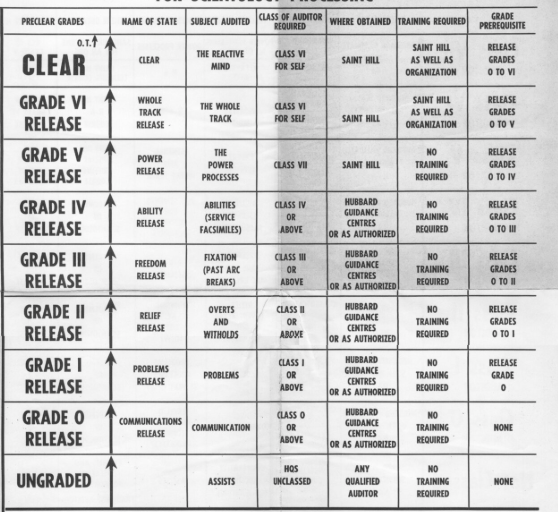
The Scientology Grades focus on the fixations of a person due to his IDENTIFICATIONS with the universe. Each grade is made up of processes that address a different level of fixation. The person may do a grade level several times until he is satisfied with it. He may then move to the next grade level. These grades are done in the following order.

  1. ARC Straight wire Processes
  2. Grade 0 Processes (Communications Release)
  3. Grade 1 Processes (Problems Release)
  4. Grade 2 Processes (Relief Release)
  5. Grade 3 Processes (Freedom Release)
  6. Grade 4 Processes (Ability Release)
  7. Grade 5 Exercises (Power Release)
  8. Grade 6 Exercises (Whole Track Release)

One may then recycle through all the grade levels as necessary. This goes very fast with mindfulness and without an e-meter.

.

The OT Levels

Then one may move on to the OT Levels.

  1. The Level of OT I
  2. The Level of OT II
  3. The Level of OT III
  4. OT Level IV (see Scientology OT Levels)
  5. OT Level V (see Scientology OT Levels)
  6. OT Level VI (see Scientology OT Levels)
  7. OT Level VII (see Scientology OT Levels)
  8. The Level of OT VIII

OT Levels are accompanied by Subject Clearing as the continuing process of OT VIII.

.

Dianetics

The erasure on Dianetics fully occurs at the level of NOTs (New Era Dianetics for OTs). The procedure of NOTs shall be added when it is fully researched for Grassroots Scientology.

.

Notes

  1. Scientology focuses on the RIGHT MINDFULNESS section of the Eight-Fold Path of Buddhism. To understand Scientology properly, you may want to study the following “subject-cleared” summary of Buddhism: SC: Buddhism.
  2. To understand the philosophy underlying Scientology, you may go to this link: Scientology Research.
  3. If you are willing to follow the Grassroots Scientology program as a solo auditor, I shall be happy to work with you as your C/S (Case Supervisor). It is all free, of course, for the sake of humanity that is soon going to be challenged by Artificial Intelligence.

.