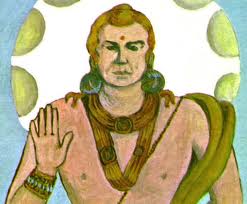
Hubbard promoting himself through his ADVANCE magazine as Buddha’s successor
The goal of Buddhism has always been to perceive reality for what it is, and to help transcend all illusions including the illusion of self or individuality. Unfortunately, this was unacceptable to Hubbard, whose effort was to empower his individuality to the utmost. Hubbard made individuality the centerpiece of his philosophy of Scientology. It had a great appeal to those living in the competitive environment of the twentieth century.
Hubbard looked upon the Buddhist goal of Nirvana with derision. To him Nirvana was giving up one’s individuality and becoming an ineffectual part of the physical universe. Here are references to Buddhism from Hubbard’s writings followed by my comments.
.
Dianetics – The Modern Science of Mental Health (1950)
“A fine swami trick; which most amazed the author in India, was the inhibition of blood flow by the awake individual in himself. On command a cut would bleed or not bleed. It looked fantastic and made very good press agentry that here was a swami who had so associated himself with Nirvana that he was in control of all material matters. Awe faded when the author learned that, via hypnosis, he could make his own body do the same thing and no Nirvana involved.”
This quote shows that Hubbard is ignorant about Nirvana. Here he is lumping Hinduism and Buddhism together. The control of blood flow has nothing to do with Nirvana.
.
ADVANCED PROCEDURE AND AXIOMS (1951)
“All life forms are not from a single source. The ideas of Nirvana, Valhalla, Adam, the original cell, each is now rather completely disproven.”
Here Hubbard is trying to associate the idea of a single source with Nirvana, but Nirvana has no idea of God associated with it.
.
SCIENTOLOGY A HISTORY OF MAN (1952)
“Separation from the body! How the mystics have striven for this one! India and “join Nirvana” has given us “techniques” WHICH ARE GUARANTEED TO GLUE A THETAN TO A BODY AS THOUGH RIVETED AND TIED WITH IRON BANDS. So beware of mysticism and its techniques and yogism. Your hardworking author has been over the jumps and through the hoops of more mysticism than is even suspected and on the ground where mysticism first hit Earth— India, and I can guarantee you that these practices and hopes are a sort of theta trap to keep men in their bodies, in apathy, ill and tied to superstition.”
The technique associated with Nirvana is mindfulness. Mindfulness is seeing things as they are. It is impossible to find fault with the technique of mindfulness. By lumping Nirvana with mysticism, Hubbard seems to be intent on promoting that his philosophy is superior to all other philosophies of the past.
.
SCIENTOLOGY 8-8008 (1952)
“One of the control mechanisms which has been used on thetans is that when they rise in potential they are led to believe themselves one with the universe. This is distinctly untrue. Thetans are individuals. They do not as they rise up the scale, merge with other individualities. They have the power of becoming anything they wish while still retaining their own individuality. They are first and foremost themselves. There is evidently no Nirvana. It is the feeling that one will merge and lose his own individuality that restrains the thetan from attempting to remedy his lot. His merging with the rest of the universe would be his becoming matter. This is the ultimate in cohesiveness and the ultimate in affinity, and is at the lowest point of the tone-scale. One declines into a brotherhood with the universe. When he goes up scale, he becomes more and more an individual capable of creating and maintaining his own universe. In this wise (leading people to believe they had no individuality above that of MEST) the MEST universe cut out all competition.”
Hubbard seems to be intent on empowering individuality as his ultimate goal. Buddha had earlier discovered the self to be impermanent. To Buddha, seeking to empower self was like chasing after an illusion. He discovered that a person could transcend individuality and be in complete harmony of Nirvana. To Hubbard, individuality was everything, and letting go of individuality was to become an unthinking entity controlled by the laws of the physical universe. Hubbard believed obsessively in competing and winning. (Please see KHTK Postulates.)
.
“The Hindu sought to depart into his Nirvana by refusing to have anything to do with having. He sought thus to promote himself into Being. He saw that so long as he retained a grasp on a body in any degree he was Having, and thus was pressed into Doing.”
Nirvana is a Buddhist concept. Unlike Hinduism, Buddha was against the path of asceticism. Buddha put forth Nirvana as a state where one can see reality for what it is, and is not deluded by it. Attaining nirvana is not departing from “having” as Hubbard eludes here.
.
THE PHOENIX LECTURES (1954)
“We first find this Buddha called actually Bohdi, and a Bohdi is one who has attained intellectual and ethical perfection by human means. This probably would be a Dianetic Release (Dianetic Release: One who in Dianetic auditing has attained good case gains, stability and can enjoy life more. Such a person is “Keyed out” or in other words released from the stimulus response mechanisms of the reactive mind) or something of this level. Another level has been mentioned to me — Arhat, with which I am not particularly familiar, said to be more comparable to our idea of Theta Clear.”
How many Dianetic Release or Theta Clears are noticeable in the society who have the abilities as promoted by Hubbard? The fact that there are none makes one wonder if Hubbard thought of himself as the proof. Maybe in his mind his theory worked as long as he could display those abilities. He definitely used Scientology to empower himself.
.
“There were many Bohdis, or Buddhas. And the greatest of these was a fellow by the name of Gautama Sakyamuni and he lived between 563 and 483 BC. I won’t go so far as to say he’d ever read the Tao-Teh-King because there is absolutely no evidence to that effect at all, except that they certainly were riding on the same pathway. So much so that when Taoism turned into Buddhism later on they never abandoned the Tao. Taoist principles became Chinese Buddhist principles, in very large measure. And what we have just talked about in terms of knowing the way to Knowingness is very, very closely associated here with Buddha or Lord Buddha, or Gautama Buddha, or the Blessed One, or the Enlightened one. He is looked upon, and according to my belief in the line, erroneously, as the founder of the Dhyana. I think that this was in existence for quite a long time before he came along, but that he pumped life into it, he gave it codification, he straightened it up and made it run on the right track and it has kept running in that direction ever since, he did such a thoroughly good job. He was such an excellent scientific philosopher, and he himself was so persuasive and so penetrative in his work, that nobody has ever managed to pry apart Dhyana and Gautama Buddha. This identification is such a very close one that even in areas that have no understanding whatsoever of the principles laid down by Gautama Buddha, we find him sitting there as an idol, which would have been a very, very amusing thing to Buddha, because he, like Lao-Tzu, never said that he was otherwise than a human being.
“He didn’t ever announce any revelations from supernatural sources, there were no guardian angels sitting on his shoulders preaching to him, as in the case of Mohammed and some other prophets. Nobody was ever giving him the word. But he went around giving what he had to people, he never intended to be anything but a human being, and he was a teacher. A tremendously interesting man. Now we find, however, some of the things that were written by Gautama, find them very significantly interesting to us, completely aside from Dhyana (which could be literally translated as “Indian for Scientology”, if you wished to do that).”
Is Hubbard trying to position himself next to Buddha. He certainly wanted to be known as Mettaya, the next Buddha, who took knowledge to a higher level.
.
THE CREATION OF HUMAN ABILITY (1955)
“Randomity comes about when one selects out and gives determinism to another entity or object. This tells you immediately that the problem of healing at a distance could be looked upon with some favor, and this would be true if the concept of Nirvana were true, where all life comes about as a fragmentation of Life.”
Nirvana is not a theory that all life comes from fragmentation of some higher form of life. Buddha described Nirvana as, ‘The extinction of desire, the extinction of hatred, the extinction of illusion.’
.
THE ROAD TO TRUTH Lecture (1962):
“Now, Buddha – Gautama Siddhartha – nobody should say any hard words about this man, because he told everybody he was just a man, he was trying to set men free and he was trying to help people out and so forth. And all that was perfectly true. And he discovered how to exteriorize without being able to stably exteriorize, without discovering any of the rules or laws of exteriorization, without making it possible for anybody else to exteriorize at will. How many hundred million people, since twenty-five hundred years ago until now, did Gautama Siddhartha totally condemn to utter and complete slavery by not walking down that road all the way? Because that-those half-truths have been used and used and misused and abused and booby-trapped and monkeyed up and so forth. That’s merely because he didn’t go all the way down the road, don’t you see?
“Now, knowing this sort of thing, it takes a rather brave man to walk in the direction of truth because he knows very definitely that he must go on down the road. If he knows anything at all, he realizes that the traps of existence and the upsets of existence are composed of half-truths, and that all work to amuse or enlighten or something is susceptible to being employed in the field of enslavement. The slave makers always use it; it serves as the mechanism to trap by the two-way flow, don’t you see? Somebody comes along and want to set everybody free and naturally the reverse flow on it is to trap everybody. One has to recognize this as an action.”
Hubbard never took Buddha seriously or hardly studied his work. He simply assumed that Buddha did not walk down the road all the way. But Buddha did and discovered that even self was an illusion. He came up with the Four Noble Truths and the successful Eight-fold path to Nirvana, which is being followed even to this day after 2600 years.
Hubbard, on the other hand got trapped in the aggrandizement of self. He actively trapped others by promising them super-natural abilities through OT levels. His Church is already in a decline after his death 1n 1986.
.
Dianetics – Evolution of a Science (preface of 1967)
“As far as the basic attempt is concerned, there has been only one organization of knowledge on earth which has had a similar goal —which is the goal of Total Freedom, being able to get out of the trap of confusion, being able to back up and take a look at it all, and that was Buddhism, practically 2500 years ago. Unfortunately Buddhism isn’t adequate as a comparable datum to Scientology because the Western World hasn’t a clue as to what Buddhism is all about, and we should understand that we’re embarked upon something that hasn’t been embarked upon for 2500 years. It isn’t that what we’re doing is as important as Buddhism. It isn’t that Buddhism is as important as Scientology. But both of them attempted to select out the important things—a selection of the importance’s of life, and to fill Man’s void of knowing with accurate observation.”
My conclusion is that Hubbard tried to position Scientology using the popularity of Buddhism. He defined the goals of Scientology to be similar to the goals of Buddhism; and the state of Clear to be similar to the state of Bodhi. According to him, Scientology far surpassed the results of Buddhism.
But the truth is that through the technique of mindfulness Buddha could see that the self was illusory, and he took steps to help others transcend that illusion. However, Hubbard and Scientology went in the opposite direction making the empowering of individuality to be its goal. These two goals are completely opposite of each other.
Buddha lived a long fulfilling life of 80 years in the relatively primitive conditions that prevailed 2600 years ago in India. He passed away peacefully surrounded by his disciples.
Hubbard lived for 74 years in the comfortable affluence of twentieth century America. He died while living in hiding, alone and in quite an unhappy and disturbed state of mind.
.