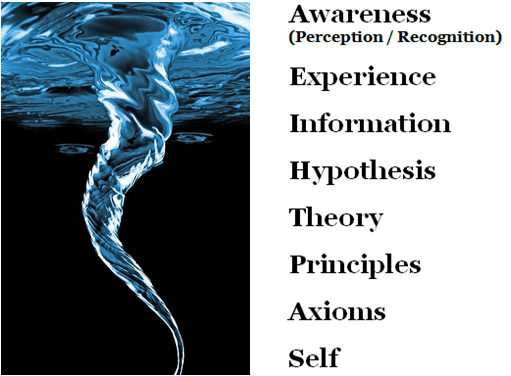
Primary Axioms
Dianetics and Scientology axioms have been established on a trial and error basis. Work continues to prove or disprove them. By the use of these axioms certain definite and predictable results have been obtained.
Earliest Dianetics axiom assigns a dynamic principle of existence, SURVIVE, as the lowest common denominator to everything in this universe. All animals, vegetable, and minerals are assumed to have a purpose to survive toward some end.
The urge to survive underlies all activities of life from forming a cell to possession of a central control system, which was designed to solve problems relating to food, defense, protection and means of procreation.
In surviving, the ultimate success would be immortality, and the ultimate failure would be death. In the middle would be mere existence without hope of much success and without fear of failure. There will be gradations of success above it, and gradations of failure below it. This idea is presented in Scientology in the form of a scale called TONE SCALE.
The organism acts within its environment upon information received or recorded. The mind as the central control system of the body, poses, perceives and resolves problems of survival and directs or fails to direct their execution.
The DYNAMIC is defined as the persistency of the individual in life. INTELLIGENCE is defined as the ability of the individual to resolve problems relating to survival. The Dynamic and Intelligence are two primary factors independent of each other.
PLEASURE is a perception of advance toward the ultimate goal, and PAIN is a perception of reduction of reach toward that goal. Both are necessary survival factors.
GOOD are those things that aid the dynamic drive of the individual, his family, his group, his race, or life in general. EVIL are those things, which tend to limit the dynamic thrust. Good may be defined as constructive. Evil may be defined as destructive. The perception of good and evil may be modified by the viewpoint.
HAPPINESS depends upon making, consolidating, or contemplating gains toward his goal.
.
An Analogy of the Mind
Dianetics simply addresses those aberrative experiences in the mind in which conditions, such as psychosomatic manifestations, have their roots. Aberrated behavior is that which is contrary to survival. Invariably its source is found to be a painful experience containing data, which is not available to the analytical mind. Dianetics consists of discovering the aberration in the individual, finding the physically painful experience, which corresponds to it, and placing the data therein contained at the disposal of the analytical mind.
There is an aspect of the conscious mind that is entirely reactive in its “thinking.” This aspect of mind dominates in animals. “Consciousness” means the awareness of now. The mind records successive instances of now. This makes up a time track connecting memory in an orderly chain. This process is not interrupted during “unconsciousness,” which is basically an interruption of only the analytical process.
The primary motivator in lower orders is energy in its various forms. This energy evolves into a physio-animal mind with ability to command the entire organism. The physio-animal mind evolves a self-deterministic ability to analyze and direct itself. In lower organisms this ability is expressed as simple reactions learned from painful experiences. We may call this low level of “self-deterministic” ability, THE REACTIVE MIND. In higher organisms this ability becomes much more complex. In man it acquires such power and complexity that it has no real rival in any other species. We may call this highly developed self-deterministic ability, THE ANALYTICAL MIND.
The self-deterministic ability coordinates the response of the physio-animal mind. In the state of extreme emergency, this ability may reduce itself from a high-level complex and delicate analytical process to a low-level simple and rugged reaction. This reduction is perceived as “error in thinking.” It is activated by the need for immediate action in response to perceived emergency as triggered by restimulators. RESTIMULATORS are things in the environment, which are perceived to approximate the painful experiences in the mind, and thus bring about an awareness of emergency.
The entire organism is always conscious but the temporary dispersion of the thought processes of the analytical mind brings about a condition whereby that mind, having been dispersed and considering itself the residence of the person, is unable to obtain and reach data perceived and received by the organism during the analytical mind’s condition of dispersion.
.
The Dynamics
All energy efforts and all forms follow a dynamic thrust through time toward the attainment of some goal. We may refer to the dynamic thrust as urge to SURVIVE.
This urge to survive may be divided as follows:
SELF: Concern with the survival of body and self-determinism.
SEX: Concern with procreation of progeny and its survival into the future.
GROUP: Concern with one’s activity to obtain and maintain the survival of the group of which one is a part. Family is a combination of dynamics.
MANKIND: Concern with the survival of the species of man.
LIFE: Concern with the survival of life as expressed through all species.
PHYSICAL UNIVERSE: Concern with the survival of all matter, energy, space and time.
THOUGHT: Concern with the survival of thought.
UNIVERSAL THOUGHT: Concern with the survival of the Creative impulse.
Each dynamic is of nearly equal importance in the individual. It breaks further into purposes, which are specific and which interact with each other in a complex way.
Even an unaberrated individual reasoning freely can have difficulty rationalizing the problems of importances and choices amongst these dynamics. An aberrated individual will, however, come up with non-survival solutions thinking them to be survival.
Individual and group irrationalities may introduce further complexity amongst the dynamics. The aberrated conditions of a society tend to vary the stress on these dynamics, making first one and then another keynote of the society.
.
The Basic Individual
The basic individual is the state of complete integration and highest possible rationality. This state is established by
The strength of his basic DYNAMIC, and the relative strengths of his dynamics;
The sensitivity, which is to say the intelligence, of his analyzer;
The coordination of his motor controls, and his physiological and glandular condition;
His environment and education.
Though amazingly varied one from the next, the basic individual is essentially “good” and he lacks no courage. He is responsive on all dynamics. There are no intentional vices or destructive dramatizations. He is in possession of self-determinism. Artistry, personal force, personality, all are residual in the basic personality, and do not derive from his aberrations.
.
Engrams
The engram is a packaged perceptic intimately connected to the physio-animal mind. Lowered analytical awareness combined with pain and actual or conceived antagonism allows engram to be formed. The engram interprets organism’s immediate perceptions during periods of weariness, illness, or hypnotic moments, per the associations formed earlier under extreme conditions.
Each sensory perception is organized precisely as the field of semantics is organized. It is plotted in time according to the earliest or most forceful significances. Words are sounds in syllabic form delivered with a definite timbre, pitch, and volume or sight recognition in each case. The mind is better able to differentiate amongst qualities of utterance than amongst the meanings of words themselves.
Scanners of the analytical mind can scan ordinary memory data, but they cannot scan charge antagonistic to survival from an engram. The reverse charge exerts hidden influence on the analytical computations, and it is directly hooked to motor controls and other physical functions.
An engram is an entire dramatic sequence, implanted during unconsciousness, which possesses specific perceptic keys (restimulators), any one of which, when unanalytically perceived by the individual in his environment, may in greater or lesser degrees set the engram into reaction. The engram is dramatized literally by physio-animal circuits. Its content is denied to the analytical mind in its exact character during its dramatization.
There are three kinds of thought:
Engramic thought is literal. It demands immediate action without examination by the analytical mind.
Justified thought is the effort of the conscious mind to explain away the aberrated side effects caused by engramic thought,
Rational thought is optimum in terms of providing solutions.
Individual is much more susceptible to the effects of engrams when there is hostility and confusion in the environment. An engram confuses the time sense of a person. It can keep an individual partly in a regressed state.
An aberration is serious to the degree it undermines the competence of the individual. Every aberration contains its exact command in some engram. For every engram there is a somatic as part of that engram. The aberrated condition depends on severity of engrams rather than the number of them. The severity of engram is proportional to perceived threat to survival.
A “floater” is an engram that has not been restimulated. A “chronic” is an engram that has been restimulated enough times to become a part of the individual.
A “lock” is painful mental experience which is joined to an engram and dependent on it for its pain value. The lock can be scanned by the analyzer, but not the engram. Removal of engram removes all related locks. Attention should be paid to engrams rather than to locks.
It is therapeutic to remove the individual from a restimulative environment. Effects of an engram may be overcome by a survival purpose boosted by necessity.
A birth engram is common to both mother and child and it may collect a lot of locks because of their close association and continual restimulation.
The organic sensation aspect of an engram, when restimulated, may cause somatic and deny body fluids to parts of the body causing psychosomatic illness and actual disease.
Hypnosis is creation of associations at amnesia-trance level. The mind is compelled to follow such associations and explain them to itself. When suggestion of such association is recalled, the mind suddenly understands the real reason, and the compulsion vanishes.
The release of the post-hypnotic suggestion into the analytical mind brings about rational thought. An engram is like a post-hypnotic suggestion inflicted with pain and antagonism to give it a more lasting effect. An engram can be formed prior to birth even.
Pain appears to jumble up the perceptions into a knot which then persists. When activated, this knot of perceptions bears down on the body the same way as it did when it was first formed. The raw perceptic associations of pain and antagonism override finer learned associations.
Under pain perceptics function differently and develop complex associations. Reaction to environment from earlier experience of pain and antagonism can be observed even at cellular level. Birth is ordinarily an engram of some magnitude.
Presence of analytical power and an absence of pain prevent the formation of engrams. Normal hurdles encountered in life accompany enough analytical power and absence of pain. They are not capable of aberrating the individual. The human mind is founded upon powerful and constructive basics, which only powerful, painful and antagonistic experiences can impede.
The first problem of the auditor is discovery of the basic engram.
The engram is a bundle of perceptics which include, as the primary manifestation, organic sensation. The organic sensation is enforced on the members of the body to a greater or lesser degree whenever, and as long as, the engram is restimulated. It then co-exists with NOW. Every engram contains and enforces the command on the analytical mind that it has been dispersed and is not operating.
.
Aberrations
It is the content of the engram, which causes the aberration and forms its nature.
Engrams modify the basic command SURVIVE, thus producing abnormal characteristics in the behavior of the analytical mind.
When the organism can no longer influence or command its environment, it can be considered to be insane in that environment.
Aberration is caused by the factors
(a) That derange the time sense of the individual
(b) That make the individual chronically unable to conceive differences.
(c) That suspend analytical mind’s ability to conceive associations
The mind resolves problems related to survival, utilizing its ability to conceive similarities and observe differences.
The following are some complexions of aberration:
Compulsion – command that organism must do something.
Repression –command that the organism must not do something
Neurosis – an emotional state containing conflicts and emotional data
Psychosis – a conflict which seriously reduces individual’s ability to solve his problems.
The engram cannot manifest itself as a mental aberration without also manifesting itself to some degree as somatic aberration.
In the absence of disease or injury, any mind not in a physiological amnesia state may be restored to normal function by the removal of the reactive mind.
.
The Tone Scale
The tone scale provides a measure for sanity in an individual.
The location and development of an engram begins with apathy, develops into anger (or the various facets of antagonism), proceeds into boredom, and arrives at last in cheerfulness or vanishes utterly.
An individual with a zero tone would be dead. Zero to one is that emotional bracket which may be denoted as apathy. From one to two is the range of antagonism. From two to three is the range of boredom. From three to four is the range of cheerfulness. The term tone four denotes a person who has achieved rationality and cheerfulness.
Each engram in the reactive mind can be said to possess a tone value. Above two point five an engram could not be considered to have any great power to affect the analytical mind. Engrams can be computed as they lie along the dynamics. Complete rationality depends upon exhaustion of the reactive mind.
The initial diagnosis is done by the assignation of a general tone to denote the condition of an individual’s reactive mind. An engram normally can be expected to run from its initial value in the apathy or anger range to tone four.
.
The Character of Engrams
Traumatic perceptics create associations and identities in the analytical mind where such did not exist before. The individual then uses these associations and identifications to interpret what it perceives. The mind perceives the impressions left by past perceptics in the form of a time track of experience.
This derangement itself, having become part of the analyzer, cannot be perceived by the analyzer. The impression left of those traumatic perceptics, which cause this derangement, cannot be perceived by ordinary means.
Both body and mind get aligned to the engram (the impression left by traumatic perceptics) and get activated into its pattern when similar perceptics appear in the environment. The engramic content then gets dramatized.
The analyzer cannot permit itself to be wrong. So it has to justify what it does under the influence of the engram. Engramic thought is irrational identity-thought by which the mind is made to conceive identities where only vague similarities may exist.
As the analytical mind becomes more corrupted due to the infiltration of traumatic perceptics from outside it reacts to unsolved problems as follows:
- Succumbs – justifies the organism’s reaction to them
- Neglect – apathetically may neglect them
- Avoid – avoid them in many intricate ways
- Flee – causes the organism to attempt to flee from them
- Attack – attacks them
The problems contain their own solutions. But the analytical mind is unable to pull the strings. It cannot even isolate the situation. It becomes entirely indiscriminate and irrational.
The individual’s tone drops as engramic patterns take over more and more of individual determinism. The analytical mind introverts not being able to discover the source of its command. Below 2.0 the individual is more or less in a state of being commanded by its engramic patterns.
The tone of the analytical mind determines the degree to which engramic data is hard wired to bodies controls. The engramic pattern may be fed in sequence to accomplish a dramatization.
How traumatized the mind is depends entirely on the traumatic perceptics received from the environment. The auditor is only interested in what has been done to the person. The acts committed by the person are useful for diagnostics purposes only.
By eradicating pain from the life of an individual, the auditor returns the individual to complete rationality and sanity. The auditor should restore the person to tone-four, which is far in advance of the normal state in the society. This can be accomplished with any person who is not physically hopeless.
Anything implanted, even if “positive” is bad for the individual. This includes positive suggestions through hypnotism, auto-control hypnotism, or “education.” Only the individual can decide and evaluate things in his environment.
Traumatic perceptics disrupt the self-determination of the individual and introduce unseen foreign, careless and unreasoning commands. They are much more severe than the usual parental punishments, family complications, reprimands, minor accidents normally encountered in life.
Traumatic perceptics may cause identifications in the mind with “hidden” personalities. This may cause irrational attachments and antipathies in one’s contemporary environment.
Traumatic perceptics are interpreted most literally as they were received. They can and do aberrate all the sensory perceptions, any and all parts of the mind and body. The evolution of speech has greatly contributed to this aberration. With speech the delicate mechanism of the analytical mind could be aberrated in complex ways.
Aberrations in no way contribute to individual’s power or purpose. A person may apply the impulse of “do not get rid off” unknowingly to his aberrations as well. An incident of attempted abortion may provide mass to this impulse.
Traumatic perceptics create associations and identities in the analytical mind where such did not exist before. The analytical mind cannot then perceive this derangement of itself. Aberrated eccentricities are not part of the true individuality.
.
Dramatization
Impressions left by traumatic perceptics become a part of the mental and physical make-up. When the organism operates through these traumatic impressions, it is said to be dramatizing.
When the general tone of the person is high he can be aware of the effect of these impressions and can override them. As this general tone lowers through ill health, reverses, or constant restimulation, the person is proportionately less aware, and dramatization ensues.
Low tone, high restimulation, creates complete dramatization in terms of identity. The person acts like one or more of the identities present in the traumatic impression. However, high tone, mild restimulation, mild dramatization in terms of similarity is the usual case.
Insanity can be acute or chronic. The common denominator of all insanity is the absence of all or almost all awareness potential in the person. By examination of the rage or apathy or hysteria patterns of a person, one may assess the character of the traumatic impressions in the person.
The dramatization of a manic, fanatic, or zealot appears to be highly purposeful. However, it has a hectic quality. It is a false purpose coming from the traumatic impression. It channels native ability into a furious and destructive effort. A deeper restimulation, however, brings about physical pain and sporadic sag of “purpose.”
A prevention of dramatization reduces the dynamic thrust and tone of the person toward a break point. Unhampered dramatization produces other harmful effects. A strong necessity may help overcome a dramatization. Dramatization occurs most often in the absence of necessity.
The mental and physical condition of the organism at the moment of trauma becomes part of the traumatic impression and gets activated by restimulation. The physical dramatization may be allayed by physical exhaustion. The mental dramatization may be allayed by mental exhaustion of the phrases uttered during the receipt of traumatic perceptics.
.
The Auditor’s Code
The auditor must behave and act totally rationally toward the preclear. Since the preclear’s case can be restimulative to him, he should either be clear or be undergoing clearing himself.
The auditor must maintain affinity with the preclear toward preclear’s survival. He must keep his tone as close to 4.0 as possible and never go below boredom. He must have a presence that is confident, cheerful, optimistic and reassuring to the preclear.
The auditor must courageously face any low tone reactions of the preclear. He must always act in a kind and rational manner. He must be trustworthy and never break his word. He must keep good hygiene. He must take care not to offend the concepts or sensibilities of the preclear.
The auditor must be persistent in handling the preclear’s case, and properly exhaust the traumatic impression, until the tone rises to proper tone four. He must be patient and willing to work long hours at any and all times to get his job done.
The auditor should not allow the preclear to be infatuated with him. He must always redirect preclear’s infatuation elsewhere.
.
Auditing
The auditor functions as an extra analytical mind of the preclear during an auditing session. The goal is to view the traumatic impressions.
Establish personal affinity by understanding and communication on agreeable subjects. Use no drugs that affect awareness. Use no hypnotism. Give no hidden suggestions.
Ask the person to go back to a certain incident while retaining the awareness of the subject in present time, then recount what he can of the incident.
Drain data from his time track to present time. To locate data, observe some somatic pain and seek to discover wherein it was received.
The somatics are employed primarily because the motor controls possess a less disturbed time track than the sensory strip. By talking to the muscles or motor controls or various bodily aches and pains, the auditor can shift them at will up and down their time track. This time track is not connected to the analytical mind and speech, but is apparently a parallel time track with greater reliability than the sensory track. Muscles can be made to tense or relax. Coughs, aches, and pains can be made to come and go simply by uttering the right words for the engrams, or the wrong words. The motor strip time track can be asked questions down to the smallest moment of time, and the area of an engram can be so located and its character determined.
Glean data from a person’s remarks, or illogicalness, on a subject. Ask the person to dream about this data and direct him to go back to the engram causing the dream.
Create a codified restimulator list after inquiry into the person’s life. You may find the remarks of the person about his engrams to be included in the content of those engrams.
.
Diagnosis
Whatever confronts or contests the analytical mind of the preclear will also confront and contest the analytical mind of the auditor. Take due notice of what a person says about the process of going back to an incident. Don’t listen to any justifications about his actions. Listen to what he thinks has happened to him or what he is afraid of. There is a sound basic personality under all that aberration.
Discover what immediately preceded the break of the person or what is currently causing him unhappiness. The probability is that he has a chronic restimulator in his vicinity. The problem of “Fixed Person” is that some part of the personality of some individual in the current environment is identified with some part of the personality in the engramic past. The problem of “Sympathy engram” is that the person is prone to reactivate somatic ills in the presence of the identity personality, with whom he is now associated, to gain sympathy. The person also assumes unknowingly one or the other engramic identity and thinks and behaves accordingly. He loses his own determinism.
The discovery of the basic traumatic impression (engram) on the chain of similar impressions is extremely important. If the person can’t see, feel hear, or freely emote an incident then it is later on the chain. It is necessary first and foremost to locate the basic engram. The basic engram may lie at or before birth. It is with the greatest difficulty that the auditor will find the basic engram as the scanning mechanism of the analytical mind purposefully avoids pain.
Light prenatals are the best possible approach to a case. The basic engram and the beginning of the actual engram chains is very early, before, near, or during birth. The task requires a great deal of imagination and persuasion. If an engram does not seem to be lifting after a few recountings, a precursor (earlier engram) must be suspected and returned to.
On the first few recountings an engram might be faint and then become more severe as more data is located. The data will finally be in a more or less complete state and the engram will begin to lift, rising up through the various tones. Guessing the actual engramic phrase, or thought, helps penetrate the engram. Lifting the basic may automatically release the later charge on the chain.
The auditor must learn to compute engramically. Earlier preparatory work on a case may involve rehabilitating the time track by rapid scanning and exhausting later locks. Then auditor should enter upon the problem of reaching the basic.
An auditor must think his way through every case. He should pay attention to statements the preclear is reiterating constantly during auditing. He should accumulate experience as to how incidents can be thrust off the time track and buried from sight.
.
Exhaustion of Engrams
An engram is an unconscious moment containing physical pain and conceived or actual antagonism to the organism. Before it is discovered the engram will exhibit antagonism toward the auditor trying to discover it. Upon discovery, it may be found to be lacking in its essential data. Many returns through the incident are therefore necessary.
When an engram will not exhaust, the first thing the auditor should suspect is an earlier engram. If at last the auditor is entirely certain that there is no engram earlier of the one being run, some possible locking mechanism later on may be found and exhausted.
THE PRINCIPLE OF RECOUNTING: The preclear is merely told to go back to the beginning and to tell it all over again. He does this many times. He should not be “recounting” from memory of what he has told you before. He must be returned to the consciousness of somatics continually until these are fully developed, begin to lighten and are then gone.
If the preclear is bored with the incident and refuses to go on with it, there is either an earlier engram or there is other data in the engram which has not been located. Tone four will not be reached if there are earlier basics. After erasing the basic one must come forward erasing other engrams on the chain in sequence. At this time the locks, the merely mentally painful incidents in the person’s life, will begin to release automatically. While these are releasing, the auditor must concern himself with secondary engrams. The auditor can take the prenatal and birth contents of the engrams of his preclear and run them to discover post-birth locks and secondary engrams.
A person is introverted if he retains any part of a reactive mind. Introversion is not natural as it impedes dynamic pursuit of life. A person is guided by his general basic purpose, which is formed around the age of two. This purpose may get buried. A person is normally interested in its rehabilitation. An auditor, for the term of auditing may engage his preclear along the purpose line of becoming a Clear.
The circuits of the mind can become entangled to a point where even the motor control time track is confused. One may have to jockey back and forth between earlier and later engrams. The dispersal of purpose by some engram along some dynamic or purpose line is a common situation. For example, promiscuity indicates dispersal of second dynamic.
A standard patter during emergencies or stress creates certain types of engrams, which in turn create types of insanities. Insanities are so definitely contagious that when aberrated parents raise a child, the child becomes aberrated. Parent’s engrams combine into doubled engrams in the children. The result of this is a contagion and a progression of aberration.
It is useless to return a preclear to his or her aberrated spouse and expect domestic tranquility to result. You need to release the spouse too. The auditor should be prepared to audit the family of his preclear, should an investigation of that preclear make it seem necessary. The preclear may be somewhat victimized and impeded by his reactive mind, which now exists in his associates.
Auditing is a process, which is taking the “normal” and “average” and giving them their birthright of happiness and creative attainment in the world of man.
.
Engram Chains
There are more than one engram chains in a person. Effort should be to discover the earliest chain if possible. Otherwise, exhaust the later and more available chains.
An engram chain is composed of a basic engram and a series of similar incidents. A true engram is unknown and underlies the awareness, as a false datum on which is erected almost equally unknown similar incidents and an enormous number of known locks.
In order to release an engram chain it is vital and absolutely necessary to discover the basic of that chain. A basic engram will rise to laughter, “sag” slightly, and then rise to tone four and vanish. Successive engrams will then erase from that chain with very little work. An engram not basic may come up in tone but it is subject to “sag” back to a lower tone. Its content maybe reduced somewhat with repeated work.
After releasing the basic on a chain, return up the time track releasing all subsequent engrams to bring the whole engram chain to tone four. The engram chain can be considered to have vanished, as the locks will vanish of their own accord.
An engram may embrace more than one engram chain (cross engram) causing convergence of those chains. These are handled only by exhausting the basics on those chains. All engram chains should be exhausted from a preclear.
There are certain rules to establish the basic engram on a chain.
- No engram will lift if the basic of that chain has not been lifted.
- The basic engram will not lift until the first moment of the basic engram has been reached.
- If after two or three test recountings of an engram it does not seem to be improving, then look for an earlier engram.
- No engram is valid unless accompanied by somatic pain.
.
Prenatal, Birth and Infant Engrams
Only incidents of the greatest magnitude in physical pain and hostile content are sufficient to aberrate a mind. A human being receives and stores exact impressions of everything, which occurs. At some future date, when similar perceptics are encountered, the reactive mind re-analyzes—on the basis of identities only—the content of the early mind. This becomes the foundation of the post-conception personality.
The basic personality and its dynamics do not proceed from engrams. The dynamics are impeded not enhanced by engrams. There seems to be cellular recording, which duplicates as cells duplicate. Then there is individuality, which is independent of cells.
After a very short time in the womb, the brain and nervous system are already operating. Fear, pain, and unconsciousness extend the range of perception of the individual. The repair facilities available to a human being before birth are unimaginably great. The prenatal human being may survive grave injuries, but they cause engrams of extreme severity.
The attempted abortion is the most serious aberration producer. Nearly all preclears will be found to have at least one prenatal engram and the case will not solve unless that prenatal is reached and exhausted. The auditor should suspect an abortion attempt in every preclear he audits, at least for this next generation. The attempted abortion may not be discovered until considerable auditing has already been done.
The auditor will find it necessary to “unstack” the prenatal period. Attempted abortions may run to any number. The basic engram on the attempted abortion case may be found shortly after the first missed period of the mother. Its emotion will be exactly that of the person or persons attempting to perform the abortion. The prenatal human being is confusing himself with other people associated in the attempts.
The auditor should be prepared to encounter difficulty in the ability of the preclear to hear voices or feel pain. The auditor should never question the validity of his preclear’s data. Rationality of content in the engrams should not be expected.
The test of an engram is whether or not it will lift and whether or not the somatics, which accompanied it, disappear and a tone four is obtained. The exact content must be brought out. The periods of unconsciousness in early engrams must be penetrated. Such will quite ordinarily release slowly.
Birth is in itself a severe experience and is recorded by the human being from the first moments of pain throughout the entire experience. Prenatals, on the other hand, restimulate more easily. Everything in infant life is recorded and the engrams received in it are extremely valid. The auditor will find himself dealing mainly with prenatal, birth, and infant life.
Moments of unconsciousness, which contain physical pain and conceived antagonism lying in childhood and adult life are serious and can produce aberration.
.
The “Laws” of Returning
ABERRATION: the aberree’s reactions to and difficulties with his current environment. It is the mental error caused by engrams.
SOMATIC: any physical or physically sensory abnormality. It is the physical error caused by engrams.
RULE: An auditor must keep his own case in good shape to be able to continue auditing.
Every engram possesses some quality which denies it to the analytical mind. There is strong compulsive or repressive data. There is denial and self-invalidation. There is bouncing away or being held in one place. There is also self-perpetuation. Engrams are self-locking and off the time track.
There is also the principle of avoidance of pain, which makes it difficult to contact the engram. The organism may then act in the followings five ways.
Succumb__________ Self-invalidate
Neglect_________________ Be Held
Avoid____________________ Deny
Flee____________________ Bounce
Attack_________________ Confront
An artificial approach to engram must be made. The preclear must be persuaded not to avoid, neglect, flee or succumb. There must be enough of preclear dynamic, which should then be boosted further by auditor’s dynamic. The auditor’s dynamics operating against an awake preclear can produce an “insanity break.”
The Dianeticist is interested solely in what has been done to the preclear. Greater patience is required on the part of the auditor. Preclear’s dynamics are at least restraining the dramatization to some degree. This restraint is gone if preclear’s dynamics are invalidated.
Under reverie the analytical mind is reduced in potential, but, it is still capable of thinking its own thoughts and forming its own opinions. In the absence of this analytical awareness the engram dramatizes itself without weakening. The additive dynamic drive law must be made to apply before engrams are reached.
In reverie the preclear is placed in a light state of “concentration,” which, in the state of alliance, can be directed interiorly. The auditor usually encounters the aberration of sense of time on part of the preclear, and handles it by constructing a time track. He does this by having the preclear examine experiences that, which can easily be reached. Then he begins an immediate effort to reach basic. This may take much effort.
The difficulties the analytical mind encounters when returned to or searching for an engram are identical to the command content of that engram. An aberree in adult life is more or less obeying, as restimulated, the composite experiences contained in his engrams.
The preclear’s behavior in reverie is regulated by the commands contained in the engram to which he is returned and is modified by the composite of chronologically preceding engrams on his time track.
The somatics of a preclear are at their highest in an engram where they were received and at the moment of reception in that experience.
When returned to a point prior to an engram, the commands and somatics of that engram are not effective on the preclear. As he is returned to the moment of an engram, the preclear experiences, as the common denominator of all engrams, a considerable lessening of his analytical potential. He speaks and acts in a modified version of the engram. All complaints he makes to the auditor should be regarded as possibly being verbatim from, first, the engram that he is re-experiencing or, second, from prior engrams.
At the precise moment of an engramic command the preclear experiences obedience to that command. The emotion a preclear experiences when regressed to an engram is identical to the emotional tone of that engram. Excesses of emotion will be found to be contained in the word content of the engram as commands.
When a preclear is returned to before the moment of reception of an engram he is not subject to any part of that engram, emotionally, aberrationally, or somatically.
When the time track is found to contain loops or is blurred in any portion, its crossings or confusions are directly attributable to engramic commands which precisely state the confusion.
Any difficulty a preclear may experience with returning, reaching engrams, perceiving, or recounting, is directly and precisely commanded by engrams.
An engram would not be an engram were it easy to reach or if it gave the preclear no difficulty and contained no physical pain.
The characteristic of engrams is confusion. First, the confusion of the time track; second, the confusion of an engramic chain wherein similar words or somatics mix incidents; third, confusion of incidents with engrams.
This confusion is occasioned by the disconnected state of the analytical mind during the receipt of the engram.
- Locate and identify hidden incidents in relation to each other.
- Thus, rebuild the time track.
- Then locate and exhaust the basic.
- Then locate and exhaust the chain.
Any perception of pre-speech life during reverie denotes the existence of engramic experience as far back as the time track is open.
If the individual’s general tone is clearly not tone four, if he is still interested in his engrams, another more basic chain than the one found still exists.
If the preclear is observing the incident from outside of himself, there is engramic material earlier than that incident.
If the engram “sags” instead of lifting then there is earlier engramic material. The discovery and lifting of the basic to which the locks are appended removes the locks automatically.
.