The property of a particle is that it is discrete. But a particle can be discrete in many ways. It can be discrete from the viewpoint of energy; or it can be discrete from the viewpoint of space. A particle of energy does not necessarily imply that it is also a particle of space. A particle of energy can very well be continuous spatially.
The current idea of particles in Physics comes from quantum interaction that was first observed in black body radiation.
Einstein then came up with the idea of a “light particle” or photon from the discreteness of energy interactions as observed in black body radiation. Thus, the idea of quantum was born as “a discrete chunk of energy”.
But then, simultaneously, Einstein proposed his theory of special relativity that sees light as a continuous field of waves. Does this pose a contradiction?
No contradiction arises if the light wave is continuous in space but appears discrete only when interacting with matter. This raises the question, “Does discreteness of energy interactions mean that there must also be a discreteness in space?”
We seem to have an energy particle here. Do we then assume that such particles exist in space as discrete chunks? Can an energy particle remain continuous in space as a wave?
According to Disturbance Theory, Space is like a field of zero frequency. It may be compared to undisturbed surface of a pond.
When space is disturbed it splits into electrical and magnetic fields. These two fields seem to transmute back and forth at a frequency. This forms the disturbance.
This disturbance is transmitted to other parts of space as three-dimensional waves. This is similar to the waves on the surface of a pond when it is disturbed.
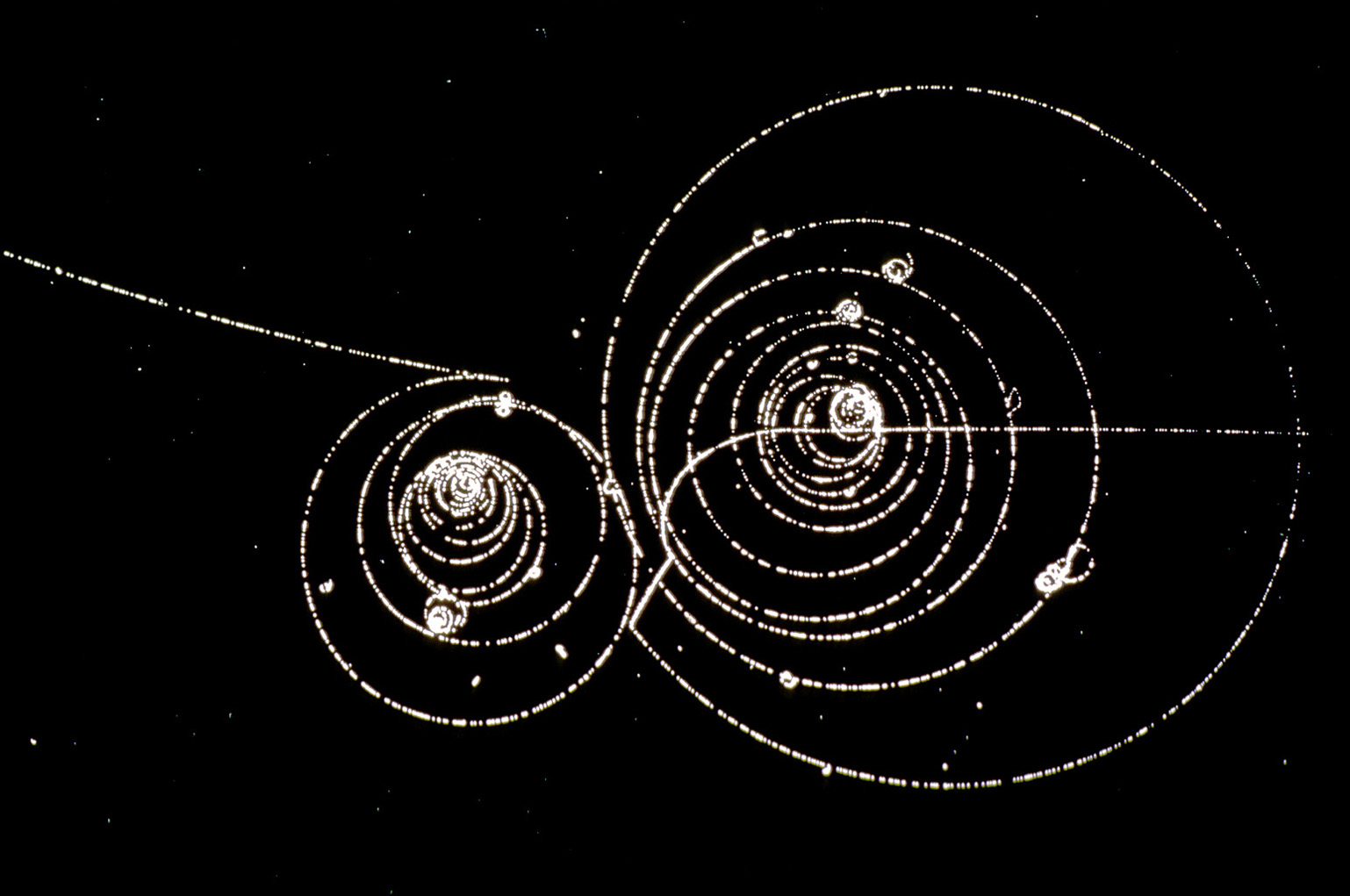
The wave-interference in the double-slit experiment is a spatial phenomenon and not an energy phenomenon. We are dealing here with a spatial wave and not with spatial particles.
Quantum is a particle of energy and not a particle of space. It seems to be continuous spatially.
NOTE: We are talking about photon here. The case of electron is a little more complex but the same argument is applicable.
The largest context of any subject, including physics, seems to be Metaphysics.
Metaphysics deals with the observer and what is observed. Thus it deals with the self and the universe.
Logically, the observer and the observed, or the self and the universe, shall appear together and there shall be no sequence between them.
In my view, the self is the essence and the universe is the outer form, because the universe must have self.
That means the observer is the essence, and what is observed is the outer form. In other words, one is essence of what one is observing.
If I am observing space then I am essence of space. I can say that the space is me. The same logic applies when I am observing field or matter.
There is no difference between what I am observing and what I am as an observer. To regard myself as different from what I am observing is putting a filter there.
What is the difference between what I am and what I am observing? Is it the ability to observe? In other words, I have ability to observe but what I am observing does not have ability to observe back?
What happens when I am observing myself? Does myself have that ability to observe or not?
The idea of ability seems to be something subjective. Objectively, it seems to be some fundamental characteristic, such as, awareness and motion.
Awareness and motion seems to occur together. Motion seems to be the outer form and awareness seems to be its essence.
We seem to be looking at the very core of Metaphysics that manifests itself both as the observer and the observed.
When there is awareness, there must be something to be aware of.
In final analysis, the universe is observing itself. We have simply introduced a lot of filters in between.
We may view Space as “undisturbed field” with zero frequency. As space is disturbed a field of finite frequency is generated.
The field has electrical and magnetic aspects to it. As these aspects change, they reinforce each other through generation of force.
Thus field conveys force, which brings about changes elsewhere.
Inertia is expressed as “mass” in classical mechanics of matter. The equivalent expression of inertia would be as “frequency” in the field.
Inertia in a field shall increase with frequency. Higher frequency regions in a field shall have higher inertia, and more force shall be conveyed through such regions.
In very high frequency regions in a field, the frequency may condense and precipitate as mass.
Field has properties of interference and diffraction.
I started with investigation of the interface between Physics and Metaphysics and now I seem to have come to a full circle. But in doing so I have learned a lot.
The important part of E-learning is self-learning; and the important part of self-learning is repairing holes in understanding.
The holes in understanding parallel the logic of the subject. Logical holes when filled bring about understanding.
The first hole, undoubtedly, is not having the logical context to study a subject. The overall context is, obviously, this universe.
There is observation; there is something to be observed; and there is an observer. This is the beginning of Metaphysics.
Within metaphysics, it is Physics that focuses on the nature of what is observed. Metaphysics provides the context to understand physics.
Physics is the study of nature. This study starts with observation of the concrete universe. It continues with observation of the abstract patterns underlying the concrete universe. And then it goes deeper into abstraction.
Physics is characterized by objectivity that comes the concrete universe. Physics maintains this objectivity by being logically consistent with the concrete universe as it dives into abstraction.
Subjectivity is something different because it starts with the context of “self” instead of the context of universe. (But isn’t “self” included in the universe?)
Self is something abstract but it is assumed to be concrete. (Could this be the basic confusion?)
The concrete universe seems to be out there and self seems to be within. (What forms the interface?)
The relationship of self as observer to the universe as observed is the subject of Metaphysics.
What is the second hole in understanding that needs to be overcome?
The second hole in understanding occurs when a person does not know the scope and extent of the subject. In this case the hole is a missing overview.
The second hole leaves a person without a logical context to understand the information provided on the subject.
Lacking this logical context the person is also unable to formulate questions to ask when he does not understand something in that subject.
The overview of Mathematics shall include a brief introduction to Arithmetic, Algebra and Geometry showing the type of problems each part would address.
The overview of Physics shall include Mechanical, Chemical and Atomic nature of objects, going into a bit of detail in each area.
The overview of Metaphysics shall briefly describe awareness, the nature of self as observer and dimension of abstraction underlying the physical objects.
When studying a subject you ask yourself, “What is the scope and extent of this subject?” “What kind of logical context we have here?” “How can I get an overview of the subject?