The Book of Philosophy

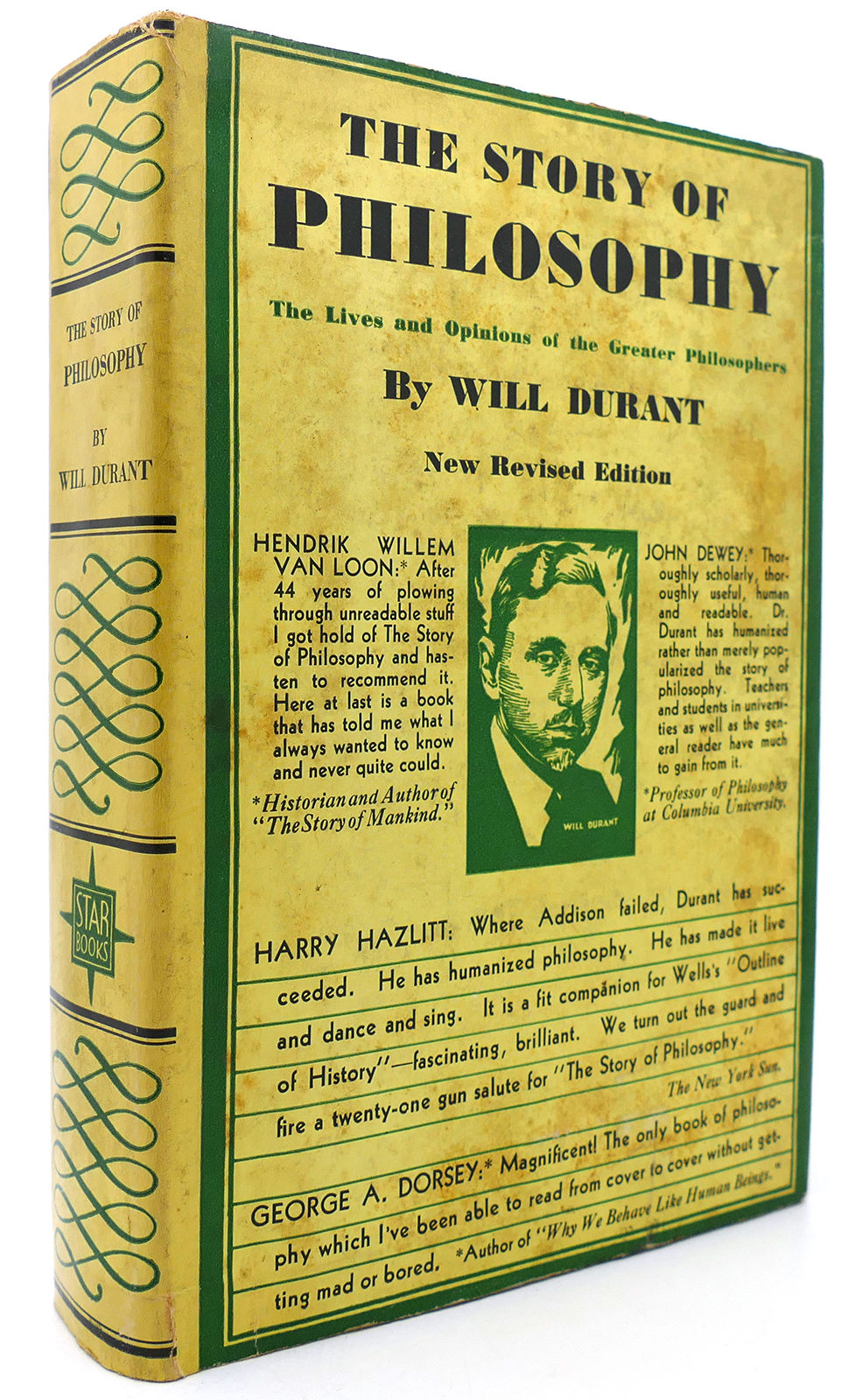
Reference: The Story of Philosophy by Will Durant

The Story of Philosophy: the Lives and Opinions of the Greater Philosophers is a book by Will Durant that profiles several prominent Western philosophers and their ideas, beginning with Plato and on through Friedrich Nietzsche. Durant attempts to show the interconnection of their ideas and how one philosopher’s ideas informed the next. There are nine chapters each focused on one philosopher, and two more chapters each containing briefer profiles of three early 20th century philosophers.

CONTENTS

PREFACE, CONTENTS, and INTRODUCTION

CHAPTER ONE: Plato

  1. The Context of Plato
  2. Socrates
  3. The Preparation of Plato
  4. The Ethical Problem
  5. The Political Problem
  6. The Psychological Problem
  7. The Psychological Solution
  8. The Political Solution
  9. The Ethical Solution
  10. Criticism

CHAPTER TWO: Aristotle and Greek Science

  1. The Historical Background
  2. The Work of Aristotle
  3. The Foundation of Logic
  4. The Organization of Science
  5. Metaphysics and the Nature of God
  6. Psychology and the Nature of Art
  7. Ethics and the Nature of Happiness
  8. Politics
  9. Criticism
  10. Later Life and Death

CHAPTER THREE: Francis Bacon

  1. From Aristotle to the Renaissance 
  2. The Political Career of Francis Bacon 
  3. The Essays
  4. The Great Reconstruction
    1. The Advancement of Learning 
    2. The New Organon
    3. The Utopia of Science 
  5. Criticism
  6. Epilogue

CHAPTER FOUR: Spinoza

  1. Historical and Biographical
    1. The Odyssey of the Jews
    2. The Education of Spinoza
    3. Excommunication
    4. Retirement and Death
  2. The Treatise on Religion and the State
  3. The Improvement of the Intellect
  4. The Ethics
    1. Nature and God
    2. Matter and Mind
    3. Intelligence and Morals
    4. Religion and Immortality
  5. The Political Treatise
  6. The Influence of Spinoza

CHAPTER FIVE: Voltaire and the French Enlightenment

  1. Paris: Oedipe
  2. London: The Letters on the English
  3. Cirey: The Romances
  4. Potsdam and Frederick
  5. Les Délices: The Essay on Morals
  6. Ferney: Candide
  7. The Encyclopedia and the Philosophic Dictionary
  8. Écrasez l’lnfame
  9. Voltaire and Rousseau
  10. Dénouement

CHAPTER SIX: Immanuel Kant and German idealism

  1. Roads to Kant
  2. Kant Himself
  3. The Critique of Pure Reason
  4. The Critique: Transcendental Esthetic
  5. The Critique: Transcendental Analytic
  6. The Critique: Transcendental Dialectic
  7. The Critique of Practical Reason
  8. On Religion and Reason
  9. On Politics and Eternal Peace
  10. Criticism and Estimate
  11. A Note on Hegel

CHAPTER SEVEN: Schopenhauer

  1. The Age
  2. The Man
  3. The World as Idea
  4. The World as Will
    1. The Will to Live
    2. The Will to Reproduce
  5. The World as Evil
  6. The Wisdom of Life
    1. Philosophy
    2. Genius
    3. Art
    4. Religion
  7. The Wisdom of Death
  8. Criticism

CHAPTER EIGHT: Herbert Spencer

  1. Comte and Darwin
  2. The Development of Spencer
  3. First Principles
    1. The Unknowable
    2. Evolution
  4. Biology: The Evolution of Life 
  5. Psychology: The Evolution of Mind
  6. Sociology: The Evolution of Society
  7. Ethics: The Evolution of Morals
  8. Criticism
    1. First Principles
    2. Biology and Psychology 
    3. Sociology and Ethics
  9. Conclusion

CHAPTER NINE: Friedrich Nietzsche

  1. The Lineage of Nietzsche
  2. Youth
  3. Nietzsche and Wagner
  4. The Song of Zarathustra
  5. Hero-morality
  6. The Superman
  7. Decadence
  8. Aristocracy
  9. Criticism
  10. Finale

CHAPTER TEN: Contemporary European Philosophers

  1. Henri Bergson
    1. The Revolt against Materialism
    2. Mind and Brain
    3. Creative Evolution
    4. Criticism
  2. Benedetto Croce
    1. The Man
    2. The Philosophy of the Spirit
    3. What is Beauty?
    4. Criticism
  3. Bertrand Russell 
    1. The Logician
    2. The Reformer 
    3. Epilogue

CHAPTER ELEVEN: Contemporary American Philosophers

Introduction

  1. George Santayana
    1. Biographical
    2. Skepticism and Animal Faith
    3. Reason in Science
    4. Reason in Religion
    5. Reason in Society
    6. Comment
  2. William James
    1. Personal
    2. Pragmatism 
    3. Pluralism
    4. Comment
  3. John Dewey
    1. Education
    2. Instrumentalism
    3. Science and Politics

Conclusion

KANT: Criticism and Estimate

Reference: The Story of Philosophy

This paper presents Chapter VI, Immanuel Kant and German Idealism, Section 7 from the book THE STORY OF PHILOSOPHY by WILL DURANT. The contents are from the 1933 reprint of this book by TIME INCORPORATED by arrangement with Simon and Schuster, Inc.

The paragraphs of the original material (in black) are accompanied by brief comments (in color) based on the present understanding.  Feedback on these comments is appreciated.

The heading below is linked to the original materials.

.

Criticism and Estimate

And now how does this complex structure of logic, metaphysics, psychology, ethics, and politics stand today, after the philosophic storms of a century have beaten down upon it? It is pleasant to answer that much of the great edifice remains; and that the “critical philosophy” represents an event of permanent importance in the history of thought. But many details and outworks of the structure have been shaken.

First, then, is space a mere “form of sensibility,” having no objective reality independent of the perceiving mind? Yes and no. Yes: for space is an empty concept when not filled with perceived objects; “space” merely means that certain objects are, for the perceiving mind, at such and such a position, or distance, with reference to other perceived objects; and no external perception is possible except of objects in space; space then is assuredly a “necessary form of the external sense.” And no: for without doubt, such spatial facts as the annual elliptical circuit of sun by earth, though statable only by a mind, are independent of any perception whatever; the deep and dark blue ocean rolled on before Byron told it to, and after he had ceased to be. Not is space a “construct” of the mind through the coordination of spaceless sensations; we perceive space directly through our simultaneous perception of different objects and various points as when we see an insect moving across a still background. Likewise: time as a sense of before and after, or a measurement of motion, is of course subjective, and highly relative; but a tree will age, wither and decay whether or not the lapse of time is measured or perceived. The truth is that Kant was too anxious to prove the subjectivity of space, as a refuge from materialism; he feared the argument that if space is objective and universal, God must exist in space, and be therefore spatial and material. He might have been content with the critical idealism which shows that all reality is known to us primarily as our sensations and ideas. The old fox bit off more than he could chew. [The persistent vitality of Kant’s theory of knowledge appears in its complete acceptance by so matter-of-fact a scientist as the late Charles P. Steinmetz: “All our sense-perceptions are limited by, and attached to, the conceptions of time and space. Kant, the greatest and most critical of all philosophers, denies that time and space are the product of experience, but shows them to be categories—conceptions in which our minds clothe the sense perceptions. Modern physics has come to the same conclusion in the relativity theory, that absolute space and absolute time have no existence, hut time and space exist only as far as things or events fill them; that is, they are forms of perception.”—Address at the Unitarian Church, Schenectady, 1923.]

He might well have contented himself, too, with the relativity of scientific truth, without straining towards that mirage, the absolute. Recent studies like those of Pearson in England, Mach in Germany, and Henri Poincare in France, agree rather with Hume than with Kant: all science, even the most rigorous mathematics, is relative in its truth. Science itself is not worried about the matter; a high degree of probability contents it. Perhaps, after all, “necessary” knowledge is not necessary?

All science deals with the knowable (manifested) universe of substance. The substance is manifested as thought, energy and matter. In the background of the knowable universe is the Unknowable. As long as the Unknowable is there, science is not absolute.

The great achievement of Kant is to have shown, once for all, that the external world is known to us only as sensation; and that the mind is no mere helpless tabula rasa, the inactive victim of sensation, but a positive agent, selecting and reconstructing experience as experience arrives. We can make subtractions from this accomplishment without injuring its essential greatness. We may smile, with Schopenhauer, at the exact baker’s dozen of categories, so prettily boxed into triplets, and then stretched and contracted and interpreted deviously and ruthlessly to fit and surround all things. [Op. cit., vol. ii, p. 23.] And we may even question whether these categories, or interpretive forms of thought, are innate, existing before sensation and experience; perhaps so in the individual, as Spencer conceded, though acquired by the race; and then, again, probably acquired even by the individual: the categories may be grooves of thought, habits of perception and conception, gradually produced by sensations and perceptions automatically arranging themselves, first in disorderly ways, then, by a kind of natural selection of forms of arrangement, in orderly and adaptive and illuminating ways. It is memory that classifies and interprets sensations into perceptions, and perceptions into ideas; but memory is an accretion. That unity of the mind which Kant thinks native (the “transcendental unity of apperception”) is acquired and not by all; and can be lost as well as won in amnesia, or alternating personality, or insanity. Concepts are an achievement, not a gift.

It is true that the external world (Unknowable) first manifests as sensations. Sensations upon assimilation become perceptions. Such assimilation is guided by the inherent makeup of the mind, which may be described as a set of postulates. Reason applied to perceptions then generates further considerations, ideas, etc. Underlying this assimilation and reasoning is the active Principle of Oneness. Any violation of the Principle of Oneness generates anomalies.

Kant contributed much to this understanding. He describes the postulates referenced above as categories. The development of these categories is assisted by the Principle of Oneness. This Principle of Oneness fills in what was left out by Kant.

The nineteenth century dealt rather hardly with Kant’s ethics, his theory of an innate, a priori, absolute moral sense. The philosophy of evolution suggested irresistibly that the sense of duty is a social deposit in the individual, the content of conscience is acquired, though the vague disposition to social behavior is innate. The moral self, the social man, is no “special creation” coming mysteriously from the hand of God, but the late product of a leisurely evolution. Morals are not absolute; they are a code of conduct more or less haphazardly developed for group survival, and varying with the nature and circumstances of the group: a people hemmed in by enemies, for example, will consider as immoral that zestful and restless individualism which a nation youthful and secure in its wealth and isolation will condone as a necessary ingredient in the exploitation of natural resources and the formation of national character. No action is good in itself, as Kant supposes. [Practical Reason, p. 31.]

Kant’s theory of an innate and absolute moral sense has mostly been ignored. Instead the theory of evolution has been favored, according to which the sense of duty is mostly acquired through social conditions. No action is good in itself, as Kant supposes. This anomaly is resolved when one accepts the Principle of Oneness as the ultimate criterion.

His pietistic youth, and his hard life of endless duty and infrequent pleasure, gave him a moralistic bent; he came at last to advocate duty for duty’s sake, and so fell unwittingly into the arms of Prussian absolutism. [Cf. Prof. Dewey: German Philosophy and Politics.] There is something of a severe Scotch Calvinism in this opposition of duty to happiness; Kant continues Luther and the Stoic Reformation, as Voltaire continues Montaigne and the Epicurean Renaissance. He represented a stern reaction against the egoism and hedonism in which Helvetius and Holbach had formulated the life of their reckless era, very much as Luther had reacted against the luxury and laxity of Mediterranean Italy. But after a century of reaction against the absolutism of Kant’s ethics, we find ourselves again in a welter of urban sensualism and immorality, of ruthless individualism untempered with democratic conscience or aristocratic honor; and perhaps the day will soon come when a disintegrating civilization will welcome again the Kantian call to duty.

Kant’s sense of duty and moralistic bent may be contrasted against the free thinking and happy bent of Voltaire. Again, the apparent anomaly disappears as one accepts the Principle of Oneness as one’s ultimate criterion.

The marvel in Kant’s philosophy is his vigorous revival, in the second Critique, of those religious ideas of God, freedom, and immortality, which the first Critique had apparently destroyed. “In Kant’s works,” says Nietzsche’s critical friend, Paul Ree, “you feel as though you were at a country fair. You can buy from him anything you want freedom of the will and captivity of the will, idealism, and a refutation of idealism, atheism and the good Lord. Like a juggler out of an empty hat, Kant draws out of the concept of duty a God, immortality, and freedom, to the great surprise of his readers.” [In Untermann, Science and Revolution, Chicago, 1905; p. 81.] Schopenhauer too takes a fling at the derivation of immortality from the need of reward: “Kant’s virtue, which at first bore itself so bravely towards happiness, loses its independence later, and holds out its hand for a tip.” [In Paulsen, p. 317.] The great pessimist believes that Kant was really a sceptic who, having abandoned belief himself, hesitated to destroy the faith of the people, for fear of the consequences to public morals. “Kant discloses the groundlessness of speculative theology, and leaves popular theology untouched, nay even establishes it in a nobler form as a faith based upon moral feeling.” This was afterwards distorted by the philosophasters into rational apprehension and consciousness of God, etc. . . . ; while Kant, as he demolished old and revered errors, and knew the danger of doing so, rather wished through the moral theology merely to substitute a few weak temporary supports, so that the ruin might not fall upon him, but that he might have time to escape.” [The World as Will and Idea, vol. ii, p. 129.] So too Heine, in what is no doubt an intentional caricature, represents Kant, after having destroyed religion, going out for a walk with his servant Lampe, and suddenly perceiving that the old man’s eyes are filled with tears. “Then Immanuel Kant has compassion, and shows that he is not only a great philosopher, but also a good man; and half kindly, half ironically, he speaks: ‘Old Lampe must have a God or else he cannot be happy, says the practical reason; for my part, the practical reason may, then, guarantee the existence of God.’” [Quoted by Paulsen, p. 8.] If these interpretations were true we should have to call the second Critique a Transcendental Anesthetic.

Kant first destroys religion from the viewpoint of reason and then builds it back up from the viewpoint of faith. Thus, he appears self-contradictory. However, as we substitute faith by the Principle of Oneness, it starts to make sense.

But these adventurous reconstructions of the inner Kant need not be taken too seriously. The fervor of the essay on ”Religion within the Limits of Pure Reason” indicates a sincerity too intense to be questioned, and the attempt to change the base of religion from theology to morals, from creeds to conduct, could have come only from a profoundly religious mind. “It is indeed true,” he wrote to Moses Mendelssohn in 1766, “that I think many things with the clearest conviction, . . . which I never have the courage to say; but I will never say anything which I do not think.” [In Paulsen, p. 53.] Naturally, a long and obscure treatise like the great Critique lends itself to rival interpretations; one of the first reviews of the book, written by Reinhold a few years after it appeared, said as much as we can say today: “The Critique of Pure Reason has been proclaimed by the dogmatists as the attempt of a sceptic who undermines the certainty of all knowledge;—by the sceptics as a piece of arrogant presumption that undertakes to erect a new form of dogmatism upon the ruins of previous systems;—by the supernaturalists as a subtly plotted artifice to displace the historical foundations of religion, and to establish naturalism without polemic;—by the naturalists as a new prop for the dying philosophy of faith;—by the materialists as an idealistic contradiction of the reality of matter;—by the spiritualists as an unjustifiable limitation of all reality to the corporeal world, concealed under the name of the domain of experience.” [In Paulsen, p. 114,] In truth the glory of the book lay in its appreciation of all these points of view; and to an intelligence as keen as Kant’s own, it might well appear that he had really reconciled them all, and fused them into such a unity of complex truth as philosophy had not seen in all its history before.

As to his influence, the entire philosophic thought of the nineteenth century revolved about his speculations. After Kant, all Germany began to talk metaphysics: Schiller and Goethe studied him; Beethoven quoted with admiration his famous words about the two wonders of life “the starry heavens above, the moral law within”; and Fichte, Schelling, Hegel and Schopenhauer produced in rapid succession great systems of thought reared upon the idealism of the old Konigsberg sage. It was in these balmy days of German metaphysics that Jean Paul Richter wrote: “God has given to the French the land, to the English the sea, to the Germans the empire of the air.” Kant’s criticism of reason, and his exaltation of feeling, prepared for the voluntarism of Schopenhauer and Nietzsche, the intuitionism of Bergson, and the pragmatism of William James; his identification of the laws of thought with the laws of reality gave to Hegel a whole system of philosophy; and his unknowable “thing-in-itself” influenced Spencer more than Spencer knew. Much of the obscurity of Carlyle is traceable to his attempt to allegorize the already obscure thought of Goethe and Kant that diverse religions and philosophies are but the changing garments of one eternal truth. Caird and Green and Wallace and Watson and Bradley and many others in England owe their inspiration to the first Critique; and even the wildly innovating Nietzsche takes his epistemology from the “great Chinaman of Konigsberg” whose static ethics he so excitedly condemns. After a century of struggle between the idealism of Kant, variously reformed, and the materialism of the Enlightenment, variously redressed, the victory seems to lie with Kant. Even the great materialist Helvetius wrote, paradoxically: “Men, if I may dare say it, are the creators of matter.” [In Chamberlain, vol. i, p. 86.] Philosophy will never again be so naive as in her earlier and simpler days; she must always be different hereafter, and profounder, because Kant lived.

After Kant, all Germany began to talk metaphysics. After a century of struggle between the idealism of Kant, variously reformed, and the materialism of the Enlightenment, variously redressed, the victory seems to lie with Kant. Philosophy will never again be so naive as in her earlier and simpler days; she must always be different hereafter, and profounder, because Kant lived.

.

Final Comments

.

KANT: On Politics and Eternal Peace

Reference: The Story of Philosophy

This paper presents Chapter VI, Immanuel Kant and German Idealism, Section 6 from the book THE STORY OF PHILOSOPHY by WILL DURANT. The contents are from the 1933 reprint of this book by TIME INCORPORATED by arrangement with Simon and Schuster, Inc.

The paragraphs of the original material (in black) are accompanied by brief comments (in color) based on the present understanding.  Feedback on these comments is appreciated.

The heading below is linked to the original materials.

.

On Politics and Eternal Peace

The Prussian government might have pardoned Kant’s theology, had he not been guilty of political heresies as well. Three years after the accession of Frederick William II, the French Revolution had set all the thrones of Europe trembling. At a time when most of the teachers in the Prussian universities had rushed to the support of legitimate monarchy, Kant, sixty-five years young, hailed the Revolution with joy; and with tears in his eyes said to his friends: “Now I can say like Simeon, ‘Lord, let now Thy servant depart in peace; for mine eyes have seen Thy salvation.’” [Wallace, p. 40.]

Kant hailed the French revolution with joy.

He had published, in 1784, a brief exposition of his political theory under the title of “The Natural Principle of the Political Order considered in connection with the Idea of a Universal Cosmopolitical History.” Kant begins by recognizing, in that strife of each against all which had so shocked Hobbes, nature’s method of developing the hidden capacities of life; struggle is the indispensable accompaniment of progress. If men were entirely social, man would stagnate; a certain alloy of individualism and competition is required to make the human species survive and grow. ‘Without qualities of an unsocial kind . . . men might have led an Arcadian shepherd life in complete harmony, contentment, and mutual love; but in that case all their talents would have forever remained hidden in their germ.” (Kant, therefore, was no slavish follower of Rousseau.) “Thanks be then to nature for this unsociableness, for this envious jealousy and vanity, for this insatiable desire for possession and for power. . . . Man wishes concord; but nature knows better what is good for his species; and she wills discord, in order that man may be impelled to a new exertion of his powers, and to the further development of his natural capacities.”

According to Kant, struggle is the indispensable accompaniment of progress. It is nature’s method of developing the hidden capacities of life. A certain alloy of individualism and competition is required to make the human species survive and grow.

The struggle for existence, then, is not altogether an evil. Nevertheless, men soon perceive that it must be restricted within certain limits, and regulated by rules, customs, and laws; hence the origin and development of civil society. But now “the same unsociableness which forced men into society becomes again the cause of each commonwealth’s assuming the attitude of uncontrolled freedom in its external relations, i.e., as one state in relation to other states; and consequently, any one state must expect from any other the same sort of evils as formerly oppressed individuals and compelled them to enter into a civil union regulated by law.” [Eternal Peace and Other Essays; Boston, 1914; p. 14.] It is time that nations, like men, should emerge from the wild state of nature, and contract to keep the peace. The whole meaning and movement of history is the ever greater restriction of pugnacity and violence, the continuous enlargement of the area of peace. ‘The history of the human race, viewed as a whole, may be regarded as the realization of a hidden plan of nature to bring about a political constitution, internally and externally perfect, as the only state in which all the capacities implanted by her in mankind can be fully developed.” [Eternal Peace and Other Essays; Boston, 1914; p. 19.] If there is no such progress, the labors of successive civilizations are like those of Sisyphus, who again and again “up the high hill heaved a huge round stone,” only to have it roll back as it was almost at the top. History would be then nothing more than an endless and circuitous folly; “and we might suppose, like the Hindu, that the earth is a place for the expiation of old and forgotten sins.” [P.58.]

The struggle for existence is not an evil but it must be restricted within certain limits, and regulated by rules, customs, and laws. It is time that nations, like men, should emerge from the wild state of nature, and contract to keep the peace.

The essay on “Eternal Peace” (published in 1795, when Kant was seventy-one) is a noble development of this theme. Kant knows how easy it is to laugh at the phrase; and under his title he writes: “These words were once put by a Dutch inn-keeper on his sign-board as a satirical inscription, over the representation of a church-yard” cemetery. [P. 68.] Kant had before complained, as apparently every generation must, that “our rulers have no money to spend on public education . . . because all their resources are already placed to the account of the next war.” [P. 21.] The nations will not really be civilized until all standing armies are abolished. (The audacity of this proposal stands out when we remember that it was Prussia itself which, under the father of Frederick the Great, had been the first to establish conscription.) “Standing armies excite states to outrival one another in the number of their armed men, which has no limit. Through the expense occasioned thereby, peace becomes in the long run more oppressive than a short war; and standing armies are thus the cause of aggressive wars undertaken in order to get rid of this burden.” [P. 71.] For in time of war the army would support itself on the country, by requisitioning, quartering, and pillaging; preferably in the enemy’s territory, but if necessary, in one’s own land; even this would be better than supporting it out of government funds.

Nation’s resources are usually earmarked for war and little is left for public education. According to Kant, the nations will not really be civilized until all standing armies are abolished.

Much of this militarism, in Kant’s judgment, was due to the expansion of Europe into America and Africa and Asia; with the resultant quarrels of the thieves over their new booty. “If we compare the barbarian instances of inhospitality . . . with the inhuman behavior of the civilized, and especially the commercial, states of our continent, the injustice practiced by them even in their first contact with foreign lands and peoples fills us with horror; the mere visiting of such peoples being regarded by them as equivalent to a conquest. America, the negro lands, the Spice Islands, the Cape of Good Hope, etc., on being discovered, were treated as countries that belonged to nobody; for the aboriginal inhabitants were reckoned as nothing. . . . And all this has been done by nations who make a great ado about their piety, and who, while drinking up iniquity like water, would have themselves regarded as the very elect of the orthodox faith.” [P. 68.] The old fox of Konigsberg was not silenced yet!

Much of this militarism, in Kant’s judgment, was due to the expansion of Europe into America and Africa and Asia; with the resultant quarrels of the thieves over their new booty.

Kant attributed this imperialistic greed to the oligarchical constitution of European states; the spoils went to a select few, and remained substantial even after division. If democracy were established, and all shared in political power, the spoils of international robbery would have to be so subdivided as to constitute a resistible temptation. Hence the “first definitive article in the conditions of Eternal Peace” is this: “The civil constitution of every state shall be republican, and war shall not be declared except by a plebiscite of all the citizens.” [Pp. 76-77.] When those who must do the fighting have the right to decide between war and peace, history will no longer be written in blood. “On the other hand, in a constitution where the subject is not a voting member of the state, and which is therefore not republican, the resolution to go to war is a matter of the smallest concern in the world. For in this case the ruler, who, as such, is not a mere citizen, but the owner of the state, need not in the least suffer personally by war, nor has he to sacrifice his pleasures of the table or the chase, or his pleasant palaces, court festivals, or the like. He can, therefore, resolve for war from insignificant reasons, as if it were but a hunting expedition; and as regards its propriety, he may leave the justification of it without concern to the diplomatic corps, who are always too ready to give their services for that purpose.” [Pp. 76-77.] How contemporary truth is!

Kant attributed this imperialistic greed to the oligarchical constitution of European states; the spoils went to a select few, and remained substantial even after division. Kant suggested that the civil constitution of every state shall be republican, and war shall not be declared except by a plebiscite of all the citizens.

The apparent victory of the Revolution over the armies of reaction in 1795 led Kant to hope that republics would now spring up throughout Europe, and that an international order would arise based upon a democracy without slavery and without exploitation, and pledged to peace. After all, the function of government is to help and develop the individual, not to use and abuse him. “Every man is to be respected as an absolute end in himself; and it is a crime against the dignity that belongs to him as a human being, to use him as a mere means for some external purpose.” [In Paulsen, p. 340.] This too is part and parcel of that categorical imperative without which religion is a hypocritical farce. Kant therefore calls for equality: not of ability, but of opportunity for the development and application of ability; he rejects all prerogatives of birth and class, and traces all hereditary privilege to some violent conquest in the past. In the midst of obscurantism and reaction and the union of all monarchical Europe to crush the Revolution, he takes his stand, despite his seventy years, for the new order, for the establishment of democracy and liberty everywhere. Never had old age so bravely spoken with the voice of youth.

According to Kant, the function of government is to help and develop the individual, not to use and abuse him. Kant therefore calls for equality: not of ability, but of opportunity for the development and application of ability; he rejects all prerogatives of birth and class, and traces all hereditary privilege to some violent conquest in the past.

But he was exhausted now; he had run his race and fought his fight. He withered slowly into a childlike senility that came at last to be a harmless insanity: one by one his sensibilities and his powers left him; and in 1804, aged seventy-nine, he died, quietly and naturally, like a leaf falling from a tree.

.

Final Comments

Individualism arises from struggle amongst individual ideas and not people. Kant’s are powerful ideas. Kant is not against struggle but any struggle must be regulated to ensure peaceful evolution.

Militarism has been due to the expansion of Europe into America and Africa and Asia to acquire resources by force. The greed has come from the few in power who take advantage of even their general population.

Kant, therefore, suggests a republican constitution where the public has a say in declaring war. According to Kant, the function of government is to help and develop the individual, not to use and abuse him. Kant therefore calls for equality: not of ability, but of opportunity for the development and application of ability; he rejects all prerogatives of birth and class, and traces all hereditary privilege to some violent conquest in the past.

.

KANT: On Religion and Reason

Reference: The Story of Philosophy

This paper presents Chapter VI, Immanuel Kant and German Idealism, Section 5 from the book THE STORY OF PHILOSOPHY by WILL DURANT. The contents are from the 1933 reprint of this book by TIME INCORPORATED by arrangement with Simon and Schuster, Inc.

The paragraphs of the original material (in black) are accompanied by brief comments (in color) based on the present understanding.  Feedback on these comments is appreciated.

The heading below is linked to the original materials.

.

On Religion and Reason

Does this appear trite, and timid, and conservative? But it was not so; on the contrary, this bold denial of “rational” theology, this frank reduction of religion to moral faith and hope, aroused all the orthodox of Germany to protests. To face this “forty-parson-power” (as Byron would have called it) required more courage than one usually associates with the name of Kant.

Kant’s bold denial of “rational” theology, and frank reduction of religion to moral faith and hope, required a lot of courage.

That he was brave enough appeared in all clarity when he published, at sixty-six, his Critique of Judgment, and, at sixty-nine, his Religion within the Limits of Pure Reason. In the earlier of these books Kant returns to the discussion of that argument from design which, in the first Critique, he had rejected as an insufficient proof of the existence of God. He begins by correlating design and beauty; the beautiful he thinks, is anything which reveals symmetry and unity of structure, as if it had been designed by intelligence. He observes in passing (and Schopenhauer here helped himself to a good deal of his theory of art) that the contemplation of symmetrical design always gives us a disinterested pleasure; and that “an interest in the beauty of nature for its own sake is always a sign of goodness.” [Critique of Judgment, sect 29.] Many objects in nature show such beauty, such symmetry and unity, as almost to drive us to the notion of supernatural design. But on the other hand, says Kant, there are also in nature many instances of waste and chaos, of useless repetition and multiplication; nature preserves life, but at the cost of how much suffering and death! The appearance of external design, then, is not a conclusive proof of Providence. The theologians who use the idea so much should abandon it, and the scientists who have abandoned it should use it; it is a magnificent clue, and leads to hundreds of revelations. For there is design, undoubtedly; but it is internal design, the design of the parts by the whole; and if science will interpret the parts of an organism in terms of their meaning for the whole, it will have an admirable balance for that other heuristic principle—the mechanical conception of life—which also is fruitful for discovery, but which, alone, can never explain the growth of even a blade of grass.

Kant argued that there is the beautiful symmetry and unity of design, but there are also many instances of waste and chaos. There is the appearance of external design; but there is also internal design, the design of the parts by the whole, that is mechanical in its conception. Alone, neither external nor inter design provide a conclusive proof of Providence. 

The essay on religion is a remarkable production for a man of sixty-nine; it is perhaps the boldest of all the books of Kant. Since religion must be based not on the logic of theoretical reason but on the practical reason of the moral sense, it follows that any Bible or revelation must be judged by its value for morality, and cannot itself be the judge of a moral code. Churches and dogmas have value only in so far as they assist the moral development of the race. When mere creeds or ceremonies usurp priority over moral excellence as a test of religion, religion has disappeared. The real church is a community of people, however scattered and divided, who are united by devotion to the common moral law. It was to establish such a community that Christ lived and died; it was this real church which he held up in contrast to the ecclesiasticism of the Pharisees. But another ecclesiasticism has almost overwhelmed this noble conception. “Christ has brought the kingdom of God nearer to earth; but he has been misunderstood; and in place of God’s kingdom the kingdom of the priest has been established among us.” [Quoted in Chamberlain, Immanuel Kant; vol. i, p. 510.] Creed and ritual have again replaced the good life; and instead of men being bound together by religion, they are divided into a thousand sects; and all manner of “pious nonsense” is inculcated as “a sort of heavenly court service by means of which one may win through flattery the favor of the ruler of heaven.” [In Paulsen,366.]—Again, miracles cannot prove a religion, for we can never quite rely on the testimony which supports them; and prayer is useless if it aims at a suspension of the natural laws that hold for all experience. Finally, the nadir of perversion is reached when the church becomes an instrument in the hands of a reactionary government; when the clergy, whose function it is to console and guide a harassed humanity with religious faith and hope and charity, are made the tools of theological obscurantism and political oppression.

Kant boldly argued that religion must be based not on the logic of theoretical reason but on the practical reason of the moral sense. Bible or any revelation must be judged by its value for morality, and cannot itself be the judge of a moral code. When mere creeds or ceremonies usurp priority over moral excellence as a test of religion, religion has disappeared. Miracles cannot prove a religion, for we can never quite rely on the testimony which supports them; and prayer is useless if it aims at a suspension of the natural laws that hold for all experience.

The audacity of these conclusions lay in the fact that precisely this had happened in Prussia. Frederick the Great had died in 1786, and had been succeeded by Frederick William II, to whom the liberal policies of his predecessor seemed to smack unpatriotically of the French Enlightenment. Zedlitz, who had been Minister of Education under Frederick, was dismissed; and his place was given to a Pietist, Wollner. Wollner had been described by Frederick as “a treacherous and intriguing priest,” who divided his time between alchemy and Rosicrucian mysteries, and climbed to power by offering himself as “an unworthy instrument” to the new monarch’s policy of restoring the orthodox faith by compulsion. [Encyclopaedia Britannica, article “Frederick William II”] In 1788 Wollner issued a decree which forbade any teaching, in school or university, that deviated from the orthodox form of Lutheran Protestantism; he established a strict censorship over all forms of publication, and ordered the discharge of every teacher suspected of any heresy. Kant was at first left unmolested, because he was an old man, and as one royal adviser said only a few people read him, and these did not understand him. But the essay on religion was intelligible; and though it rang true with religious fervor, it revealed too strong a strain of Voltaire to pass the new censorship. The Berliner Monatsschrift, which had planned to publish the essay, was ordered to suppress it.

According to Kant, the nadir of perversion is reached when the church becomes an instrument in the hands of a reactionary government. The audacity of these conclusions lay in the fact that precisely this had happened in Prussia. Kant was at first left unmolested, because he was an old man, and as one royal adviser said only a few people read him.

Kant acted now with a vigor and courage hardly credible in a man who had almost completed three score years and ten. He sent the essay to some friends at Jena, and through them had it published by the press of the university there. Jena was outside of Prussia, under the jurisdiction of that same liberal Duke of Weimar who was then caring for Goethe. The result was that in 1794 Kant received an eloquent cabinet order from the Prussian King, which read as follows: “Our highest person has been greatly displeased to observe how you misuse your philosophy to undermine and destroy many of the most important and fundamental doctrines of the Holy Scriptures and of Christianity. We demand of you immediately an exact account, and expect that in future you will give no such cause of offense, but rather that, in accordance with your duty, you will employ your talents and authority so that our paternal purpose may be more and more attained. If you continue to oppose this order you may expect unpleasant consequences.” [In Paulsen, p. 49.] Kant replied that every scholar should have the right to form independent judgments on religious matters, and to make his opinions known; but that during the reign of the present king he would preserve silence. Some biographers who can be very brave by proxy, have condemned him for this concession; but let us remember that Kant was seventy, that he was frail in health, and not fit for a fight; and that he had already spoken his message to the world.

But, at the age of 70, Kant got his essay on religion published outside Prussia. This essay was relatively intelligible, and the Prussian government threatened to prosecute him. Kant offered to preserve silence during the reign of the present king. He had already spoken his message to the world.

.

Final Comments

.

KANT: The Critique of Practical Reason

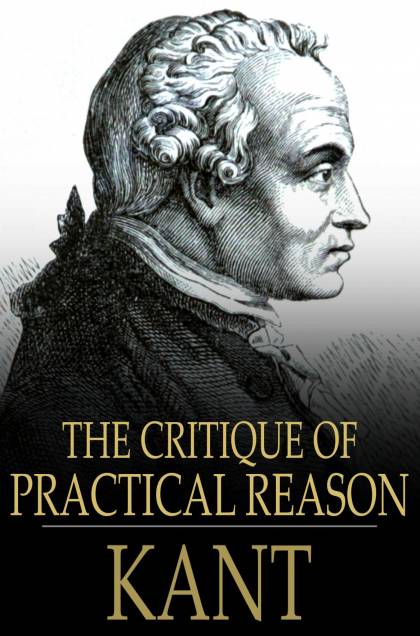
The Critique of Practical Reason by Immanuel Kant (ebook)

Reference: The Story of Philosophy

This paper presents Chapter VI, Immanuel Kant and German Idealism, Section 4 from the book THE STORY OF PHILOSOPHY by WILL DURANT. The contents are from the 1933 reprint of this book by TIME INCORPORATED by arrangement with Simon and Schuster, Inc.

The paragraphs of the original material (in black) are accompanied by brief comments (in color) based on the present understanding.  Feedback on these comments is appreciated.

The heading below is linked to the original materials.

.

The Critique of Practical Reason

If religion cannot be based on science and theology, on what then? On morals. The basis in theology is too insecure; better that it should be abandoned, even destroyed; faith must be put beyond the reach or realm of reason. But therefore the moral basis of religion must be absolute, not derived from questionable sense-experience or precarious inference; not corrupted by the admixture of fallible reason; it must be derived from the inner self by direct perception and intuition. We must find a universal and necessary ethic; a priori principles of morals as absolute and certain as mathematics. We must show that “pure reason can be practical; i.e., can of itself determine the will independently of anything empirical,” [Critique of Practical Reason, p. 31.] that the moral sense is innate, and not derived from experience. The moral imperative which we need as the basis of religion must be an absolute, a categorical, imperative.

Religion cannot be based on science, because science deals with the phenomenal world; and it cannot be based on theology; because theology tries to apply reason to the noumenal realm. The moral imperative which we need as the basis of religion must be an absolute imperative. The faith of religion must be derived from the inner self by direct perception and intuition. 

Now the most astounding reality in all our experience is precisely our moral sense, our inescapable feeling, in the face of temptation, that this or that is wrong. We may yield; but the feeling is there nevertheless. Le matin je fais des projets, et le soir je fais des sottises; [“In the morning I make good resolutions; in the evening I commit follies.”] but we know that they are sottises [nonsense], and we resolve again. What is it that brings the bite of remorse, and the new resolution? It is the categorical imperative in us, the unconditional command of our conscience, to “act as if the maxim of our action were to become by our will a universal law of nature.” [Practical Reason, p. 139.] We know, not by reasoning, but by vivid and immediate feelings, that we must avoid behavior which, if adopted by all men, would render social life impossible. Do I wish to escape from a predicament by a lie? But “while I can will the lie, I can by no means will that lying should be a universal law. For with such a law there would be no promises at all.” [Practical Reason, p. 19.] Hence the sense in me, that I must not lie, even if it be to my advantage. Prudence is hypothetical; its motto is, Honesty when it is the best policy; but the moral law in our hearts is unconditional and absolute.

There is a moral sense within us. We know, not by reasoning, but by vivid and immediate feelings, that we must avoid behavior which, if adopted by all men, would render social life impossible. The moral law in our hearts is unconditional and absolute.

And an action is good not because it has good results, or because it is wise, but because it is done in obedience to this inner sense of duty, this moral law that does not come from our personal experience, but legislates imperiously and a priori for all our behavior, past, present, and future. The only thing unqualifiedly good in this world is a good will—the will to follow the moral law, regardless of profit or loss for ourselves. Never mind your happiness; do your duty. “Morality is not properly the doctrine how we may make ourselves happy, but how we may make ourselves worthy of happiness.” [Practical Reason, p. 227.] Let us seek the happiness in others; but for ourselves, perfection whether it bring us happiness or pain. [Preface to The Metaphysical Elements of Ethics.] To achieve perfection in yourself and happiness in others, “so act as to treat humanity, whether in thine own person or in that of another, in every case as an end, never only as a means”: [Metaphysics of Morals, London, 1909; p. 47.]—this too, as we directly feel, is part of the categorical imperative. Let us live up to such a principle, and we shall soon create an ideal community of rational beings; to create it we need only act as if we already belonged to it; we must apply the perfect law in the imperfect state. It is a hard ethic, you say, this placing of duty above beauty, of morality above happiness; but only so can we cease to be beasts, and begin to be gods.

The only thing unqualifiedly good in this world is the will to follow the moral law. Let us seek the happiness in others; but for ourselves, perfection whether it brings us happiness or pain. It is done in obedience to an inner sense of duty.

Notice, meanwhile, that this absolute command to duty proves at last the freedom of our wills; how could we ever have conceived such a notion as duty if we had not felt ourselves freer. We cannot prove this freedom by theoretical reason; we prove it by feeling it directly in the crisis of moral choice. We feel this freedom as the very essence of our inner selves, of the “pure Ego”; we feel within ourselves the spontaneous activity of a mind moulding experience and choosing goals. Our actions, once we initiate them, seem to follow fixed and invariable laws, but only because we perceive their results through sense, which clothes all that it transmits in the dress of that causal law which our minds themselves have made. Nevertheless, we are beyond and above the laws we make in order to understand the world of our experience; each of us is a center of initiative force and creative power. In a way which we feel but cannot prove, each of us is free.

This absolute command to duty proves at last the freedom of our wills. We feel this freedom as the very essence of our inner selves. In a way which we feel but cannot prove, each of us is free.

And again, though we cannot prove, we feel, that we are deathless. We perceive that life is not like those dramas so beloved by the people—in which every villain is punished, and every act of virtue meets with its reward; we learn anew every day that the wisdom of the serpent fares better here than the gentleness of the dove, and that any thief can triumph if he steals enough. If mere worldly utility and expediency were the justification of virtue, it would not be wise to be too good. And yet, knowing all this, having it flung into our faces with brutal repetition, we still feel the command to righteousness, we know that we ought to do the inexpedient good. How could this sense of right survive if it were not that in our hearts we feel this life to be only a part of life, this earthly dream only an embryonic prelude to a new birth, a new awakening; if we did not vaguely know that in that later and longer life the balance will be redressed, and not one cup of water given generously but shall be returned a hundred-fold?

And again, though we cannot prove, we feel, that we are deathless. If mere worldly utility and expediency were the justification of virtue, it would not be wise to be too good. And yet, knowing all this, we still feel the command to righteousness. How could this sense of right survive if it were not that in our hearts we feel this earthly dream only an embryonic prelude to a new birth.

Finally, and by the same token, there is a God. If the sense of duty involves and justifies belief in rewards to come, “the postulate of immortality . . . must lead to the supposition of the existence of a cause adequate to this effect; in other words, it must postulate the existence of God.” [Practical Reason, p. 220.] This again is no proof by “reason”; the moral sense, which has to do with the world of our actions, must have priority over that theoretical logic which was developed only to deal with sense-phenomena. Our reason leaves us free to believe that behind the thing-in-itself there is a just God; our moral sense commands us to believe it. Rousseau was right: above the logic of the head is the feeling in the heart. Pascal was right: the heart has reasons of its own, which the head can never understand.

The moral sense, which has to do with the world of our actions, must have priority over that theoretical logic which was developed only to deal with sense-phenomena. Our reason leaves us free to believe that behind the thing-in-itself there is a just God.

.

Final Comments

.