KANT: Transcendental Dialectic

Reference: The Story of Philosophy

This paper presents Chapter VI, Immanuel Kant and German Idealism, Section 3 (part 3) from the book THE STORY OF PHILOSOPHY by WILL DURANT. The contents are from the 1933 reprint of this book by TIME INCORPORATED by arrangement with Simon and Schuster, Inc.

The paragraphs of the original material (in black) are accompanied by brief comments (in color) based on the present understanding.  Feedback on these comments is appreciated.

The heading below is linked to the original materials.

.

Transcendental Dialectic

Nevertheless, this certainty, this absoluteness, of the highest generalizations of logic and science, is, paradoxically, limited and relative: limited strictly to the field of actual experience, and relative strictly to our human mode of experience. For if our analysis has been correct, the world as we know it is a construction, a finished product, almost one might say a manufactured article, to which the mind contributes as much by its moulding forms as the thing contributes by its stimuli. (So we perceive the top of the table as round, whereas our sensation is of an ellipse.) The object as it appears to us is a phenomenon, an appearance, perhaps very different from the external object before it came within the ken of our senses; what that original object was we can never know; the “thing-in-itself” may be an object of thought or inference (a “noumenon”), but it cannot be experienced, for in being experienced it would be changed by its passage through sense and thought. “It remains completely unknown to us what objects may be by themselves and apart from the receptivity of our senses. We know nothing but our manner of perceiving them; that manner being peculiar to us, and not necessarily shared by every being, though, no doubt, by every human being.” [Critique, p. 37. If Kant had not added the last clause, his argument for the necessity of knowledge would have fallen.] The moon as known to us is merely a bundle of sensations (as Hume saw), unified (as Hume did not see) by our native mental structure through the elaboration of sensations into perceptions, and of these into conceptions or ideas; in result, the moon is for us merely our ideas. [So John Stuart Mill, with all his English tendency to realism, was driven at last to define matter as merely “a permanent possibility of sensations.”]

Not that Kant ever doubts the existence of “matter” and the external world; but he adds that we know nothing certain about them except that they exist. Our detailed knowledge is about their appearance, their phenomena, about the sensations which we have of them. Idealism does not mean, as the man in the street thinks, that nothing exists outside the perceiving subject; but that a goodly part of every object is created by the forms of perception and understanding: we know the object as transformed into idea; what it is before being so transformed we cannot know. Science, after all, is naive; it supposes that it is dealing with things in themselves, in their full-blooded external and uncorrupted reality; philosophy is a little more sophisticated, and realizes that the whole material of science consists of sensations, perceptions and conceptions, rather than of things. “Kant’s greatest merit,” says Schopenhauer, “is the distinction of the phenomenon from the thing-in-itself.” [The World as Will and Idea; vol. ii, p. 7.]

We know nothing about the world except that it exists. We know it as a phenomenon. Our observation and understanding is a part of that phenomenon. This phenomenon is not absolute even when we may think it to be so. What can said to be absolute is the distinction between knowable and Unknowable.

It follows that any attempt, by either science or religion, to say just what the ultimate reality is, must fall back into mere hypothesis; “the understanding can never go beyond the limits of sensibility.” [Critique, p. 215.] Such transcendental science loses itself in “antinomies,” and such transcendental theology loses itself in “paralogisms.” It is the cruel function of “transcendental dialectic” to examine the validity of these attempts of reason to escape from the enclosing circle of sensation and appearance into the unknowable world of things “in themselves.”

The understanding of reality can never go beyond the limits of sensibility. Therefore, any ultimate reality promulgated by religion or science must be examined closely for validity.

It is difficult to conceive of antinomies, such as, infinite space, eternal time and first cause. According to Kant, space, time and cause are modes of perception and conception, which must enter into all our experience; they are not external things independent of perception. 

So with the paralogisms of “rational” theology which attempts to prove by theoretical reason that the soul is an incorruptible substance, that the will is free and above the law of cause and effect, and that there exists a “necessary being,” God, as the presupposition of all reality. Transcendental dialectic must remind theology that substance and cause and necessity are finite categories, modes of arrangement and classification which the mind applies to sense-experience, and reliably valid only for the phenomena that appear to such experience; we cannot apply these conceptions to the noumenal (or merely inferred and conjectural) world. Religion cannot be proved by theoretical reason.

Similarly, the paralogisms of soul, free will and God cannot be proved by theoretical reason as the presupposition of all reality. According to Kant, these are modes of arrangement and classification which the mind applies to sense-experience. We cannot apply it to the noumenal world.

So the first Critique ends. One could well imagine David Hume, uncannier Scot than Kant himself, viewing the results with a sardonic smile. Here was a tremendous book, eight hundred pages long; weighted beyond bearing, almost, with ponderous terminology; proposing to solve all the problems of metaphysics, and incidentally to save the absoluteness of science and the essential truth of religion. What had the book really done? It had destroyed the naive world of science, and limited it, if not in degree, certainly in scope,—and to a world confessedly of mere surface and appearance, beyond which it could issue only in farcical “antinomies”; so science was “saved”! The most eloquent and incisive portions of the book had argued that the objects of faith—a free and immortal soul, a benevolent creator—could never be proved by reason; so religion was “saved”! No wonder the priests of Germany protested madly against this salvation, and revenged themselves by calling their dogs Immanuel Kant. [Wallace, p. 82.].

Kant’s book “saved” science by limiting it to a world of mere surface and appearance. And, it “saved” religion by arguing that that the objects of faith, such as, an immortal soul and a benevolent creator, could never be proved by reason.

And no wonder that Heine compared the little professor of Konigsberg with the terrible Robespierre; the latter had merely killed a king, and a few thousand Frenchmen which a German might forgive; but Kant, said Heine, had killed God, had undermined the most precious arguments of theology. ‘What a sharp contrast between the outer life of this man, and his destructive, world-convulsing thoughts! Had the citizens of Konigsberg surmised the whole significance of those thoughts, they would have felt a more profound awe in the presence of this man than in that of an executioner, who merely slays human beings. But the good people saw in him nothing but a professor of philosophy; and when at the fixed hour he sauntered by, they nodded a friendly greeting, and set their watches.” [Heine, Prose Miscellanies, Philadelphia, 1876; p. 146.]

Was this caricature, or revelation?

Kant was a man of formidable intellect.

.

Final Comments

.

KANT: Transcendental Analytic

Reference: The Story of Philosophy

This paper presents Chapter VI, Immanuel Kant and German Idealism, Section 3 (part 2) from the book THE STORY OF PHILOSOPHY by WILL DURANT. The contents are from the 1933 reprint of this book by TIME INCORPORATED by arrangement with Simon and Schuster, Inc.

The paragraphs of the original material (in black) are accompanied by brief comments (in color) based on the present understanding.  Feedback on these comments is appreciated.

The heading below is linked to the original materials.

.

Transcendental Analytic

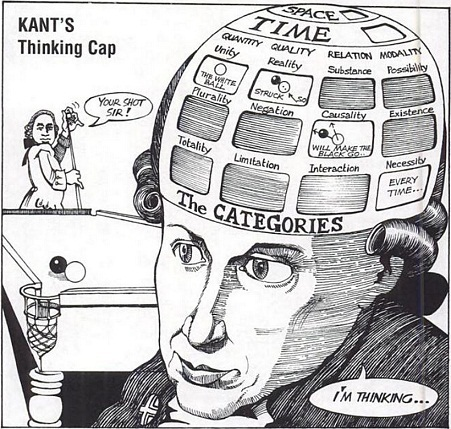
So we pass from the wide field of sensation and perception to the dark and narrow chamber of thought; from “transcendental esthetic” to “transcendental logic.” And first to the naming and analysis of those elements in our thought which are not so much given to the mind by perception as given to perception by the mind; those levers which raise the “perceptual” knowledge of objects into the “conceptual” knowledge of relationships, sequences, and laws; those tools of the mind which refine experience into science. Just as perceptions arranged sensations around objects in space and time, so conception arranges perceptions (objects and events) about the ideas of cause, unity, reciprocal relation, necessity, contingency, etc.; these and other “categories” are the structure into which perceptions are received, and by which they are classified and moulded into the ordered concepts of thought. These are the very essence and character of the mind; mind is the coordination of experience.

Perception comes about as the sensations are arranged around objects and events in space and time. Conception comes about as the perceptions are arranged around “categories,” such as, cause, unity, reciprocal relation, necessity, contingency, etc. Mind is the coordination of experience.

And here again observe the activity of this mind that was, to Locke and Hume, mere “passive wax” under the blows of sense-experience. Consider a system of thought like Aristotle’s; is it conceivable that this almost cosmic ordering of data should have come by the automatic, anarchistic spontaneity of the data themselves? See this magnificent card-catalogue in the library, intelligently ordered into sequence by human purpose. Then picture all these card-cases thrown upon the floor, all these cards scattered pell-mell into riotous disorder. Can you now conceive these scattered cards pulling themselves up, Munchausen-like, from their disarray, passing quietly into their alphabetical and topical places in their proper boxes, and each box into its fit place in the rack,–until all should be order and sense and purpose again? What a miracle-story these sceptics have given us after all!

Prior to Kant, it was assumed that the sensations arranged themselves into a remarkable order automatically somehow. No ordering agency was postulated.

Sensation is unorganized stimulus, perception is organized sensation, conception is organized perception, science is organized knowledge, wisdom is organized life: each is a greater degree of order, and sequence, and unity. Whence this order, this sequence, this unity? Not from the things themselves; for they are known to us only by sensations that come through a thousand channels at once in disorderly multitude; it is our purpose that put order and sequence and unity upon this importunate lawlessness; it is ourselves, our personalities, our minds, that bring light upon these seas. Locke was wrong when he said, “There is nothing in the intellect except what was first in the senses”; Leibnitz was right when he added,–“nothing, except the intellect itself.” “Perceptions without conceptions,” says Kant, “are blind.” If perceptions wove themselves automatically into ordered thought, if mind were not an active effort hammering out order from chaos, how could the same experience leave one man mediocre, and in a more active and tireless soul be raised to the light of wisdom and the beautiful logic of truth?

Sensation is unorganized stimulus, perception is organized sensation, conception is organized perception, science is organized knowledge, wisdom is organized life: each is a greater degree of order, and sequence, and unity. There has to be some agency to bring this order about.

The world, then, has order, not of itself, but because the thought that knows the world is itself an ordering, the first stage in that classification of experience which at last is science and philosophy. The laws of thought are also the laws of things, for things are known to us only through this thought that must obey these laws, since it and they are one; in effect, as Hegel was to say, the laws of logic and the laws of nature are one, and logic and metaphysics merge. The generalized principles of science are necessary because they are ultimately laws of thought that are involved and presupposed in every experience, past, present, and to come. Science is absolute, and truth is everlasting.

There is thought that knows the world is itself an ordering. It orders itself from sensations into perceptions, conceptions, science and philosophy. The laws of thought underlie all things. The universe is a conscious, living thing. 

.

Final Comments

.

KANT: Transcendental Esthetic

Reference: The Story of Philosophy

This paper presents Chapter VI, Immanuel Kant and German Idealism, Section 3 (part 1) from the book THE STORY OF PHILOSOPHY by WILL DURANT. The contents are from the 1933 reprint of this book by TIME INCORPORATED by arrangement with Simon and Schuster, Inc.

The paragraphs of the original material (in black) are accompanied by brief comments (in color) based on the present understanding.  Feedback on these comments is appreciated.

The heading below is linked to the original materials.

.

Transcendental Esthetic

The effort to answer this question, to study the inherent structure of the mind, or the innate laws of thought, is what Kant calls “transcendental philosophy,” because it is a problem transcending sense-experience. “I call knowledge transcendental which is occupied not so much with objects, as with our a priori concepts of objects.” [Critique of Pure Reason, p. 10.] –with our modes of correlating our experience into knowledge. There are two grades or stages in this process of working up the raw material of sensation into the finished product of thought. The first stage is the coordination of sensations by applying to them the forms of perception—space and time; the second stage is the coordination of the perceptions so developed, by applying to them the forms of conception—the “categories” of thought. Kant, using the word esthetic in its original and etymological sense, as connoting sensation or feeling, calls the study of the first of these stages ‘Transcendental Esthetic”; and using the word logic as meaning the science of the forms of thought, he calls the study of the second stage ‘Transcendental Logic.” These are terrible words, which will take meaning as the argument proceeds; once over this hill, the road to Kant will be comparatively clear.

Kant’s “transcendental philosophy” studies the inherent structure of the mind. Such a structure is unknowable because it precedes knowledge. It can only be theorized based on how sensations are converted into perceptions and thought. The conversion occurs in two stages.

Now just what is meant by sensations and perceptions?—and how does the mind change the former into the latter? By itself a sensation is merely the awareness of a stimulus; we have a taste on the tongue, an odor in the nostrils, a sound in the ears, a temperature on the skin, a flash of light on the retina, a pressure on the fingers: it is the raw, crude beginning of experience; it is what the infant has in the early days of its groping mental life; it is not yet knowledge. But let these various sensations group themselves about an object in space and time –say this apple; let the odor in the nostrils, and the taste on the tongue, the light on the retina, the shape-revealing pressure on the fingers and the hand, unite and group themselves about this “thing”: and there is now an awareness not so much of a stimulus as of a specific object; there is a perception. Sensation has passed into knowledge.

By itself a sensation is merely the response of the sense organ to some stimulus. But as these sensations unite and group themselves they acquire a meaningful awareness. This is perception.

But again, was this passage, this grouping, automatic? Did the sensations of themselves, spontaneously and naturally, fall into a cluster and an order, and so become perception? Yes, said Locke and Hume; not at all, says Kant.

For these varied sensations come to us through varied channels of sense, through a thousand “afferent nerves” that pass from skin and eye and ear and tongue into the brain; what a medley of messengers they must be as they crowd into the chambers of the mind, calling for attention! No wonder Plato spoke of “the rabble of the senses.” And left to themselves, they remain rabble, a chaotic “manifold,” pitifully impotent, waiting to be ordered into meaning and purpose and power. As readily might the messages brought to a general from a thousand sectors of the battle-line weave themselves unaided into comprehension and command. No; there is a law-giver for this mob, a directing and coordinating power that does not merely receive, but takes these atoms of sensation and moulds them into sense.

But this uniting and grouping of sensations is not automatic. There is a directing and coordinating power, which moulds sensation into perception.

Observe, first, that not all of the messages are accepted. Myriad forces play upon your body at this moment; a storm of stimuli beats down upon the nerve-endings which, amoeba-like, you put forth to experience the external world: but not all that call are chosen; only those sensations are selected that can be moulded into perceptions suited to your present purpose, or that bring those imperious messages of danger which are always relevant. The clock is ticking, and you do not hear it; but that same ticking, not louder than before, will be heard at once if your purpose wills it so. The mother asleep at her infant’s cradle is deaf to the turmoil of life about her; but let the little one move, and the mother gropes her way back to waking attention like a diver rising hurriedly to the surface of the sea. Let the purpose be addition, and the stimulus “two and three” brings the response, “five”; let the purpose be multiplication, and the same stimulus, the same auditor)’ sensations, “two and three,” bring the response, “six.” Association of sensations or ideas is not merely by contiguity in space or time, nor by similarity, nor recency, frequency or intensity of experience; it is above all determined by the purpose of the mind. Sensations and thoughts are servants, they await our call, they do not come unless we need them. There is an agent of selection and direction that uses them and is their master. In addition to the sensations and the ideas there is the mind.

There is an agent of selection and direction that picks only those sensations that can be moulded into perceptions suited to the existing purpose.

This agent of selection and coordination, Kant thinks, uses first of all two simple methods for the classification of the material presented to it: the sense of space, and the sense of time. As the general arranges the messages brought him according to the place for which they come, and the time at which they were written, and so finds an order and a system for them all; so the mind allocates its sensations in space and time, attributes them to this object here or that object there, to this present time or to that past. Space and time are not things perceived, but modes of perception, ways of putting sense into sensation; space and time are organs of perception.

According to Kant, the sense of space and time is applied for such a selection.

They are a priori, because all ordered experience involves and presupposes them. Without them, sensations could never grow into perceptions. They are a priori because it is inconceivable that we should ever have any future experience that will not also involve them. And because they are a priori, their laws, which are the laws of mathematics, a priori, absolute and necessary, world without end. It is not merely probable, it is certain that we shall never find a straight line that is not the shortest distance between two points. Mathematics, at least, is saved from the dissolvent scepticism of David Hume.

The criterion that is applied is a priori, absolute and necessary.

Can all the sciences be similarly saved? Yes, if their basic principle, the law of causality that a given cause must always be followed by a given effect can be shown, like space and time, to be so inherent in all the processes of understanding that no future experience can be conceived that would violate or escape it. Is causality, too, a priori, an indispensable prerequisite and condition of all thought?

A similar criterion may be applied to all sciences that consist of a priori cause and effect.

.

Final Comments

.

KANT: The Critique of Pure Reason

Reference: The Story of Philosophy

This paper presents Chapter VI, Immanuel Kant and German Idealism, Section 3 (beginning only) from the book THE STORY OF PHILOSOPHY by WILL DURANT. The contents are from the 1933 reprint of this book by TIME INCORPORATED by arrangement with Simon and Schuster, Inc.

The paragraphs of the original material (in black) are accompanied by brief comments (in color) based on the present understanding.  Feedback on these comments is appreciated.

The heading below is linked to the original materials.

.

The Critique of Pure Reason

[A word about what to read. Kant himself is hardly intelligible to the beginner, because his thought is insulated with a bizarre and intricate terminology (hence the paucity of direct quotation in this chapter). Perhaps the simplest introduction is Wallace’s Kant, in the Blackwood Philosophical Classics. Heavier and more advanced is Paulsen’s Immanuel Kant. Chamberlain’s Immanuel Kant (2 vols.; New York, 1914) is interesting but erratic and digressive. A good criticism of Kant may be found in Schopenhauer’s World as Will and Idea; vol. ii. pp. 1-159. But caveat emptor.]

What is meant by this title? Critique is not precisely a criticism, but a critical analysis; Kant is not attacking “pure reason,” except, at the end, to show its limitations; rather he hopes to show its possibility, and to exalt it above the impure knowledge which comes to us through the distorting channels of sense. For “pure” reason is to mean knowledge that does not come through our senses, but is independent of all sense experience; knowledge belonging to us by the inherent nature and structure of the mind.

At the very outset, then, Kant flings down a challenge to Locke and the English school: knowledge is not all derived from the senses. Hume thought he had shown that there is no soul, and no science; that our minds are but our ideas in procession and association; and our certainties but probabilities in perpetual danger of violation. These false conclusions, says Kant, are the result of false premises: you assume that all knowledge comes from “separate and distinct” sensations; naturally these cannot give you necessity, or invariable sequences of which you may be forever certain; and naturally you must not expect to “see” your soul, even with the eyes of the internal sense. Let us grant that absolute certainty of knowledge is impossible if all knowledge comes from sensation, from an independent external world which owes us no promise of regularity of behavior. But what if we have knowledge that is independent of sense-experience, knowledge whose truth is certain to us even before experience—a priori? Then absolute truth, and absolute science, would become possible, would it not? Is there such absolute knowledge? This is the problem of the first Critique. “My question is, what we can hope to achieve with reason, when all the material and assistance of experience are taken away.” [Critique of Pure Reason, pref. p. xxiv.] The Critique becomes a detailed biology of thought, an examination of the origin and evolution of concepts, an analysis of the inherited structure of the mind. This, as Kant believes, is the entire problem of metaphysics. “In this book I have chiefly aimed at completeness; and I venture to maintain that there ought not to be one single metaphysical problem that has not been solved here, or to the solution of which the key at least has not here been supplied.” [Critique of Pure Reason, pref. p. xxiii.] Exegi monumentum aere perennius! With such egotism nature spurs us on to creation.

Kant maintains that knowledge is not all derived from the senses. This is true because the basis of knowledge is the postulate structure of the mind. This is the unknowable “soul”. The science is the assimilation, because knowledge does not all come from “separate and distinct” sensations.

In his “Critique of Pure Reason” Kant poses the question, “What can we hope to achieve with reason, when all the material and assistance of experience are taken away?” He examines the origin and evolution of concepts. He makes an analysis of the inherited structure of the mind.

The Critique comes to the point at once. “Experience is by no means the only field to which our understanding can be confined. Experience tells us what is, but not that it must be necessarily what it is and not otherwise. It therefore never gives us any really general truths; and our reason, which is particularly anxious for that class of knowledge, is roused by it rather than satisfied. General truths, which at the same time bear the character of an inward necessity, must be independent of experience—clear and certain in themselves.” [Critique of Pure Reason, pref. p. 1.] That is to say, they must be true no matter what our later experience may be; true even before experience; true a priori. “How far we can advance independently of all experience, in a priori knowledge, is shown by the brilliant example of mathematics.” [Critique of Pure Reason, pref. p. 4.] Mathematical knowledge is necessary and certain; we cannot conceive of future experience violating it. We may believe that the sun will “rise” in the west tomorrow, or that some day, in some conceivable asbestos world, fire will not burn stick; but we cannot for the life of us believe that two times two will ever make anything else than four. Such truths are true before experience; they do not depend on experience past, present, or to come. Therefore they are absolute and necessary truths; it is inconceivable that they should ever become untrue. But whence do we get this character of absoluteness and necessity? Not from experience; for experience gives us nothing but separate sensations and events, which may alter their sequence in the future. [“Radical empiricism” (James, Dewey, etc.) enters the controversy at this point, and argues, against both Hume and Kant, that experience gives us relations and sequences as well as sensations and events.] These truths derive their necessary character from the inherent structure of our minds, from the natural and inevitable manner in which our minds must operate. For the mind of man (and here at last is the great thesis of Kant) is not passive wax upon which experience and sensation write their absolute and yet whimsical will; nor is it a mere abstract name for the series or group of mental states; it is an active organ which moulds and coordinates sensations into ideas, an organ which transforms the chaotic multiplicity of experience into the ordered unity of thought.

But how?

.

Final Comments

.

KANT: Kant Himself

Reference: The Story of Philosophy

This paper presents Chapter VI, Immanuel Kant and German Idealism, Section 2 from the book THE STORY OF PHILOSOPHY by WILL DURANT. The contents are from the 1933 reprint of this book by TIME INCORPORATED by arrangement with Simon and Schuster, Inc.

The paragraphs of the original material (in black) are accompanied by brief comments (in color) based on the present understanding.  Feedback on these comments is appreciated.

The heading below is linked to the original materials.

.

Kant Himself

He was born at Konigsberg, Prussia, in 1724. Except for a short period of tutoring in a nearby village, this quiet little professor, who loved so much to lecture on the geography and ethnology of distant lands, never left his native city. He came of a poor family, which had left Scotland some hundred years before Immanuel’s birth. His mother was a Pietist, i.e., a member of a religious sect which, like the Methodists of England, insisted on the full strictness and rigor of religious practice and belief. Our philosopher was so immersed in religion from morning to night that on the one hand he experienced a reaction which led him to stay away from church all through his adult life; and on the other hand he kept to the end the sombre stamp of the German Puritan, and felt, as he grew old, a great longing to preserve for himself and the world the essentials, at least, of the faith so deeply inculcated in him by his mother.

Kant [1724 – 1804]. He grew up with the full strictness and rigor of religious practice and belief of Pietism.

But a young man growing up in the age of Frederick and Voltaire could not insulate himself from the sceptical current of the time. Kant was profoundly influenced even by the men whom later he aimed to refute, and perhaps most of all by his favorite enemy, Hume; we shall see later the remarkable phenomenon of a philosopher transcending the conservatism of his maturity and returning in almost his last work, and at almost the age of seventy, to a virile liberalism that would have brought him martyrdom had not his age and his fame protected him. Even in the midst of his work of religious restoration we hear, with surprising frequency, the tones of another Kant whom we might almost mistake for a Voltaire. Schopenhauer thought it “not the least merit of Frederick the Great, that under his government Kant could develop himself, and dared to publish his Critique of Pure Reason. Hardly under any other government would a salaried professor” (therefore, in Germany, a government employee) “have ventured such a thing. Kant was obliged to promise the immediate successor of the great King that he would write no more.” [The World as Will and Idea, London,1883; vol. ii, p. 133.] It was in appreciation of this freedom that Kant dedicated the Critique to Zedlitz, Frederick’s far-sighted and progressive Minister of Education.

Kant’s last work was quite controversial in his time.

In 1755 Kant began his work as private lecturer at the University of Konigsberg. For fifteen years he was left in this lowly post; twice his applications for a professorship were refused. At last, in 1770, he was made professor of logic and metaphysics. After many years of experience as a teacher, he wrote a text-book of pedagogy, of which he used to say that it contained many excellent precepts, none of which he had ever applied. Yet he was perhaps a better teacher than writer; and two generations of students learned to love him. One of his practical principles was to attend most to those pupils who were of middle ability; the dunces, he said, were beyond all help, and the geniuses would help themselves.

Kant was very much liked as a teacher.

Nobody expected him to startle the world with a new metaphysical system; to startle anybody seemed the very last crime that this timid and modest professor would commit. He himself had no expectations in that line; at the age of forty-two he wrote: “I have the fortune to be a lover of metaphysics; but my mistress has shown me few favors as yet.” He spoke in those days of the “bottomless abyss of metaphysics,” and of metaphysics as “a dark ocean without shores or lighthouse,” strewn with many a philosophic wreck. [In Paulsen, Immanuel Kant; New York, 1910; p. 82.] He could even attack the metaphysicians as those who dwelt on the high towers of speculation, “where there is usually a great deal of wind.” [In Paulsen, Immanuel Kant; New York, 1910; p. 56.] He did not foresee that the greatest of all metaphysical tempests was to be of his own blowing.

Kant loved the subject of metaphysics, but found it to be very confusing.

During these quiet years his interests were rather physical than metaphysical. He wrote on planets, earthquakes, fire, winds, ether, volcanoes, geography, ethnology, and a hundred other things of that sort, not usually confounded with metaphysics. His Theory of the Heavens (1755) proposed something very similar to the nebular hypothesis of Laplace, and attempted a mechanical explanation of all sidereal motion and development. All the planets, Kant thought, have been or will be inhabited; and those that are farthest from the sun, having had the longest period of growth, have probably a higher species of intelligent organisms than any yet produced on our planet. His Anthropology (put together in 1798 from the lectures of a life-time) suggested the possibility of the animal origin of man. Kant argued that if the human infant, in early ages when man was still largely at the mercy of wild animals, had cried as loudly upon entering the world as it does now, it would have been found out and devoured by beasts of prey; that in all probability, therefore, man was very different at first from what he had become under civilization. And then Kant went on, subtly: “How nature brought about such a development, and by what causes it was aided, we know not. This remark carries us a long way. It suggests the thought whether the present period of history, on the occasion of some great physical revolution, may not be followed by a third, when an orangutan or a chimpanzee would develop the organs which serve for walking, touching, speaking, into the articulated structure of a human being, with a central organ for the use of understanding, and gradually advance under the training of social institutions.”  Was this use of the future tense Kant’s cautiously indirect way of putting forth his view of how man had really developed from the beast?  [So Wallace suggests: Kant, Philadelphia, 1882,; p. 115.]

Kant’s earlier work has not been about Metaphysics.

So we see the slow growth of this simple little man, hardly five feet tall, modest, shrinking, and yet containing in his head, or generating there, the most far-reaching revolution in modern philosophy. Kant’s life, says one biographer, passed like the most regular of regular verbs. “Rising, coffee-drinking, writing, lecturing, dining, walking,” says Heine,– “each had its set time. And when Immanuel Kant, in his gray coat, cane in hand, appeared at the door of his house, and strolled towards the small avenue of linden trees which is still called ‘The Philosopher’s Walk,’ the neighbors knew it was exactly half-past-three by the clock. So he promenaded up and down, during all seasons; and when the weather was gloomy, or the gray clouds threatened rain, his old servant Lampe was seen plodding anxiously after, with a large umbrella under his arm, like a symbol of Prudence.”

Kant had a strict daily schedule.

He was so frail in physique that he had to take severe measures to regimen himself; he thought it safer to do this without a doctor; so he lived to the age of eighty. At seventy he wrote an essay “On the Power of the Mind to Master the Feeling of Illness by Force of Resolution.” One of his favorite principles was to breathe only through the nose, especially when out-doors; hence, in autumn, winter and spring, he would permit no one to talk to him on his daily walks; better silence than a cold. He applied philosophy even to holding up his stockings by bands passing up into his trousers’ pockets, where they ended in springs contained in small boxes. [“Introd. to Kant’s Critique of Practical Reason; London, 1909; p. xiii.] He thought everything out carefully before acting; and therefore remained a bachelor all his life long. Twice he thought of offering his hand to a lady; but he reflected so long that in one case the lady married a bolder man, and in the other the lady removed from Konigsberg before the philosopher could make up his mind. Perhaps he felt, like Nietzsche, that marriage would hamper him in the honest pursuit of truth; “a married man,’ Talleyrand used to say, “will do anything for money.” And Kant had written, at twenty-two, with all the fine enthusiasm of omnipotent youth: “I have already fixed upon the line which I am resolved to keep. I will enter on my course, and nothing shall prevent me from pursuing it.” [Wallace,p.100.]

And so he persevered, through poverty and obscurity, sketching and writing and rewriting his magnum opus for almost fifteen years; finishing it only in 1781, when he was fifty-seven years old. Never did a man mature so slowly; and then again, never did a book so startle and upset the philosophic world.

.

Final Comments

Kant was a small, frail, and a very private man, who taught and lectured about subjects other than metaphysics. He wrote about metaphysics only after great thought as his final work.

.