Reference: Einstein’s 1920 Book
Section XXIV (Part 2)
Euclidean and Non-Euclidean Continuum
Please see Section XXIV at the link above.
.
Summary
A surface is continuous. It can be divided into square units. The property of flatness of the surface is quite special. It supports straight lines. This property underlies the Cartesian co-ordinate system. This is the Euclidean continuum.
A non-flat surface shall still form a continuum, but it would not support straight-line units of the same size throughout. It would no longer be a Euclidean continuum and it would not support the Cartesian co-ordinates directly. So we shall use a more flexible co-ordinate system that would comply with the inertial requirements of the gravitational field.
The Euclidean geometry and the Cartesian system represents a totally rigid medium with no flexibility. A gravitational field requires non-Euclidean geometry and a co-ordinate system that can take into account some flexibility in the medium. The mathematics, which takes this flexibility into account is the method of Riemann of treating multi-dimensional, non-Euclidean continua based on the principles outlined by Gauss.
.
Final Comments
The Euclidean geometry is basically considering the surface of a sphere of infinite radius. Such a surface appears flat and it supports straight lines. These are boundary conditions that represent a substance of total flexibility. Within this boundary is substance that varies in the flexibility of its structure, such that the farthest point from the boundary is totally rigid.
The Euclidean geometry arbitrarily assumes a substance of totally rigid structure at the boundary and within that boundary throughout. The non-Euclidean geometry introduces the required flexibility, and the methods of Riemann accounts for the variations in that flexibility.
This flexibility represents the variations in the inertia of matter or, more generally, the variations in the consistency of substance filling the space-time.
.
Reference: Einstein’s 1920 Book
Section XXIII (Part 2)
Behaviour of Clocks and Measuring Rods on a Rotating Body of Reference
Please see Section XXIII at the link above.
.
Summary
The physical interpretation of the space-time continuum in the context of the general theory of relativity may require some patience and power of abstraction. In a Galilean space-time continuum, only uniform motion is manifested. But in the general space-time continuum, inertia or consistency is also manifested due to curvilinear motion. This is taken as the effect of a gravitational field. The general law of gravitation would then be expected to explain not only the motion, but also the inertia/consistency of the stars.
In the given thought experiment, the reference point at the edge of the rotating disc will have much greater motion and flexibility than the reference point at the center of the disc. Therefore, measurements by clocks and rods will differ greatly at the two locations. As a result, the physical interpretation of the space-time continuum shall differ greatly in the gravitational field observed.
.
Final Comments
The space-time continuum in the gravitational field of a rotating body of reference shall have a varying sense of inertia/consistency associated with different locations.
.
Reference: Einstein’s 1920 Book
Section XXII (Part 2)
A Few Inferences from the General Theory of Relativity
Please see Section XXII at the link above.
.
Summary
Gravitational field exists along with the fact of acceleration. We may now study its influence theoretically. We notice that a body at rest, or with uniform motion otherwise, would be accelerating in this gravitational field. In general it would have a curvilinear motion instead of a straight line motion. This would then apply to a ray of light as well when it passes through a gravitational field.
Theoretical calculations show that the light from stars that reach earth would acquire a curvature of 1.7 seconds of arc as they pass the sun at a grazing incidence. This would mean that the velocity of light must also change as it passes through a gravitational field. We then conclude that the results of the special theory of relativity hold only so long as we are able to disregard the influences of gravitational fields on light.
We may consider the special theory of relativity to be contained within the general theory of relativity as a limiting case. The general theory of relativity also tells us about the laws satisfied by the gravitational field itself.
We may visualize space-time domains where no gravitational fields exist as Galilean domains. The general theory of relativity considers those space-time domains where the gravitational field is present. We hope that the general theory of relativity leads to laws that are applicable to all gravitational fields. This will extend our ideas of the space-time continuum still farther.
.
Final Comments
The most natural condition in this universe is the presence of gravitational fields. The general theory of relativity considers the effect of this condition on the space-time continuum.
The space-time continuum essentially describes the continuum of energy in which the matter is floating. Our knowledge of this energy extends to the electromagnetic spectrum. The flexible structure of this electromagnetic spectrum manifests in the form of gravitational fields. The gravitational fields are expected to be made up of curvilinear motions in the sea of energy.
The gravitational fields may be visualized as rotating motions much like whirlpools in the sea of energy. The substance in gravitational fields accelerates toward a center, where it collects and condenses.
.
Reference: Einstein’s 1920 Book
Section XXI (Part 2)
In What Respects Are the Foundations of Classical Mechanics and of the Special Theory of Relativity Unsatisfactory?
Please see Section XXI at the link above.
.
Summary
In Classical Mechanics, and also in the special theory of relativity, reference bodies that maintain inherent uniform rotation are disregarded. Therefore, a new basis for physics is required that includes uniformly rotating reference bodies.
In rotating bodies radial acceleration is involved. Such a basis would obviously be conformable to the general principle of relativity.
.
Final Comments
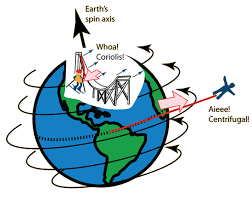
Classical mechanics refers to motion in a straight line only. But its laws may be generalized for curved motion. Curved motion exists in rotation that involves radial acceleration. Because there is acceleration, it must be balanced by inertia. When there is natural inertia there is also a field. Therefore, the curved motion shall bring a gravitational field into existence.
.
Reference: Einstein’s 1920 Book
Section XX (Part 2)
The Equality of Inertial and Gravitational Mass as an Argument for the General Postulate of Relativity
Please see Section XX at the link above.
.
Summary
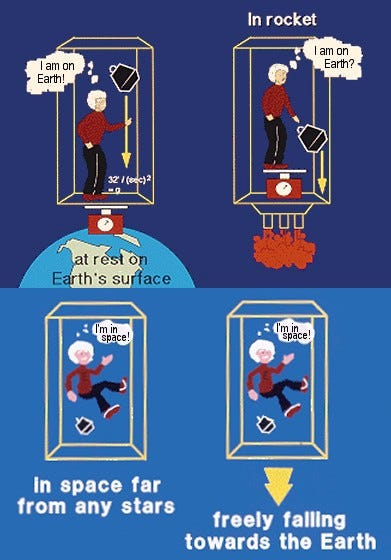
In a Galilean space, bodies are either at rest or moving at uniform velocity. There is neither acceleration, nor any sense of gravity. But, when uniformly accelerated motion is applied to a body, the velocity of the body will increase to enormous values in course of time. However, from the reference point of the body, it would appear to be at rest; but, as its inertia resists the acceleration, it would acquire weight, as if it is in a gravitational field. We have thus good grounds for extending the principle of relativity to include bodies of reference which are accelerated with respect to each other.
From the viewpoint of the accelerating body, bodies that are at rest or in uniform motion will appear to accelerate uniformly in the opposite direction irrespective of their masses. This is the fundamental property of the gravitational field of giving all bodies the same acceleration. Guided by this example, we see that our extension of the principle of relativity implies the necessity of the law of the equality of inertial and gravitational mass.
Thus, we see that a general theory of relativity must yield important results on the laws of gravitation. But it is not so straightforward, because we cannot always choose another reference-body such that no gravitational field exists with reference to it. It is, for instance, impossible to choose a body of reference such that, as judged from it, the gravitational field of the earth (in its entirety) vanishes.
.
Final Comments
A uniformly moving body appears at rest relative to itself. But, a uniformly accelerating body appears at rest relative to itself too; except, in this case, there is also a sense of mass or consistency.
.