Einstein’s Paper on Light Quanta

In his very first paper published in 1905 Einstein establishes the concept of “energy quantum” or “light quantum”. The energy of light quantum (photon) is proportional to frequency that becomes more pronounced as one moves up the electromagnetic spectrum. Here is a summary of Einstein’s 1905 paper on Light Quantum followed by some comments.

SECTION 0: Introduction

Einstein says,

The energy of a ponderable body cannot be split into arbitrarily many, arbitrarily small parts, while the energy of a light ray, emitted by a point source of light is according to Maxwell’s theory (or in general according to any wave theory) of light distributed continuously over an ever increasing volume.

In other words, Einstein observes that atoms are not infinitely divisible, but the electromagnetic radiation is treated as a continuum and infinitely divisible.

Einstein says,

“In fact, it seems to me that the observations on “black-body radiation”, photoluminescence, the production of cathode rays by ultraviolet light and other phenomena involving the emission or conversion of light can be better understood on the assumption that the energy of light is distributed discontinuously in space.”

In other words, Einstein proposes that the creation and conversion of light may not be continuous.

SECTION 1. On a Difficulty in the Theory of “Black-body Radiation’’

In this section Einstein sets up a thought experiment. He assumes electrons to be particles that are colliding like gas molecules. There are bound “resonator electrons” that emit and absorb electromagnetic waves with definite periods. The average kinetic energy of a resonator electron must equal the average kinetic energy corresponding to the translational motion of a gas molecule under dynamic equilibrium. Similarly, it should also equal the energy of interaction with radiation present in space.

Einstein says,

“This relation, which we found as the condition for dynamic equilibrium does not only lack agreement with experiment, but it also shows that in our picture there can be no question of a definite distribution of energy between aether and matter. The greater we choose the range of frequencies of the resonators, the greater becomes the radiation energy in space…”

This was famously known as the ultraviolet catastrophe.

SECTION 2. On Planck’s Determination of Elementary Quanta

In this section Einstein shows that “determination of elementary quanta given by Mr. Planck is, to a certain extent, independent of the theory of “black-body radiation” constructed by him.”

Using mathematics to back up his argument, Einstein concludes:

“The higher the energy density and the longer the wavelengths of radiation, the more usable is the theoretical basis used by us; for short wavelengths and low radiation densities, however, the basis fails completely.”

In other words, the radiation appears continuous per Maxwell’s theory at lower frequencies, but not at higher frequencies.

SECTION 3. On the Entropy of the Radiation

In this section Einstein presents Wien’s consideration that entropy of radiation may be determined completely from black body radiation law when the radiation energy is given for all frequencies.

SECTION 4. Limiting Law for the Entropy of Monochromatic Radiation for Low Radiation Density

In this section Einstein uses Wien’s approximation (valid for higher frequencies of black body radiation) to derive an equation for the entropy of radiation.

Einstein writes:

“This equation shows that the entropy of a monochromatic radiation of sufficiently small density varies with volume according to the same rules as the entropy of a perfect gas or of a dilute solution.”

Thus, Einstein proves that the energy distribution of radiation becomes particle-like at high frequencies. This is an ingenious way of arriving at this conclusion.

SECTION 5. Molecular-Theoretical Investigation of the Volume-dependence of the Entropy of Gases and Dilute Solutions

In this section Einstein shows that, when applied to a large number of discrete particles, the use of “statistical probability” is compatible with macroscopic laws of physics.

SECTION 6. Interpretation of the Expression for the Volume-dependence of the Entropy of Monochromatic Radiation according to Boltzmann’s Principle

In this section, Einstein uses mathematical arguments to conclude:

“Monochromatic radiation of low density behaves—as long as Wien’s radiation formula is valid—in a thermodynamic sense, as if it consisted of mutually independent energy quanta of magnitude Rßv/N.”

Each quantum is the energy of one interaction. Einstein mathematically determines the theoretical value of a quantum.

SECTION 7. On Stokes’ Rule

In this section Einstein uses the new idea of “energy quanta” to explain the Stokes’ Rule for photoluminescence and indicates new possibilities.

SECTION 8. On the Production of Cathode Rays by Illumination of Solids

In this section Einstein brilliantly verifies the calculated value of energy quanta from the experimental value obtained from the study of photoelectricity. Here we have the conclusive evidence that energy of light is made up of frequency (kinetic energy) and not amplitude (wave energy).

SECTION 9. On the Ionization of Gases by Ultraviolet Light

In this section Einstein tests his ideas to explain the existing experimental observations and further proves the viability of the idea of “energy quantum” or “light quantum”.

.

Comments

Einstein’s concept of quantum is based on energy. From the phenomenon of photoelectricity, it can be seen that this energy is kinetic (based on frequency) and not that of a wave (based on amplitude). Light carries this energy with it. This means light is a fast-moving substance.

The kinetic energy depends on relative velocity between two things. Therefore, this energy is visible only when there is interaction between two things, such as, light and electron. Einstein is mathematically comparing this interaction to collisions among gas molecules in the kinetic theory of gases.

Therefore, quantum is tied to the energy of interaction. If there is no interaction, the energy, or the quantum, cannot be perceived. The very perception of quantum requires an interaction. Interactions are discrete. Therefore, quantum is discrete also, but only as energy of interaction. This is what Einstein is thinking about when he says, The energy of a ponderable body cannot be split into arbitrarily many, arbitrarily small parts…”

In the kinetic theory of gases, not only the interactions are discrete, but the interacting gas molecules are discrete also. The molecules are discrete because they have individual centers of mass. This is not the case with light because light has no centers of mass. Therefore, light “particles” cannot be distinguished from each other. Light forms a continuum in space even when its interactions are discrete.

Einstein disagreed with Maxwell treating energy of light as a continuous function across the spectrum; but he did agree with Maxwell for energy being continuous at the lower end of the spectrum. Maxwell treated light as a wave, which is not really the case. There is no stationary aether through which light is moving as a disturbance. Therefore, a continuous energy function at lower frequencies can only mean that energy interactions are so frequent that they appear continuous.

Thus, as the frequency reduces, light starts to act as a continuum in terms of energy interactions also. This can be used as an argument to support the observation that, fundamentally, light is infinitely divisible. As frequency increases, the energy interactions become increasingly differentiable.

Electrons also form a continuum in space similar to light, but their frequency is much higher. When light interacts with electrons in the photoelectric phenomenon, it is two continuums of very different frequencies interacting with each other, and not two particles. Any interaction shall only be in terms of partial resonance, and not as an impact between two billiard balls.

Much seems to be unknown about the nature of this interaction between light and electron.

The frequency of light may best be understood as the density of its continuum. The higher is the frequency, the greater is the density of light. There appears to be a high-density gradient from the electronic region to the nucleus within the atom. This is where the charge appears and the center of mass forms. This is an area of transition where radiation appears to be in equilibrium with matter.

Much seems to be unknown about this area of transition from electronic region to nucleus of atom.

In conclusion, let us look at the following assumption made by Einstein in this paper:

According to the assumption considered here, when a light ray starting from a point is propagated, the energy is not continuously distributed over an ever increasing volume, but it consists of a finite number of energy quanta, localized in space, which move without being divided and which can be absorbed or emitted only as a whole.

It appears that quanta are more particle-like only because the density of the continuum has increased.

From Faraday’s perspective, quanta can be represented by thicker lines of force, but those lines are still continuous.

.
Einstein’s Relativity

The null results from Michelson-Morley’s experiment in 1887 initiated a line of research that eventually led to Einstein’s theory of Special Relativity. The expected difference between the speed of light in the direction of movement through the presumed aether, and the speed at right angles, was found not to exist. The special relativity then ruled out a stationary aether.

The difference between the universal motion of light and Earth shall be constant because the difference between their densities is constant. This explains the null result of Michelson-Morley’s experiment.

One may object to the above reasoning by saying, “The earth is orbiting the sun. Therefore, it is constantly accelerating in the radial direction towards the sun, but not in the tangential direction. So, there must be a slight difference in speed in the two directions.”

.

Michael-Morley’s Experiment

We may calculate this accuracy required of Michael-Morley’s experiment as follows:

1.    From de Broglie’s relationship the frequency of Earth is about 8 x 1070. The frequency of visible light is about 8 x 10¹⁴. Therefore, the ratio of their frequency is of the order of 1056

2.     This means that earth is 1056 times as dense as light.

3.     Then the intrinsic speed of earth is 1056 times slower than the speed of light. Even if we take density to be proportional to the square of speed, the intrinsic speed of Earth shall still be 1028 times slower.

4.     Therefore, the intrinsic speed of earth is about (3 x 10⁸ meters/sec) times (10-28), or of the order of 10-20 m/s.

5.     Then, under best of the scenarios, the Michelson-Morley’s experiment is required to detect a velocity difference of the order of 10-20 m/s.

Michelson-Morley’s experiment was unable to detect the difference in speed of the order of 10-20 m/s. It, therefore, gave a null result. According to Wikipedia, modern experiments indicate that the two-way speed of light is isotropic (the same in every direction) to within 6 nanometres per second.

.

The Speed of Light

The null results from Michelson-Morley’s experiment led to the formulation of the Lorentz transformation. Einstein derived the same formulation from the principles of relativity. These principles required that the speed of light be the same in all inertial frames of reference.

From Wikipedia,

In 1905 Einstein postulated from the outset that the speed of light in vacuum, measured by a non-accelerating observer, is independent of the motion of the source or observer. Using this and the principle of relativity as a basis he derived the special theory of relativity, in which the speed of light in vacuum c featured as a fundamental constant, also appearing in contexts unrelated to light. This made the concept of the stationary aether (to which Lorentz and Poincaré still adhered) useless and revolutionized the concepts of space and time.

The speed of light provides the basis of universal motion just like Newton’s fixed stars. The fixed stars may be approximated as infinite density and zero motion; whereas, light may be approximated as zero density and infinite motion. Both work as the basis for universal motion because the scale of universal motion is inverse of the scale of density (see The Universal Frame of Reference).

.

The Theory of Relativity

The theory of relativity essentially converts local motion (relative to earth) to universal motion before doing math. That is why it gives more accurate results for Mercury’s orbit (see Newtonian Relativity). It does so through the use of Lorentz Transformation.

The Lorentz transformation reduces to Galilean transformation when ‘c’ is infinite. The speed of light is practically infinite compared to the motion in material domain. This means that Lorentz transformation is essentially “Galilean transformation with a correction factor for using local motion”.  The Newton’s laws of motion remain completely valid because they were originally designed for the universal frame of reference.

Lorentz transformation looks at the characteristics of space and time from the viewpoint of the invariant speed of light. Space and time actually represent the “extents” and “duration” of the substance respectively. Thus, space-time relates to the intrinsic properties (density and intrinsic motion) of substance.

The theory of relativity is applying the universal frame of reference in looking at the density and intrinsic motion of substance in the material domain.

We shall be looking at the mathematics of Lorentz transformation in the next chapter.

.

Newtonian Relativity

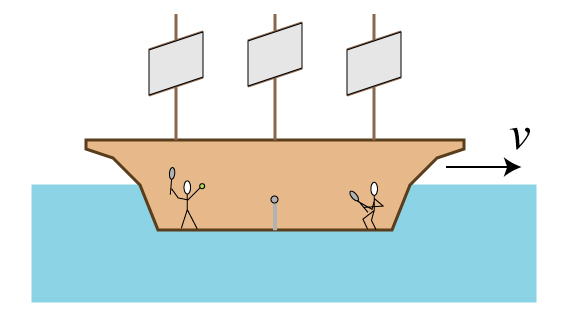
Newtonian relativity is an expansion upon Galilean relativity, which states that the laws of motion are the same in all inertial frames. Galileo Galilei first described this principle in 1632 using the example of a ship traveling at constant velocity, without rocking, on a smooth sea; any observer doing experiments below the deck would not be able to tell whether the ship was moving or stationary.

.

Inertial Frame of Reference

Newton considered the background of stars, which was at absolute rest, as the basis of all motion. According to Newton, all frames of reference, that are neither rotating nor accelerating, are in a state of constant, rectilinear motion with respect to one another. In other words, the first law of motion applies equally to these frames. Such a frame is called inertial frame of reference. Measurements in one inertial frame can be converted to measurements in another by a simple Galilean transformation.

In an inertial frame of reference, a body does not accelerate unless force is applied to it. In the absence of force, the body either stays at rest or moves at a constant speed in a straight line. Conceptually, the physics of a system in an inertial frame have no causes external to the system.

The inertial frame of reference operates from the perspective of MATERIAL-VOID duality. There is only matter that is homogeneous and isotropic throughout. The matter moves in the void with its space. There is no free space (see Matter, Void and Space).

.

Newton’s Assumptions

Newton assumes that matter can move at different uniform velocities independent of density. This assumption is valid for the material region since the velocities are so small that their variation has negligible effect on density.

Newton also assumes that the Laws of Motion (and the Galilean transformation) apply to objects on Earth for motions relative to the Earth. This assumption is valid because Earth adds the same motion to these objects relative to the fixed stars.

Newton also assumes that the Laws of Motion (and the Galilean transformation) apply to the motion of planets of the solar system, when Earth, or the Sun, is used as the basis of motion (instead of the fixed stars). This assumption is generally valid as long as the variations in densities are negligible (see The Universal Frame of Reference).

.

Mercury’s Orbit

Error occurs in calculating the precession of the perihelion of Mercury’s orbit because the variation in the densities involved is considerable. Mercury is 12 times as dense as the Sun, and 4 times as dense as the Earth. Therefore, neither Earth nor the Sun can be used as the basis of motion in lieu of the fixed stars.

Einstein resolved this problem through his theory of special relativity (SR), by using the speed of light as the basis of motion. This basis is just as workable as the basis of fixed stars because the speed of light is an intrinsic motion relative to fixed stars (see The Universal Frame of Reference).

Einstein says in The Evolution of Physics:

We really have no choice. We tried to save the Galilean relativity principle by assuming that systems carry the ether along in their motion, but this led to a contradiction with experiment. The only way out is to abandon the Galilean relativity principle and try out the assumption that all bodies move through the calm ether-sea.

The phrase “systems carry the ether along in their motion” seems to refer to the inertial frame operating from the perspective of MATERIAL-VOID duality (see above). Einstein seems to think that the problem is with the Galilean relativity principle.

The truth is that the problem arises because Earth and Sun are being used as the basis of motion instead of the fixed stars.

.

Local and Universal Motion

Newton’s Laws of Motion, and the Galilean transformation, apply to motion relative to fixed stars. The fixed stars are assumed to have an intrinsic motion of zero. The intrinsic motion is a characteristic that is inherent to the substance and it does not depend on anything outside of the moving body. We refer to intrinsic motion as universal motion because it is the same throughout the universe like other intrinsic properties, such as, mass.

Therefore, the fixed stars provide the zero of a scale, relative to which we can measure intrinsic or universal motion.

In contrast to universal motion we have local motion, which is measured relative to a local body, such as, the Earth or the Sun. Working with local motion is like working with unlike quantities that require conversion to like quantities before adding and subtracting. Therefore, local motion must be converted to universal motion before Galilean transformation can be applied, especially if the densities of the moving bodies are different.

Current physics uses the terms relative and absolute motion. This is confusing because relative motion exists on the absolute scale also. By absolute motion we really mean intrinsic, or universal motion.

Therefore, the terms local and universal motion are more useful than the terms relative and absolute motion.

.

Physics, Objectivity and Subjectivity

As explained in the preface, the very fact that the fundamental theories of physics cannot be reconciled indicates that there are basic assumptions underlying physics that are inconsistent with reality.

Physics starts with the concepts of matter and void. These two concepts are then expanded upon throughout the development of physics. Therefore, our search for assumptions should start with how matter and void have been conceived and expanded upon.

The starting concept in classical physics is matter as the basic substance, and the void as the absence of substance. All other concepts are then derived from the idea of matter as substance. For example, mass is the “density” of matter, kinetic energy is the “motion” of matter; potential energy is the “tension” in matter; momentum is the “impact” of matter.

Classical physics deals with matter up till the concept of atom. Beyond atom we encounter the constituents of atom and their characteristics.  These are dealt by quantum physics. A sharp break in reality occurs at this transition from classical to quantum physics because the characteristics of matter do not seem to continue beyond atom. Beyond matter, atom and quantum particles, there is electromagnetic radiation and, of course, void.

We need to investigate the concept of matter as a substance beyond the atom, where classical physics is replaced by quantum physics.

.

Objectivity

Physics takes pride in being objective. The word objective is derived from object that has the sense of “something perceived”. Objectivity requires consistency among what is observed and not just agreement on what is postulated to explain those observations.

Objective reality is not only made tangible through physical perceptions of sight, touch, hearing, taste and smell, but it is also made logical by the mental perceptions of continuity, consistency, and harmony. The objective reality is that which has been tested and verified and cannot be argued with. It is the same for all people because all known inconsistencies have been resolved.

When we say that physics is objective, we mean that there is a natural continuity, consistency, and harmony among all its observations, interpretations and conclusions.

.

Subjectivity

Physics tries to resolve subjectivity. The word subjective is derived from subject that has the sense of “open to inspection”. It is characterized by inconsistencies that still need to be resolved. As inconsistencies are resolved the subjective reality becomes increasingly objective.

Subjectivity exists when there is difficulty in obtaining direct observations, so gaps are filled with educated guesses and, sometimes, with outright assumptions. Such guesses and assumption must always be open to inspection. Trouble comes when things that are subjective are closed to inspection, mainly by agreement among physicists.

The route from subjectivity to objectivity in physics is a closer inspection of anomalies (discontinuity, inconsistency, and disharmony) concerning matter and void, and resolving them.

To find the assumptions that are hidden behind the mathematical symbolism for matter and void, we need to inspect the matter-void interface first.

The survey of Physics in Part I shows that we have a gradient of substance from matter to void.

.

The Local Frames of Reference

In contrast to the Universal Frame of Reference there are local frames of reference. A local frame of reference is like a viewpoint attached to a body within the universe as compared to the viewpoint of the whole universe.

The local frames of reference may be outlined as:

• Inertial frame of reference
• Inertial frame of reference (Newtonian)
• Inertial frame of reference (Relativistic)
• Non-inertial frame of reference

.

Inertial Frame of Reference

An inertial frame of reference is defined as one in which all laws of physics take on their simplest form. In this frame of reference, a body does not accelerate unless force is applied to it. In the absence of force, the body either stays at rest or moves at a constant speed in a straight line. Conceptually, the physics of a system in an inertial frame have no causes external to the system.

The inertial frame of reference describes time and space as homogeneous, isotropic, and independent of each other. In other words, it assumes space to be filled with matter that is homogeneous and isotropic throughout. (see Matter, Void and Space). It does not consider any variations in its density. The inertial frame of reference applies to the material domain only from the perspective of MATERIAL-VOID duality. It is not universal because it does not include the motion associated with electromagnetic radiation and gravitational force.

Conceptually, a body will move freely at a constant speed relative to another body only when there is a density differential (see The Universal Frame of Reference). But such differential is so small in the material domain that it is ignored. Therefore, all inertial frames are in a state of constant, rectilinear motion with respect to one another irrespective of density. Measurements in one inertial frame can be converted to measurements in another by a simple transformation (the Galilean transformation in Newtonian physics and the Lorentz transformation in special relativity).

.

Inertial Frame of Reference (Newtonian)

Newton viewed the first law as valid in any reference frame that is in uniform motion relative to the fixed stars; that is, neither rotating nor accelerating relative to the stars.

Hence, with respect to an inertial frame, an object or body accelerates only when a physical force is applied, and (following Newton’s first law of motion), in the absence of a net force, a body at rest will remain at rest and a body in motion will continue to move uniformly—that is, in a straight line and at constant speed. Newtonian inertial frames transform among each other according to the Galilean transformation.

The Newtonian frame of reference was the original inertial frame of reference that used Earth as its reference point for the motion of material objects on Earth; and Sun as its reference point for the motion of planets in the solar system. It was local because the basis of reference were local bodies.

.

Inertial Frame of Reference (Relativistic)

The principle of special relativity generalizes the notion of inertial frame to include all physical laws, not simply Newton’s first law. It, like Newtonian mechanics, postulates the equivalence of all inertial reference frames. However, because special relativity postulates that the speed of light in free space is invariant, the transformation between inertial frames is the Lorentz transformation, not the Galilean transformation which is used in Newtonian mechanics.

The special theory of relativity measures the material velocities from the basis of the velocity of light. The large density differential between matter and light makes the material velocities closer to being absolute as in the universal frame of reference. This gives more accurate results as in the calculation of the precession of the perihelion of Mercury’s orbit.

The invariance of the speed of light leads to counter-intuitive phenomena, such as time dilation and length contraction, and the relativity of simultaneity. But this is similar to the shrinking of period and wavelength as frequency increases in the electromagnetic spectrum. This indicates increasing density. This effect continues in the material domain. When external force is applied to matter its density increases by an infinitesimal amount (see The Electromagnetic Spectrum).

The Lorentz transformation reduces to the Galilean transformation as the speed of light approaches infinity. But those Galilean transformation require velocities to be measured relative to the stars as in the Universal Frame of Reference. Error comes about when velocities are measured relative to local bodies.

The Relativistic frame of reference uses a universal basis, but it still limits itself to the material domain. It is local in that sense.

.

Non-Inertial Frame of Reference

In contrast to the inertial frame, a non-inertial frame of reference is one in which fictitious forces must be invoked to explain observations. In other words, when there are curved paths, or rotation, in the inertial reference frame and no forces are visible, then fictitious forces of inertia are assumed.

These fictitious forces come about because of the frame of reference itself is accelerating. This makes the frame of reference non-inertial. For example, Coriolis effect occurs due to Earth’s rotation. This is accounted for by a fictitious force. Another example of such a fictitious force is the centrifugal force associated with rotating reference frames (see video). All of these forces including gravity disappear in a truly inertial reference frame, which is one of free-fall.

Both inertial and non-inertial frames are local because they are limited to the material domain. The Newtonian version uses a body within the universe from which to observe the motion of other bodies. The Relativistic version, however, uses a near universal basis that allows more accuracy but for the material domain only (see The Universal Frame of Reference).

.