Aberrations are contagious. They are passed along through dramatizations of engrams just like disease are carried by germs. The common source of contagion is somebody dramatizing his engram around an “unconscious” person; for example, on operating table under anaesthetic, after an accident, or when sick or injured. The father and mother, in dramatizing their own engrams around sick or injured children, pass them along just as certainly as if those engrams were bacteria. This is how misconceptions and poor data also gets manifested in a society’s culture.
Aberration passes from people to other people in a society like a communicable disease does.
Aberration is also passed through the programming recorded on the genes. Birth itself may contribute to contagion as it can be a very painful experience for both mother and child that causes unconsciousness. Mother and child can then become mutually restimulative to each other. If the husband has been aberrated, he will have aberrated or restimulated his wife and children in one way or another, even when he used no physical violence upon them.
Aberration passes from parents to children in a family.
In the larger sphere of society contagion of aberration is extremely dangerous and cannot but be considered as a vital factor in undermining the health of that society. A society which practices punishment of any kind against any of its members is carrying on a contagion of aberration. Contagion of aberration is never more apparent than in that social insanity called war.
Engrams enter from the exterior world into the hidden recesses below rational thinking and prevent rational answers being reached. This is exterior-determinism. Any interference with self-determinism cannot but lead to wrong computations. Forced groups are invariably less efficient than free groups working for the common good.
In a society, the passing of aberration has much more severe consequences than the passing of misinformation alone.
This paper presents Chapter II, Section 9 from the book THE STORY OF PHILOSOPHY by WILL DURANT. The contents are from the 1933 reprint of this book by TIME INCORPORATED by arrangement with Simon and Schuster, Inc.
The paragraphs of the original material (in black) are accompanied by brief comments (in color) based on the present understanding. Feedback on these comments is appreciated.
The heading below is linked to the original materials.
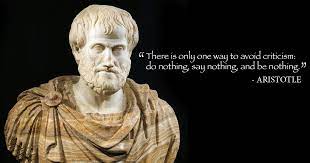
What shall we say of this philosophy? Perhaps nothing rapturous. It is difficult to be enthusiastic about Aristotle, because it was difficult for him to be enthusiastic about anything; and si vis me flere, primum tibi flendum.* His motto is nil admirari—to admire or marvel at nothing; and we hesitate to violate his motto in his case. We miss in him the reforming zeal of Plato, the angry love of humanity which made the great idealist denounce his fellow-men. We miss the daring originality of his teacher, the lofty imagination, the capacity for generous delusion. And yet, after reading Plato, nothing could be so salutary for us as Aristotle’s sceptic calm.
*[“If you wish me to weep you must weep first”-Horace (Ars Poetica) to actors and writers.]
Aristotle approached his investigations very calmly.
Let us summarize our disagreement. We are bothered, at the outset, with his insistence on logic. He thinks the syllogism a description of man’s way of reasoning, whereas it merely describes man’s way of dressing up his reasoning for the persuasion of another mind; he supposes that thought begins with premisses and seeks their conclusions, when actually thought begins with hypothetical conclusions and seeks their justifying premisses,—and seeks them best by the observation of particular events under the controlled and isolated conditions of experiment. Yet how foolish we should be to forget that two thousand years have changed merely the incidentals of Aristotle’s logic, that Occam and Bacon and Whewell and Mill and a hundred others have but found spots in his sun, and that Aristotle’s creation of this new discipline of thought, and his firm establishment of its essential lines, remain among the lasting achievements of the human mind.
Aristotle was a pioneer in organizing the subject of logic.
It is again the absence of experiment and fruitful hypothesis that leaves Aristotle’s natural science a mass of undigested observations. His specialty is the collection and classification of data; in every field he wields his categories and produces catalogues. But side by side with this bent and talent for observation goes a Platonic addiction to metaphysics; this trips him up in every science, and inveigles him into the wildest presuppositions. Here indeed was the great defect of the Greek mind: it was not disciplined; it lacked limiting and steadying traditions; it moved freely in an uncharted field, and ran too readily to theories and conclusions. So Greek philosophy leaped on to heights unreached again, while Greek science limped behind. Our modern danger is precisely opposite; inductive data fall upon us from all sides like the lava of Vesuvius; we suffocate with uncoordinated facts; our minds are overwhelmed with sciences breeding and multiplying into specialistic chaos for want of synthetic thought and a unifying philosophy. We are all mere fragments of what a man might be.
Aristotle lacked experimentation in the field of science, instead he depended on making wild suppositions.
Aristotle’s ethics is a branch of his logic: the ideal life is like a proper syllogism. He gives us a handbook of propriety rather than a stimulus to improvement. An ancient critic spoke of him as “moderate to excess.” An extremist might call the Ethics the champion collection of platitudes in all literature; and an Anglophobe would be consoled with the thought that Englishmen in their youth had done advance penance for the imperialistic sins of their adult years, since both at Cambridge and at Oxford they had been compelled to read every word of the Nicomachean Ethics. We long to mingle fresh green Leaves of Grass with these drier pages, to add Whitman’s exhilarating justification of sense joy to Aristotle’s exaltation of a purely intellectual happiness. We wonder if this Aristotelian ideal of immoderate moderation has had anything to do With the colorless virtue, the starched perfection, the expressionless good form, of the British aristocracy. Matthew Arnold tells us that in his time Oxford tutors looked upon the Ethics as infallible. For three hundred years this book and the Politics have formed the ruling British mind, perhaps to great and noble achievements, but certainly to a hard and cold efficiency. What would the result have been if the masters of the greatest of empires had been nurtured, instead, on the holy fervor and the constructive passion of the Republic?
Aristotle’s Ethics is passionless and full of platitudes.
After all, Aristotle was not quite Greek; he had been settled and formed before coming to Athens; there was nothing Athenian about him, nothing of the hasty and inspiriting experimentalism which made Athens throb with political elan and at last helped to subject her to a unifying despot. He realized too completely the Delphic command to avoid excess: he is so anxious to pare away extremes that at last nothing is left. He is so fearful of disorder that he forgets to be fearful of slavery; he is so timid of uncertain change that he prefers a certain changelessness that near resembles death. He lacks that Heraclitean sense of flux which justifies the conservative in believing that all permanent change is gradual, and justifies the radical in believing that no changelessness is permanent. He forgets that Plato’s communism was meant only for the elite, the unselfish and ungreedy few; and he comes deviously to a Platonic result when he says that though property should be private, its use should be as far as possible common. He does not see (and perhaps he could not be expected in his early day to see) that individual control of the means of production was stimulating and salutary only when these means were so simple as to be purchasable by any man; and that their increasing complexity and cost lead to a dangerous centralization of ownership and power, and to an artificial and finally disruptive inequality.
Aristotle is looking for order in everything so much so that he loses any sense of adventure.
But after all, these are quite inessential criticisms of what remains the most marvelous and influential system of thought ever put together by any single mind. It may be doubted if any other thinker has contributed so much to the enlightenment of the world. Every later age has drawn upon Aristotle, and stood upon his shoulders to see the truth. The varied and magnificent culture of Alexandria found its scientific inspiration in him. His Organon played a central role in shaping the minds of the medieval barbarians into disciplined and consistent thought. The other works, translated by Nestorian Christians into Syriac in the fifth century A. D., and thence into Arabic and Hebrew in the tenth century, and thence into Latin towards 1225, turned scholasticism from its eloquent beginnings in Abelard to encyclopedic completion in Thomas Aquinas. The Crusaders brought back more accurate Greek copies of the philosopher’s texts; and the Greek scholars of Constantinople brought further Aristotelian treasures with them when, after 1453, they fled from the besieging Turks. The works of Aristotle came to be for European philosophy what the Bible was for theology—an almost infallible text, with solutions for every problem. In 1215 the Papal legate at Paris forbade teachers to lecture on his works; in 1231 Gregory IX appointed a commission to expurgate him; by 1260 he was de rigueur in every Christian school, and ecclesiastical assemblies penalized deviations from his views. Chaucer describes his student as happy by having
At his beddes hed Twenty bookes clothed in blake or red, Of Aristotle and hill philosophie;
and in the first circles of Hell, says Dante,
I saw the Master there of those who know, Amid the philosophic family, By all admired, and by all reverenced; There Plato too I saw, and Socrates, Who stood beside him closer than the rest.
Such lines give us some inkling of the honor which a thousand years offered to the Stagirite. Not till new instruments, accumulated observations, and patient experiments remade science and gave irresistible weapons to Occam and Ramus, to Roger and Francis Bacon, was the reign of Aristotle ended. No other mind had for so long a time ruled the intellect of mankind.
But Aristotle’s mind remains unmatched in its contribution to the enlightenment of the world.
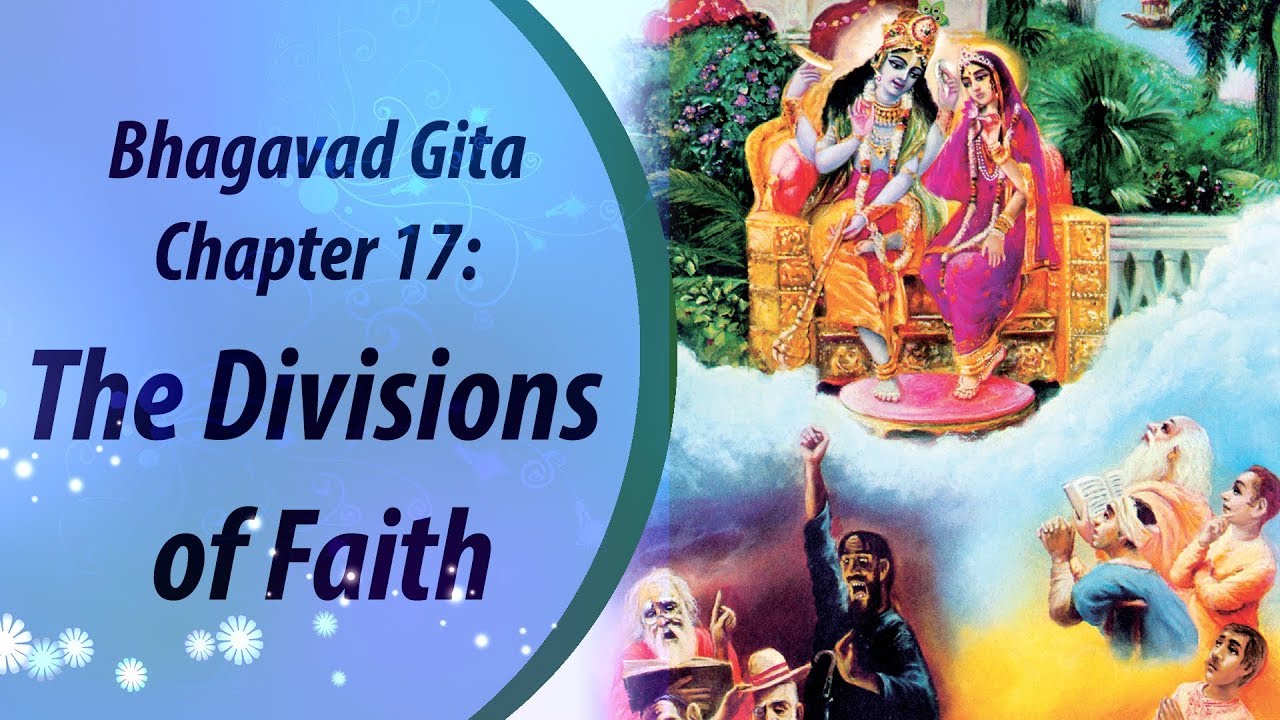
17.1 Arjuna asked: My Lord! Those who do acts of sacrifice, not according to the scriptures but nevertheless with implicit faith, what is their condition? Is it one of Purity, of Passion or of Ignorance?
17.3 The faith of every man conforms to his nature. By nature he is full of faith. He is in fact what his faith makes him.
Every person has faith, which shows up as his nature. A person is pure, passionate or ignorant because of his faith. He commits acts of sacrifice out of that faith and not necessarily because he is following scriptures.
17.4 The Pure worship the true God; the Passionate, the powers of wealth and magic; the Ignorant, the spirits of the dead and of the lower orders of nature.
17.5 Those who practice austerities not commanded by scripture, who are slaves to hypocrisy and egotism, who are carried away by the fury of desire and passion,
17.6 They are ignorant. They torment the organs of the body; and they harass Me also, Who lives within. Know that they are devoted to evil.
It is interesting to observe that scriptures do not support austerities that may hurt organs of the body. Discipline must be well devised to accomplish a beneficial purpose. One should not be devoted to things that are based on illusion. One should have one’s feet planted solidly on the ground.
17.8 The foods that prolong life and increase purity, vigour, health, cheerfulness and happiness are those that are delicious, soothing, substantial and agreeable. These are loved by the Pure.
17.9 Those in whom Passion is dominant like foods that are bitter, sour, salty, over-hot, pungent, dry and burning. These produce unhappiness, repentance and disease.
17.10 The Ignorant love food which is stale, not nourishing, putrid and corrupt, the leavings of others and unclean.
Food may also be categorized based on the three Qualities (Gunas) as described above. Eating the right food is very much a part of a clean, spiritual life.
17.11 Sacrifice is Pure when it is offered by one who does not covet the fruit thereof, when it is done according to the commands of scripture, and with implicit faith that the sacrifice is a duty.
17.13 Sacrifice that is contrary to scriptural command, that is unaccompanied by prayers or gifts of food or money, and is without faith – that is the product of Ignorance.
Sacrifice may also be characterized based on the three Qualities (Gunas) as described above. Offering sacrifice the right way is also a part of a clean, spiritual life. Pure sacrifice requires the firm conviction of spiritual faith, and it is part of one’s duty.
17.14 Worship of God and the Master; respect for the preacher and the philosopher; purity, rectitude, continence and harmlessness – all this is physical austerity.
17.15 Speech that hurts no one, that is true, is pleasant to listen to and beneficial, and the constant study of the scriptures – this is austerity in speech.
17.18 Austerity coupled with hypocrisy or performed for the sake of self-glorification, popularity or vanity, comes from Passion, and its result is always doubtful and temporary.
17.20 The gift which is given without thought of recompense, in the belief that it ought to be made, in a fit place, at an opportune time and to a deserving person – such a gift is Pure.
17.21 That which is given for the sake of the results it will produce, or with the hope of recompense, or grudgingly – that may truly be said to be the outcome of Passion.
17.22 And that which is given at an unsuitable place or time or to one who is unworthy, or with disrespect or contempt – such a gift is the result of Ignorance.
These verses describe the gifts as affected by the Qualities (guna).
17.23 Om Tat Sat’ is the triple designation of the Eternal Spirit, by which of old the Vedic Scriptures, the ceremonials and the sacrifices were ordained.
17.24 Therefore all acts of sacrifice, gifts and austerities, prescribed by the scriptures, are always begun by those who understand the Spirit with the word Om.
17.25 Those who desire deliverance begin their acts of sacrifice, austerity or gift with the word Tat’ (meaning That’), without thought of reward.
The deeper understanding of spirit is imparted here. Ordained is something ordered, arranged or appointed per the natural law. This applied to the Vedic scriptures and ceremonials. It also applies to all sacrifices, gifts and austerities. This Eternal spirit is designated by ‘Om Tat Sat.’ Such ordination is begun by those who understand the Spirit with the word ‘Om.’ Those who desire liberation begin their acts of sacrifice, austerity or gift with the word Tat’, without thought of reward. ’Tat’ means ‘That’, which points to the ultimate foundation of all existence.
17.28 Whatsoever is done without faith, whether it be sacrifice, austerity or gift or anything else, as called Asat’ (meaning Unreal’) for it is the negation of Sat,’ O Arjuna! Such an act has no significance, here or hereafter.
’Sat’ is the reality (as the result of natural laws), and the complete harmony of action with that reality (the highest good). ‘Sat’ is also the conviction in sacrifice, in austerity, in giving and in being non-judgmental about it all. When it is done without faith or conviction, it is ‘Asat’ (unreal) and has no significance.
.
Final Comment
Every person has faith, which shows up as his nature. A person is pure, passionate or ignorant (the three Qualities) because of his faith. He commits acts of sacrifice out of that faith and not necessarily because of the scriptures. It is interesting to observe that scriptures do not support austerities that may hurt organs of the body. Discipline must be well devised to accomplish a beneficial purpose. One should not be devoted to things that are based on illusion. One should have one’s feet planted solidly on firm ground.
Food, Sacrifice and austerities may also be categorized based on the three Qualities (Gunas). Eating the right food and offering sacrifice the right way, are very much a part of a clean, spiritual life. Pure sacrifice requires the firm conviction of spiritual faith, and it is part of one’s duty.
Ordained refers to something ordered, arranged or appointed per the natural law. This concept was used in the context of Vedic scriptures and ceremonials. It also applies to all sacrifices, gifts and austerities. Such ordination is begun by those who understand the Spirit with the word ‘Om.’ Those who desire liberation begin their acts of sacrifice, austerity or gift with the word ‘Tat’, without thought of reward. ’Tat’ means ‘That’, or the ultimate foundation of all existence. ’Sat’ is the reality (outcome of the natural laws), and the complete harmony of action with that reality (the highest good). ‘Sat’ is also the conviction in sacrifice, in austerity, in giving and in being non-judgmental about it all.
‘Om Tat Sat’ is the designation for the Eternal spirit.
When ordination is done without faith or conviction, it is ‘Asat’ (unreal) and has no significance.
A person working on a key word may clarify his understanding by discussing it with another person. The key word may be the subject title. Such a discussion may be carried out face-to-face, or through messages back and forth. The discussion must be limited to that one word to sort out its
Broad concept
Definition, and
Related anomalies.
The end product will be no more anomalies, a conceptual understanding of the key word, and a clarity on its definition in the given context.
.
Discussion
The purpose of a discussion is to learn by exchanging viewpoints. One uses experience and experimentation to obtain data and then brings it to the table to be discussed.
The participants in a discussion focus on the subject and not on each other. A discussion is not a debate where one is in a contest to win argument against others. There is no need for sophistry. In a discussion there are no opponents. All participants are on the same side. On the other side may just be ignorance. In a discussion each participant’s viewpoint is bound to change and evolve as he/she learns from the data pooled together by all.
Thus, a discussion is a cooperative effort. There is no reason to censor any data in a discussion. The data simply needs to be examined in detail.
.
Conceptual Understanding
A concept means “something conceived”. It has to do with “seizing” an idea. In order to seize an idea completely, it must be fully assimilated with one’s knowledge. There should not be anything anomalous within that concept. In other words, the concept must be completely continuous, consistent and harmonious within itself.
Each key word must be brought to the state of conceptual understanding in subject clearing.
.
Definition
A definition has the etymological sense of being a “finished or completed product.” It refers to the precise meaning of a word in a given context. There is a definite clarity associated with it. Therefore, after obtaining the conceptual understanding of a word one must define it completely in the given context.
Each key word most be defined completely in the context at hand in subject clearing.
.
Anomaly
An anomaly is something irregular, which does not fit in. It has to do with incongruity or inconsistency. In subject clearing, one resolves any sense of discontinuity, inconsistency or disharmony connected with the key word.
.
Subject Clearing and Discussion
Besides dictionary, Wikipedia and textbooks, discussion is a valuable tool to be used in subject clearing. It is an activity in which two or more people closely examine a key word together.
Textbooks exist because more than dictionaries are needed to clear the whole subject. Key words help one understand the fundamentals and main ideas of a subject in the proper sequence. But text books are needed to fill in all the supportive details.
When studying the text, one must not go by a word or symbol that he does not understand. It is not only the meaning of the words that one clears up, he also sorts out the anomalies encountered.
NOTE: Procure the study materials in a form that you can add your thoughts to them. This can be done when the materials are copied to a word processor on a computer. Add the comments in a color different from the text. See an example here:Socrates.
.
Steps for Studying a Subject
1. Read the subject material one paragraph at a time.
Study the materials of the subject one paragraph at a time. If the paragraph is too big, break it down into chunks of reasonable size. If the paragraph is too small, then combine two or more consecutive paragraphs together.
2. If the paragraph is difficult to understand then look for the first word not fully understood.
If you find your mind going blank as you read the paragraph, then find the first sentence which doesn’t make sense. Then find the first word in that sentence that seem to generate confusion. Here you have to be careful because the confusion may come from a simple word like “on”, “of”, or “in”.
A word usually has more than one definition. Confusion arises when a wrong definition is used. Usually there is an obvious word, whose meaning you may have guessed in the past, but never actually looked up in a standard dictionary. Make sure you have the right definitions of words such that the sentence make sense. Repeat this procedure until the whole paragraph is understood.
3. If the paragraph is still difficult to understand then look for anomalies.
If the difficulty persists even after looking up all possible words that could have been misunderstood, then look for anomalies in that paragraph. An anomaly is generated when there is a discontinuity (missing information), an inconsistency (contradictory information), or disharmony (altered importance of arbitrary opinion). Once the anomaly is precisely identified, it would explain the difficulty.
4. When the paragraph, or its difficulty, is understood, write your comment below it.
The comment may consist of your understanding of the main thought expressed in that paragraph, or your reaction to that thought. Treat this action as having a conversation with the author. Additionally, you may write down any anomaly you noticed in that paragraph. Write you comments such that they are helpful when you review them later. See examples of comments at Comments on Books.
5. Check the paragraph for key words, or for explanations given for key words.
Go over the paragraph as many times as necessary to understand the main thought. Make sure that you understand the key word to which that thought relates. If that thought relates to a new key word, then add that word to your Key Word List. Furthermore, you may add brief explanations to those key words.
6. Continue as above.
Continue as above with rest of the paragraphs in that chapter, and with the chapters in the book.
7. Gradually build up the key word list and glossary for that subject.
Add new key words to your list as you come across them. It may be convenient to build up the Key Word List on Excel, where you can easily rearrange their sequence. You also start adding next to each word its original broad concept and the applicable definition. It is easy to cut and paste.
As you study the subject chapter after chapter, and book after book, note down additional concepts next to the appropriate key word. Also note down the questions that may arise in your mind about the key words or the underlying concept. In this way, you may convert your Key Word List into a subject glossary and a research reference. Keep it concise and to the point.
When you are dealing with a broad subject, such as, Religion, you may find many different definitions for the same key word, such as, GOD, all written down in one place. You may also find different words used in different religions for the same fundamental concept.
As you work on this step for a subject you will have many realizations along the way. This is a continuing step.
8. Arrange the key words in sequences appropriate for understanding.
The concepts in a subject always evolve in some sequence. This sequence may be linear at first but then it branches out in different directions like a network or a matrix of concepts. This can easily be seen in Mathematics and Science.
In Excel, you may place the “fundamental concepts” on one worksheet, and “derived concepts” on separate worksheets, and then arrange the concepts in each worksheet in the best order they seem to have evolved.
Since the sequence of the evolution of these concepts is multi-dimensional, you may set up the Excel worksheet to sort out the key words in different sequences. To do this you may create different “priority columns” in the worksheet. In each “priority column” assign a unique number to the key word so it sorts out in the order you want. The whole idea is to arrange these words in different ways to examine the relations among them.
9. Note any inconsistencies among the concepts and clarify them.
As the study of the subject progresses, you’ll be collecting more data to describe each key word. As you come across an anomaly for a key word, resolve it through careful examination and contemplation. Once resolved, express the broad concept and meanings for the key word in your own words. You are now creating your own glossary.
Next, examine the evolution of the key words by arranging and rearranging them in different sequences. You are looking for inconsistencies that do not make sense. Or they may simply represent holes among the concepts that need to be filled. Be wary of arbitrary notions, assumptions and beliefs that may be covering those holes. Isolate the areas of anomalies and discover and get rid of arbitrariness and assumptions.
Deeper research may be required to clearly identify the holes among the concepts, and fill them. Review your study materials to clarify the anomaly. Research through other materials in the library, or on Internet, until the inconsistency is resolved.
10. Clarify the fundamentals of the subject as a priority.
The consistency of the fundamentals determines the consistency in rest of the subject. Any inconsistency at the fundamental level must be handled as a priority. For example, a unified theory is desperately being looked for in the subject of Physics, which could bring the fundamentals of Newtonian Physics, the Theory of Relativity, and Quantum Mechanics in line. This means that inconsistencies exist in our understanding at the fundamental level of physics
There are likely to be many contributors to a subject who may use different words for the same concept. This is the case with religious knowledge from different cultures. Group such words together to discover inconsistencies among concepts.
Study of anomalies may lead to discovery of arbitrary beliefs that were advanced in the absence of knowledge, or you may find erroneous observation, or simply some notions that are taken for granted. This may reveal gaps in the subject itself. Develop your own understanding by seeking consistency among the fundamental concepts in a subject.
11. Make the subject as complete as possible.
There are many examples in the subject of religion where gaps in knowledge are hidden under fixed beliefs and dubious explanations. This may be the case with any subject where anomalies abound. Follow up on anomalies, which may then reveal gaps in the subject. Real progress then becomes possible.
Fill gaps in the subject with wider research. Make the subject as complete as possible through direct experience and experimentation.
12. Keep your viewpoint as objective as possible.
This step is done after one has acquired a good bit of experience with subject clearing. This is an advanced step that consists of doing meditation along the following lines: Meditation from Mystery to Knowing.