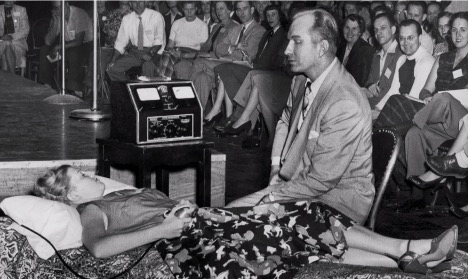
DIANETICS: Mechanisms and Aspects of Therapy Part II

Reference: Hubbard 1950: Dianetics TMSMH

These are some comments on Book Three, Chapter 10, “Mechanisms and Aspects of Therapy Part II” from DIANETICS: THE MODERN SCIENCE OF MENTAL HEALTH.

.

Comments on
Mechanisms and Aspects of Therapy Part II

KEY WORDS: Single word technique, Tokens, Lie factory

Note: These sections provide quick summaries. If you need details, please consult the section in the book.

EXTRA-SENSORY PERCEPTION

There is no such thing as ESP in the recall as a fetus. The prenatal engram is not a memory but a recording of pain and percepts. A person returned to an engram is supposed to run out the engrams and their contents. But he may interpret that recording in some fantastic ways. Simply look for despair charges, allies, sympathy engrams and the source of his “dub-in”.

ELECTRIC SHOCK

When there have been electric shocks, it is important to relieve them first as they form a grouping of engrams. Apparently, the electric shocks derange the memory files and generate a great depth of “unconsciousness”.

TACIT CONSENT

The applies to two people auditing each other, in which case, they avoid running common engrams. But in case of the subject clearing approach, you simply watch out for mental resistance to resolving some anomaly. Once you recognize such a resistance it goes away.

EMOTION AND PAIN SHUT-OFFS

The word “feeling” means both pain and emotion: thus the phrase, “I can’t feel anything,” may be an anesthetic for both. Run the words “No emotion” until a paraphrase is obtained: run the words “I can’t feel,” or some other phrase meaning the same thing. If the engrams are available and are not suppressed by others, will eventually be accessed. After this the therapy is more beneficial.

EXTERIORIZED VIEWS

Whenever you find yourself, returned, outside yourself and seeing yourself, you are off the track. The painful emotion engrams, should be found as soon as possible and discharged. 

TELEPATHY

When there is a sense of telepathy when returned, such as, receiving mother’s thoughts prenatally, be certain that somewhere around there is an engram in which she says these exact words aloud. 

PRENATAL LIVING CONDITIONS

It is very noisy in the womb. Intestinal squeaks and groans, and other body activities of the mother produce a continual sound. It is also very tight in later prenatal life

THE ENGRAM FILING SYSTEM

Time, topic, value, somatic and emotion are the methods of filing. Engrams are not filed in the orderly fashion. It is difficult to know when the proper consecutive item will appear. You may be progressing from prenatal to later life  Suddenly a despair charge is triggered and discharged. You look back at the prenatal area and find a whole new series of incidents in view. These are erased and progress is made back toward present time when still another despair charge is released and still more prenatals come to view.

ALLEVIATION

A sudden deterioration of serenity, generally stems from some incident which has caused you mental anguish. Although this change of mind has its source in the restimulation of an engram, the moment of restimulation, which is a lock, may be addressed and alleviated with success. Simply close your eyes and return to the instant wherein you were disturbed. A moment of analytical shut-down will be discovered wherein some restimulative person or circumstance upset your equilibrium. This moment can be recounted, ordinarily, as an engram and the immediate source of tension will relieve. The engram itself, upon which the lock depended, may not be accessible without a full dianetic address to the problem.

THE TONE SCALE AND REDUCTION OF ENGRAMS

Whatever the shock or upset, it is run exactly like any other engram, beginning at the beginning of the first shock with you returning to it and continuing far enough along it to adequately embrace its first impact. Subsequent recountings may take you through apathy (grief), anger, boredom and cheerfulness. When there is flippancy and unwillingness to recount again, data is being suppressed and more charge is present. Further recounting should bring it to, most favorably, laughter. These are the tones 0 to 4 of the Tone Scale. A Tone 4 is laughter. Engrams which show no emotion anywhere on the track are suppressed by emotional or feeling shut-offs. There must be variability of emotion.

IF THE PATIENT DOES NOT WORK WELL ON REPEATER TECHNIQUE

If you do not move to an incident with repeater technique, three things can be wrong: first, you cannot move on the track; second, the phrase may be sensibly withheld by the file clerk until such time as it can be cleared; or third, the phrase does not exist as engramic material. The usual reason repeater technique does not work is that a holder is active. A large emotional charge may also inhibit repeater technique.

SINGLE WORD TECHNIQUE

Words as well as engrams exist in chains. There is always a first time for the recording of each word in a person’s life. Aberrative phrases in engrams tend to repeat themselves. This tends to make the engrams appear in chains of incidents, each incident much like the next. The first incident on the chain holds the others more or less in place and out of sight; therefore, the basic of the chain is the goal. The repetition by themselves of one word will cause the associated words to suggest themselves. For example, repetition of the word Forget may suggest a phrase, such as “You can never forget me.” Here we have a phrase in an engram and the remainder of the engram can then be run.

There are only a few dozens of words necessary to get almost any engram. They are such words as these: forget, remember, memory, blind, deaf, dumb, see, feel, hear, emotion, pain, fear, terror, afraid, bear, stand, lie, get, come, time, difference, imagination, right, dark, black, deep, up, down, words, corpse, dead, rotten, death, book, reed, soul, hell, god, scared, miserable, horrible, past, look, everything, everybody, always, never, everywhere, all, believe, listen, matter, seek, original, present, back, early, beginning, secret, tell, die, found, sympathy mad, crazy, insane, rid, fight, fist, chest, teeth, jaw, stomach, ache, misery, head, sex, words of sex and profanity, skin, baby, it, curtain, shell, barrier, wall, think, thought, slippery, confused, mixed, smart, poor, little, sick, life, father, mother, familiar names of parents and any others of household during prenatal and childhood period, money, food, tears, no, world, excuse, stop, laugh, hate, jealous, shame, ashamed, coward, etc.

Single word technique using the name of the ally, if known, or words of sympathy, endearment, death, rejection or farewell and the love name as a child in particular will often yield swift results. In this repeater technique, it should not be a rapid, unmeaning repetition but a slow repeat, while contacting anything else which might associate with the word.

SPECIAL CLASSES OF COMMANDS

In Dianetic, we find (hypnotic) “commands”, such as, “The world is all against me,” which then translate into some aberration. They come up in due course. Working on them or about them is secondary and less. Of primary importance are the classes of commands that keep one from moving on the track. The are:

DENYERS: “Forget it” is the classic of the sub-class of denyer, the forgetter mechanism. When the engram simply won’t come to view but there is a somatic or a muscle twitch. You send the somatic strip to the denyer. 

HOLDERS: “I’m stuck” is the classic phrase. “That fixed it” is another. The holder is the most frequent and the most used since whenever the pre-clear can’t shift on the track or come to present, he is in a holder.

BOUNCERS: “Get out” is the classic bouncer. The patient usually goes toward present time. When the pre-clear can’t seem to get earlier, there is a bouncer ejecting him from an engram. Get a comment from him on what’s happening. 

GROUPER: “I have no time” and “Nothing makes any difference” are the classic groupers. It can be so variously worded and its effect is so serious on the time track that the whole track can roll up into a ball and all incidents then appear to be in the same place. But it will settle out as the case progresses and the case can be worked with a grouper in restimulation.

MISDIRECTOR: “You don’t know down from up” is the classic phrase. When a misdirector appears in an engram, the patient goes in wrong directions, to wrong places, etc. A special case is the derailer, such as, “Down and out”, which throws him off the track and makes him lose touch with his time track. This is a very serious phrase since it can make a schizophrenic. Emotional charges usually hold the person off his track.

DIFFERENCES

There are differences and identities that always consist of gradients. Absolutes are unobtainable for scientific purposes. Optimum is a reality that is continuous, consistent and harmonious. All departures from optimum are useful in locating engrams. One should observe one’s conduct and reactions to life to gain data. Irrationality arises when one cannot see things for what they are. Sanity is the ability to see things as they are.

RELATIVE IMPORTANCES AND “BELIEVE” AND “CAN’T BELIEVE”

One of the most important functions of the mind is the computing of the relative importances of data. Evaluation of the data for its importance is vital before the information is of value. For every datum which approaches truth there are billions which are untrue. The missing part of each datum is a scientific evaluation of its importance to the solution. Monotone importance in a class of facts leads to nothing but the most cluttered confusion. Establishment of relative importance is the key.

There are people who doubt everything. Such a person inspects the most precise evidence, and he still doubts. He has difficulty giving credence to any fact more than any other fact. This produces an inability to compute relative importances amongst data. Similarly, a person who believes everything finds difficulty in differentiating amongst importances of various data. Both cases “worry,” because they are unable to compute the relative importances of various data. The thing to do is to place such persons in a situation where they can evaluate their own data. 

PHYSICAL PAIN AND PAINFUL EMOTION COMMANDS

Running a physically painful incident without a somatic is worthless. If the incident contains pain but the somatic is not turned on, the patient will wriggle his toes and breathe heavily and nervously or he may have jumping muscles. There are four additional classes of phrases: shut-offs, exaggerators, derailers and lie factories. All pain felt is genuine, even if exaggerated. Imaginary pain is non-existent. The painful emotion is only a surface manifestation of the physical pain engrams and would not be painful if the physical pain did not co-exist or exist priorly. When emotion and pain shut-offs exists, one is normally tense of muscle and nervous, given to twitching or merely tension. When pain and emotion are exaggerated by commands, there is lot of dramatization.

THE ALLY VERSUS THE ANTAGONIST

The reactive mind distinguishes violently between friend and foe. It considers everything about an ally to be right, and everything about an antagonist to be wrong. The reactive mind with its two-valued logic is very certain. However, there is such a thing as necessity level that can key out the control of the reactive mind. The solution of chronic psycho-somatic ills lies largely in the field of sympathy engrams. The real factors for such illnesses are allies. Look for them and exhaust from them the painful emotion of loss or denial and backtrack immediately to find the underlying engrams. 

TOKENS

The token is any object, practice or mannerism, which is an extension of an ally. It may be used to detect vital information that may help  locate the ally. Tokens could be his habits that you pick up, or the sympathy you expect from a family member. Token is what you say that is strange to your personality, or things you do but not much seem to enjoy. This is all mechanical and is actually merely restimulation of an engram. Once you have identifies the ally, reach swiftly toward the sympathy engram in which that ally is contained or reach toward the painful emotion engram of the loss of that ally, his illness or incidents concerning him, for an emotional discharge.

WHAT TO DO IF A CASE STOPS PROGRESSING

Check for the special classes of commands, especially a holder. Look for pain or emotional shut-offs. This is especially the case when the muscles often get very tense. See if you are feeling emotion without feeling the pain. There may be a feeling shut-off early in the prenatal area. There could be an emotional upset in the present.

IF A CASE “REFUSES” TO GET WELL

Whenever this happens, the engrams are resisting. Usually it is an ally computation “not to get rid of it,” or if he parts with any engrams, “he will lose his mind.” Yet another computation is one of secrecy. One secrecy computation stems from the mother’s fearing to tell the father that she is pregnant. Such computations yield to the repeater technique.

DRUGS

Dianetics wakes people up; it does not try to drug them or hypnotize them. Hence, the hypnotic drug is worthless to the auditor. Vitamin B1 seems to reduce nightmares and DT’s among people getting audited.

AUTO-CONTROL

According to Hubbard one cannot do dianetic therapy alone because somebody is needed there to listen, to provide insistence, and to compute the trouble one is having and remedy it. This is because the dianetic therapy requires a high gradient of confront.

On the other hand, the subject clearing approach chips away at the facsimiles at a gradient that the person can handle. At the same time, it builds up the analytical sense with which to handle the facsimiles. Therefore, a person can handle his facsimiles by himself, though it may take a bit longer at first, but then it gradually speeds up. 

ORGANIC MENTAL ALTERATIONS

In this category, we have people who have suffered strokes, paralysis, severe injuries, severe drug side-effects etc. Such people, if able, can apply dianetics through the subject clearing approach, as it is quite safe.

ORGANIC DERANGEMENT

This section discusses organic derangements as a result of engrams. Obviously, the physiological damage is best addressed through medical approach. But there would also be an aberrational component that may be resolved with dianetics through the subject clearing approach.

DIANETIC FIRST AID

A return to a recent injury or accident in contemplation can be very helpful in assimilating the related trauma. This may considerably speed up the recovery.

A PROBLEM IN MUTUAL THERAPY

Problems of mutual therapy are not relevant when one is applying the dianetic therapy to oneself using the subject clearing approach.

A PROBLEM IN A RESTIMULATED CASE

This is an interesting case study that shows the difficulties the auditor may run into outside the case that he would have to address. A person engaged in applying dianetic therapy to oneself must address external and internal situations alike through subject clearing.

ADVICE TO THE AUDITOR

Reason for non-assimilation is too much motion too fast. This appears as physical and emotional pain. The mind is confronted with intensity of charge. It is difficult to see through the sheer irrationality of short circuiting. The problem is to discover and discharge the painful emotion engrams. Just apply the fundamentals of dianetics. The subject clearing approach of dianetic therapy is obviously limited to those who are able to apply it to themselves. This section contains interesting insight regarding hypnotism. Use of hypnotism and amnesia trance is not advised.

EXTERNAL PROBLEMS WITH PATIENTS

Progress may be retarded by intensely restimulative environment. In such a circumstance the environment needs to be handled first. It is best to look at your environment as well as your own case from an extroverted viewpoint. As you progress through the dianetic therapy you will become increasingly extroverted. The aberration is primarily caused by what has been done to the person (the facsimile). The secondary effect of that is the person dramatizing that facsimile.

RESTIMULATION

The mind is a self-protecting mechanism. The mind is diagnosed by its reaction to life. You then learn to handle these reactions while respecting mind’s self-protection mechanism. The better you understand the principles of Dianetics and Subject Clearing, the more you can keep the restimulation level low, and be able to resolve your case. Discussion in subject clearing is a cooperative effort that helps handle the cases of all those involved.

REBALANCING A CASE

Any case dropped out of therapy will rebalance itself in a few weeks, much benefited. Restimulations can be expected to die down if they are due to therapy. 

WORKING TIME IN THERAPY

With subject clearing approach, the dianetic therapy can be done in sessions of 20 minutes to 2 hours, and as many sessions in a day as feasible. The engram is asked for on day one, is ready to reduce on day three, sags on day four and is rebalanced by day seven. On subject clearing approach one starts to get realizations from day one. As he continues he attains higher and higher states of clarity as he assimilates his knowledge and cleans up his traumas.

DATA FROM RELATIVES

It is a uniform experience that the data obtained from relatives, parents and friends is absolutely and utterly worthless. More accurate data can be obtained through dianetic therapy. The correct data is that which makes one well.

STOPPING THERAPY

The dianetic therapy satisfies a very basic goal to get better. The mind naturally wants to unwind, in spite of the resistance from the facsimiles. The therapy is attacked only when no results are forthcoming. You can remedy the situation only by delivering results as promised.

AUDITOR EVALUATION

You evaluate only to make sure you are not accepting imagined or incomplete data. An incident will not lift unless the data in it is correct: this is automatic. Even if the contents seem improbable run the incident. If there is a lie factory, find the lie factory by using appropriate phrase. Simply make a quiet estimate of the situation, reduce everything which seems valid and keep on trying to get the reason why the case is not functioning as well as possible. Facsimiles are just collections of remarks contained in periods of “unconsciousness.” A facsimile is basically illogical and irrational; don’t try to read rationality into one! See things as they are. The objective is to reduce the facsimiles.

.
Subject: Human Condition

Reference: Course on Subject Clearing

This special glossary is being developed for the subject of HUMAN CONDITION. It is made up of a Key Word List, and a Glossary.

.

KEY WORD LIST

This Key Word List provides a logical arrangement of the key words by their concepts. You may look up the keys words of the glossary in this sequence. Not all the words of the glossary are listed here.

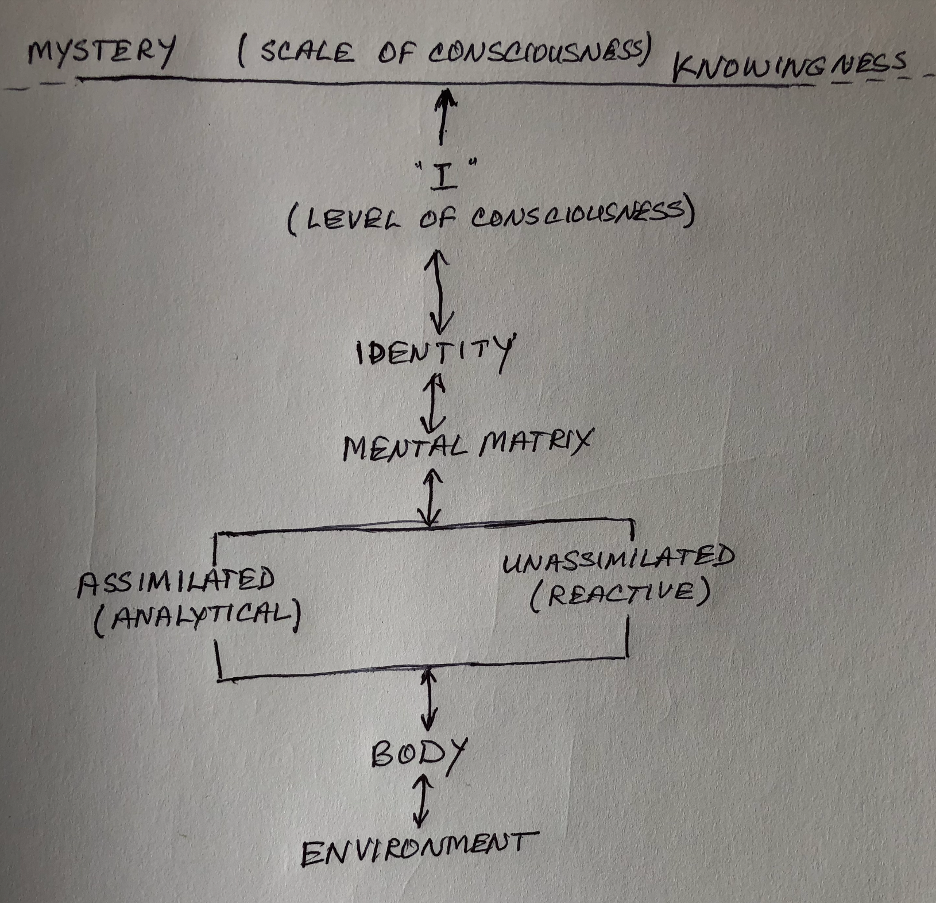
  1. HUMAN (Self, Identity, Consciousness)
  2. CONDITION (Aberration, Psychosomatic Illness, Dianetics, Subject Clearing)
  3. SELF (“I”, Ego, Egotism, Beingness)
  4. IDENTITY (body, mind, Individuality, Life cycle)
  5. CONSCIOUSNESS (Spirit, Soul, Thetan, Ātman, Immortality)
  6. EVOLUTION (Survival, Static Viewpoint, Paramātman, God)
  7. MIND (Senses, Mental Matrix, Assimilation, Perception, Memory, Thought)
  8. MENTAL MATRIX (Analytical Mind, Reactive Mind, Trauma, Facsimile)
  9. FACSIMILE (Anomaly, Arbitrary)

Conclusion: The human condition results from unresolved anomalies. The anomalies are there because of missing knowledge. As knowledge becomes available in the area of doubt and perplexity, one should make every effort to resolve those doubts.

NOTE: This key word sequence and glossary definitions can definitely be improved. In fact, I shall request you to improve upon them.

.

GLOSSARY

Please refer to

  1. KHTK Glossary
  2. Technical Dictionary

Additional data shall be added as necessary.

.

FRANCIS BACON: Epilogue

Reference: The Story of Philosophy

This paper presents Chapter III, Section 6 from the book THE STORY OF PHILOSOPHY by WILL DURANT. The contents are from the 1933 reprint of this book by TIME INCORPORATED by arrangement with Simon and Schuster, Inc.

The paragraphs of the original material (in black) are accompanied by brief comments (in color) based on the present understanding.  Feedback on these comments is appreciated.

The heading below is linked to the original materials.

.

VI. Epilogue  

“Men in great place are thrice servants; servants to the sovereign or state, servants of fame, and servants of business, so as they have no freedom, neither in their persons nor in their action, nor in their time. … The rising unto place is laborious, and by pains men come to greater pains; and it is sometimes base, and by indignities men come to dignities. The standing is slippery, and the regress is either a downfall or at least an eclipse.” What a wistful summary of Bacon’s epilogue! 

Francis Bacon was a man of his time.

“A man’s shortcomings,” said Goethe, “are taken from his epoch; his virtues and greatness belong to himself.” This seems a little unfair to the Zeitgeist, but it is exceptionally just in the case of Bacon. Abbott, after a painstaking study of the morals prevalent at Elizabeth’s court, concludes that all the leading figures, male and female, were disciples of Machiavelli. Roger Ascham described in doggerel the four cardinal virtues in demand at the court of the Queen: 

Cog, lie, flatter and face,
Four ways in Court to win men grace. 
If thou be thrall to none of these, 
Away, good Piers! Home, John Cheese!

In those times, man were beholden to their status.

It was one of the customs of those lively days for judges to take “presents” from persons trying cases in their courts. Bacon was not above the age in this matter; and his tendency to keep his expenditure several years in advance of his income forbade him the luxury of scruples. It might have passed unnoticed, except that he had made enemies in Essex’ case, and by his readiness to sabre foes with his speech. A friend had warned him that “it is too common in every man’s mouth in Court that … as your tongue hath been a razor to some, so shall theirs be to you.” But he left the warnings unnoticed. He seemed to be in good favor with the King; he had been made Baron Verulam of Verulam in 1618, and Viscount St. Albans in 1621; and for three years he had been Chancellor.

Bacon was extravagant and accepted bribes to support his lifestyle. He was caustic and had made enemies.

Then suddenly the blow came. In 1621 a disappointed suitor charged him with taking money for the despatch of a suit; it was no unusual matter, but Bacon knew at once that if his enemies wished to press it they could force his fall. He retired to his home, and waited developments. When he learned that all his foes were clamoring for his dismissal, he sent in his “confession and humble submission” to the King. James, yielding to pressure from the now victorious Parliament against which Bacon had too persistently defended him, sent him to the Tower. But Bacon was released after two. days; and the heavy fine which had been laid upon him was remitted by the King. His pride was not quite broken. “I was the justest judge that was in England these fifty years,” he said; “but it was the justest judgment that was in Parliament these two hundred years.”

Bacon was finally dismissed under the pressure of his enemies for something not so unusual.

He spent the five years that remained to him in the obscurity and peace of his home, harassed by an unwonted poverty, but solaced by the active pursuit of philosophy. In these five years he wrote his greatest Latin work, De Augmentis Scientiarum, published an enlarged edition of the Essays, a fragment called Sylva Sylvarum, and a History of Henry VII. He mourned that he had not sooner abandoned politics and given all his time to literature and science. To the very last moment he was occupied with work, and died, so to speak, on the field of battle. In his essay “Of Death” he had voiced a wish to die ”in an earnest pursuit, which is like one wounded in hot blood, who for the time scarce feels the hurt.” Like Caesar, he was granted his choice. 

Bacon lived the last five years of his life in poverty but happy in the pursuit of philosophy till his last breath.

In March, 1626, while riding from London to Highgate, and turn.ing over in his mind the question how far flesh might be preserved from putrefaction by being covered with snow, he resolved to put the matter to a test at once. Stopping off at a cottage, he bought a fowl, killed it, and stuffed it with snow. While he was doing this he was seized with chills and weakness; and finding himself too ill to ride back to town, he gave directions that he should be taken to the nearby home of Lord Arundel, where he took to bed. He did not yet resign life; he wrote cheerfully that “the experiment … succeeded excellently well.” But it was his last. The fitful fever of his varied life had quite consumed him; he was all burnt out now, too weak to fight the disease that crept up slowly to his heart. He died on the ninth of April, 1626, at the age of sixty-five. 

He had written in his will these proud and characteristic words: “1 bequeath my soul to God. … My body to be buried obscurely. My name to the next ages and to foreign nations.” The ages and the nations have accepted him. 

.

FRANCIS BACON: Criticism

Reference: The Story of Philosophy 

This paper presents Chapter III, Section 5 from the book THE STORY OF PHILOSOPHY by WILL DURANT. The contents are from the 1933 reprint of this book by TIME INCORPORATED by arrangement with Simon and Schuster, Inc.

The paragraphs of the original material (in black) are accompanied by brief comments (in color) based on the present understanding.  Feedback on these comments is appreciated.

The heading below is linked to the original materials.

.

V. Criticism 

And now how shall we appraise this philosophy of Francis Bacon’s?

Is there anything new in it? Macaulay thinks that induction as described by Bacon is a very old-fashioned affair, over which there is no need of raising any commotion, much less a monument. “Induction has been practiced from morning till night by every human being since the world began. The man who infers that mince pies disagreed with him because he was ill when he ate them, well when he ate them not, most ill when he ate most and least ill when he ate least, has employed, unconsciously but sufficiently, all the tables of the Novum Organum.” But John Smith hardly handles his “‘table of more or less” so accurately, and more probably will continue his mince-pies despite the seismic disturbances of his lower strata. And even were John Smith so wise, it would not shear Bacon of his merit; for what does logic do but formulate the experience and methods of the wise?—what does any discipline do but try by rules to turn the art of a few into a science teachable to all? 

Bacon gave a precise definition to the method of induction in logic and made it more applicable. 

But is the formulation Bacon’s own? Is not the Socratic method inductive? Is not Aristotle’s biology inductive? Did not Roger Bacon practice as well as preach the inductive method which Francis Bacon merely preached? Did not Galileo formulate better the procedure that science has actually used? True of Roger Bacon, less true of Galileo, less true yet of Aristotle, least true of Socrates. Galileo outlined the aim rather than the method of science, holding up before its followers the goal of mathematical and quantitative formulation of all experience and relationships; Aristotle practiced induction when there was nothing else for him to do, and where the material did not lend itself to his penchant for the deduction of specific conclusions from magnificently general assumptions; and Socrates did not so much practice induction—the gathering of data—as analysis—the definition and discrimination of words and ideas. 

Induction has been practiced and preached by other philosophers but not in such inspiring terms as Bacon did.

Bacon makes no claim to parthenogenetic originality; like Shakespeare he takes with a lordly hand, and with the same excuse, that he adorns whatever he touches. Every man has his sources, as every organism has its food; what is his is the way in which he digests them and turns them into flesh and blood. As Rawley puts it, Bacon “contemned no man’s observations, but would light his torch at every man’s candle.” But Bacon acknowledges these debts: he refers to “that useful method of Hippocrates,”—so sending us at once to the real source of inductive logic among the Greeks; and “Plato,” he writes (where less accurately we write “Socrates”), “giveth good example of inquiry by induction and view of particulars; though in such a wandering manner as is of no force or fruit.” He would have disdained to dispute his obligations to these predecessors; and we should disdain to exaggerate them. 

Bacon does acknowledge Hippocrates as the source of inductive logic.

But then again, is the Baconian method correct? Is it the method most fruitfully used in modern science? No: generally, science has used, with best result, not the accumulation of data (“natural history”) and their manipulation by the complicated tables of the Novum Organum, but the simpler method of hypothesis, deduction and experiment. So Darwin, reading Malthus’ Essay on Population, conceived the idea of applying to all organisms the Malthusian hypothesis that population tends to increase faster than the means of subsistence; deduced from this hypothesis the probable conclusion that the pressure of population on the food-supply results in a struggle for existence in which the fittest survive, and by which in each generation every species is changed into closer adaptation to its environment; and finally (having by hypothesis and deduction limited his problem and his field of observation) turned to “the unwithered face of nature” and made for twenty years a patient inductive examination of the facts. Again, Einstein conceived, or took from Newton, the hypothesis that light travels in curved, not straight lines; deduced from it the conclusion that a star appearing to be (on the straight~line theory) in a certain position in the heaven, is really a little to one side of that position; and he invited experiment and observation to test the conclusion. Obviously the function of hypothesis and imagination is greater than Bacon supposed; and the procedure of science is more direct and circumscribed than in the Baconian scheme. Bacon himself anticipated the superannuation of his method; the actual practice of science would discover better modes of investigation than could be worked out in the interludes of statesmanship. “These things require some ages for the ripening of them.” 

Science actually uses the method of hypothesis, deduction and experiment, which is simpler than the Baconian scheme.

Even a lover of the Baconian spirit must concede, too, that the great Chancellor, while laying down the law for science, failed to keep abreast of the science of his time. He rejected Copernicus and ignored Kepler and Tycho Brahe; he depreciated Gilbert and seemed unaware of Harvey. In truth, he loved discourse better than research; or perhaps he had no time for toilsome investigations. Such work as he did in philosophy and science was left in fragments and chaos at his death; full of repetitions, contradictions, aspirations, and introductions. Ars longa, vita brevis—art is long and time is fleeting: this is the tragedy of every great soul. 

Bacon was really not very aware of the scientific research of his time.

To assign to so overworked a man, whose reconstruction of philosophy had to be crowded into the crevices of a harassed and a burdened political career, the vast and complicated creations of Shakespeare, is to waste the time of students with the parlor controversies of idle theorists. Shakespeare lacks just that which distinguishes the lordly Chancellor—erudition and philosophy. Shakespeare has an impressive smattering of many sciences, and a mastery of none; in all of them he speaks with the eloquence of an amateur. He accepts astrology: “This huge state … whereon the stars in secret influence comment.” He is forever making mistakes which the learned Bacon could not possibly have made: his Hector quotes Aristotle and his Coriolanus alludes to Cato; he supposes the Lupercalia to be a hill; and he understands Caesar about as profoundly as Caesar is understood by H. G. Wells. He makes countless references to his early life and his matrimonial tribulations. He perpetrates vulgarities, obscenities and puns natural enough in the gentle roisterer who could not quite out-live the Stratford rioter and the butcher’s son, but hardly to be expected in the cold and calm philosopher. Carlyle calls Shakespeare the greatest of intellects; but he was rather the greatest of imaginations, and the keenest eye. He is an inescapable psychologist, but he is not a philosopher: he has no structure of thought unified by a purpose for his own life and for mankind. He is immersed in love and its problems, and thinks of philosophy, through Montaigne’s phrases, only when his heart is broken. Otherwise he accepts the world blithely enough; he is not consumed with the reconstructive vision that ennobled Plato, or Nietzsche, or Bacon. 

But Bacon single-handedly reconstructed the whole field of philosophy. He was very different from Shakespeare.

Now the greatness and the weakness of Bacon lay precisely in his passion for unity, his desire to spread the wings of his coordinating genius over a hundred sciences. He aspired to be like Plato, “a man of sublime genius, who took a view of everything as from a lofty rock.” He broke down under the weight-of the tasks he had laid upon himself; he failed forgivably because he undertook so much. He could not enter the promised land of science, but as Cowley’s epitaph expressed it, he could at least stand upon its border and point out its fair features in the distance.

If Bacon appears to have failed it was because he undertook so much. He could at least stand upon the border of science and point out its fair features in the distance.

His achievement was not the less great because it was indirect. His philosophical works, though little read now, “moved the intellects which moved the world.” He made himself the eloquent voice of the optimism and resolution of the Renaissance. Never was any man so great a stimulus to other thinkers. King James, it is true, refused to accept his suggestion for the support of science, and said of the Novum Orgaum, that “it was like the peace of God, which passeth all understanding.” But better men, in 1662, founding that Royal Society which was to become the greatest association of scientists in the world, named Bacon as their model and inspiration; they hoped that this organization of English research would lead the way toward that Europe-wide association which the Advancement of Learning had taught them to desire. And when the great minds of the French Enlightenment undertook that masterpiece of intellectual enterprise, the Encyclopedie, they dedicated it to Francis Bacon. “If,” said Diderot in the Prospectus, “we have come of it successfully, we shall owe most to the Chancellor Bacon, who threw out the plan of a universal dictionary of sciences and arts, at a time when, so to say, neither arts nor sciences existed. That extraordinary genius, when it was impossible to write a history of what was known, wrote one of what it was necessary to learn.” D’Alembert called Bacon “the greatest, the most universal, and the most eloquent of philosophers.” The Convention published the works of Bacon at the expense of the state. The whole tenor and career of British thought have followed the philosophy of Bacon. His tendency to conceive the world in Democritean mechanical terms gave to his secretary, Hobbes, the starting-point for a thorough-going materialism; his inductive method gave to Locke the idea of an empirical psychology, bound by observation and freed from theology and metaphysics; and his emphasis on “commodities” ‘and “fruits” found formulation in Bentham’s identification of the useful and the good. 

Bacon’s philosophical works, though little read now, “moved the intellects which moved the world.” 

Wherever the spirit of control has overcome the spirit of resignation, Bacon’s influence has been felt. He is the voice of all those Europeans who have changed a continent from a forest into a treasure-land of art and science, and have made their little peninsula the center of the world. “Men are not animals erect,” said Bacon, “but immortal gods.” “The Creator has given us souls equal to all the world, and yet satiable not even with a world.” Everything is possible to man. Time is young; give us some little centuries, and we shall control and remake all things. We shall perhaps at last learn the noblest lesson of all, that man must not fight man, but must make war only on the obstacles that nature offers to the triumph of man. “It will not be amiss,” writes Bacon, in one of his finest passages, “to distinguish the three kinds, and as it were grades, of ambition in mankind. The first is of those who desire to extend their power in their native country; which kind is vulgar and degenerate. The second is of those who labor to extend the power of their country and its dominion among men; this certainly has more dignity, but not less covetousness. But if a man endeavor to establish and extend the power and dominion of the human race itself over the universe, his ambition is without doubt both a more wholesome thing and a nobler than the other two.” It was Bacon’s fate to be torn to pieces by these hostile ambitions struggling for his soul. 

Bacon is the voice of all those Europeans who have changed a continent from a forest into a treasure-land of art and science, and have made their little peninsula the center of the world. 

.

FRANCIS BACON: The Utopia of Science

Reference: The Story of Philosophy

This paper presents Chapter III, Section 4 (Part 3) from the book THE STORY OF PHILOSOPHY by WILL DURANT. The contents are from the 1933 reprint of this book by TIME INCORPORATED by arrangement with Simon and Schuster, Inc.

The paragraphs of the original material (in black) are accompanied by brief comments (in color) based on the present understanding.  Feedback on these comments is appreciated.

The heading below is linked to the original materials.

.

IV.3 The Utopia of Science

To perfect science so, and then to perfect social order by putting science in control, would itself be utopia enough. Such is the world described for us in Bacon’s brief fragment and last work, The New Atlantis, published two years before his death. Wells thinks it Bacon’s “greatest service. to science” to have drawn for us, even so sketchily, the picture of a society in which at last science has its proper place as the master of things; it was a royal act of imagination by which for three centuries one goal has been held in view by the great army of warriors in the battle of knowledge and invention against ignorance and poverty. Here in these few pages we have the essence and the “form” of Francis Bacon, the law of his being and his life, the secret and continuous aspiration of his soul. 

Bacon’s utopia was to perfect science so, and then to perfect social order by putting science in control.

Plato in the Timaeus had told of the old legend of Atlantis, the sunken continent in the Western seas. Bacon and others identified the new America of Columbus and Cabot with this old Atlantis; the great continent had not sunk after all, but only men’s courage to navigate the sea. Since this old Atlantis was now known, and seemed inhabited by a race vigorous enough, but not quite like the brilliant Utopians of Bacon’s fancy, he conceived of a new Atlantis, an isle in that distant Pacific which only Drake and Magellan had traversed, an isle distant enough from Europe and from knowledge to give generous scope to the Utopian imagination. 

Bacon though of America as the place where his utopia could be fulfilled.

The story begins in the most artfully artless way, like the great tales of Defoe and Swift. “We sailed from Peru (where we had continued for the space of one whole year), for China and Japan by the South Sea.” Came a great calm, in which the ships for weeks lay quietly on the boundless ocean like specks upon a mirror, while, the provisions of the adventurers ebbed away. And then resistless winds drove the vessels pitilessly north and north and north, out of the island-dotted south into an endless wilderness of sea. The rations were reduced, and reduced again, and again reduced; and disease took hold of the crew. At last, when they had resigned themselves to death, they saw, almost unbelieving, a fair island looming up under the sky. On the shore, as their vessel neared it, they saw not savages, but men simply and yet ‘beautifully clothed, clean, and manifestly of developed intelligence. They were permitted to land, but were told that the island government allowed no strangers to remain. Nevertheless, since some of the’ crew were sick, they might all stay till these were well again. 

The story starts with a long sea voyage, when the desperately lost crew suddenly comes upon this fair island inhabited by intelligent people.

During the weeks of convalescence the wanderers unraveled, day by day, the mystery of the New Atlantis; “There reigned in this island about nineteen hundred years ago,” one of the inhabitants tells them, “a King whose memory above all others we most adore. … His name was Solamona, and we esteem him as the Law-giver of our nation. This King had a large heart . … and was wholly bent to make his kingdom and people happy.” “Among the excellent acts of that King one above all hath the preeminence. It was the creation and institution of the Order, or Society, which is called Solomon’s House; the noblest foundation, as we think, that was ever upon the earth; and the lantherne of this kingdom.” 

Nineteen hundred years ago, an institution of the Order, or Society, called Solomon’s House was created.

There follows a description of Solomon’s House, too complicated for a quoted abstract, but eloquent enough to (draw from the hostile Macaulay the judgment that “there is not to be found in any human composition a passage more eminently distinguished by profound and serene wisdom.” Solomon’s House takes the place, in the New Atlantis, of the Houses of Parliament in London; it is the home of the island government. But there are no politicians there, no insolent “elected persons,” no “national palaver,” as Carlyle would say; no parties, caucuses, primaries, conventions, campaigns, buttons, lithographs, editorials, speeches, lies, and elections; the idea of filling public office by such dramatic methods seems never to have entered the heads of these Atlantans. But the road to the heights of scientific repute is open to all, and only those who have traveled the road sit in the councils of the state. It is a government of the people and for the people by the selected best of the people; a government by technicians, architects, astronomers, geologists, biologists, physicians, chemists, economists, sociologists, psychologists and philosophers. Complicated enough; but think of a government without politicians! 

Solomon’s House is the home of the island government; but there are no elected politicians there. only those who have traveled the road to the heights of scientific repute sit in the councils of the state. 

Indeed there is little government at all in the New Atlantis; these governors are engaged rather in controlling nature than in ruling man. “The End of Our Foundation is the Knowledge of Causes and secret motions of things; and the enlarging of the bounds of human empire, to the effecting of all things possible.” This is the key-sentence of the book, and of Francis Bacon. We find the governors engaged in such undignified tasks as studying the stars, arranging to utilize for industry the power of falling water, developing gases for the cure of various ailments, experimenting on animals for surgical knowledge, growing new varieties of plants and animals by cross-breeding, etc. “We imitate the flights of birds; we have some degree of flying in the air. We have ships and boats for going under water.” There is foreign trade, but of an unusual sort; the island produces what it consumes, and consumes what it produces; it does not go to war for foreign markets. “We maintain a trade, not of gold, silver, or jewels, nor for silks, nor for spices, nor for any other commodity or matter; but only for God’s first creature, which was light; to have light of the growth of all parts of the world.” These “Merchants of Light” are members of Solomon’s House who are sent abroad every twelve years to live among foreign peoples of every quarter of the civilized globe; to learn their language and study their sciences and industries and literatures; and to return, at the end of the twelve years, to report their findings to the leaders of Solomon’s House; while their places abroad are taken by a new group of scientific explorers. In this way the best of all the world comes soon to the New Atlantis.

The goal of the government is defined by this key sentence: “The End of Our Foundation is the Knowledge of Causes and secret motions of things; and the enlarging of the bounds of human empire, to the effecting of all things possible.”


Brief as the picture is, we see in it again the outline of every philosopher’s utopia—a people guided in peace and modest plenty by their wisest men. The dream of every thinker is to replace the politician by the scientist; why does it remain only a dream after so many incarnations? Is it because the thinker is too dreamily intellectual to go out into the arena of affairs and build his concept into reality? Is it because the hard ambition of the narrowly acquisitive soul is forever destined to overcome the gentle and scrupulous aspirations of philosophers and saints? Or is it that science is not yet grown to maturity and conscious power?—that only in our day do physicists and chemists and technicians begin tosee that the rising role of science in industry and war gives them a pivotal position in social strategy, and points to the time when their organized strength will persuade the world to call them to leadership? Perhaps science has not yet merited the mastery of the world; and perhaps in a little while it will. 

We see in this picture again the outline of every philosopher’s utopia—a people guided in peace and modest plenty by their wisest men.

.