DIANETICS: Past and Future

Reference: Hubbard 1950: Dianetics TMSMH

These are some comments on Book Three, Chapter 10, “Dianetics—Past and Future” from DIANETICS: THE MODERN SCIENCE OF MENTAL HEALTH.

.

Comments on
Dianetics—Past and Future

THE HISTORY OF DIANETICS
Dianetics is addressing a problem that has been known since ancient times. For example, the facsimile has been known as “samskāra” in Hinduism since Buddha’s time (500 BC). The ancient solution has been the yogic meditation. 

Dianetics resurrected the old knowledge and presented it in modern scientific terms. Dianetics original contribution to this field of knowledge is its therapeutic method of the “repeater technique.” Subsequent research has brought about the methods of Scientology as presented on its Grade Chart. These methods have been efficient.

All these methods have involved an auditor working on a preclear. The insertion of an auditor has presented its own set of new difficulties, which makes a broader application very expensive and practically unfeasible. The yogic method has been broadly available because a person can apply it to himself, but it lacks the efficiency of the methods of Dianetics and Scientology.

The development of the Subject Clearing approach eliminates the need for an auditor, while retaining the efficiency of Dianetics and Scientology methods. Subject Clearing allows a person to apply the Yogic, Dianetics and Scientology methods to himself or herself with great ease and efficiency.

JUDICIARY DIANETICS
Judiciary Dianetics presents the science of judgment. The problems of jurisprudence and, indeed, all judgment, are inextricably interwoven with the problems of behavior. An ideal society would be a society of unaberrated persons conducting their lives within an unaberrated culture.

The Subject Clearing approach allows the refinement of this science. By having correct definitions in the subject of jurisprudence a correct solution can be reached with regard to any action or actions of Man. The civil equity which will not lead to injustice can only then be established and formulated. 

In his attitude toward one’s fellows or toward society at large, a person can gain nothing by reprimanding and judging past error in the light of current sentience. Not only can he gain nothing but he can inhibit progress. It is a remorseless fact that the attack upon unreason has begun. Attack unreason, not the society or the man.

DIANETICS AND WAR
The social organisms which we call states and nations behave and react in every respect as though they were individual organisms. An individual society has as well its reactive mind as represented by the prejudices and irrationalities of the entire group. This reactive mind is served by its facsimiles wherein lie past painful experiences and which dictates reactive action on certain subjects whenever those subjects are restimulated in the society. This, all too briefly, is an analogy used in Political Dianetics.

A society, working in complete cooperation toward common goals would be a free society. A society governed by the mystery and superstition of some mystic body would be a bound society. The quarrel of society with society, nation with nation, has many causes, all of them more or less irrational. No nation ever finally triumphed by force of arms. The problem is in the control of Man.

There is no national problem in the world today which cannot be resolved by reason alone. There is no justification for war. The solution lies in the definition of political theory and policy in such terms that there can be no mistaking the rational goals toward which societies can collectively and individually work. The enemy of Man is not Man. Man’s primary fight is with those elements which oppress him as a species and bar his thrust toward high goals.  

THE FUTURE OF THERAPY
Hubbard predicted that in twenty or a hundred years the therapeutic technique which is offered in this volume will appear to be obsolete. It has now been three-quarters of a century since Dianetics was first developed. There has been much refinement through Scientology; but Subject Clearing is the first breakthrough that makes the auditor, and the problems with auditing, obsolete.

Hubbard indicated, “There are two definite drawbacks to this present technique. It demands more skill of the auditor than should be necessary and it is not as swift as it could be. The auditor should not be required to do any computing whatever and indeed, a therapy technique could be envisioned where no auditor at all was necessary, for he is vital at the present time.” I believe that Subject Clearing meets these requirements, and its application will only improve.

Dianetics came up with its axioms that numbered in hundreds. In Subject Clearing we have a tool that has helped organize the data of those axioms in much simpler form. As we organize these truths better, we also discover simpler techniques to remove the causes of man’s ills.

We can now specify Subject Clearing at least as follows: Subject Clearing is the method of chipping away at the restimulation of the facsimile by noticing anomalies and resolving them through meditation. You start resolving the anomalies as you study a subject, until you have drilled them down to the basic postulates of the subject. You then take up the next subject. Most people usually select the subjects that they studied in school or grew up with. Religion is one of those subjects. Studying a Subject provides you with some basic instructions for subject clearing. From this link you can obtain the link to the whole course on Subject Clearing.

We can now report back to Hubbard, “Sir, the better bridge has been built and it is now available.”

Please see:

  1. Running Dianetics with Subject Clearing
  2. Subject: Human Condition
  3. Subject: DIANETICS

.

SPINOZA: The Odyssey of the Jews

Reference: The Story of Philosophy

This paper presents Chapter IV Section 1.1 from the book THE STORY OF PHILOSOPHY by WILL DURANT. The contents are from the 1933 reprint of this book by TIME INCORPORATED by arrangement with Simon and Schuster, Inc.

The paragraphs of the original material (in black) are accompanied by brief comments (in color) based on the present understanding.  Feedback on these comments is appreciated.

The heading below is linked to the original materials.

.

I.1 The Odyssey of the Jews

The story of the Jews since the Dispersion is one of the epics of European history. Driven from their natural home by the Roman capture of Jerusalem (70 A. D.), and scattered by flight and trade among all the nations and to all the continents; persecuted and decimated by the adherents of the great religions—Christianity and Mohammedanism—which had been born of their scriptures and their memories; barred by the feudal system from owning land, and by the guilds from taking part in industry; shut up within congested ghettoes and narrowing pursuits, mobbed by the people and robbed by the kings; building with their finance and trade the towns and cities indispensable to civilization; outcast and excommunicated, insulted and injured;—yet, without any political structure, without any legal compulsion to social unity, without even a common language, this wonderful people has maintained itself in body and soul, has preserved its racial and cultural integrity, has guarded with jealous love its oldest rituals and traditions; has patiently and resolutely awaited the day of its deliverance, and has emerged greater in number than ever before, renowned in every field for the contributions of its geniuses, and triumphantly restored, after two thousand years of wandering, to its ancient and unforgotten home. What drama could rival the grandeur of these sufferings, the variety of these scenes, and the glory and justice of this fulfillment? What fiction could match the romance of this reality?

The diaspora of Jews has been a remarkable event of human resilience under difficult circumstance over a long period.

The dispersion had begun many centuries before the fall of the Holy City; through Tyre and Sidon and other ports the Jews had spread abroad into every nook of the Mediterranean—to Athens and Antioch, to Alexandria and Carthage, to Rome and Marseilles, and even to distant Spain. After the destruction of the Temple the dispersion became almost a mass migration. Ultimately the movement followed two streams: one along the Danube and the Rhine, and thence later into Poland and Russia; the other into Spain and Portugal with the conquering Moors (711 A. D.). In Central Europe the Jews distinguished themselves as merchants and financiers; in the Peninsula they absorbed gladly the mathematical, medical and philosophical lore of the Arabs, and developed their own culture in the great schools of Cordova, Barcelona and Seville. Here in the twelfth and thirteenth centuries the Jews played a prominent part in transmitting ancient and Oriental culture to western Europe. It was at Cordova that Moses Maimonides (1135-1204), the greatest physician of his age, wrote his famous Biblical commentary, the Guide to the Perplexed; it was at Barcelona that Hasdai Crescas (1370-1430) propounded heresies that shook all Judaism. 

The Jews have been very thoughtful, progressive and adaptable while maintaining their racial and cultural integrity.

The Jews of Spain prospered and flourished until the conquest of Granada by Ferdinand in 1492 and the final expulsion of the Moors. The Peninsular Jews now lost the liberty which they had enjoyed under the lenient ascendency of Islam; the Inquisition swept down upon them with the choice of baptism and the practice of Christianity, or exile and the confiscation of their goods. It was not that the Church was violently hostile to the Jews—the popes repeatedly “protested against the barbarities” of the Inquisition; but the King of Spain thought he might fatten his purse with the patiently-garnered wealth of this alien race. Almost in the year that Columbus discovered America, Ferdinand discovered the Jews. 

With Christian ascendency in Spain the Jews were suppressed.

The great majority of the Jews accepted the harder alternative, and looked about them for a place of refuge. Some took ship and sought entry into Genoa and other Italian ports; they were refused, and sailed on in growing misery and disease till they reached the coast of Africa, where many of them were murdered for the jewels they were believed to have swallowed. A few were received into Venice, which knew how much of its maritime ascendency it owed to its Jews. Others financed the voyage of Columbus, a man perhaps of their own race, hoping that the great navigator would find them a new home. A large number of them embarked in the frail vessels of that day and sailed up the Atlantic, between hostile England and hostile France, to find at last some measure of welcome in little big-souled Holland. Among these was a family of Portuguese Jews named Espinoza. 

Most Jews took desperate measure of leaving Spain to escape the oppression. Some of them settled in Holland.

Thereafter Spain decayed, and Holland prospered. The Jews built their first synagogue in Amsterdam in 1598; and when, seventy-five years later, they built another, the most magnificent in Europe, their Christian neighbors helped them to finance the enterprise. The Jews were happy now, if we may judge from the stout content of the merchants and rabbis to whom Rembrandt has given immortality. But towards the middle of the seventeenth century the even tenor of events was interrupted by a bitter controversy within the synagogue. Uriel a Costa, a passionate youth who had felt, like some other Jews, the sceptical influence of the Renaissance, wrote a treatise vigorously attacking the belief in another life. This negative attitude was not necessarily contrary to older Jewish doctrine; but the Synagogue compelled him to retract publicly, lest it should incur the disfavor of a community that had welcomed them generously, but would be unappeasably hostile to any heresy striking so sharply at what was considered the very essence of Christianity. The formula of retraction and penance required the proud author to lie down athwart the threshold of the synagogue while the members of the congregation walked over his body. Humiliated beyond sufferance, Uriel went home, wrote a fierce denunciation of his persecutors, and shot himself.

Jews prospered in Holland, but they had to be very careful of not offending their Christian hosts.

This was in 1647.At that time Baruch Spinoza, “the greatest Jew of modern times,” and the greatest of modern philosophers, was a lad of fifteen, the favorite student of the synagogue. 

.

DIANETICS: Mechanisms and Aspects of Therapy Part II

Reference: Hubbard 1950: Dianetics TMSMH

These are some comments on Book Three, Chapter 10, “Mechanisms and Aspects of Therapy Part II” from DIANETICS: THE MODERN SCIENCE OF MENTAL HEALTH.

.

Comments on
Mechanisms and Aspects of Therapy Part II

KEY WORDS: Single word technique, Tokens, Lie factory

Note: These sections provide quick summaries. If you need details, please consult the section in the book.

EXTRA-SENSORY PERCEPTION

There is no such thing as ESP in the recall as a fetus. The prenatal engram is not a memory but a recording of pain and percepts. A person returned to an engram is supposed to run out the engrams and their contents. But he may interpret that recording in some fantastic ways. Simply look for despair charges, allies, sympathy engrams and the source of his “dub-in”.

ELECTRIC SHOCK

When there have been electric shocks, it is important to relieve them first as they form a grouping of engrams. Apparently, the electric shocks derange the memory files and generate a great depth of “unconsciousness”.

TACIT CONSENT

The applies to two people auditing each other, in which case, they avoid running common engrams. But in case of the subject clearing approach, you simply watch out for mental resistance to resolving some anomaly. Once you recognize such a resistance it goes away.

EMOTION AND PAIN SHUT-OFFS

The word “feeling” means both pain and emotion: thus the phrase, “I can’t feel anything,” may be an anesthetic for both. Run the words “No emotion” until a paraphrase is obtained: run the words “I can’t feel,” or some other phrase meaning the same thing. If the engrams are available and are not suppressed by others, will eventually be accessed. After this the therapy is more beneficial.

EXTERIORIZED VIEWS

Whenever you find yourself, returned, outside yourself and seeing yourself, you are off the track. The painful emotion engrams, should be found as soon as possible and discharged. 

TELEPATHY

When there is a sense of telepathy when returned, such as, receiving mother’s thoughts prenatally, be certain that somewhere around there is an engram in which she says these exact words aloud. 

PRENATAL LIVING CONDITIONS

It is very noisy in the womb. Intestinal squeaks and groans, and other body activities of the mother produce a continual sound. It is also very tight in later prenatal life

THE ENGRAM FILING SYSTEM

Time, topic, value, somatic and emotion are the methods of filing. Engrams are not filed in the orderly fashion. It is difficult to know when the proper consecutive item will appear. You may be progressing from prenatal to later life  Suddenly a despair charge is triggered and discharged. You look back at the prenatal area and find a whole new series of incidents in view. These are erased and progress is made back toward present time when still another despair charge is released and still more prenatals come to view.

ALLEVIATION

A sudden deterioration of serenity, generally stems from some incident which has caused you mental anguish. Although this change of mind has its source in the restimulation of an engram, the moment of restimulation, which is a lock, may be addressed and alleviated with success. Simply close your eyes and return to the instant wherein you were disturbed. A moment of analytical shut-down will be discovered wherein some restimulative person or circumstance upset your equilibrium. This moment can be recounted, ordinarily, as an engram and the immediate source of tension will relieve. The engram itself, upon which the lock depended, may not be accessible without a full dianetic address to the problem.

THE TONE SCALE AND REDUCTION OF ENGRAMS

Whatever the shock or upset, it is run exactly like any other engram, beginning at the beginning of the first shock with you returning to it and continuing far enough along it to adequately embrace its first impact. Subsequent recountings may take you through apathy (grief), anger, boredom and cheerfulness. When there is flippancy and unwillingness to recount again, data is being suppressed and more charge is present. Further recounting should bring it to, most favorably, laughter. These are the tones 0 to 4 of the Tone Scale. A Tone 4 is laughter. Engrams which show no emotion anywhere on the track are suppressed by emotional or feeling shut-offs. There must be variability of emotion.

IF THE PATIENT DOES NOT WORK WELL ON REPEATER TECHNIQUE

If you do not move to an incident with repeater technique, three things can be wrong: first, you cannot move on the track; second, the phrase may be sensibly withheld by the file clerk until such time as it can be cleared; or third, the phrase does not exist as engramic material. The usual reason repeater technique does not work is that a holder is active. A large emotional charge may also inhibit repeater technique.

SINGLE WORD TECHNIQUE

Words as well as engrams exist in chains. There is always a first time for the recording of each word in a person’s life. Aberrative phrases in engrams tend to repeat themselves. This tends to make the engrams appear in chains of incidents, each incident much like the next. The first incident on the chain holds the others more or less in place and out of sight; therefore, the basic of the chain is the goal. The repetition by themselves of one word will cause the associated words to suggest themselves. For example, repetition of the word Forget may suggest a phrase, such as “You can never forget me.” Here we have a phrase in an engram and the remainder of the engram can then be run.

There are only a few dozens of words necessary to get almost any engram. They are such words as these: forget, remember, memory, blind, deaf, dumb, see, feel, hear, emotion, pain, fear, terror, afraid, bear, stand, lie, get, come, time, difference, imagination, right, dark, black, deep, up, down, words, corpse, dead, rotten, death, book, reed, soul, hell, god, scared, miserable, horrible, past, look, everything, everybody, always, never, everywhere, all, believe, listen, matter, seek, original, present, back, early, beginning, secret, tell, die, found, sympathy mad, crazy, insane, rid, fight, fist, chest, teeth, jaw, stomach, ache, misery, head, sex, words of sex and profanity, skin, baby, it, curtain, shell, barrier, wall, think, thought, slippery, confused, mixed, smart, poor, little, sick, life, father, mother, familiar names of parents and any others of household during prenatal and childhood period, money, food, tears, no, world, excuse, stop, laugh, hate, jealous, shame, ashamed, coward, etc.

Single word technique using the name of the ally, if known, or words of sympathy, endearment, death, rejection or farewell and the love name as a child in particular will often yield swift results. In this repeater technique, it should not be a rapid, unmeaning repetition but a slow repeat, while contacting anything else which might associate with the word.

SPECIAL CLASSES OF COMMANDS

In Dianetic, we find (hypnotic) “commands”, such as, “The world is all against me,” which then translate into some aberration. They come up in due course. Working on them or about them is secondary and less. Of primary importance are the classes of commands that keep one from moving on the track. The are:

DENYERS: “Forget it” is the classic of the sub-class of denyer, the forgetter mechanism. When the engram simply won’t come to view but there is a somatic or a muscle twitch. You send the somatic strip to the denyer. 

HOLDERS: “I’m stuck” is the classic phrase. “That fixed it” is another. The holder is the most frequent and the most used since whenever the pre-clear can’t shift on the track or come to present, he is in a holder.

BOUNCERS: “Get out” is the classic bouncer. The patient usually goes toward present time. When the pre-clear can’t seem to get earlier, there is a bouncer ejecting him from an engram. Get a comment from him on what’s happening. 

GROUPER: “I have no time” and “Nothing makes any difference” are the classic groupers. It can be so variously worded and its effect is so serious on the time track that the whole track can roll up into a ball and all incidents then appear to be in the same place. But it will settle out as the case progresses and the case can be worked with a grouper in restimulation.

MISDIRECTOR: “You don’t know down from up” is the classic phrase. When a misdirector appears in an engram, the patient goes in wrong directions, to wrong places, etc. A special case is the derailer, such as, “Down and out”, which throws him off the track and makes him lose touch with his time track. This is a very serious phrase since it can make a schizophrenic. Emotional charges usually hold the person off his track.

DIFFERENCES

There are differences and identities that always consist of gradients. Absolutes are unobtainable for scientific purposes. Optimum is a reality that is continuous, consistent and harmonious. All departures from optimum are useful in locating engrams. One should observe one’s conduct and reactions to life to gain data. Irrationality arises when one cannot see things for what they are. Sanity is the ability to see things as they are.

RELATIVE IMPORTANCES AND “BELIEVE” AND “CAN’T BELIEVE”

One of the most important functions of the mind is the computing of the relative importances of data. Evaluation of the data for its importance is vital before the information is of value. For every datum which approaches truth there are billions which are untrue. The missing part of each datum is a scientific evaluation of its importance to the solution. Monotone importance in a class of facts leads to nothing but the most cluttered confusion. Establishment of relative importance is the key.

There are people who doubt everything. Such a person inspects the most precise evidence, and he still doubts. He has difficulty giving credence to any fact more than any other fact. This produces an inability to compute relative importances amongst data. Similarly, a person who believes everything finds difficulty in differentiating amongst importances of various data. Both cases “worry,” because they are unable to compute the relative importances of various data. The thing to do is to place such persons in a situation where they can evaluate their own data. 

PHYSICAL PAIN AND PAINFUL EMOTION COMMANDS

Running a physically painful incident without a somatic is worthless. If the incident contains pain but the somatic is not turned on, the patient will wriggle his toes and breathe heavily and nervously or he may have jumping muscles. There are four additional classes of phrases: shut-offs, exaggerators, derailers and lie factories. All pain felt is genuine, even if exaggerated. Imaginary pain is non-existent. The painful emotion is only a surface manifestation of the physical pain engrams and would not be painful if the physical pain did not co-exist or exist priorly. When emotion and pain shut-offs exists, one is normally tense of muscle and nervous, given to twitching or merely tension. When pain and emotion are exaggerated by commands, there is lot of dramatization.

THE ALLY VERSUS THE ANTAGONIST

The reactive mind distinguishes violently between friend and foe. It considers everything about an ally to be right, and everything about an antagonist to be wrong. The reactive mind with its two-valued logic is very certain. However, there is such a thing as necessity level that can key out the control of the reactive mind. The solution of chronic psycho-somatic ills lies largely in the field of sympathy engrams. The real factors for such illnesses are allies. Look for them and exhaust from them the painful emotion of loss or denial and backtrack immediately to find the underlying engrams. 

TOKENS

The token is any object, practice or mannerism, which is an extension of an ally. It may be used to detect vital information that may help  locate the ally. Tokens could be his habits that you pick up, or the sympathy you expect from a family member. Token is what you say that is strange to your personality, or things you do but not much seem to enjoy. This is all mechanical and is actually merely restimulation of an engram. Once you have identifies the ally, reach swiftly toward the sympathy engram in which that ally is contained or reach toward the painful emotion engram of the loss of that ally, his illness or incidents concerning him, for an emotional discharge.

WHAT TO DO IF A CASE STOPS PROGRESSING

Check for the special classes of commands, especially a holder. Look for pain or emotional shut-offs. This is especially the case when the muscles often get very tense. See if you are feeling emotion without feeling the pain. There may be a feeling shut-off early in the prenatal area. There could be an emotional upset in the present.

IF A CASE “REFUSES” TO GET WELL

Whenever this happens, the engrams are resisting. Usually it is an ally computation “not to get rid of it,” or if he parts with any engrams, “he will lose his mind.” Yet another computation is one of secrecy. One secrecy computation stems from the mother’s fearing to tell the father that she is pregnant. Such computations yield to the repeater technique.

DRUGS

Dianetics wakes people up; it does not try to drug them or hypnotize them. Hence, the hypnotic drug is worthless to the auditor. Vitamin B1 seems to reduce nightmares and DT’s among people getting audited.

AUTO-CONTROL

According to Hubbard one cannot do dianetic therapy alone because somebody is needed there to listen, to provide insistence, and to compute the trouble one is having and remedy it. This is because the dianetic therapy requires a high gradient of confront.

On the other hand, the subject clearing approach chips away at the facsimiles at a gradient that the person can handle. At the same time, it builds up the analytical sense with which to handle the facsimiles. Therefore, a person can handle his facsimiles by himself, though it may take a bit longer at first, but then it gradually speeds up. 

ORGANIC MENTAL ALTERATIONS

In this category, we have people who have suffered strokes, paralysis, severe injuries, severe drug side-effects etc. Such people, if able, can apply dianetics through the subject clearing approach, as it is quite safe.

ORGANIC DERANGEMENT

This section discusses organic derangements as a result of engrams. Obviously, the physiological damage is best addressed through medical approach. But there would also be an aberrational component that may be resolved with dianetics through the subject clearing approach.

DIANETIC FIRST AID

A return to a recent injury or accident in contemplation can be very helpful in assimilating the related trauma. This may considerably speed up the recovery.

A PROBLEM IN MUTUAL THERAPY

Problems of mutual therapy are not relevant when one is applying the dianetic therapy to oneself using the subject clearing approach.

A PROBLEM IN A RESTIMULATED CASE

This is an interesting case study that shows the difficulties the auditor may run into outside the case that he would have to address. A person engaged in applying dianetic therapy to oneself must address external and internal situations alike through subject clearing.

ADVICE TO THE AUDITOR

Reason for non-assimilation is too much motion too fast. This appears as physical and emotional pain. The mind is confronted with intensity of charge. It is difficult to see through the sheer irrationality of short circuiting. The problem is to discover and discharge the painful emotion engrams. Just apply the fundamentals of dianetics. The subject clearing approach of dianetic therapy is obviously limited to those who are able to apply it to themselves. This section contains interesting insight regarding hypnotism. Use of hypnotism and amnesia trance is not advised.

EXTERNAL PROBLEMS WITH PATIENTS

Progress may be retarded by intensely restimulative environment. In such a circumstance the environment needs to be handled first. It is best to look at your environment as well as your own case from an extroverted viewpoint. As you progress through the dianetic therapy you will become increasingly extroverted. The aberration is primarily caused by what has been done to the person (the facsimile). The secondary effect of that is the person dramatizing that facsimile.

RESTIMULATION

The mind is a self-protecting mechanism. The mind is diagnosed by its reaction to life. You then learn to handle these reactions while respecting mind’s self-protection mechanism. The better you understand the principles of Dianetics and Subject Clearing, the more you can keep the restimulation level low, and be able to resolve your case. Discussion in subject clearing is a cooperative effort that helps handle the cases of all those involved.

REBALANCING A CASE

Any case dropped out of therapy will rebalance itself in a few weeks, much benefited. Restimulations can be expected to die down if they are due to therapy. 

WORKING TIME IN THERAPY

With subject clearing approach, the dianetic therapy can be done in sessions of 20 minutes to 2 hours, and as many sessions in a day as feasible. The engram is asked for on day one, is ready to reduce on day three, sags on day four and is rebalanced by day seven. On subject clearing approach one starts to get realizations from day one. As he continues he attains higher and higher states of clarity as he assimilates his knowledge and cleans up his traumas.

DATA FROM RELATIVES

It is a uniform experience that the data obtained from relatives, parents and friends is absolutely and utterly worthless. More accurate data can be obtained through dianetic therapy. The correct data is that which makes one well.

STOPPING THERAPY

The dianetic therapy satisfies a very basic goal to get better. The mind naturally wants to unwind, in spite of the resistance from the facsimiles. The therapy is attacked only when no results are forthcoming. You can remedy the situation only by delivering results as promised.

AUDITOR EVALUATION

You evaluate only to make sure you are not accepting imagined or incomplete data. An incident will not lift unless the data in it is correct: this is automatic. Even if the contents seem improbable run the incident. If there is a lie factory, find the lie factory by using appropriate phrase. Simply make a quiet estimate of the situation, reduce everything which seems valid and keep on trying to get the reason why the case is not functioning as well as possible. Facsimiles are just collections of remarks contained in periods of “unconsciousness.” A facsimile is basically illogical and irrational; don’t try to read rationality into one! See things as they are. The objective is to reduce the facsimiles.

.

Subject: Human Condition

Reference: Course on Subject Clearing

This special glossary is being developed for the subject of HUMAN CONDITION. It is made up of a Key Word List, and a Glossary.

.

KEY WORD LIST

This Key Word List provides a logical arrangement of the key words by their concepts. You may look up the keys words of the glossary in this sequence. Not all the words of the glossary are listed here.

  1. HUMAN (Self, Identity, Consciousness)
  2. CONDITION (Aberration, Psychosomatic Illness, Dianetics, Subject Clearing)
  3. SELF (“I”, Ego, Egotism, Beingness)
  4. IDENTITY (body, mind, Individuality, Life cycle)
  5. CONSCIOUSNESS (Spirit, Soul, Thetan, Ātman, Immortality)
  6. EVOLUTION (Survival, Static Viewpoint, Paramātman, God)
  7. MIND (Senses, Mental Matrix, Assimilation, Perception, Memory, Thought)
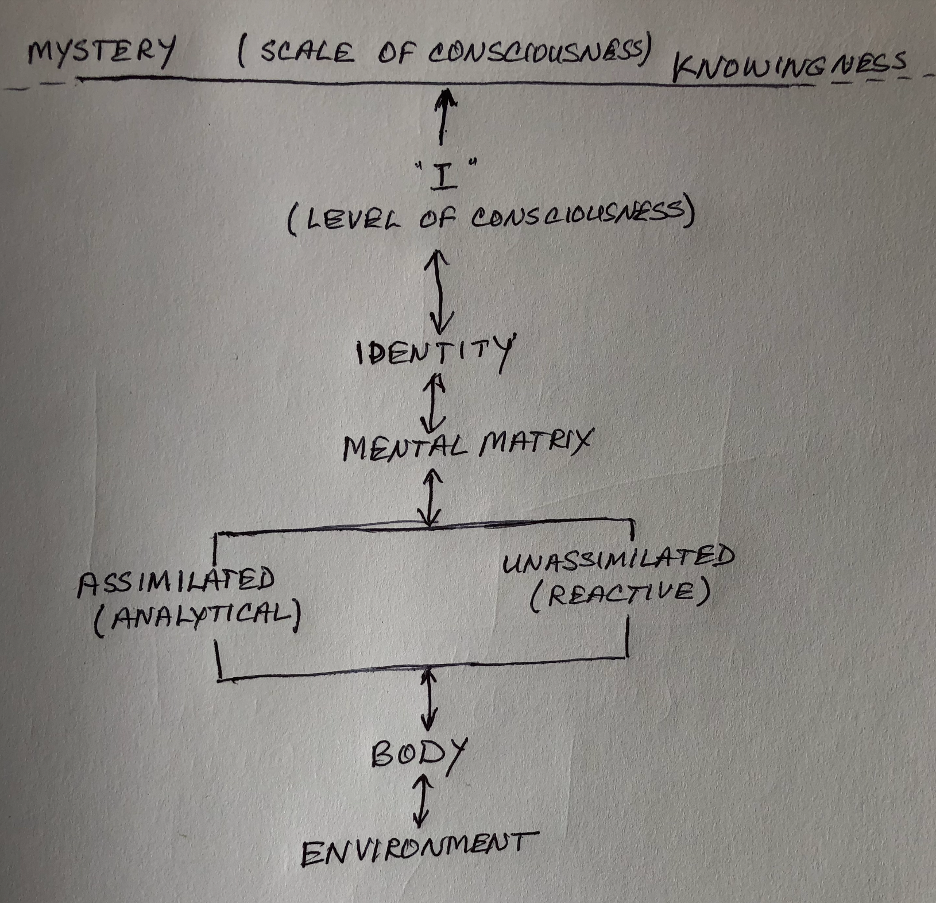
  8. MENTAL MATRIX (Analytical Mind, Reactive Mind, Trauma, Facsimile)
  9. FACSIMILE (Anomaly, Arbitrary)

Conclusion: The human condition results from unresolved anomalies. The anomalies are there because of missing knowledge. As knowledge becomes available in the area of doubt and perplexity, one should make every effort to resolve those doubts.

NOTE: This key word sequence and glossary definitions can definitely be improved. In fact, I shall request you to improve upon them.

.

GLOSSARY

Please refer to

  1. KHTK Glossary
  2. Technical Dictionary

Additional data shall be added as necessary.

.

FRANCIS BACON: Epilogue

Reference: The Story of Philosophy

This paper presents Chapter III, Section 6 from the book THE STORY OF PHILOSOPHY by WILL DURANT. The contents are from the 1933 reprint of this book by TIME INCORPORATED by arrangement with Simon and Schuster, Inc.

The paragraphs of the original material (in black) are accompanied by brief comments (in color) based on the present understanding.  Feedback on these comments is appreciated.

The heading below is linked to the original materials.

.

VI. Epilogue  

“Men in great place are thrice servants; servants to the sovereign or state, servants of fame, and servants of business, so as they have no freedom, neither in their persons nor in their action, nor in their time. … The rising unto place is laborious, and by pains men come to greater pains; and it is sometimes base, and by indignities men come to dignities. The standing is slippery, and the regress is either a downfall or at least an eclipse.” What a wistful summary of Bacon’s epilogue! 

Francis Bacon was a man of his time.

“A man’s shortcomings,” said Goethe, “are taken from his epoch; his virtues and greatness belong to himself.” This seems a little unfair to the Zeitgeist, but it is exceptionally just in the case of Bacon. Abbott, after a painstaking study of the morals prevalent at Elizabeth’s court, concludes that all the leading figures, male and female, were disciples of Machiavelli. Roger Ascham described in doggerel the four cardinal virtues in demand at the court of the Queen: 

Cog, lie, flatter and face,
Four ways in Court to win men grace. 
If thou be thrall to none of these, 
Away, good Piers! Home, John Cheese!

In those times, man were beholden to their status.

It was one of the customs of those lively days for judges to take “presents” from persons trying cases in their courts. Bacon was not above the age in this matter; and his tendency to keep his expenditure several years in advance of his income forbade him the luxury of scruples. It might have passed unnoticed, except that he had made enemies in Essex’ case, and by his readiness to sabre foes with his speech. A friend had warned him that “it is too common in every man’s mouth in Court that … as your tongue hath been a razor to some, so shall theirs be to you.” But he left the warnings unnoticed. He seemed to be in good favor with the King; he had been made Baron Verulam of Verulam in 1618, and Viscount St. Albans in 1621; and for three years he had been Chancellor.

Bacon was extravagant and accepted bribes to support his lifestyle. He was caustic and had made enemies.

Then suddenly the blow came. In 1621 a disappointed suitor charged him with taking money for the despatch of a suit; it was no unusual matter, but Bacon knew at once that if his enemies wished to press it they could force his fall. He retired to his home, and waited developments. When he learned that all his foes were clamoring for his dismissal, he sent in his “confession and humble submission” to the King. James, yielding to pressure from the now victorious Parliament against which Bacon had too persistently defended him, sent him to the Tower. But Bacon was released after two. days; and the heavy fine which had been laid upon him was remitted by the King. His pride was not quite broken. “I was the justest judge that was in England these fifty years,” he said; “but it was the justest judgment that was in Parliament these two hundred years.”

Bacon was finally dismissed under the pressure of his enemies for something not so unusual.

He spent the five years that remained to him in the obscurity and peace of his home, harassed by an unwonted poverty, but solaced by the active pursuit of philosophy. In these five years he wrote his greatest Latin work, De Augmentis Scientiarum, published an enlarged edition of the Essays, a fragment called Sylva Sylvarum, and a History of Henry VII. He mourned that he had not sooner abandoned politics and given all his time to literature and science. To the very last moment he was occupied with work, and died, so to speak, on the field of battle. In his essay “Of Death” he had voiced a wish to die ”in an earnest pursuit, which is like one wounded in hot blood, who for the time scarce feels the hurt.” Like Caesar, he was granted his choice. 

Bacon lived the last five years of his life in poverty but happy in the pursuit of philosophy till his last breath.

In March, 1626, while riding from London to Highgate, and turn.ing over in his mind the question how far flesh might be preserved from putrefaction by being covered with snow, he resolved to put the matter to a test at once. Stopping off at a cottage, he bought a fowl, killed it, and stuffed it with snow. While he was doing this he was seized with chills and weakness; and finding himself too ill to ride back to town, he gave directions that he should be taken to the nearby home of Lord Arundel, where he took to bed. He did not yet resign life; he wrote cheerfully that “the experiment … succeeded excellently well.” But it was his last. The fitful fever of his varied life had quite consumed him; he was all burnt out now, too weak to fight the disease that crept up slowly to his heart. He died on the ninth of April, 1626, at the age of sixty-five. 

He had written in his will these proud and characteristic words: “1 bequeath my soul to God. … My body to be buried obscurely. My name to the next ages and to foreign nations.” The ages and the nations have accepted him. 

.