Category Archives: Scientology

Remedy of Laughter

When a person finds himself in an environment that makes it difficult for him to reject what he doesn’t like, he is likely to feel very uncomfortable. When this continues, he may become serious, and even neurotic. Getting a person to laugh is always a good remedy because, besides surprise, laughter is rejection. Laughter surprises the person into rejecting, and that is very therapeutic.

The Remedy of Laughter could be entered simply by having the individual predict that a wall would be there in ten seconds, count off ten seconds on his watch, and then ascertain with thoroughness that the wall is still there.

A direct mock up process can be applied to the Remedy of Laughter by having the person mock up alternately himself and others laughing.

The person can also be made simply to stand up and start laughing. He at first will demand to have something to laugh at, but at length will be able to laugh without reason. 

The goal of the process is to regain the ability to laugh without reason. One may run this process simply by using the following two commands.

Start laughing.’
‘Keep on laughing.’

.

The Excerpt

Here is the full excerpt of this Scientology process from the Book, The Creation of Human Ability by L. Ron Hubbard.

R2-26: REMEDY OF LAUGHTER 

The earliest known psychotherapy consisted of getting a patient to laugh. Laughter is rejection. A preclear being continually inflowed upon by the physical universe at length may find it difficult to reject anything. Getting him to reject something could be made an auditing goal. The best manifestation of this is laughter. Laughter includes both surprise and rejection. The individual is surprised into rejecting. 

In order to laugh, he must have laid aside some of his ability to predict. An individual who is serious has laid aside so much of his ability to predict that he now cannot be surprised into rejection. The anatomy of mystery consists of, in this order, unpredictability, confusion, and chaos covered up because it cannot be tolerated. Therefore, this is also the anatomy of problems. Problems always begin with an unpredictability, deteriorate into a confusion, and then if still unsolved become a mystery which is massed confusion. It will be observed that as a person falls further and further away from the ability to laugh he becomes more and more confused until at last he sees no points in any jokes, he sees only embarrassment when confronted by laughter, and the whole action of laughter itself escapes him. The ability to laugh is rehabilitated in general by Scientology as it advances the ability of the preclear to know – which is to say, predict. 

The Remedy of Laughter could be entered simply by having the individual predict that a wall would be there in ten seconds, count off ten seconds on his watch, and then ascertain with thoroughness that the wall is still there, to establish if the wall is there, then to predict that it will be there in ten seconds, then to count off ten seconds on his watch and ascertain if the wall is still there. By thus bringing solid objects into the realm of prediction, an individual at length comes to a point where he can predict very slowly moving objects. A cheap train and track could be set up for this purpose and the preclear could be led to predict with accuracy the position of engines on the small circular track. However, the preclear can be made to watch automobiles on the street – a process which serves just as well with no such equipment. 

The preclear would then be led to predict the positions of his own body, first by predicting that it was going to be in a certain spot, then moving it there and seeing whether or not it had arrived at that spot. He would then be brought to swing his arm in a circle, predict that it would swing faster, and swing it faster. And thus being led to predict the motion of his body with these simplicities, he could be exercised in making his body go tense and go limp by his command until he was thoroughly certain that he could both predict the tension or relaxation by doing it. Then he could be led to predict the positions of people walking on the street until he felt some security in predicting without exercising physical control. By thus remedying his ability to predict, one brings the preclear up into a tolerance of motion. He is then led to put his attention on one moving object, then on two moving objects at once, and so forth using the processes of spanning attention on moving objects.

A direct mock up process can be applied to the Remedy of Laughter by having the preclear mock up alternately himself and others laughing or by having him mock up an acceptable level of amusement and remedy his havingness with it until he can have people laughing very broadly in his mock-ups. The preclear can also be made simply to stand up and start laughing. He at first will demand to have something to laugh at, but at length will be able to laugh without reason. The goal of the process is contained in the last line – to regain the ability to laugh without reason. 

In this Intensive Procedure only two steps are employed to remedy laughter. The first consists of these commands, ‘Be completely certain that the wall is there’. And when the preclear has become with considerable conversation completely certain that the wall is there, touching it, pushing against it, and so forth, the auditor then says, ‘Sit down, take this (your) watch’, ‘Now predict that the wall will be there ten seconds from now’, ‘Have you done so?’ ‘All right wait ten seconds by your watch’. And when this is done, ‘Is the wall still there?’ And when the preclear has answered, ‘Now make absolutely certain the wall is there’ and the preclear does so by touching it, pushing at it, kicking it. ‘Now make very sure that the wall is there’. And when the preclear very vigorously has done so, ‘Now predict that it will be there in ten seconds’. And when the preclear has done so, the remainder of the commands are given and this is repeated over and over. 

Then the second part of lntensive Procedure’s process of laughter, but only after the preclear has experienced considerable relief and is absolutely sure that he can predict that all parts of the room will be there, not only in ten seconds, but in an hour – although no such timing is used, and only ten seconds of time is employed – ‘Start laughing’. And no matter what the preclear says thereafter, or what arguments he advances, or how many things he asks about, or how many reasons he wants or gives, the auditor merely says (adding words that urge the preclear), ‘Start laughing’. And when the preclear at length does so, no matter how half heartedly, ‘Keep on laughing’. The two commands which are used in addition to words necessary to urge the preclear without giving the preclear any reason whatsoever are, ‘Start laughing’ and ‘Keep on laughing’. 

This process is then done until the preclear can actually enjoy a laugh without any reason whatsoever, without believing that laughing without reason is insane, without feeling self-conscious about laughing, and without needing any boost from the auditor. The auditor in this second part need take no pains to agree with the preclear by laughing. He need not chuckle or smile nor need he even particularly act seriously, his laughter is not needed or used in the process. An auditor can be as serious as he pleases, and indeed, if he wishes to do so, can be even more serious than is usual when running this second step of R2-26. 

In earlier Scientology it was learned that serious preclears would often recover considerable ground simply when they were made to do things without any reason whatsoever. This achievement is much greater when they are made to laugh without any reason.

.
Dianetics Axioms 181 – 194

Reference: The Dianetics Axioms

L. Ron Hubbard found that man is obeying very definite laws and rules which could be set forward in axioms. The very first and most fundamental of these is: The dynamic principle of existence is survive. That is the basic axiom of Dianetics.

The original Dianetic axioms are referenced below in black.

.

Executive Summary 2025

.

Axioms 181-194

DN AXIOM 181: Pain is stored as plus or minus randomity

.

DN AXIOM 182: Pain, as an area of plus or minus randomity, can reinflict itself upon the organism.

.

DN AXIOM 183: Past pain becomes ineffective upon the organism when the randomity of its area is addressed and aligned.

.

DN AXIOM 184: The earlier the area of plus or minus randomity, the greater self-produced effort existed to repel it.

.

DN AXIOM 185: Later areas of plus or minus randomity cannot be realigned easily until earlier areas are realigned.

.

DN AXIOM 186: Areas of plus or minus randomity become increased in activity when perceptions of similarity are introduced into them.

.

DN AXIOM 187: Past areas of plus or minus randomity can be reduced and aligned by address to them in present time.

.

DN AXIOM 188: Absolute good and absolute evil do not exist in the mest universe.

.

DN AXIOM 189: That which is good for an organism may be defined as that which promotes the survival of that organism. 

COROLLARY: Evil may be defined as that which inhibits or brings plus or minus randomity into the organism, which is contrary to the survival motives of the organism.

.

DN AXIOM 190: Happiness consists in the act of bringing alignment into hitherto resisting plus or minus randomity. Neither the act or action of attaining survival, nor the accomplishment of this act itself, brings about happiness.

.

DN AXIOM 191: Construction is an alignment of data. 

COROLLARY: Destruction is a plus or minus randomity of data. The effort of constructing is the alignment toward the survival of the aligning organism. Destruction is the effort of bringing randomity into an area.

.

DN AXIOM 192: Optimum survival behavior consists of effort in the maximum survival interest in everything concerned in the dynamics.

.

DN AXIOM 193: The optimum survival solution of any problem would consist of the highest attainable survival for every dynamic concerned.

.

DN AXIOM 194: The worth of any organism consists of its value to the survival of its own THETA along any dynamic.

.

Dianetics Axioms 166 – 180

Reference: The Dianetics Axioms

L. Ron Hubbard found that man is obeying very definite laws and rules which could be set forward in axioms. The very first and most fundamental of these is: The dynamic principle of existence is survive. That is the basic axiom of Dianetics.

The original Dianetic axioms are referenced below in black.

.

Executive Summary 2025

.

Axioms 166-180

DN AXIOM 166: An individual is as happy as he can perceive survival potentials in the future.

.

DN AXIOM 167: As the needs of any organism are met it rises higher and higher in its efforts along the dynamics. An organism which achieves ARC with itself can better achieve ARC with sex in the future; having achieved this it can achieve ARC with groups; having achieved this, it can achieve ARC with mankind, etc.

.

DN AXIOM 168: Affinity, reality and communication coexist in an inextricable relationship. The coexistent relationship between affinity, reality and communication is such that none can be increased without increasing the other two and none can be decreased without decreasing the other two.

.

DN AXIOM 169: Any aesthetic product is a symbolic facsimile or combination of facsimiles of theta or physical universes in varied randomities and volumes of randomities with the interplay of tones.

.

DN AXIOM 170: An aesthetic product is an interpretation of the universes by an individual or group mind.

.

DN AXIOM 171: Delusion is the postulation by the imagination of occurrences in areas of plus or minus randomity.

.

DN AXIOM 172: Dreams are the imaginative reconstruction of areas of randomity or the resymbolization of the efforts of theta.

.

DN AXIOM 173: A motion is created by the degree of optimum randomity introduced by the counter-effort to an organism’s effort.

.

DN AXIOM 174: MEST which has been mobilized by life forms is in more affinity with life organisms than nonmobilized mest.

Substance which has been assimilated by life forms is in more affinity with life organisms.

.

DN AXIOM 175: All past perception, conclusion and existence moments, including those of plus or minus randomity, are recoverable to the control center of the organism.

.

DN AXIOM 176: The ability to produce survival effort on the part of an organism is affected by the degrees of randomity existing in its past. (This includes learning.)

.

DN AXIOM 177: Areas of past plus or minus randomity can be readdressed by the control center of an organism and the plus or minus randomity exhausted.

.

DN AXIOM 178: The exhaustion of past plus or minus randomities permits the control center of an organism to effect its own efforts toward survival goals.

.

DN AXIOM 179: The exhaustion of self-determined effort from a past area of plus or minus randomity nullifies the effectiveness of that area.

.

DN AXIOM 180: Pain is the randomity produced by sudden or strong counter-efforts.

.

Grassroots Scientology

Reference: The Book of Subject Clearing

If you really want to go after the cruelty of the Church of Scientology, and eliminate it once and for all, then you have to generate and promote a grassroots version of Scientology that is free, doable and effective.

The grassroots’ version of Scientology is rooted in Buddhism, as Scientology was originally conceived to be. It is unlike the Scientology promoted by the Church of Scientology that uses the therapist-patient model borrowed from psychotherapy. This grassroots version of Scientology is Self-Help.

.

Grassroots Version and E-meter

The e-meter is not used in the Grassroots version, which uses The 12 Aspects of Mindfulness instead. By drilling on these 12 aspects of Mindfulness, a person develops an internal sensitivity for processing one’s own mind. This internal sensitivity replaces the dependence on the E-meter.

.

Grassroots Version and End Phenomenon (EP)

Scientology uses the technique of “repetitive questioning” to make a person look closely at an auditing question. This makes the person search his mind for answers. A Scientology process is not ended until some realization (called EP) takes place. Very often this ends up in overrunning the process. “Overrun” means continuing a process past the optimum point. The “overrun” then requires repair and wastes valuable auditing time.

In the grassroots version, the person does not search his mind for answers. He simply contemplates on the question by being there and confronting. He has enough sensitivity to know ahead of time if a new answer to the auditing question is accessible or not. If it is, he waits for the answer to appear. When there are no more answers appearing, the person ends the process.

A person can always go back to a process and run it again. As his confront improves, more answers become accessible. So, even when there is no EP in the first attempt, there will certainly be realizations in subsequent attempts in running a process. And there will also come a point, when the person knows that he is done with a process, or a Grade, and he is ready to move on.

.

Grassroots Version and Solo Auditing

The grassroots version does not use the therapist-patient model of psychotherapy, in which a therapist (or auditor) uses some theory to figure out what is wrong with a person in each moment, and tries to handle that wrongness. Such an approach is prone to many errors because the therapist can never be fully in the shoes of the person. Such errors of “external evaluation” are avoided when the person uses mindfulness approach in grassroots Scientology.

Of course, there are going to be a small percentage of people who would not be able to apply the mindfulness approach of grassroots version without some initial help. Such help may be provided by field auditors at a reasonable cost. Otherwise, the grassroots version is free.

.

Prerequisite

One should start with Handling Introversion.

Then do the drills provided in The 12 Aspects of Mindfulness.

Then do TR0 with Mindfulness with a friend or another person.

You can always do these basic actions (prerequisites) whenever you need to free up your attention. Recycling through them now and then is very helpful.

.

Scientology Grades

A person contemplates on the grade processes in the “TR0 mode”, with all the 12 aspects of mindfulness naturally present.

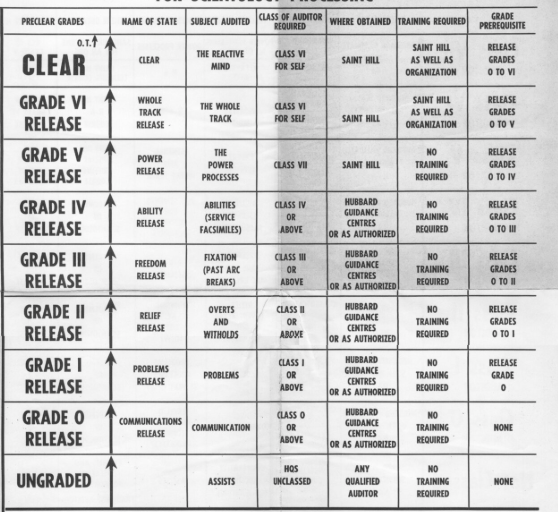
The Scientology Grades focus on the fixations of a person due to his IDENTIFICATIONS with the universe. Each grade is made up of processes that address a different level of fixation. The person may do a grade level several times until he is satisfied with it. He may then move to the next grade level. These grades are done in the following order.

  1. ARC Straight wire Processes
  2. Grade 0 Processes (Communications Release)
  3. Grade 1 Processes (Problems Release)
  4. Grade 2 Processes (Relief Release)
  5. Grade 3 Processes (Freedom Release)
  6. Grade 4 Processes (Ability Release)
  7. Grade 5 Exercises (Power Release)
  8. Grade 6 Exercises (Whole Track Release)

One may then recycle through all the grade levels as necessary. This goes very fast with mindfulness and without an e-meter.

.

The OT Levels

Then one may move on to the OT Levels.

OT Levels are accompanied by Subject Clearing as the continuing process of OT VIII.

.

Dianetics

The erasure on Dianetics fully occurs at the level of NOTs (New Era Dianetics for OTs). The procedure of NOTs shall be added when it is fully researched for Grassroots Scientology.

.

Notes

  1. Scientology focuses on the RIGHT MINDFULNESS section of the Eight-Fold Path of Buddhism. To understand Scientology properly, you may want to study the following “subject-cleared” summary of Buddhism: SC: Buddhism.
  2. To understand the philosophy underlying Scientology, you may go to this link: Scientology Research.
  3. If you are willing to follow the Grassroots Scientology program as a solo auditor, I shall be happy to work with you as your C/S (Case Supervisor). It is all free, of course, for the sake of humanity that is soon going to be challenged by Artificial Intelligence.

.

OT III Anomaly

Reference: The Level of OT III

Specially refer to LRH OT III Instructions (Transcript)

OT III Anomaly

  1. It is interesting to observe that “mass implanting” was seen as the solution to overpopulation on OT III background story instead of death.
  2. It may mean that the population was considered to be made up of immortal thetans, and death of the body could not properly eliminate them. So, dead people were also counted as part of the population.
  3. If so, then the anomaly is that if the number of thetans cannot decrease through death, then it cannot increase through birth either. There is no one-way street in this matter. If the thetans were always there then their number should have remained constant.
  4. “Mass implanting” is no way of decreasing the number of thetans. It can only make them controllable. In that case, the problem was one of control and not of over population. But Hubbard did not use that as the problem.
  5. This means that overpopulation is a made-up story. Hubbard simply wanted to stress upon the idea of “mass implanting.” This is because there exists sameness of the reactive mind mechanism from person to person.
  6. One needs to analyze how OT III addresses this sameness of the reactive mind mechanism from person to person.
  7. H-bomb in the story simply means that at the bottom of reactive mechanism, there is a severe explosion-like shock. A severe shock allows  misleading data to become deeply embedded in the mind. 
  8. It is very difficult to handle such deeply embedded data, without approaching it in a very precise manner. On OT III the approach is to run Incidents I and II as engrams on each body thetan one at a time.
  9. Hubbard must have experienced Incidents I and II repeatedly during his OT III research in full detail. That must have made quite an impression on him. He ended with the conclusion that “One’s body is a mass of individual thetans stuck to oneself or to the body.”
  10. These body thetans appear to be units of deep programming much like AI (artificial intelligence) that manifest as body sensations.
  11. When you are running a body thetan, you are essentially sorting out a viewpoint. This viewpoint may be associated with some body sensation. That sensation may be connected eventually to some experience. 
  12. This viewpoint of body thetan must be pared down to its simplest form before running it. As an example, one can have a very unappreciative viewpoint toward the body; whereas, body is a wonderful and useful mechanism.
  13. The suggested primary handling of body thetans is by running them through Incidents I and II. Sometimes level 0 to VI processes are required before they can run engrams (Inc 1 & Inc 2). Sometimes they have to be run on Power Processes first.
  14. In the auditing of body thetans, the person acts as pure awareness. He is thus exterior to the condition while observing that condition. The viewpoint (body thetan) is part of that condition. That condition can be out of valance condition, psychosis, fixed ideas, or service facsimiles. 
  15. The auditing is done per the grade chart, and directed at what needs to be addressed. Such auditing is fast. The e-meter is not that useful other than indicating the TA movement.
  16. Running OT III requires extensive training in running all other Scientology procedures. That makes it too long a runaway.
  17. When OT III is not working, precision is missing in terms of having the precise viewpoint or running the precise process.
  18. LRH provides the datum: “Thetans believed they were one. This is the primary error.” But this is an erroneous viewpoint.
  19. Actually, the primary error is not addressing the precise viewpoint with the precise process when auditing OT III.
  20. The precision is provided through subject clearing by simplifying the L&N process. Please see The Listing Procedure.

.

Subject Clearing

Subject Clearing starts with the following basics.

  1. The Unknowable
  2. The Postulate
  3. The Universe
  4. The Oneness
  5. The Reality
  6. The Anomaly

According to Subject Clearing, a body thetan would be a special kind of anomaly that affects the viewpoint.

.