Category Archives: Science

Newton’s Fourth Law

Reference: Fundamentals of Physics

This law is post-Quantum Mechanics. Newton didn’t write this law, but he may just as well have written it if he were alive today. 

The Fourth Law: When a particle of matter is accelerated, its mass decreases. The decrease in mass is proportional to the increase in its speed.

We have already established in “Motion” in Quantum Mechanics that the “absolute speed” of a particle is inversely proportional to its frequency. Therefore, as the speed of the particle increases from rest due to acceleration, its frequency decreases. This means, that the mass, or consistency, of the particles also decreases proportionally. When the acceleration goes back to zero and the particle returns to rest, its mass or consistency is also restored. The change in mass is so small in the inertial frames, that it is ignored.

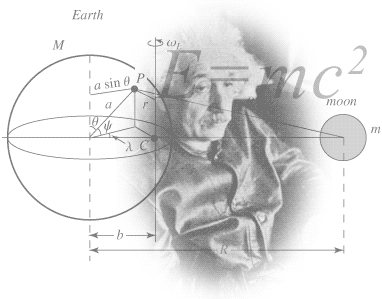
The property that is fundamentally conserved is force. The force is conserved in the form of angular momentum as can be seen from the units of the Planck’s constant. The figure above provides a rough analysis that shows the proportionality of decrease in mass to increase in speed. The constant of proportionality, when fully worked out, shall include the Planck’s constant, and it would be extremely small.

.

Mass and Inertia

Let me also take this opportunity to define inertia in terms of mass.

Inertia is the measure of consistency of substance per quantum. In case of matter, inertia is mass per unit particle.

Therefore, Inertia may be compared on The Spectrum of Substance in terms of “consistency per quantum”, or “mass per particle”. Total Inertia shall be equivalent to total mass of an object. We may say that 

Upon acceleration, inertia converts to speed.

This satisfies Faraday’s postulate of conservation of force.

Once we have a practical and simpler way of converting inertia into speed, and speed back into inertia, we shall have the INERTIAL DRIVE that has long been imagined in science fiction.

.

Fundamentals of Physics

  1. Faraday: On the Conservation of Force
  2. Einstein: 1905 Paper #1 on Light Quanta
  3. Einstein: 1905 Paper #2 on Molecular Dimensions
  4. The Quantum
  5. Newtonian Concepts for Quantum Age
  6. The Spectrum of Substance 
  7. “Energy” in Quantum Mechanics
  8. “Force” in Quantum Mechanics
  9. “Motion” in Quantum Mechanics
  10. Newton’s Fourth Law
  11. “Charge” in Quantum Mechanics
  12. Feynman on Quantum Behavior
  13. Higgs Mechanism

.

“Motion” in Quantum Mechanics

Reference: Fundamentals of Physics

In Classical Mechanics, we are looking at the motion of objects that have a precise center of mass (CM). Therefore, their position can be represented by a dimensionless point in space. Their speed can be measured by the relative motion of this dimensionless point. We are familiar with this as Galilean relativity.

But in Quantum Mechanics, we are looking at the motion of particles with no CM. An electron or photon cannot be pinpointed with accuracy because it has no CM. They cannot be treated as dimensionless points. The concept of motion is very different for such particles; and it cannot be visualized like the motion of material particles.

Electron and photons are built of cycles of motion. Their size and speed as a particle is determined by the frequency of their cycles.

The idea of mass comes from particles that make up the nucleus of an atom, such as, neutrons and protons. These particles are extremely small and made up of an extremely high frequency of cycles. They represent “mass.” The largest stable nucleus of an atom consists of 83 protons and 126 neutrons. But the size of this nucleus is still so small that it can be approximated as a point.

Mass may be looked upon as extremely high frequency of cycles packed in an extremely small size. 

We may say that an atom has its nucleus as its CM. When the atoms are arranged in a fixed configuration in a solid object, then that object has a CM. Even liquid and gaseous objects made of atoms will have a CM that can be determined statistically. This is classical mechanics. But in Quantum mechanics the situation is quite different.

An electron is 1836 times loosely packed with “mass” as a proton. We may visualize that proton to be embedded at the center of the electron in a hydrogen atom. This makes an electron to be roughly of the size of the hydrogen atom. We may not be able to measure sizes accurately at atomic level; but we can say with certainty that the size of an electron is much bigger than the size of a proton. 

The size of an electron is roughly thousands of time bigger than the size of a proton.

The relative sizes of quantum particles may be estimated by the ratios of their wavelengths. Since the speed of light is a universal constant, this ratio will be inverse of the ratio of their frequencies. Therefore, the smaller is the frequency the larger would be the size of a quantum particle. Using the data from The Spectrum of Substance, we may say that

An electron is 2000 times bigger than a proton.

A photon of visible light is more than 200,000 times bigger than an electron.

A proton appears as a point in classical space. The electron may appear as a point in a classical space expanded 2000 times. Similarly, the photon may appear as a point in classical space expanded 400,000,000 times.

A particle’s speed is zero relative to itself in its own space. Therefore, an electron’s speed will be zero relative to itself in “electron space”. Similarly, the speed of a photon will be zero relative to itself in “photon space”.

All this adds up to “absolute speeds” of particles being in a ratio that is inverse of the ratio of their frequencies. The higher is the frequency the lower will be the absolute speed. This appears to be valid when we calculate the ratio of the frequency of the proton to the frequency of the photon.

The desired ratio =  277.6 / 249  =  228.6  =  4 x 10⁸

This is of the same order as the speed of light in the inertial frame of matter. This value is higher because the frequency of neutron is slightly higher than the average frequency of matter.

We may say that the “absolute speed” of a particle is inversely proportional to its frequency.

.

Definitions

MOTION
Motion is self-actuated and inherently free aliveness as observed in the motion of light and the electrons. It is infinite when it is free. Motion becomes bounded and finite when it is cyclic. With the increase of cycles, the motion becomes increasingly centered. It then takes force to move it away from that centeredness. That resistance of motion to being changed is called inertia. Pure motion is an absence of cycles and inertia.

PARTICLE
A particle is a unit of substance whose size is proportional to its wavelength. Electron as a particle is 2000 times bigger than a proton. Photon as a particle is more than 200,000 times bigger than an electron. The boundary of a particle is determined by the cycles of motion of which it is constructed. A particle has the property of centeredness, which is proportional to its frequency. This centeredness is manifested as inertia when attempt is made to change its inherent motion.

SPEED
The concept of speed applies to a particle. The measure of absolute speed of a particle is inverse of its centeredness. Since the “particle” of gravity is least centered, its speed is infinite. This means that the particle of gravity is manifested instantly at any location in the universe. Thus, speed has the sense of the rapidity with which a particle is manifested at a location in the universe after being manifested at another location.  

.

“Force” in Quantum Mechanics

Reference: Fundamentals of Physics

Quantum mechanics started with the study of black body radiation. It is, therefore, the mechanics of radiative energy. It not only applies to the radiative energy inside the atom, but also to the radiative energy out in the broad universe. Quantum mechanics’ object of study is much wider than the classical study of matter. 

As we have already established, the concept of force is more basic than the concept of energy. This concept originated in the context of matter. We now want to understand force in the context of the universe. 

Force comes about when there is a change in momentum, as in slowing, curving or reflecting of motion. This requires the universe to have a boundary where motion is slowed, curved or reflected. The universe is, therefore, finite with a boundary. We have explained elsewhere that the universe implies awareness. Beyond the universe there is non-awareness.

When motion slows, curves or reflects, it means that the motion is cyclic. The cycles have a frequency. The frequency could be extremely slow or extremely high.

Force gets its meaning from cyclic motion, as in E = hf, where E has the sense of force with substance.

Thus, more basic than force is the concept of cyclic motion, which has the property of frequency.

Force comes about when there is a change in motion, such as in the case of an impact. Change in motion occurs in terms of change in the frequency of cycles. This is seen as acceleration or deceleration in classical mechanics.

Force comes about in an impact because motion has the property of “centeredness” and it resists being changed. That means motion has a tendency to maintain its frequency. This tendency is referred to as inertia in classical mechanics.

.

Definitions

FORCE
Force is the manifestation of acceleration or deceleration in motion caused by a change in frequency. This is sensed in our very being. It underlies all our physical senses. All our perception is based on force. Any sense of substantialness comes from impacts on our sense organs. The impact is always in the form of force. This is what defines any substance. 

This was Faraday’s view of force. Maxwell defined it mathematically as “the tendency of a body to pass from one place to another,” that depended upon “the amount of change of tension which that passage would produce.” Unlike Faraday, Maxwell did not relate force directly to the nature of substance.

INERTIA
Inertia is the tendency of the motion to continue in its course. Any effort to change that course is met with resistance. Inertia is caused by the cyclic nature of motion. The cycles make the motion centered and finite. As the cycles increase in frequency, the motion becomes more centered and finite. This increases the inertia of motion. In fact, inertia may be measured in terms of frequency of motion.

Inertia is manifested only when the course of motion changes, as during an impact. There is an acceleration or deceleration of motion. This phenomena of inertia underlies the sense of touch. It also underlies during any contact, such as, between the eye and light. 

.

“Energy” in Quantum Mechanics

Reference: Fundamentals of Physics

Energy is a classical concept that applies to Newtonian mechanics as “the capacity for doing work.” But this same word “energy” has gone through a fundamental shift in its meaning in Quantum Mechanics.

The word QUANTUM means, “quantity or amount”. It refers to the smallest quantity of radiant energy, equal to Planck’s constant times the frequency of the associated radiation (E = hf). “Quantity of radiant energy” means that radiant energy is a substance that can be collected and measured. This is a revolutionary thought. 

Quantum refers to “the smallest quantity of substance,” where substance means “something substantial enough to be sensed.” 

The basis of substance is impact, which comes from a change in momentum. This is the classical definition of force. Light has momentum. Light can have impact and force. Therefore, light is substance. It was for establishing the reality of quantum as quantity of substance, which he demonstrated through the phenomenon of photoelectricity, that Einstein got a Nobel Prize.

The classical sense of energy is derived from force as the product “force x distance.” Thus, energy is a mathematical concept, much like the “lagrangian” and “hamiltonian” functions. But force is a real concept that can be experienced. The concept of “energy” in Quantum Mechanics is closer to the sense of force and substance.

Quantum is closer to the basic sense of FORCE as in the “impact of substance” than to ENERGY as in the “capacity for doing work.”

It was Faraday who first articulated that the concept of force is more basic than energy in his thesis: On the Conservation of Force. Maxwell, who applied mathematics to Faraday’s ideas, disagreed with Faraday on his notion of force (see Faraday & Maxwell). But Einstein, who kept a picture of Faraday on his wall, did understand the notion of force as Faraday intended.

Thanks to Faraday and Einstein, that we can visualize a broad spectrum of substance today (see The Spectrum of Substance). The concept of substance translates into having an atom-less consistency and not just atomic mass. The concept of inertia is not just limited to mass, but it applies to consistency as well.

Mass is, essentially, “frozen inertia” as in the case of the nucleus of atom. It is more like “liquid inertia” as in the case of electrons; and it is “vaporized inertia” as in the case of radiant energy. The property of inertia is the core of substance as it generates sensation.

Underlying substance, mass, consistency and inertia is the concept of FORCE.

This force is proportional to frequency.

.

Definition

ENERGY
Energy is a mathematical concept derived from force. It is a mathematical function, much like the “lagrangian” and “hamiltonian” functions. 

.