Category Archives: Sadhguru

SADHGURU 2016: When I Lost My Sense

Reference: Inner Engineering (Content)

This paper presents the summary of Part one, chapter 2, from the book, INNER ENGINEERING By Sadhguru. The contents are from the first edition (2016) of this book published in the United States by Spiegel & Grau, an imprint of Random House, a division of Penguin Random House LLC, New York.

The summary of the original material (in black) is accompanied by brief comments (in color) based on the present understanding.

.

When I Lost My Sense

Real education comes from the direct observation of nature, life and human activity, and not through language. Meditation is simply observing your thoughts just like you observe any other human activity. When your mental matrix opens up to the universal matrix, the sense of mine is gone and nature takes over.

With a well-assimilated matrix, one can easily recall all past experiences in vivid details. The person is extroverted and can easily notice anomalies in the environment. To keep one’s matrix well-assimilated, a person always questions everything that doesn’t make sense, no matter how small.

The state of “I don’t know” has immense value in learning. One should not destroy this state with beliefs and assumptions. There is enquiry of the universe with eyes open; there is also the enquiry of “me” with eyes closed. Eventually the certainty of “me” collapses as a deeper sense of what it is to be a human being starts to open up.

The practice of yoga helps develop the sense of what it is to be a human being. If you really want to know spirituality, don’t look for anything. Simply look without motive. It is not the object of your search that is important; it is the faculty of looking.

Wide study is necessary to resolve the anomalies one finds oneself surrounded by. There is a natural urge to resolve anomalies. The most interesting question is, “How?”

The transformation of the energy of food into the energy of body cells, when experienced, shifts the sense of “I”. Conscious awareness of this energy of the body cells has the power of healing you very rapidly. Being in touch with this fundamental intelligence is quite transformative both for you and for those around you.

Human intellect is mere smartness that ensures survival, but, the ultimate intelligence is the life itself. The human body can function as a piece of flesh and blood or as the very source of creation. The human spine isn’t just a bad arrangement of bones; it is the very axis of the universe. 

Yoga is the union of the mental matrix with the universal matrix. We all are seeking to become infinite; the only problem is that we are seeking it in installments. The human desire is not for any particular thing, but just to expand without limit.

Real Yoga is being totally in tune with Nature. There is no attention on “me” then.

.

SADHGURU 2016: A Note to the Reader (Part One)

Reference: Inner Engineering (Content)

This paper presents the summary of Part one, chapter 1, from the book, INNER ENGINEERING By Sadhguru. The contents are from the first edition (2016) of this book published in the United States by Spiegel & Grau, an imprint of Random House, a division of Penguin Random House LLC, New York.

The summary of the original material (in black) is accompanied by brief comments (in color) based on the present understanding.

.

A Note to the Reader

This book has a strong practical orientation that has come from inner experience. This section seeks to offer a series of fundamental insights on which the more practice-oriented second section is built. It begins on an autobiographical note, then unfolds into an examination of certain basic ideas.

Sadhana” at the end of chapters are tools that offer a chance for the reader to explore the insights. This book explores an ancient technology, which is based on timeless truths. It uses contemporary language to present that technology in state-of-the-art form.

This book has the right approach and a nice layout.

.

SADHGURU 2016: The Four-Letter Word

Reference: Inner Engineering (Content)

This paper presents the summary of the beginning chapter from the book, INNER ENGINEERING By Sadhguru. The contents are from the first edition (2016) of this book published in the United States by Spiegel & Grau, an imprint of Random House, a division of Penguin Random House LLC, New York.

The summary of the original material (in black) is accompanied by brief comments (in color) based on the present understanding.

.

The Four-Letter Word

The word “Guru” literally means “dispeller of darkness.” He is there to throw light on the very nature of your existence. The problem is that you suffer a play of your memory and imagination. You need to take charge of it, and not annihilate it. Teachings like “be in the moment,” “do only one thing at a time,” and “positive thinking,” are limited and do not work in the long term.

The only solution for all the ills that plague humanity is self-transformation. Self-transformation is a dimensional shift in the way you perceive and experience life. Self-transformation is achieved by experiencing the limitless nature of who we are.

For me, that self-transformation is the attainment of The Static Viewpoint.

,

Inner Engineering (Sadhguru, 2016)

INNER ENGINEERING
By Sadhguru

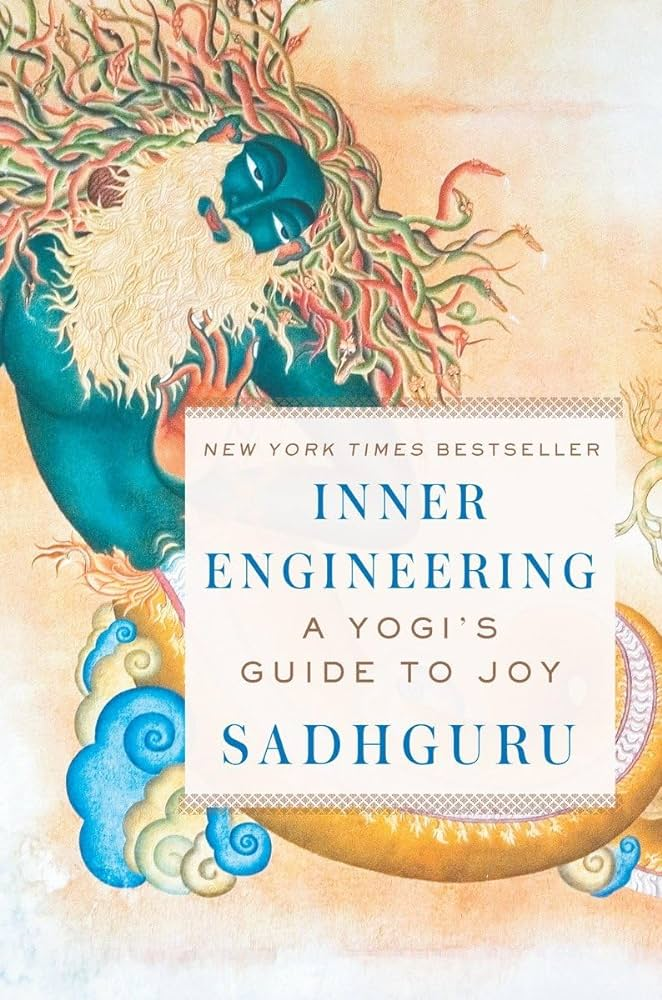
Inner Engineering – A Yogi’s Guide to Joy, a New York Times Bestseller, is a guide to self-empowerment that relies on the teaching and principles of classical yoga to help readers create an enduring foundation for inner stability and peace. For the first time, Sadhguru presents readers with a path to achieving absolute well-being through the classical science of yoga in a practical, accessible book. It is a means to create inner situations exactly the way you want them, turning you into the architect of your own joy.

In this transformative book, Sadhguru tells the story of his own awakening, from a boy with an affinity for the natural world, to a young daredevil who crossed the Indian continent on his motorcycle. He relates the moment of his enlightenment on a mountaintop in southern India, from which he emerged radically changed. Today, as the founder of Isha, he lights the path for millions. The wisdom distilled in this accessible, profound, and engaging book offers readers the opportunity to achieve nothing less than a life of joy.

Contents

Cover

Title Page

Copyright


Epigraph

“One man’s “magic” is another man’s engineering.”
—ROBERT A. HEINLEIN

The Four-Letter Word

Part One

  1. A Note to the Reader
  2. When I Lost My Sense
  3. The Way Out Is In
  4. Design Your Destiny
  5. No Boundary, No Burden
    1. Sadhana
  6. “. . . And Now, Yoga”

Part Two

  1. A Note to the Reader
  2. Body
    1. The Ultimate Machine
    2. “Something there is that doesn’t love a wall”
      1. Sadhana
    3. Life Sense: Knowing Life Beyond the Senses
      1. Sadhana
    4. Listening to Life
      1. Sadhana
    5. Downloading the Cosmos
      1. Sadhana
      2. INTENSITY OF INACTIVITY
    6. Morsel of the Earth
      1. Sadhana
    7. In Sync with the Sun
      1. A LEGENDARY YOGI
    8. Elemental Mischief
      1. Sadhana
      2. ENSHRINING THE ELEMENTS
    9. When the Shit Hit the Ceiling
      1. Sadhana
    10. Food as Fuel
      1. Sadhana
      2. IN A NUTSHELL
    11. Hell’s Kitchen
      1. THE PROTEIN DEBATE
    12. Digestion Drama
      1. Sadhana
      2. EVOLUTIONARY CODE
    13. Gastronomic Sense
      1. Sadhana
    14. Restlessness to Restfulness
      1. Sadhana
    15. Carnal to Cosmic
      1. Sadhana
    16. Hormonal Hijack
      1. MORTALITY AND PROFUNDITY
  3. Mind
    1. Miracle or Mess?
      1. Sadhana
    2. Thinking Yourself Out of Life
      1. LIMITS OF LOGIC
      2. Sadhana
    3. The Grime of Identity
      1. Sadhana
    4. Soak the Intellect in Awareness
      1. Sadhana
    5. Awareness Is Aliveness
      1. Sadhana
    6. Knowing Without Though
      1. Sadhana
    7. Believing versus Seeking
    8. The Wishing Tree
    9. The Myth of Head versus Heart
    10. Knowing and Devotion
      1. YOGA AND INTOXICATION
    11. Love Mantra
      1. Sadhana
    12. Devotion: A Dimensional Shift
      1. AKKA MAHADEVI
    13. Embracing Mystery
      1. Sadhana
  4. Energy
    1. Following the Pranic Trail
      1. PAIN NOT SUFFERING
    2. The Karmic Conundrum
      1. Sadhana
    3. The Mechanics of Life
      1. Sadhana
    4. The Energy Labyrinth
      1. Sadhana
      2. UNCHARTED PATH
    5. Sacred Science
      1. Sadhana
    6. Mountains of Grace
      1. THE SILVER PEAKS
    7. The Way of the Mystic
    8. Tantra: A Technology for Transformation
      1. SERPENT POWER
  5. Joy: The Beginning
  6. Glossary

Inner Engineering Online Program
About the Author

.

NOTES

  1. Logic of the Body

.

Tantra: A Technology for Transformation

Reference: Inner Engineering: A Yogi’s Guide to Joy by Sadhguru

The following is an excerpt from the above book by Sadhguru:

.

Tantra: A Technology for Transformation

Today, there are many practices associated with the occult sciences masquerading as spiritual processes.

Let us say I am in India and you are in America. I want to send you a flower, but I am not willing to take the journey that Columbus took. If I make this flower suddenly land in your lap, this is occult. There is nothing spiritual about it; it is just another way of handling the physical dimension of life.

In India, we have many sophisticated occult processes. There are people who can just look at a photograph and make or break a person’s life. They could ensure that the person contracts some ailment that the body could not customarily have acquired in such a short span of time. These occult practitioners can also create health, but unfortunately many of them use their ability in other ways, as there seems to be a better market for these negative talents. In any case, whether it is employed for ill health or good health is beside the point. The use of occult toward any self-oriented goal is inadvisable.

The yogic tradition is filled with stories of the great yogi Gorakhnath. Some say he lived in the eleventh century, but there are many accounts that date him much earlier. He was a disciple of Matsyendranath, an illustrious yogi in his own right. Such was his level of attainment that Matsyendranath was often venerated as a reincarnation of Shiva or Adiyogi. The lore tells us that Matsyendranath lived for about six hundred years. This need not be accepted literally or discarded as hagiography either. It essentially indicates an exceptionally long life span and the tremendous awe with which this iconic figure was regarded.

Gorakhnath became his disciple, and he adored and worshipped his master. Gorakhnath was all fire and intensity. Matsyendranath saw too much fire in him, and not enough restraint. Fire burns through many things, so Gorakhnath started burning through the walls of ignorance, and suddenly he had enormous power. Matsyendranath saw that he was running a little ahead of himself, so he told him, “Go away for fourteen years. Don’t stay near me. You are imbibing too much from me.”

This was the hardest thing for Gorakhnath to do. If Matsyendranath had said, “Give up your life,” he would have done it at once. “Go away” was something he could not bear. But since that was what his beloved master demanded of him, he went away.

For fourteen years, he counted the days and hours, waiting for the moment when he could return. The moment the period was over, he came rushing back. When he came, he found a disciple guarding the cave where Matsyendranath lived. Gorakhnath said, “I want to see my master!”

The yogi who was guarding the cave said, “I have no such instructions, so you had better wait.”

Gorakhnath flared up. He said, “I’ve waited for fourteen years, you fool! I don’t know when you came here. Maybe you came here the day before yesterday. How dare you stop me!”

He pushed him aside and went into the cave. Matsyendranath was not there. Gorakhnath came back and shook the disciple and said, “Where is he? I want to see my master now!”

The disciple said, “I have no instructions to tell you where he is.”

Gorakhnath could not contain himself. He used his occult powers, looked into the disciple’s mind, and identified where Matsyendranath was. He then started heading in that direction. His guru was waiting for him halfway.

Matsyendranath said, “I sent you away for fourteen years, because you were beginning to become occult-oriented. You were losing sight of the spiritual process and beginning to enjoy the power that it gave you. When you come back, the first thing that you do is use occult to open up your brother disciple’s mind. Another fourteen years for you.”

And so he sent him away again.

There are many stories about Gorakhnath making forays into this forbidden realm, and Matsyendranath punishing him again and again. At the same time, Gorakhnath evolved finally into the greatest disciple that Matsyendranath ever produced.

This is how the practice of occult in has always been treated in the yogic culture. It was never treated with respect. It was seen as a way of misusing life, of encroaching into areas where you should not. It was practiced only by certain types of people obsessed with power or money.

At the same time, occult is not always a negative thing. It has earned this reputation through misuse. Occult is essentially a technology. No science or technology is intrinsically negative. If we start using technology to kill or torture people, then after some time we think, “Enough of this damn technology!” That is what has happened to occult. Too many people misused it for personal benefit. So, generally on the spiritual path, occult is shunned.

What is often referred to as occult is broadly what we know as tantra. In the current understanding in society, tantra is about using very unorthodox or socially unacceptable methods. But in its classical sense, tantra simply means “technology.” It has nothing to do with unbridled sexuality. It is important to make a clear distinction between the occult kind of tantra and spiritual tantra. These two were divided as “left- hand tantra” and “right-hand tantra,” and are completely different in nature.

Left-hand tantra involves various rituals which may seem weirder than weird to many. The left hand is very external; you need materials and elaborate arrangements to make it happen. Occult practices, generally referred to as left-hand tantra, gave people powers to communicate across distances, to appear in two different places at the same time, and use energies to their own benefit and to the detriment of others. Right-hand tantra is more internal; it is about enabling you to use your energies to make things happen. You use all the simple aspects of life as a subjective science to turn inward and do something with yourself. The left-hand tantra is a rudimentary technology and more available to the uninitiated, while the right-hand tantra is highly refined and only available through powerful initiations.

Tantra is a certain capability; without it there is no spiritual process. If you have no tantra in you, you have no technology to transform people; all you have are words. Words can be inspirational and directional, but not transformative. A scholar cannot be labeled a guru. Without a technology for transformation there is no master. So there is no guru without tantra. Today there are too many people claiming to be gurus, but all they are doing is rehashing the scriptures. A true guru’s work is to overhaul the entire human mechanism from acquired cyclical patterns of karma toward its ultimate possibility. It is like a mechanic’s job, removing karmic warts! If there is no tantra or technology in him, you cannot call that person a guru.

.