Category Archives: Meditation

A Scientific Approach to Meditation

Mindfulness
Reference: Home page

.

BOOK: A Scientific Approach to Meditation

Preface–(the meditation book)

Section I–Theory of the Mind

Chapter I-1: Mind & Emptiness

Chapter I-2: Mind & Objectivity

Chapter I-3: The Structure of Mind

Chapter I-4: Calming of the Chaotic Mind

.

Section II–The Discipline of Mindfulness

Chapter II-1: Mindfulness

Chapter II-2: Assumption and Inconsistencies

Chapter II-3: The 12 Aspects of Mindfulness

Chapter II-4: The 3 Rules of Mindfulness

Chapter II-5: The Law of Non-Interference

II–Exercises

Please refer to Subject Clearing Discipline.

.

Section III–Basic Meditation

III–Study

Chapter III: Song of Mahamudra

Chapter III-1: Introduction to Meditation

Chapter III-2: Posture in Meditation

Chapter III-3: The Basics of Meditation

Chapter III-4: Walking Meditation

Chapter III-5: The Goal of Meditation

III–Exercises

Exercise III-1: Exercise: Meditative Posture

Exercise III-2: Exercise: Being There

Exercise III-3: Exercise: Confronting

III–Supplementary Exercises

Exercise III-4: Exercise: Walking Meditation #1

Exercise III-5: Exercise: Walking Meditation #2

.

Section IV–Mindfulness Applications

Chapter IV: Research into Scientology Processes

Exercise IV-1: Viewpoint Expansion

.

Section V–Mindfulness Training

Exercise V-1: Word Clearing

Exercise V-2: Subject Clearing

Exercise V-3: Mindfulness Discussions

.

Section VI–Mindfulness Therapy

.

On these materials, I would love to have the following feedback from you.

Email: vinaire@yahoo.com

1. Can you follow what I am saying?

2. Are there some portions that are boring?

3. Are there places where the language is a bit unrealistic?

4. Which passages you had to read twice?

5. Which sections do you remember best?

6. Which parts could be eliminated?

Thank you.

Posture in Meditation (Old)

Reference: A Scientific Approach to Meditation

Zen Buddhism goes into incredible detail about how to sit in meditation 1. It provides the size and shape of cushions to sit on, and the kinds of clothes that should be worn. It specifies how to place legs and knees on the mat, and hands and fingers in the lap. It dictates how ears should be lined up with the shoulders, and nose with the navel. It even directs the position of tip of the tongue, and the angle of the gaze.

If you give importance to such niceties you can waste much time worrying about the correct posture during meditation. The essential points of correct posture are explained below.

.

Buddha’s Instructions

In the Satipatthana Sutta 2 Buddha instructs:

Herein, monks, a monk, having gone to the forest, to the foot of a tree or to an empty place, sits down with his legs crossed, keeps his body erect and his mindfulness alert.

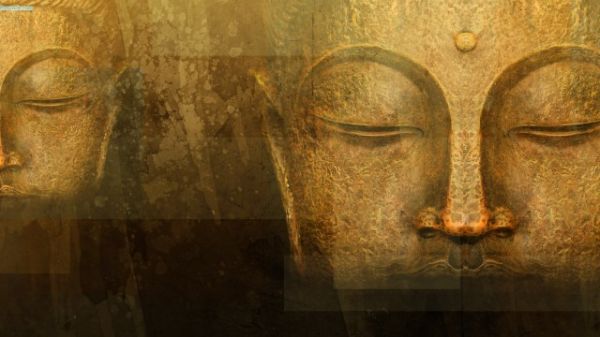
The ancient statues of Buddha show him sitting in this posture.

Buddha in meditation

In the Yoga Sutra 3, Patanjali describes this asana as a “steady and comfortable posture.” So, a meditative posture, besides being stable must also be natural and comfortable.

.

The Essential Points

Crossing of legs and locking them in full-lotus position stabilizes the body. The body thus maintains its posture even during deep meditation. In the ancient culture people were used to sitting with their legs crossed. This posture was natural and comfortable to them.

The meditative posture must stably maintain itself besides being natural and comfortable.

.

Sitting in a Chair

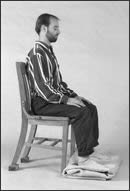
These days many people are used to sitting on a chair, and they cannot sit comfortably in a lotus position for a long time. From a scientific viewpoint it is okay to meditate sitting in a chair if that is more natural and comfortable, as long as the body can stably be maintained in an erect posture. This may be achieved by sitting in a straight-backed chair with knees parallel to the shoulders and feet flat on the ground. Cushions may be used to ensure the immobility of the body under deep meditation.

Let the body attain a naturally relaxed posture. The arms may rest in the lap. The hands, fingers and tongue may assume their natural positions. The eyes may open, half open or close according to their natural tendency. The attention may focus or not focus on anything in particular. The gaze may become narrow or wide (like in peripheral vision). These variations may occur naturally during meditation.

When the meditative posture is natural and comfortable, the body is well-balanced. There is no strain on body parts. An erect posture imparts alertness. The primary requirement is mindfulness.

It is important that the body be stably erect, and the mind alert in the mindfulness mode.

When you start to meditate the body relaxes, many physical reactions occur, and long suppressed thoughts start to emerge. Let it all happen without interference.

Meditation is being there, and seeing things as they are.

.

Three Pillars of Zenby Philip Kapleau, See Yasutani-Roshi’s Introductory Lecture 1.
2 See the text of Satipatthana Sutta.
3 See the Wikipedia article on Asana.

.

The 3 Factors of Mindfulness

Path

Reference: Course on Human Nature

The Discipline of Mindfulness warns you against digging into the mind. It lets the mind unwind and settle down naturally. The following factors are fundamental to mindfulness.

1.    ATTENTION

Let attention be totally free. Fully discern where the attention goes naturally. This forms the ground of mindfulness.

2.    FREE ASSOCIATION

Let all associations occur freely in the mind. Fully discern the associations without influencing them.

3.    UNIVERSALITY

Let the viewpoint expand freely without fixation. Fully discern all observations in a universal context.

.