KHTK Factor # 14: The viewpoints and dimension points grow in complexity; it takes admiration to consolidate them into simplicity of oneness.
The more details we come up with the more complex the knowledge gets. This knowledge may be consolidated into various forms. Thus, there are larger gases, fluids and solids. And there is energy and matter.
The only way all this knowledge can be simplified is by finding the underlying principles and fundamental relationships. It takes the understanding of the unity of the whole to discover those principles and relationships. This requires admiration for what is there.
We have consolidated our knowledge of this complex physical universe quite nicely; but we are far from consolidating our knowledge of the mankind and its various institutions. Throughout this consolidation, the principle of the oneness of reality has been the key. Admiration of reality is the major factor that helps maintain that integrity.
.
Scientology
Compare the above to the following factor in Scientology.
Scientology Factor # 14. Many dimension points combine into larger gases, fluids or solids. Thus there is matter. But the most valued point is admiration, and admiration is so strong its absence alone permits persistence.
The KHTK factors are basically consolidating the knowledge form Vedas, Buddhism, and Scientology.
.
Logic
The ultimate logic lies in the expansion and consolidation of viewpoints and dimension points guided by the principle of oneness towards the goal of knowing the Unknowable.
KHTK Factor # 13: All viewpoints and dimension points are substantial and they form our reality.
One can sense the dimension points. The viewpoint appears as the prominently repeated pattern among the dimension points. The viewpoints and dimension points are categorized as thought, energy and matter.
Our body definitely consists of matter. It is infused with energy that extends far beyond the material body. All this matter and energy is wrapped up in thought.
If there is matter, then there is energy and thought too. They cannot be separated from each other, though we can consider them separately for analysis purposes. We may assign different names to different aspects of what we sense, but this process of naming does not separate these things from one another.
The whole system of what we sense forms a single reality. It is always continuous, consistent and harmonious with small or large gradients.
.
Scientology
Compare the above to the following factor in Scientology.
Scientology Factor # 13. The dimension points are each and every one, whether large or small, solid. And they are solid solely because the viewpoints say they are solid.
The meaning of dimension points being solid can only be interpreted as having a definite characteristic common to them. This is the characteristic of being viewed or sensed. There is nothing arbitrary about it. This is just how it is. This is the basis of the universe and reality.
.
Logic
We identify one thing that we sense as different from another thing that we sense, and name them so. But they are ultimately related because we sense them all. They cannot be completely separated from each other.
Self-Inductance, Mutual Inductance, Inductor, Energy in an Inductor, Energy Density in Space, Transformers
.
GLOSSARY
For details on the following concepts, please consult Chapter 10.
SELF-INDUCTANCE Self-inductance arises from the flux that a current circuit produces within its own area. It is distinguished from mutual inductance. Self-inductance depends only on the geometry of the circuit. It connects the flux with the current as follows,
The unit for inductance is Wb/A, which is given the name henry. Practical circuits have inductance much smaller than one henry, more in the range of millihenries. The main use of the concept of inductance will be in circuits where the current changes, thus causing a proportional change in flux. This changing flux induces an EMF:
Solenoid The self-inductance, L, of the solenoid is: L = μ0 n2Ad; and the inductance per unit length is: L/d = μ0 n2A.
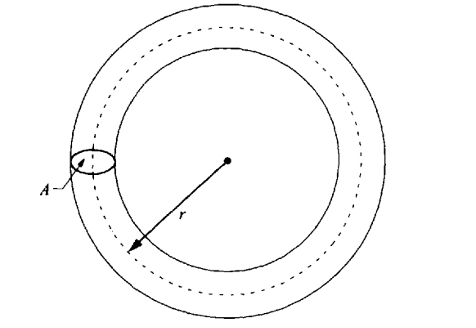
Toroid The self-inductance, L, of the solenoid is: L = μ0 N2A/2πr. If the toroid is filled with material of permeability μ, then: L = μ N2A/2πr.
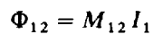
MUTUAL INDUCTANCE Whenever one has two circuits near each other, it will be possible for a current which exists in one circuit to produce flux through the second circuit. If φ12 is the flux in circuit 2 caused by a current I1, in circuit 1, Then, the mutual inductance, M12, connects these two quantities, as follows,
The exact value of M12 is determined by the geometrical relationship between the two circuits. The change in current in circuit 1 changes the flux in circuit 2 proportionally, which produces an EMF in circuit 2, given by
There is only one mutual inductance for the two circuits meaning M12 = M21. We can measure the mutual inductance by measuring the induced EMF produced in one circuit by a known rate of change in current in the other circuit.
Coil on Solenoid
Coil on Toroid
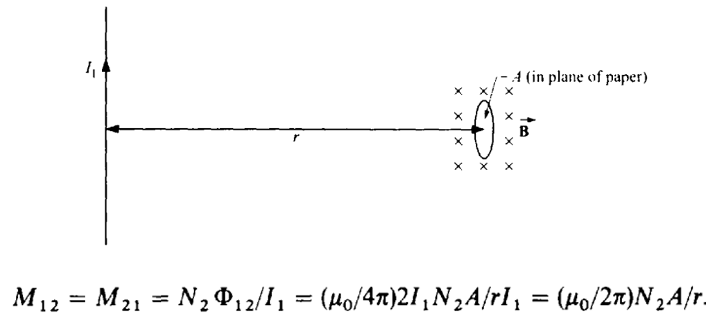
Coil Near Long Wire
Coil at Center of Loop
INDUCTOR Any circuit element that generates an inductance when current flows through it (e.g. a coil, a solenoid, a toroid) is called an inductor. An inductor has the property that it produces a back EMF if the current is changing, but does nothing if the current is steady. While an inductor will not affect a DC circuit once a current has been established it will be of great importance during the time that the current is being turned on or off.
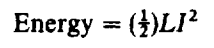
ENERGY IN AN INDUCTOR In order to increase the current in the inductor, an external driving voltage must be imposed on the circuit to overcome the back EMF, and this voltage will do work against the resisting EMF. The voltage will continue to do work until the current reaches its final value, at which time the current is no longer changing and no back EMF is being produced. During the time that the current is building up from zero to its final value, however, work must be done on the inductor. The work, or energy stored in the inductor is,
This result is similar to the case of storing energy in a capacitor by virtue of the charge that we have placed on the plates of the capacitor. There the energy stored = (1/2)Q2/C.
In terms of the magnetic field that have been set up in space, we have,
At any point in space, where there is a magnetic field, a certain amount of energy is stored. This energy equals the energy density times the volume of space being considered. The same general consideration holds for electric fields as well and indeed the electric field energy density is given by (1/2) ε0E2. In other words, wherever electric or magnetic fields exist in space, energy is being stored in the form of these fields
ENERGY DENSITY IN SPACE The total energy density at any point in space is the sum of the electric and the magnetic field energy densities. Since the units for energy density are the same irrespective of their source, this offers a means of comparing the relative magnitudes of electric and magnetic fields. Electric and magnetic fields with the same energy density can be considered to be comparable to each other. The electric and the magnetic fields associated with electromagnetic waves have equal energy densities. These considerations lend credence to the idea that these fields are real physical quantities that actually exist in space and are not merely mathematical contrivances that make it easier to calculate the forces exerted by the electric and magnetic interactions.
TRANSFORMERS We can induce EMFs in one circuit by changing the current in another circuit. This forms the basis of the transformer, which is used to transform voltage in one circuit into a different voltage in a second circuit. All the magnetic flux established by the first winding, called the primary coil, passes through the turns of the other winding, called the secondary coil. In order to get large fluxes, it is useful to place ferromagnetic material within the solenoid that has a large permeability, such as iron. The figure below shows a typical transformer:
Here, the primary winding, with N1 turns, is wound on one side of the rectangular ring, and the secondary winding, with N2 turns, is wound on the other side of the ring. This is a typical transformer. If one changes the voltage in the primary circuit, the current in the primary circuit will change, and therefore the flux. For a perfect transformer, the flux through one turn of the secondary is the same as the flux through one turn of the primary. Therefore, the total EMF developed in each winding will depend on the number of turns in that circuit.
A transformer is useful only with currents that are changing, as with AC. In that case, it is possible to use a transformer to convert a voltage applied to the primary circuit into a larger or smaller voltage in the secondary circuit. This ability to easily convert (transform) voltages in AC, which is much more difficult for DC, is the main reason why AC is the primary source of power throughout the world.
This is my first foray in applying Subject Clearing to the social issues in USA. Here are the two relevant posts that I wrote on this Facebook thread:
.
I am simply trying to understand the gun controversy, and I don’t understand why the purchase of assault weapons by the general public cannot be banned. Some people give the reason for that to be the second amendment which is as follows:
“A well regulated Militia, being necessary to the security of a free State, the right of the people to keep and bear Arms, shall not be infringed.”
As I understand it, the right of the people to keep and bear Arms is specified in the context of a well-regulated Militia. When I further look at what the constitution says about Militia, I find Article 1, Section 8 which is as follows:
“To provide for calling forth the Militia to execute the Laws of the Union, suppress Insurrections and repel Invasions.”
From this I conclude that the right of the people to keep and bear Arms is to help the State execute the Laws of the Union, suppress Insurrections and repel Invasions. Anything else is just an additive.
People may keep guns for personal protection and for recreational purposes. The constitution does not say anything about it one way or the other. So, the constitution cannot be used to argue for that particular use of guns. That would just be a matter of what is best for the society, and it would be a different argument.
So, in my opinion, the Constitution cannot be used to justify the use of guns for personal protection and for recreational purposes. But, one may use cultural and moral values of the society to decide what is best for it in this matter.
This is not the “originalist” view of what it meant in 1789. Nor this has anything to do with the view that constitution is an evolving document.
The above is what “subject clearing” tells me. It is seeing what is in the plain sight.
.
If you want to protect US citizens from the tyranny of the US Government, then you need the US army on your side. Militias cannot protect you. You have to be insane to believe that to be the purpose of Militias.
If a postulate does not reduce our confusion we discard it and make a new postulate. We do this until we have a postulate that best reduces our confusion and explains what is there.
Thus, the initial postulate must represent everything unknowable under one umbrella. Subsequent postulates then fill in the details of the initial postulate. All that is known becomes part of one consistent whole. This gives us the principle of oneness as follows:
All that is known is continuous, consistent and harmonious.
Oneness does not imply sameness. For example, all values on a scale are different from one another, yet they are continuous, consistent and harmonious.
To be real, all postulates must be part of one consistent whole per the principle of oneness.
.
Scientology
In Scientology, there is no concept of oneness as described above. Instead, the Cause in Scientology refers to multiple causes, called thetans, that are thought to be arbitrary and independent of each other. See KHTK Factor # 1.
.
Logic
The principle of oneness provides the criterion for the soundness of reasoning. An example of this is the scientific method.
The whole thrust is to know the Unknowable. This requires some discipline and a criterion. For example, one must follow the trail of what one does not understand.
What one knows, becomes a part of one’s background and the basis from which to know more. This points to the oneness of knowledge.
This is confirmed by the fact that religions point to oneness of God. The etymology of the word UNIVERSE also points to the oneness of reality.
In the scientific method, truth is verified through consistency of observations.
Thus we end up with the criterion of continuity, consistency and harmony of understanding, of knowledge, and of the integration of reality.
Any violation of the integrity of reality, such as, discontinuity (missing data), inconsistency (contradictory data), or disharmony (arbitrary data) is then perceived as an anomaly to be resolved.